Key Insights
- Pair the token with WETH for wider crypto exposure or a dollar-backed asset for clearer price tracking.
- Match liquidity levels with circulating supply, expected trade size, treasury capacity, and acceptable slippage.
- Publish ownership rights, lock periods, withdrawal rules, and market-making policies. Monitor volume, wallet concentration, and wash trading.
Robinhood Chain became public infrastructure on July 1, 2026. Robinhood launched the mainnet as an Ethereum Layer 2 built with Arbitrum technology. The network targets tokenized assets, decentralized finance, and programmable financial products. timing carries commercial weight. RWA.xyz tracked more than $34 billion in distributed tokenized real-world asset value during July 2026. Its data covered more than 170 tokenization platforms. Issuer demand is growing, and networks now compete for builders, liquidity, and users. oken launch needs more than contract deployment. Businesses need clear utility, controlled supply, tested code, credible liquidity, compliant distribution, and measurable adoption. This guide covers that full path.
Why Businesses Are Evaluating Robinhood Chain
Robinhood Chain enters the market with links to a large financial brand and an active onchain strategy. Robinhood states that Stock Tokens are available through Robinhood Wallet in more than 120 countries, subject to local availability. The chain launched with support from Alchemy, Chainlink, BitGo, LayerZero, Uniswap, and other providers. er demand now centers on usable token products. Founders want Ethereum tooling, wallet access, lower transaction costs, and DeFi links. Product leaders want faster build cycles without replacing their EVM stack.
Technical readiness earns entry. Product value, trust, and distribution earn adoption.
Why Launch a Token on Robinhood Chain?
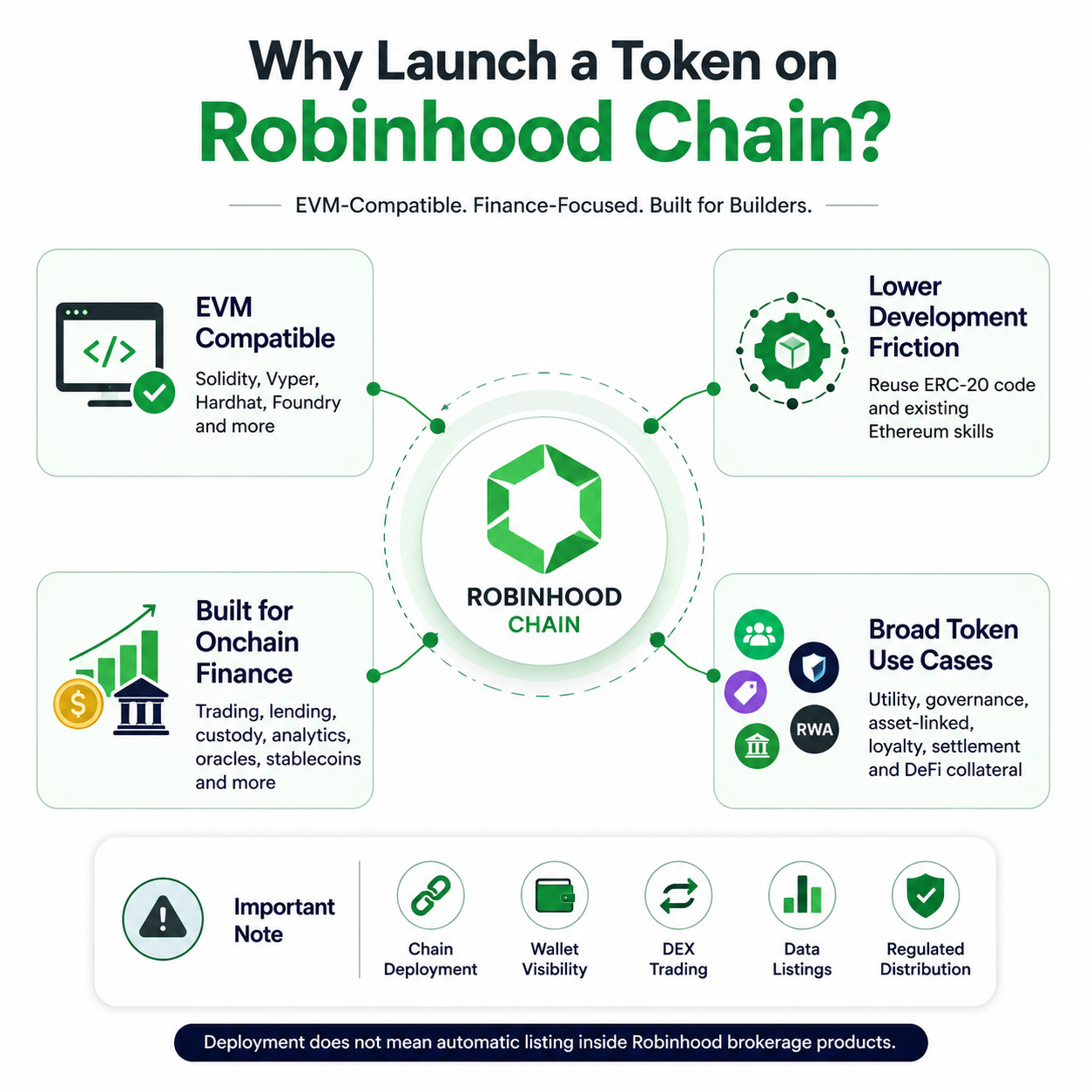
The network choice shapes cost, user access, liquidity, and product scope. Robinhood Chain offers a familiar EVM environment with a finance-led ecosystem.
EVM Compatibility Cuts Build Friction
Robinhood Chain supports Solidity and Vyper contracts without code changes. Teams can use Hardhat, Foundry, ethers.js, viem, Wagmi, MetaMask, Phantom, and Robinhood Wallet. Existing Ethereum skills transfer directly. iness gains include:
- Reuse of reviewed ERC-20 code
- Familiar testing and deployment tools
- Standard JSON-RPC wallet connections
- Access to common Solidity audit skills
- Lower chain-specific training needs
A Network Built for Onchain Finance
Robinhood Chain focuses on tokenized equities, funds, private assets, and related financial products. Its ecosystem covers trading, lending, custody, analytics, oracles, stablecoins, and cross-chain messaging. evant business uses include utility tokens, governance tokens, asset-linked tokens, loyalty programs, settlement tokens, and DeFi collateral.
Deployment does not mean automatic listing inside Robinhood brokerage products. Chain deployment, wallet visibility, DEX trading, data listings, and regulated distribution remain separate workstreams.
Understanding Robinhood Chain Architecture
Architecture affects security, cost planning, monitoring, and user experience. Leaders need a working view before approving a launch.
Network Design and Business Value
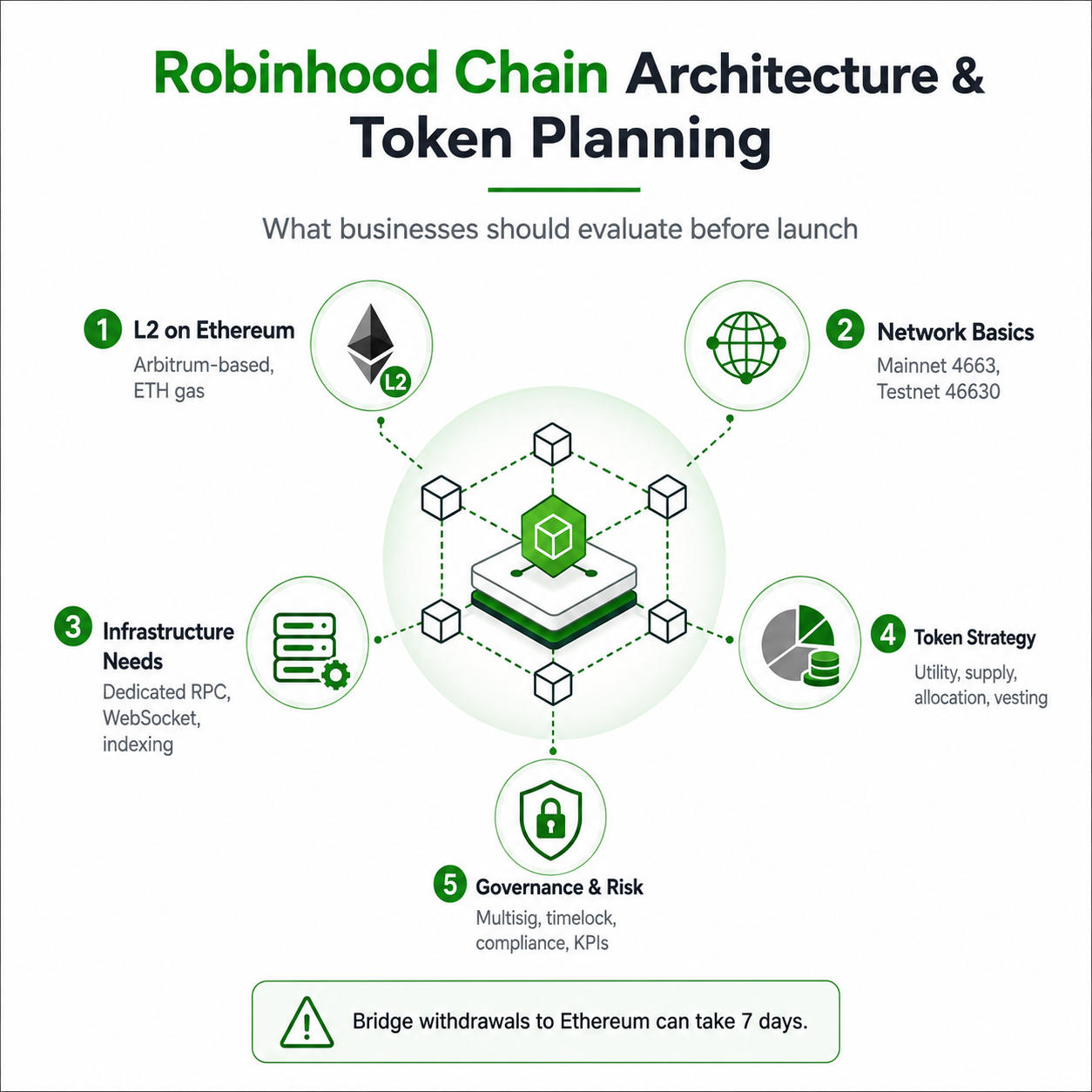
Robinhood Chain runs as an Arbitrum Layer 2 and posts data to Ethereum. It uses Ethereum blobs for data availability and ETH for gas. Mainnet uses chain ID 4663. Testnet uses chain ID 46630. s contain Layer 2 execution costs and Ethereum data costs. Gas budgets can change with network use and Ethereum conditions. network uses first-come, first-served transaction ordering. A larger gas bid cannot move a transaction ahead in the sequencer queue. This policy gives trading products a clearer ordering model. Production Infrastructure Needs
Robinhood marks its public RPC endpoints as rate-limited. Business applications should use a dedicated provider and track uptime, latency, and request limits. n for:
- Primary and backup RPC providers
- WebSocket access for live events
- Archive access for historic data
- Explorer and indexing support
- Treasury wallet alerts
The canonical bridge supports transfers between Ethereum and Robinhood Chain. Withdrawals back to Ethereum include a seven-day challenge period. Treasury teams must account for this delay. Pre-Launch Token Strategy
A smart contract records business rules. Teams must define those rules before engineering starts.
Define Utility and Buyer Value
State the action that token ownership supports. Tie demand to product use, governance, access, settlement, rewards, or asset rights.
Document these points:
- Target user group
- Product action that creates demand
- Holder rights and limits
- Reason for using a blockchain token
- Measures for repeat usage
Do not present expected price growth as utility. That claim creates trust and compliance risk.
Design Supply, Allocation, and Vesting
Set total supply, decimals, minting policy, burn rights, team allocation, investor allocation, community pool, and treasury reserve.
The plan should answer:
- Is supply fixed or mintable?
- Who controls minting?
- Which allocations follow vesting?
- What releases treasury tokens?
- How can holders track supply changes?
Concentrated allocations weaken market trust. Short vesting periods create sell pressure. Hidden minting rights can block partner reviews.
Set Governance and Compliance Controls
Use separate roles for minting, pausing, treasury transfers, and contract administration. Place broad control behind a multisignature wallet. Add a timelock for sensitive changes. OpenZeppelin provides ERC-20 modules and role-based controls for these tasks. iew token rights, sale structure, buyer locations, transfer rules, marketing claims, identity checks, sanctions screening, tax treatment, and data handling. Early legal review can prevent contract changes and launch delays.
Set KPIs before launch. Track active wallets, repeat users, holder concentration, liquidity depth, slippage, product transactions, treasury runway, and cost per verified participant.
How to Deploy an ERC-20 Token on Robinhood Chain
Deployment should follow a repeatable release process. Each stage needs test evidence and clear approval.
Configure the Network and Deployer Wallet
Add Robinhood Chain testnet to the wallet. Use chain ID 46630 and fund the wallet with test ETH. Run the full release on testnet first.
Mainnet uses chain ID 4663 and ETH for gas. Use a dedicated production RPC for business systems. Keep private keys outside source code and store them in a controlled vault. Build the ERC-20 Contract
Use a reviewed OpenZeppelin ERC-20 implementation. Add only features required by the product.
Common modules include:
- ERC20Capped for a supply limit
- ERC20Burnable for holder-led burns
- ERC20Pausable for emergency stops
- ERC20Permit for signature approvals
- ERC20Votes for delegated governance
- AccessControl for separate admin roles
Each feature expands test and audit scope. Simple code often carries less risk.
Test With Hardhat or Foundry
Robinhood documents deployment with Hardhat and Foundry. Both support compilation, scripted releases, automated tests, and Blockscout verification. t transfers, approvals, minting caps, burns, pause rights, vesting rules, role changes, and ownership transfers. Test failed calls from unauthorized wallets. Run the same deployment script on testnet and mainnet.
Verify and Publish Release Data
Verify source code on Robinhood Chain Blockscout. Match compiler versions, settings, libraries, and constructor inputs.
Publish the contract address, chain ID, decimals, supply policy, admin roles, vesting terms, and audit status. Verification supports wallet and exchange reviews, but it does not prove code safety.
Verification, Security, and Operational Control
Security covers code, keys, infrastructure, and live response. A failure can affect treasury assets and user funds within minutes.
Protect Privileged Functions
Use small permission sets. Separate minting, pause, and treasury roles. Place sensitive roles behind multisignature approval. Add a timelock for major changes.
Commission an independent audit for contracts that control funds, mint supply, manage vesting, or connect with external protocols. Fix high-risk findings before mainnet release.
Prepare Live Monitoring
Track role changes, minting, large transfers, liquidity movements, bridge activity, and failed transactions. Assign alert owners and response steps.
A launch runbook should cover contract pauses, role restriction, public notices, onchain evidence, and partner coordination. Rehearse it before deployment.
Creating Liquidity and Supporting Trading
Liquidity turns a deployed token into a tradable asset. Poor pool design creates high slippage, unstable pricing, and treasury loss.
Create a Uniswap Pool
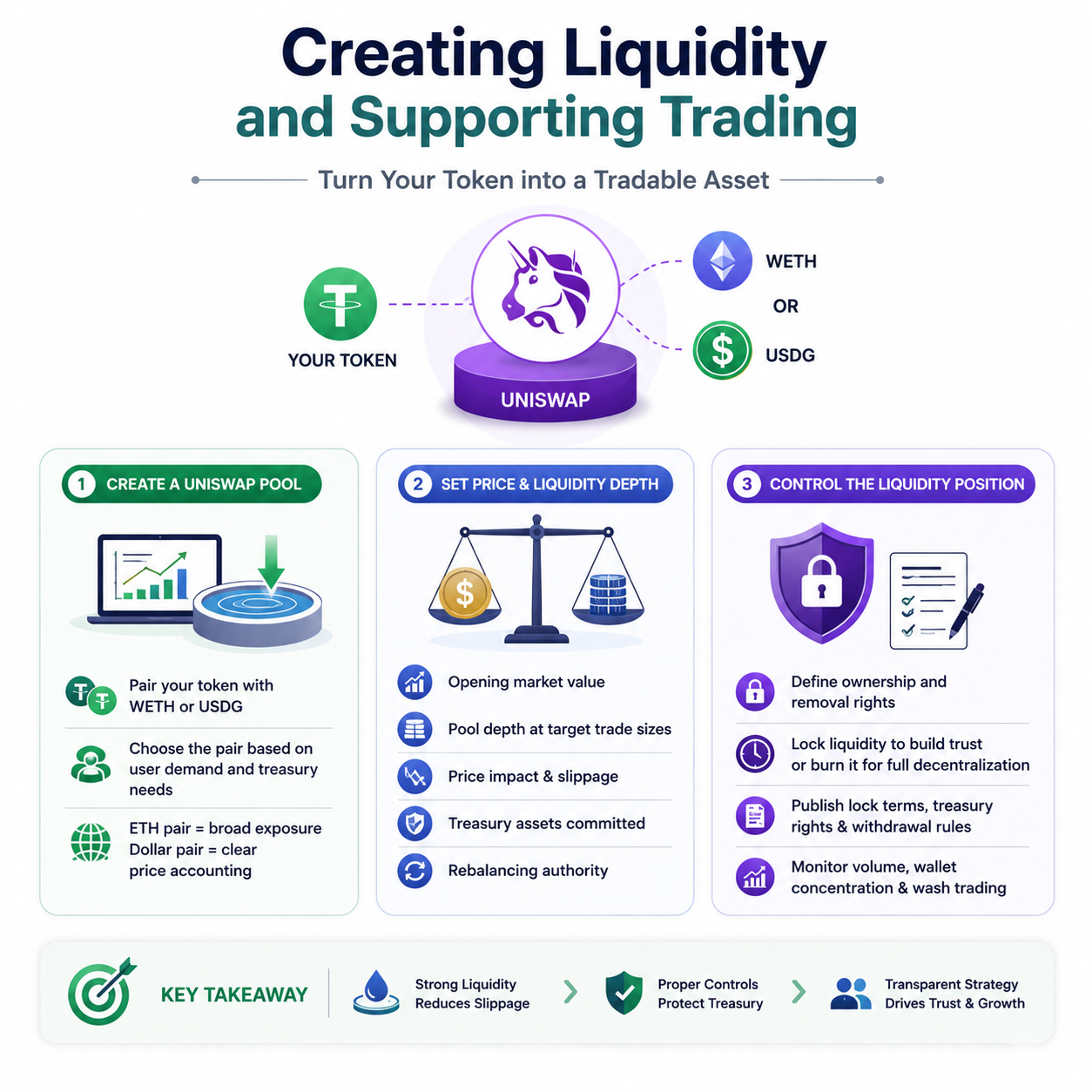
Uniswap serves as a primary public liquidity protocol on Robinhood Chain. A team can pair its token with an asset such as WETH or USDG. ose the pair through user demand and treasury needs. An ETH pair gives broad crypto exposure. A dollar-backed pair gives clearer price accounting.
Set Price and Liquidity Depth
The opening deposit ratio sets the first pool price. Link that ratio to circulating supply, treasury policy, sale terms, and expected demand.
Review:
- Opening market value
- Pool depth at target trade sizes
- Price impact and slippage
- Treasury assets committed
- Rebalancing authority
Thin liquidity lets small trades move price sharply. Excess liquidity can lock treasury capital with little product gain.
Control the Liquidity Position
Document who owns the position and who can remove liquidity. A lock can support trust but limits treasury flexibility. Burning the position removes control permanently.
Publish the lock term, treasury rights, market-making policy, and withdrawal rules. Track organic volume, wallet concentration, and wash-trading signals.
Listings, Distribution, and Token Adoption
A token needs accurate data and repeated product use. Distribution should connect ownership to a useful action.
Complete Listings and Data Profiles
Submit verified data to Blockscout, wallet registries, token trackers, DEX aggregators, and analytics platforms. Keep the name, symbol, decimals, logo, website, contract address, and chain ID consistent.
Publish one official contract address across every channel. This step helps users avoid fake assets.
Build Adoption Around Product Use
Reward actions that create product value. Examples include completed onboarding, governance votes, liquidity commitments, verified purchases, merchant activity, or protocol usage.
Avoid rewards based only on wallet creation or social engagement. Such campaigns attract low-intent users and distort adoption data.
Robinhood Chain supports ERC-4337 account abstraction. Teams can sponsor gas, batch transactions, and build programmable wallets. These features can cut onboarding steps for users unfamiliar with ETH gas. lish tokenomics, vesting, treasury wallets, admin roles, audit results, liquidity rules, and product milestones. Clear control data builds more trust than launch-day noise.
Cost, Risk, and Development Options
The delivery model shapes speed, control, cost, and support. Leaders should match the model to contract scope and launch risk.
| Delivery Model | Best Fit | Strengths | Limits |
|---|---|---|---|
| Internal team | Firms with Solidity and DevOps staff | Direct code ownership and product control | Hiring, audits, and operations stay internal |
| No-code generator | Simple fixed-supply token tests | Fast setup and low development cost | Limited code control and inconsistent verification |
| Third-party launchpad | Standard community token launches | Packaged deployment and liquidity tools | Platform dependency and fixed contract options |
| Token development company | Custom token logic or regulated use cases | Design, testing, liquidity planning, and launch support | Higher project costs and vendor review requirements |
Main Cost Drivers
Gas is only one budget line. Plan for tokenomics, engineering, testing, audit work, legal review, frontend work, liquidity capital, listings, monitoring, and user acquisition.
Risks and Vendor Checks
Track contract flaws, lost keys, uncontrolled minting, thin liquidity, legal restrictions, bridge delays, RPC outages, poor distribution, and misleading marketing.
Evaluate a development partner through code samples, Arbitrum experience, test coverage, audit support, deployment controls, liquidity knowledge, documentation, and post-launch monitoring.
Avoid vendors that keep contract ownership, hide source code, skip testnet, promise exchange listings, or judge success only through token price.
Key Points for Decision-Makers
- Robinhood Chain mainnet is live for permissionless EVM deployment.
- ERC-20 teams can reuse common Ethereum tools and libraries.
- Utility and supply policy should precede contract development.
- Testnet, verification, audits, and multisignature control reduce risk.
- Liquidity depth and opening price need treasury review.
- Chain deployment does not grant automatic Robinhood product listing.
- Lasting adoption comes from product activity and clear governance.
Conclusion
Learning how to launch a token on Robinhood Chain starts with EVM deployment, but commercial success requires a broader plan. Teams must connect utility, tokenomics, code security, liquidity, listings, governance, compliance, and user adoption.
Robinhood Chain offers a live Ethereum Layer 2 with a strong finance focus. This foundation can reduce technical setup time, but it cannot replace disciplined product planning, treasury controls, and risk management.
Before deployment, commission a token architecture review, confirm the legal model, test every privileged function, and model liquidity across several demand scenarios. Businesses seeking technical support can work with Blockchain App Factory for Robinhood Chain token development services, including token architecture, smart contract development, testing, audit coordination, liquidity planning, and post-launch monitoring. A controlled token launch protects capital, strengthens market trust, and supports lasting product use.

Vimal J is the Head of Sales at Blockchain App Factory, with 10+ years of experience in sales, client strategy, and Web3 business growth. He helps startups, enterprises, and project founders choose the right blockchain solutions for their goals, bringing a practical market perspective to topics like token development, crypto launches, and Web3 adoption.