


A couple of years ago, token development felt like something only crypto-native teams would bother with. Now, it’s being discussed in boardrooms. Not because that’s what’s trendy, but because they quietly became a practical way to run digital economies, settle value faster, and represent real ownership in a format a computer can understand.
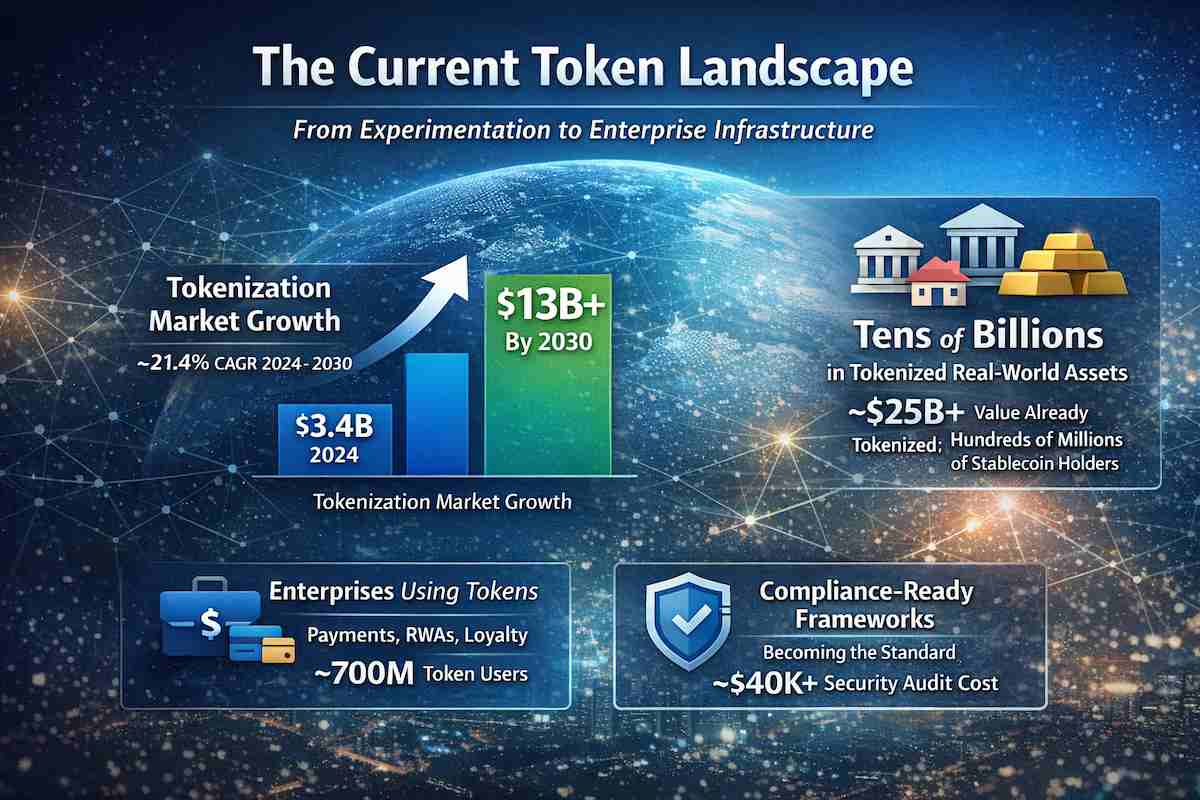
The biggest impact in 2026, however, will be tokenization, as it comes closer to “real business rails”. In RWAs, RWA dashboards for on-chain activity will show tens of billion dollars worth of tokenized assets, and stablecoins will be used for settlement. For example, RWA.xyz has $24B in distributed asset value, hundreds of billions in represented asset value, and hundreds of millions of stablecoin holders in the same ecosystem view.
Simultaneously, enterprise adoption is no longer limited to pilots and increasingly involves tokens as infrastructure for payments, rewards, access and settlement, while regulation continues to define the space. Rather than “launch anything that moves” and figure out regulators later, many teams are building tokens with transfer controls, identity checks, and auditability in mind, especially where RWAs or regulated products are concerned.
So when people say ‘What does a token cost me to develop in 2026?’, they don’t mean writing a smart contract. They’re asking about the full business-ready package:
- What will it cost to build securely?
- How long will it take?
- Which token model fits the use case?
- Where do risks show up?
- And what decisions blow up budgets later?
That’s what this guide breaks down, in plain terms, with real market context.
What Token Development Really Means in 2026?
Token development in 2026 is not just the act of minting supply and publishing a contract; it is knowing how to design a digital asset for appropriate security, compliance, integration, and growth scenarios.
Token vs Coin vs Tokenized Asset
Let’s keep this simple.
Coin
Since a coin lives on its own blockchain, launching a new coin usually requires launching a new blockchain network which is too costly, time consuming and effort intensive for most businesses.
Token
A token runs on top of an existing blockchain (Ethereum, BNB Chain, Polygon or Solana). Most businesses choose this option because it is faster, easier to integrate, and the base blockchains have tools, wallets and liquidity.
Tokenized Asset (RWA)
This means whichever real-world asset it might be, be it real estate, commodities, private credit, invoices or funds, it is tokenized on-chain, although not merely as a utility. It often comes with some conditions on its possession. Who can transfer it? What if someone fails KYC? What on-chain legal structure ties the token to the underlying asset?
When should you use what?
- For databases, grants, payments, or discounts, or for product-led growth opportunities, a simple utility token is often all that is needed.
- If your token represents ownership, a regulated claim, or anything requiring eligibility or transfer controls, choose a compliance-focused tokenized asset.
That one thing changes the budget more than almost anything else.
Why Organizations Invest in Tokenization
Companies invest in tokenization for the same reason they invest in any good technology: because it works.
Here are the most common motivations in 2026:
Incentives and loyalty that actually move
Tokens treat rewards as real value, not just “points”. They enable you to distribute rewards instantly and directly, and to track their distribution and use.
Faster settlement and cleaner reconciliation
In contrast, token transfers can be processed quickly and are traceable, which reduces the back-office frictions that plague customary settlement.
Programmable finance for modern products
Do you want revenue-sharing, staking, escrow, milestone releases or automated payouts? Tokens and smart contracts can support these use cases in a way standard databases cannot.
Liquidity and fractional ownership
RWAs are particularly well-suited to tokenization, as doing so breaks down large illiquid assets into smaller sub-assets with different characteristics depending on local regulatory requirements and business needs.
Some token models are made for revenue, some for engagement, some liquidity, and some to formalize ownership in a regulated way. Cost will follow from the token model you choose.
The Current Token Landscape
You can assess the trajectory of the market by looking at on-chain activity and industry revenue estimates.
On-chain tokenized RWAs have evolved as a category, with dashboards of tokenized assets tracking hundreds of billions across dozens of projects. Most of these projects have large holders and the majority use stablecoins as their settlement layer.
From a revenue perspective, the market for tokenization is projected to grow substantially. For example, the worldwide tokenization market revenue was projected to be about $3.47B in 2024 and reach $13.53B in 2030, corresponding to a projected compound annual growth rate (CAGR) of ~21.4%. Another estimate for 2026 is about $4.7B, rising to about $15.9B by 2034.
So why do “forecast vs reality” conversations still happen?
Because tokenization adoption depends on things that move at different speeds.
- Regulation moves slower than product innovation
- Institutional readiness varies by region and asset type
- Liquidity grows faster in some categories (like stablecoins and tokenized treasuries) than others (like real estate)
Token Development Cost in 2026 – Comprehensive Cost Bands
For token creation costs in 2026, there is still no “one-price-fits-all” but at least it is more standard. The costs depend on what you are creating, how secure your token is, if it needs to be compliant and whether or not you have assets in the real world etc.
Building a token is like building a house.
A studio apartment is far less than a smart villa with security systems, automation and legal paperwork. Tokens operate on the same principle.
Most business teams use practical estimates as a rough guideline or target project budget.
Basic Token Deployment
This is the entry-level option. It is for startups or products that need a simple fungible token as a reward, internal payment mechanism, or MVP.
What’s typically included
- ERC-20, BEP-20, or SPL token creation
- Fixed or capped supply
- Basic minting logic
- Deployment to mainnet
- Simple admin controls
Common use cases
- Loyalty programs
- Community rewards
- In-app payments
- Early-stage product tokens
Cost range: ~$5,000 to $18,000
If your needs are simple, and you don’t need the complex rules for your token mentioned above, this is straightforward to build and deploy with reasonable expectations. This is the foundation, not the full ecosystem.
Feature-Enhanced Utility Tokens
This is where most serious projects land.
You’re still creating a token, but you’re also building an understanding into it.
Typical features include
- Role-based permissions (admin, operator, user)
- Pause and resume logic for emergencies
- Burn and mint controls
- Usage analytics hooks
- Upgrade-ready contract structures
- Access-based functionality
Common use cases
- SaaS access tokens
- Membership platforms
- Gaming economies
- Product-based incentives
Cost range: ~$18,000 to $60,000
At this stage, your token is integrated with business logic. It controls access, manages supply, and communicates with applications. Development times increase as testing and security are prioritized.
Compliance & RWA-Ready Tokens
Now, we’re on regulated ground.
With real value or ownership, these tokens are also bound by the rules of who can hold or transfer.
Key capabilities usually required
- Wallet whitelisting
- Transfer restrictions
- Identity verification hooks (KYC/AML)
- Jurisdictional controls
- Reporting compatibility
- Asset linkage logic
Common use cases
- Real estate tokenization
- Private credit
- Investment platforms
- Regulated financial products
Cost range: ~$40,000 to $150,000+
Why the jump?
Because compliance adds layers. Legal logic meets technical logic. Mistakes here are expensive, so teams spend big on architecture, testing, and auditing. If your token touches real-world assets, you have no choice.
Full Token Ecosystem
This is the whole package.
You are not just launching a token. You are launching a platform.
Usually includes
- Token contract
- Vesting schedules
- Token sale contracts
- Staking systems
- Admin dashboard
- User dashboards
- Wallet integrations
- Backend APIs
Common use cases
- Token launch platforms
- DeFi ecosystems
- Large community networks
- Enterprise token platforms
Cost range: ~$60,000 to $250,000+
This stage involves developing, scaling, and maintaining a product. It requires coordination between frontend, backend, blockchain engineers, and quality assurance (QA) teams; think of it as building a product instead of just deploying code.
Smart Contract Audit Fees
Regardless of the selected tier, audits will take place in the year 2026.
Audits can discover vulnerabilities before attackers exploit.
Costs depend on:
- Contract size
- Feature complexity
- Compliance requirements
- Number of contracts
- Risk exposure
Typical audit ranges: ~$10,000 to $100,000+
At the bottom end are basic tokens. RWA or DeFi ecosystems push towards the higher end. Skipping audits to save money often costs far more later.
Ongoing Operations & Support
That’s the part where most people are surprised.
Token development does not end at launch.
You still need:
- Contract monitoring
- Bug fixes and upgrades
- Security patching
- Infrastructure maintenance
- Emergency response planning
- Compliance updates (for regulated tokens)
These are not “nice-to-haves.” They are operational realities.
Post-launch support typically includes
- Monthly monitoring
- Upgrade assistance
- Security maintenance
- Performance optimization
- Technical support
These operational costs vary with the scope, but they need to be factored in. A token without maintenance is like a car without maintenance. It might run today, but problems will catch up.
Ready to find out how much your token will cost to build?
Get a personalized estimate covering development, security, compliance, and launch timelines in just one step.

Expected Development Timelines in 2026
Founders and product teams keep asking me the same question, over and over:
“How long will this actually take?”
The honest answer is 2026 depending on the project scope. You can create a simple token in a few minutes. But it can take months to create a compliant token platform. Think about it like cooking. A sandwich is made quickly, while a full course meal requires planning and time.
Let’s break it down.
Minimal Viable Token
A basic ERC-20, BEP-20, or SPL token with simple functionality can be completed in relatively short order.
Typical delivery window: ~1 to 2 weeks
This usually includes:
- Token contract creation
- Supply configuration
- Basic admin controls
- Testnet deployment
- Mainnet launch
They move fast because the logic is simple, there are fewer edge cases, less QA, and they typically require fewer integrations. Perfect for MVP launches, early community tokens and as internal rewards for your team.
Still, speed does not mean sacrificing quality: even at this level, testing is necessary.
Utility Tokens With Advanced Features
As far as adding features, it becomes tougher.
Typical delivery window: ~3 to 8 weeks
This range applies to tokens that include:
- Vesting schedules
- Role-based permissions
- Pause and resume logic
- Staking hooks
- Dashboards or admin panels
- Wallet or backend integrations
You’re not just deploying a token anymore, you’re building the product.
More features mean more testing. More integrations mean more coordination. And every new element adds more scenarios your QA team will need to validate.
Most business-oriented utility tokens fall into this category.
Regulatory and Compliance Builds
This is where the timelines are stretched.
Typical delivery window: ~10 to 20+ weeks
Compliance-driven projects involve much more than engineering.
They usually require:
- Legal structure review
- KYC and AML integration
- Whitelisting logic
- Transfer restrictions
- Jurisdictional checks
- Security audits
- Remediation cycles
The most important thing to understand is that development is rarely the bottleneck.
Legal clearances and audit reviews are not bound to an engineering timeline. When regulatory milestones arrive, engineering might finish ahead but the launch is delayed.
If your token represents real-world assets or financial claims, you need to plan and design it before it launches.
Impact of Project Scope on Duration
The stealthy timeline killer is called Scope.
Changes that seem small on paper can take weeks in reality.
For example:
- Adding vesting means writing and testing additional contracts
- Adding dashboards means frontend and backend work
- Adding compliance rules means legal reviews and extra audits
Every new feature has a ripple effect through development, QA, and deployment.
To keep timelines realistic, smart teams focus on:
- Clear requirement documentation
- Early alignment between business and technical stakeholders
- Phased delivery instead of “build everything at once”
- QA cycles that match launch deadlines
The closer the scope of your project is aligned with your business goals, the smoother the delivery.
Cost Drivers: What Really Influences Token Development Pricing
By now, you have probably realized this.
Tokens in 2026 require more than just smart contracts to build them.
Setting a price involves a series of technical and business decisions, often made before any code is written. Think booking an airline ticket. Economy or business? Direct or multi-stop? Extra baggage? Every choice adds up.
To understand how much costs are we will discuss the major drivers of costs.
Blockchain Ecosystem Choice
Choosing a blockchain is your first major decision. Each one has its own cost profile.
Popular options include:
- Ethereum Layer 2 networks
- BNB Chain
- Solana
- Polygon
- Avalanche
So what changes between them?
Gas fees
Ethereum-based networks generally have higher mainnet transaction costs, and many Layer 2s offer cheaper transactions, but are subject to the same limitations. Solana and BNB Chain are often cheaper for transactions and offer different tooling.
Developer tooling
Some chains have mature auditing and monitoring tooling, while others require engineering from scratch, but more tooling leads to faster development. Less tooling means more manual intervention.
Ecosystem integrations
Wallets, analytics platforms, custodial solutions, and exchanges are often only compatible with specific chains. This makes integration easier if your blockchain has a strong ecosystem. Otherwise, expect additional development hours.
Bottom line: The blockchain you choose will impact engineering time, testing effort, and total cost of ownership.
Functional Requirements
Pricing starts to separate in this opening section.
It is much less expensive to create a simple token than to create a token that comprises a financial system.
Here’s what increases complexity:
- Custom token logic
- Governance mechanisms
- Role-based permissions
- Upgradeable contracts
- Treasury controls
- Emergency pause features
Each feature creates new logic paths to test. Each test case increases quality assurance (QA) time.
If your token can vote, stake or automatically distribute, you are no longer building a simple asset, you are building software.
And software takes time.
Compliance and Regulation
Compliance is one of the biggest pricing multipliers in 2026.
If your project touches financial assets, RWAs, or investor participation, you’ll likely need:
- AML and KYC integrations
- Wallet whitelisting
- Transfer restrictions
- Regional legal frameworks
- Reporting compatibility
However, the system cannot limit itself to smart contracts, but also must include backends, identity providers, and legal agreements.
With more jurisdictions, there are more rules to support, leading to more development and legal costs.
Utility tokens are like bicycles and compliance-ready tokens are like airplanes: both move value but the latter requires an order of magnitude more scrutiny.
Security Posture
It’s no longer a checkbox. It’s a strategy.
Your security budget depends on:
- Threat modeling depth
- Number of contracts
- Attack surface size
- Audit scope
- Post-audit remediation
A simple token could be audited once, while DeFi and RWA ecosystems may need several audits, internal testing, and to go through re-audits after fixes.
Here’s the reality.
The more valuable a system is, the more vulnerable it is to attack, and the better it has to be audited and designed.
Security increases costs but protects everything you build.
Integration Footprint
Finally, there’s integration.
Tokens rarely live alone.
Most projects need connections to:
- Wallets
- Custodial services
- Exchanges or liquidity pools
- Reporting tools
- Analytics platforms
- Backend APIs
Each integration involves new dependencies, testing cycles, and maintenance responsibilities.
It is relatively easy to create a token that only exists on chain, but creating a token that is tied into apps, dashboards and third party platforms is more complicated.
And systems are more expensive to design, deploy, and support.
Deep Cost Structure Breakdown
When teams discuss token development costs, they mean the cost to create smart contracts.
But coding is really only a small part of it.
Every successful token launch is more of a product launch than a deployment of some script. If each of these steps adds cost, they are also adding value. You know these layers, so you can budget accordingly and avoid surprises.
Let’s break down what happens behind the scenes.
Requirement Gathering and Business Design
Everything starts with clarity.
Before a single line of code is written, teams need to align on:
- What problem the token solves
- How it fits the business model
- Who the stakeholders are
- What success looks like
It involves workshops, technical discovery, and internal mapping across product, legal, marketing, and engineering departments.
Why does this matter?
Because unclear requirements lead to rewrites, which increase cost.
Strong requirement gathering ensures your token supports the business needs whether that be user engagement, revenue flows or representation of assets.
It’s where strategy meets structure.
Tokenomics Engineering
This is the financial brain of your token.
Tokenomics defines how value moves through your ecosystem.
It typically covers:
- Total supply and emission logic
- Cap rules and burn mechanics
- Vesting schedules for teams and investors
- Reward distribution frameworks
- Treasury allocation
Good tokenomics balances incentives. Bad tokenomics breaks ecosystems.
These systems are created using economic modeling, scenario testing, and alignment with long-term goals. It is not just math. It’s behavioral design.
And since tokenomics will impact adoption and sustainability, this phase usually takes longer than expected.
Smart Contract Development
Now we come to the engineering core.
This stage includes:
- Writing production-grade smart contracts
- Modular architecture for future upgrades
- Role-based permissions
- Emergency controls
- Automated test scripts
Good contracts are built by following best coding practices, avoiding shortcuts, and enabling modular components to be reused, upgraded, or audited.
The goal is not just functionality, but resilience.
Write clean code today to avoid costly fixes tomorrow.
Security and Testing
This is where many projects underestimate effort.
Security testing is not a quick scan, but rather a layered process.
It usually involves:
- QA test suites
- Regression testing
- Static code analysis
- Edge-case simulations
- Attack scenario reviews
Every new feature involves new test paths that need to be verified as well.
Think of this as a flight check. You don’t skip steps just because you’re trying to push the accelerator.
Strong security testing will help protect both your users and your brand.
Audit and Governance Checks
Audits provide an external perspective on your system.
Auditors examine logic, permissions, upgrade paths, and vulnerabilities, and provide reports with recommendations.
This creates a feedback loop:
- Audit findings
- Developer remediation
- Retesting
- Optional re-audit
Governance-heavy or RWA projects may also validate governance roles, treasury controls, or decision-making processes during this phase.
Designs will often undergo several iterations before they are deemed acceptable for production.
Each development cycle raises expenses and takes time, but skipping them is a higher risk.
Deployment Execution and Launch Controls
The final stretch is deployment.
But launching a token isn’t just clicking a button.
It includes:
- Deployment runbooks
- Private key management
- Multisig setup
- Admin access configuration
- Emergency rollback planning
It is here that operational discipline matters.
One misconfigured wallet or exposed key can undo months of work.
In some professional environments, code is deployed with the utmost care, supported by checklists, approvals, and fallback plans.
Once your token is live, it is on the public blockchain forever.
Token Development Frameworks and Standards to Know in 2026
The token development ecosystem has changed by 2026. Clear frameworks, standards, and battle-tested design patterns now coalesce to provide a blueprint for serious token projects.
If you plan to create a token, do not underestimate the importance of these standards, which affect security, compliance, and longevity, depending on the use case.
Let me introduce you to some of the most prominent.
Standard Token Models
Most tokens fall into one of three categories, based on the blockchain on which they are built.
ERC-20 (Ethereum and EVM chains)
It remains the most widely used standard, powering thousands of tokens on Ethereum, Polygon, Avalanche and other EVM-based networks.
Why businesses still prefer ERC-20:
- Massive wallet and exchange support
- Mature tooling and audit ecosystems
- Proven reliability
- Easy integration with DeFi and enterprise platforms
BEP-20 (BNB Chain)
Like ERC-20 but more efficient and cost-effective, it’s commonly chosen by projects with lower fees where deep DeFi integration is not a priority.
SPL (Solana Program Library)
Due to Solana’s high throughput and low transaction costs, SPL tokens are particularly popular for gaming, consumer applications, and high-frequency use cases.
Modern best practices across all standards now include:
- Modular contract architecture
- Upgrade planning from day one
- Clear role separation
- Emergency pause controls
- Supply transparency
- Automated test coverage
In short, token standards have matured. Today, tokens are designed like software products, not experiments.
Security and Compliance Token Standards
Once tokens begin to represent real-world assets of value, these standards alone are insufficient.
Where compliance-based frameworks stack up alongside each other.
ERC-3643 vs historical token standards
Previous security token standards tried to shove compliance into pure ERC-20 logic, intrinsically limiting the potential of the nascent standards.
ERC-3643 reverses the model.
In particular, it builds identity checks and transfer rules into the token layer, rather than layering compliance on a transaction.
What this enables:
- Wallet-level eligibility checks
- Controlled transfers
- Jurisdiction-based restrictions
- Revocation or recovery mechanisms (when legally required)
- Integration with KYC providers
As a result, ERC-3643 is particularly targeted for RWA tokenization, private markets, and regulated offerings.
Permissioned vs permissionless transfer logic
This is a design decision.
Permissionless tokens
Open to anyone. A great fit for open ecosystems, collaborative communities, and utility.
Permissioned tokens
Such transfers only occur between whitelisted wallets, which ensures regulatory compliance in heavily regulated sectors, e.g. real estate, funds and private investment.
Choosing between these models impacts:
- Legal structure
- Technical architecture
- Audit complexity
- Long-term operating costs
It is one of the first decisions that affects your entire project.
Governance and Control Frameworks
Tokens also provide the right to decide on certain matters.
That’s why governance frameworks matter.
As of 2026, the majority of projects today have established control systems, rather than relying on a single admin wallet.
On-chain governance patterns
These allow token holders or designated stakeholders to vote on proposals such as:
- Parameter updates
- Treasury usage
- Feature rollouts
- Protocol changes
Voting logic can be smoothly integrated into smart contracts, creating auditable and transparent decision-making processes.
Timelocks and multisig models
Think of these like safety rails.
Timelocks introduce a delay for sensitive actions, allowing a community to review proposed changes and voice concerns before such actions occur.
Multisig wallets require multiple signatures to authorize a transaction or upgrade the contract, as opposed to a single individual.
Together, these tools help protect against internal mistakes as well as attacks.
In business terms, they eliminate single points of failure, distributing the risk.
Planning to launch a token in 2026?
Best Practices to Control Costs Without Sacrificing Security
Let’s be honest.
Building a token in 2026 doesn’t have to be expensive, but if you build something without a plan, you’re probably burning cash.
The best teams treat token projects like product launches – a minimal scope, a heavy focus on risk, and seeing security as an integral component rather than an afterthought.
Learn how the most skilled builders keep their costs low while delivering production-quality systems.
Modular Scope Control
Trying to build everything at once is the fastest way to inflate budgets.
A better approach?
Build in phases.
The basic version of the token should always be launched first, prior to other features like staking, governance, and dashboards to validate the idea at a lower initial cost.
Benefits of phased delivery:
- Faster MVP launch
- Lower upfront spend
- Easier debugging
- Reduced rework
- Clearer user feedback
It’s like trying to put in a swimming pool for your house before you have fixed the foundations of the house.
Modular scope keeps individual projects leaner and flexible.
Standard Libraries and Patterns
Custom code is powerful, but expensive.
Every custom function increases:
- Development hours
- Testing effort
- Audit complexity
- Long-term maintenance
This is possible because these token projects leverage existing libraries and established design patterns.
Using proven frameworks helps:
- Reduce bugs
- Speed up development
- Shrink audit scope
- Improve reliability
In practice, this means trusting the audited code to get the transfer, permissions and supply logic right.
The less custom code, the better.
Targeted Audits vs Full-Spectrum Reviews
Not every contract is subjected to the same scrutiny.
By contrast, a basic utility token is not subject to the same level of auditing as a DeFi platform holding millions.
Smart teams calibrate audit intensity to risk exposure.
For example:
- Core token logic gets full review
- Peripheral modules receive lighter checks
- Low-risk components rely on standard library assurance
This approach allows you to focus your security spend without putting any area at risk.
You spend your budget on the most important pieces.
Early Compliance Scoping
Nothing drives up cost like late compliance changes.
Building first and thinking about regulation later leaves projects riddled with redesigns, rewrites, and additional audits.
A simple strategy is better.
Involve legal and compliance in discovery.
Early scoping helps define:
- Transfer restrictions
- KYC requirements
- Jurisdictional limits
- Reporting needs
By locking these rules ahead of time, developers build the right architecture from day one.
It is much cheaper to design in compliance than to retrofit it later.
Commercial Decision Guide: Choosing Your Token Development Strategy
By now, you know that token development in 2026 is not just about building a great technology, it is a business decision.
Like any investment strategy it’s a question of risk, cost, pace and then of course, whether you’re really in it for the long haul.
An overview of how smart teams work.
Evaluating Risk vs Cost
Here’s a hard truth.
The cheapest option is rarely actually the most affordable, in the long run.
Cutting corners on architecture, security, or compliance often leads to:
- Costly rewrites
- Delayed launches
- Failed audits
- Reputation damage
Don’t just think in terms of cost; consider quality and what you get for your money.
Ask yourself:
- What happens if this token needs changes after launch?
- Who owns the code?
- How mature is the security process?
- Are compliance requirements baked in or bolted on later?
The initial cost of a token, though, saves months of work in the recovery process later on, and stability is always highly valued.
Choosing Internal vs External Delivery Paths
Most businesses encounter this issue early on.
Should we build it ourselves, or partner with others?
Either works; it just depends on where you are in terms of resources and time.
In-house development works best when:
- You already have blockchain engineers
- You plan to maintain the platform long-term
- You need tight integration with internal systems
The advantage is control. Disadvantages include longer hiring times, lower security maturity, and slower delivery speed.
External delivery works best when:
- You need to move fast
- You want access to proven frameworks
- You prefer predictable timelines and budgets
Specialist teams come with experience, audit readiness, and deployment playbooks that internal teams often do not have.
This hybrid approach, where the core is constructed by external experts and maintenance and upgrades are managed internally, is common among successful companies.
How to Validate a Vendor Scope (RFP Primer)
If working with an external team, communication is key.
A strong RFP should clearly outline:
- Token type and blockchain
- Feature requirements
- Compliance expectations
- Security and audit scope
- Deployment responsibilities
- Post-launch support
Don’t accept vague proposals.
Look for concrete deliverables like:
- Smart contract modules
- Testing coverage
- Audit coordination
- Documentation
- Admin access models
If your scope looks fuzzy, it probably is.
Clear scope equals predictable cost.
Prepared Questions to Ask Before Committing Budget
Before signing anything, walk through these questions with your stakeholders or vendors:
- What exactly is included in this price?
- Who handles audits and remediation?
- How are upgrades managed post-launch?
- What security testing is performed before deployment?
- How is key management handled?
- What ongoing support is provided?
- How do compliance requirements affect timelines?
These answers reveal more than any sales pitch.
They tell you whether a team thinks in terms of production or just delivery.
Token Development Cost & Timeline Overview (2026)
| Token Type / Feature Level | Key Features Included | Estimated Development Cost | Typical Development Duration |
|---|---|---|---|
| Basic Token Deployment | ERC-20 / BEP-20 / SPL token, fixed or capped supply, basic minting, admin controls, mainnet deployment | $5,000 to $18,000 | 1 to 2 weeks |
| Feature-Enhanced Utility Token | Role permissions, pause logic, burn/mint, vesting hooks, analytics integration, upgrade-ready contracts | $18,000 to $60,000 | 3 to 8 weeks |
| Compliance / RWA-Ready Token | Whitelisting, transfer restrictions, KYC/AML hooks, jurisdiction controls, reporting compatibility | $40,000 to $150,000+ | 10 to 20+ weeks |
| Full Token Ecosystem | Token + dashboard, staking, sale contracts, vesting schedules, backend APIs, wallet integrations | $60,000 to $250,000+ | 8 to 16+ weeks |
| Smart Contract Audit (Add-On) | Manual code review, vulnerability testing, remediation feedback, optional re-audit | $10,000 to $100,000+ | 1 to 4 weeks (parallel to dev) |
| Ongoing Operations & Support | Monitoring, upgrades, security patching, emergency support, compliance updates | Monthly or annual retainer | Ongoing |
Conclusion
The narrative for launching tokens in 2026 isn’t about how fast you can release a token. It’s about responsible building. Costs vary based on the size of your project, needed security and compliance, and necessary integrations, but the true value comes from building a token that meets those needs. Whether you’re looking at launching a utility token, building an entire ecosystem, or getting into RWA tokenization, starting with the right kind of planning leads to choosing the right kind of development. For the best results, you can trust Blockchain App Factory to be your partner. We offer affordable token development services for startups and enterprises that take you from idea to product with a definitive roadmap, security, and scalability.
FAQ
A simple token will usually cost $5000 to build in 2026, while a full ecosystem or a compliant crypto infrastructure project will cost $250000 or more. It all depends on what you’re building. But a simple utility token costs a fraction of a regulated RWA token with dashboards, legal audits, and integrations. It’s like building software. An inexpensive landing page isn’t the same as a full SaaS.
Several factors shape your budget:
Blockchain choice (Ethereum, Solana, BNB Chain, etc.)
Feature complexity (vesting, staking, governance)
Compliance needs (KYC, transfer rules, jurisdiction controls)
Security requirements and audit depth
Integrations with wallets, dashboards, or exchanges
Increased development, testing and auditing times as a result of each project contribute to the wide range of prices.
It depends on your goals.
They’re cheap if all you want to do is to make a token, but if you want to make a token that represents real value, real users, regulated assets, then yes.
A single token might replace several systems, such as a loyalty program, a payment process, or a record of ownership. Thus, creating a token is not a cost but infrastructure to maintain.
Here’s a realistic snapshot:
Basic token: 1 to 2 weeks
Utility token with features: 3 to 8 weeks
Compliance or RWA token: 10 to 20+ weeks
Coding isn’t always what takes the longest; legal approvals and audits can add delay. Plan for them.
Most development quotes include:
Smart contract creation
Core testing
Deployment support
But many exclude:
Security audits
Legal compliance work
Exchange listings
Ongoing maintenance
Post-launch upgrades
Always ask for a detailed scope, clearly stating expectations, to avoid budget surprises.
Audits are among the biggest add-ons.
A simple token audit costs about $10,000. Complex platform or RWA audits may exceed $100,000, while remediation and re-audits take time if issues are found by the auditors.
Hence audits are essential, as saving the cost of an audit will usually cost much more later.

Vimal J is the Head of Sales at Blockchain App Factory, with 10+ years of experience in sales, client strategy, and Web3 business growth. He helps startups, enterprises, and project founders choose the right blockchain solutions for their goals, bringing a practical market perspective to topics like token development, crypto launches, and Web3 adoption.
Article Reviewed by:
Arun Kamala Santhanath
Marketing Head, Blockchain App Factory


