



Key Insights
- Projects with defined plans attract more users, stronger communities, and better token participation from day one.
- Active users stay only when the token has real use and the community feels involved and heard.
- Strong retention, ongoing updates, and steady engagement build lasting value and market trust.
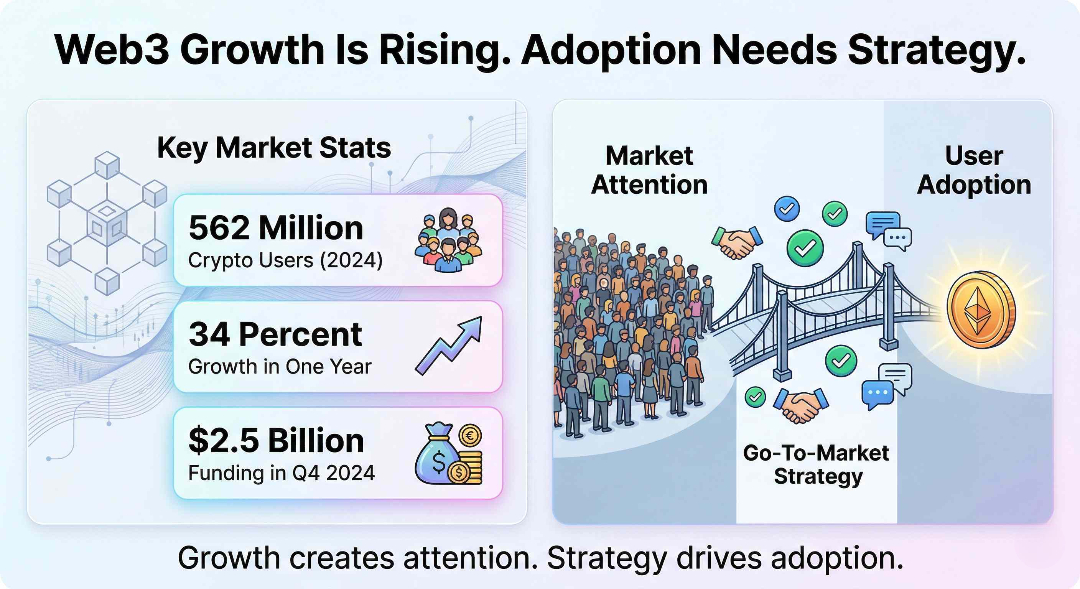
Web3 now draws serious market attention, and recent data backs that up. Triple-A estimates that 562 million people owned digital currencies in 2024, up 34 percent from 420 million in 2023. That rise shows crypto use has moved beyond early adopters. Chainalysis reports that stablecoins now account for more than two-thirds of crypto transaction value, which points to broader use in payments, trading, and daily finance. PitchBook recorded 2.5 billion dollars in crypto funding across 351 deals in Q4 2024. Those figures show a market with growing users, active capital, and real demand for strong products.
Still, growth does not create adoption on its own. Many Web3 teams launch a token, publish a whitepaper, open community channels, and wait for users to show up. That plan rarely works. Attention creates awareness, but trust drives action. Users need clear value, a clear use case, and a strong reason to engage with a token. A solid go-to-market strategy closes that gap. It defines your audience, sharpens your message, ties token utility to real product use, and keeps users active after launch. This guide explains each step so your crypto project can enter the market with clarity and real traction.
Web3 Go-To-Market Strategy
A Web3 go-to-market strategy acts as a clear plan for launching and growing a crypto project from day one. It defines who the project targets, how users join, and what keeps them active over time. The focus stays on three core areas: user acquisition, token adoption, and ecosystem growth. User acquisition in Web3 often starts with early supporters such as developers, investors, and community members. Token adoption then drives usage by giving users a reason to hold and interact with the product. Ecosystem growth follows through partnerships, integrations, and active communities. A strong GTM plan connects all these parts and sets clear goals, timelines, and metrics so teams can track progress and adjust fast.
How Web3 GTM Differs from Traditional Marketing
Web3 marketing shifts control from companies to communities. In Web2, brands push messages through ads and content. In Web3, communities drive visibility and trust through discussions, referrals, and shared ownership. Token incentives replace many paid campaigns by rewarding users for actions such as staking, sharing, or testing products. Trust also works in a different way. Web2 brands rely on logos, ads, and authority. Web3 projects rely on transparency, open code, and public communication. This change means teams must build strong communities early, keep communication open, and give users real value through tokens and participation.
Why a Strong GTM Strategy Is Critical for Crypto Projects
-
Avoiding failed launches and low token adoption
A crypto launch can attract attention fast, but attention alone does not create users. Many projects launch a token before they prove demand, explain utility, or build trust. That gap leads to weak adoption, low trading activity, and poor retention. A strong GTM strategy fixes that problem. It sets a clear market position, maps user needs, and ties the token to real product use. Teams then launch with a plan instead of hope.
-
Building credibility in a trust-sensitive market
Trust sits at the center of every Web3 launch. Users check team history, token allocation, audit status, partner quality, and public communication before they commit funds or time. One vague message can damage interest. One missed promise can hurt the brand for months. A strong GTM strategy builds credibility through clear messaging, public roadmaps, active community channels, and steady updates. People back projects that look serious, open, and prepared.
-
Creating network effects early
Web3 products grow faster once users bring in more users. That pattern shows up in wallets, DeFi apps, NFT communities, gaming tokens, and DAO platforms. Early traction matters, so teams need strong referral loops, active communities, and rewards tied to useful actions. A GTM strategy helps create those loops early. It turns first users into promoters, testers, voters, and holders. That early push can shape the entire launch curve.
-
Driving long-term token value and sustainability
Short-term hype can push a token price up for a few days. It rarely supports a project for years. Long-term value comes from demand, utility, and steady participation across the ecosystem. A strong GTM strategy supports that goal by linking the token to product access, governance, staking, rewards, or network usage. It gives users a reason to stay active after launch. That is how teams build stability instead of short spikes.
Key Phases of a Web3 Go-To-Market Strategy
Phase 1: Pre-Launch Build Awareness and Community
The pre-launch stage shapes the entire project. Teams need to define the target audience first, then write a clear value proposition that explains the problem, product, and token role in simple terms. Community building starts here through Discord, Telegram, and Twitter or X, where early users ask questions and test the story. Teams should publish a roadmap, outline tokenomics, and open teaser campaigns or waitlists to collect early demand. This stage gives the launch structure, feedback, and momentum.
Phase 2: Launch Token Launch and Market Entry
The launch stage puts the project in front of the market, so every move needs timing and clarity. Teams must pick the right launch model, such as an ICO, IDO, IEO, or airdrop, based on product stage, audience type, and compliance needs. Exchange planning matters here too, since listings affect liquidity, reach, and price action. PR campaigns, influencer outreach, AMAs, and live launch events help drive traffic and conversation across crypto channels. A good launch feels coordinated, active, and easy to follow.
Phase 3: Post-Launch Growth and Retention
The post-launch stage decides whether the project grows or fades. Teams need to keep the community engaged through updates, governance activity, and regular communication across core channels. Incentive programs such as staking, rewards, and quests can keep users active, but the product must keep improving too. New features, ecosystem expansion, partnerships, and integrations all help create fresh demand and stronger utility. Post-launch growth works best when the token, product, and community keep reinforcing each other.
Ready to launch your crypto project with real traction?
Work with experts who map your launch, build your community, and drive user adoption from day one

Core Components of a Successful Web3 GTM Strategy
Community Building
A strong Web3 project starts with a loyal community that trusts the team and talks about the product without being pushed. People join early for many reasons, but they stay for clear value, open updates, and real participation. That is why community building sits at the center of any crypto go-to-market strategy. Discord helps teams host live discussions, support channels, and feedback loops. Telegram works well for fast updates and direct contact. DAO platforms give members a voice through proposals and voting. A healthy community does more than grow follower counts. It creates demand, shapes product feedback, and turns users into advocates.
Tokenomics Design
Tokenomics design decides how value moves through the project and who gets rewarded for taking part. A utility token gives access, usage rights, or rewards inside the product. A governance token gives holders voting power over key decisions. Some projects combine both roles, but the structure must stay clear and fair. Good tokenomics align incentives between founders, users, investors, and partners. They set supply rules, vesting schedules, reward systems, and usage triggers that support long-term demand. Poor token design creates sell pressure and weak trust. Strong token design gives people a reason to join, hold, and stay active.
Branding and Positioning
Branding and positioning help a crypto project stand out in a crowded market where many teams make the same claims. A clear brand tells people what the project does, who it serves, and why it matters. Positioning then places the project in a way that feels easy to understand and hard to confuse with rivals. Teams need simple messaging, a distinct voice, and a story that matches the product and token model. Good storytelling does not rely on hype. It explains the problem, the fix, and the result in direct language. That clarity helps projects attract users, media, partners, and investors.
Partnerships and Ecosystem Growth
Partnerships can speed up trust, reach, and product usage far faster than solo growth. A new Web3 project gains more visibility once it connects with known protocols, wallets, launchpads, data tools, or infrastructure providers. These ties can bring shared users, technical support, and new use cases. Cross-promotions help both sides reach relevant audiences through co-marketing, AMAs, and product announcements. Integrations matter just as much. A token that works across tools and platforms has more utility and stronger staying power. Strong partnerships do not just add logos to a website. They expand the project’s real market footprint.
Top Marketing Channels for Web3 Project Launches
-
Organic Channels
Organic channels help Web3 projects build trust and traffic without relying only on paid reach. SEO plays a major role here, especially for keywords tied to crypto launch strategy, token launch marketing, Web3 user acquisition, and blockchain growth. A project that ranks for high-intent search terms can attract founders, investors, developers, and users at different stages of research. Content marketing supports that effort through blogs, whitepapers, landing pages, technical docs, and explainers. These assets answer questions, clarify the token model, and show product depth. Strong organic content keeps working long after launch day.
-
Social Media and Community Platforms
Social media and community platforms drive daily attention in Web3, and each channel plays a different role. Twitter or X helps teams share updates, shape public narrative, and join live crypto conversations. Discord gives space for deeper discussion, support, and direct user feedback. Telegram works well for quick announcements and community alerts. Reddit can bring sharp feedback, organic debate, and niche user groups that care about real product value. Teams need active moderation, regular posting, and a clear voice across every channel. A silent account sends the wrong signal in crypto.
- Influencer and KOL Marketing
Influencer and KOL marketing can give a project fast exposure, but the fit must be right. In crypto, people often trust niche creators more than large media outlets. That gives influencers strong power over attention and traffic. The best partnerships come from creators who understand the product, speak to the right audience, and care about long-term credibility. AMA sessions, interviews, launch threads, and product walkthroughs can all help explain the project in a human way. Empty promotion rarely works for long. Clear education and trusted voices work far better.
-
Paid Advertising
Paid advertising still matters for Web3 launches, but teams need to use the right networks and follow strict platform rules. Mainstream ad platforms often limit crypto promotions, so many projects turn to Web3 ad networks, crypto news sites, wallet ads, and display placements on niche platforms. Paid campaigns can support brand awareness, waitlist growth, token launch traffic, and retargeting. The message must stay clear and compliant at every step. Teams should avoid price promises and vague claims. Strong paid ads focus on product value, community access, and user action.
-
Growth Campaigns
Growth campaigns help Web3 projects create momentum through direct participation. Airdrops can attract early users and reward wallets that complete useful actions. Referral programs turn existing users into promoters and lower acquisition costs. Gamified engagement keeps people active through quests, points, badges, and leaderboard systems tied to product usage. These campaigns work best once rewards match real value inside the ecosystem. A reward with no purpose creates short-term traffic and fast exits. A reward tied to product use can build habits, retention, and stronger token demand.
Metrics and KPIs to Measure GTM Success
Pre-Launch Metrics
Pre-launch metrics show whether your market is warming up before launch day. Community growth is one of the first numbers to track, and that includes follower growth on Twitter or X, member joins on Discord and Telegram, and email list sign-ups. Engagement rate matters just as much. A channel with 20,000 followers and weak replies tells a very different story than a channel with 5,000 followers and daily discussion. Teams should track post reach, comments, shares, AMA attendance, waitlist sign-ups, and click-through rates. These numbers show if people care, if they understand the message, and if they want to take the next step.
Launch Metrics
Launch metrics tell you if interest turned into real action. Token sale participation is a core signal, so teams should watch the number of buyers, total funds raised, average contribution size, and the speed of allocation fill. Wallet sign-ups matter too, since a launch only works if users connect, claim, trade, stake, or interact with the product. Teams should measure new wallet connections, first-time transactions, token claims, staking activity, and platform visits during launch week. These figures show whether people showed up just to watch or came ready to join the ecosystem.
Post-Launch Metrics
Post-launch metrics reveal whether the project has real staying power after the first rush fades. User retention should sit near the top of the list, and that includes daily active wallets, weekly active wallets, repeat transactions, and governance votes. Token liquidity and trading volume show market health and show how easily people can buy, sell, or hold without sharp price swings. Ecosystem growth adds another layer through partner integrations, developer activity, app usage, and new community-led projects. Strong post-launch metrics show that the token is tied to real use and not short-lived attention.
Want your crypto project to stand out from day one?
Best Practices for a Successful Crypto Project Launch
Start marketing early
The best crypto launches start months before the public sale or product release. Early marketing gives teams time to test messages, refine audience targeting, and build trust before users are asked to commit money or time. It helps projects grow email lists, fill waitlists, run AMAs, publish educational content, and collect feedback from early supporters. A rushed launch often creates confusion and weak conversion. A planned lead-up gives your project a stronger story and a better chance to enter the market with momentum.
Focus on utility over hype
Hype can bring traffic for a short period, but utility keeps users active after launch. Teams need to explain what the token does, where it fits inside the product, and why users should keep holding or using it. That value can come from governance rights, staking rewards, access to services, transaction functions, or in-app benefits. Users lose trust fast once a token has no clear purpose. Projects that lead with product value build stronger retention and better long-term demand.
Maintain transparency and trust
Trust drives every part of a Web3 launch, so teams need to communicate in a clear and open way from the start. Users want to see who is building the product, how tokens are allocated, what the roadmap looks like, and what risks exist. Regular updates, public discussions, smart contract audits, and honest responses help build that trust over time. Silence creates doubt. Vague claims do the same. Clear communication gives people a reason to believe the team is serious and prepared.
Combine Web2 and Web3 strategies
A strong launch uses both Web2 and Web3 channels instead of picking one side. Web2 tactics such as SEO, email campaigns, PR, landing pages, and content marketing help projects reach new audiences and capture search demand. Web3 channels such as Discord, Telegram, AMAs, airdrops, and token incentives help drive community activity and deeper participation. This mix gives projects broader reach and better conversion paths. Teams can educate new users through search and content, then bring them into community spaces where engagement grows.
Continuously engage your community
Community engagement should not stop after the token goes live. A strong Web3 project keeps users active through updates, events, governance votes, product releases, reward programs, and direct conversations across core channels. People want to feel that their time matters and that their voice counts. Regular engagement keeps the project visible and keeps loyalty strong. An inactive community often signals an inactive product. A busy and informed community can become one of the project’s strongest growth drivers.
Conclusion
A strong Web3 go-to-market strategy gives your crypto project direction, structure, and real momentum. It connects your product, token, and community into one clear plan that drives adoption and long-term growth. Teams that plan early, communicate clearly, and stay active after launch build stronger user bases and better market trust. Success in Web3 does not come from hype alone. It comes from steady execution, clear value, and engaged users who stay with the project over time. If you want expert support at every stage, Blockchain App Factory provides Web3 marketing services that help you plan, launch, and grow your crypto project with confidence. If you plan to hire a partner for launch support, compare Web3 marketing agencies before you sign

Vimal J is the Head of Sales at Blockchain App Factory, with 10+ years of experience in sales, client strategy, and Web3 business growth. He helps startups, enterprises, and project founders choose the right blockchain solutions for their goals, bringing a practical market perspective to topics like token development, crypto launches, and Web3 adoption.
Article Reviewed by:
Arun Kamala Santhanath
Marketing Head, Blockchain App Factory


