
As we move through March 2026, stablecoin infrastructure 2026 has evolved from a speculative crypto trading tool into essential business infrastructure for global enterprises. This technical whitepaper explores the foundational architectural requirements and adoption drivers for 24/7 global liquidity.
The first quarter of 2026 has witnessed an unprecedented acceleration in stablecoin business adoption. What was once a niche settlement mechanism for offshore exchanges has become the primary settlement rail for Fortune 500 treasuries, European logistics hubs, and Southeast Asian manufacturing networks. The shift toward a unified stablecoin infrastructure 2026 is not purely driven by interest in digital assets, but by the undeniable friction inherent in the legacy correspondent banking model.
2026 Adoption Drivers
to automated stablecoin supply-chain settlements.
At Blockchain App Factory, we specialize in building secure, compliant, and scalable stablecoin infrastructure 2026 that helps businesses reduce costs, speed up transactions, and improve financial efficiency. By integrating stablecoin payments 2026 protocols into existing tech stacks, we enable a 24/7 financial cycle that ignores banking holidays and regional cut-off times.
THE MECHANICS OF STABLECOIN INFRASTRUCTURE 2026 ADOPTION
The traditional Correspondent Banking Network (CBN) has served the world for decades, but it was not designed for the real-time API-driven economy of 2026. A modern stablecoin infrastructure 2026 overcomes the three main failures of legacy banking: latency, fees, and opacity.
Immediate Clearing
Unlike the settlement cycles of T+2 or T+3, stablecoin transactions provide immediate on-chain finality. This drastically improves cash flow for businesses with high inventory turnover.
Forex Liquidity
Companies holding USD-pegged tokens like USDC or USDT for business can transact across 150+ countries without incurring the 2% to 4% forex spread typical of retail banking.
Audited Proofs
A modern stablecoin infrastructure provides real-time proof of reserves and transaction non-repudiation, which simplifies corporate accounting and forensic auditing.
FIG 2.0 // CROSS-BORDER SETTLEMENT SPEED (SECONDS)
We have assisted hundreds of clients in navigating this transition. The focus is no longer on “crypto speculative gains” but on “operational efficiency gains.” For a business operating across multiple jurisdictions, the ability to manage a unified digital asset treasury is a competitive moat that cannot be ignored.
UNIQUE ARCHITECTURE: THE STABLECOIN SETTLEMENT PIPELINE
Designing a secure stablecoin platform development roadmap involves more than just a token issuance. It requires a high-performance pipeline that connects to your existing business logic.
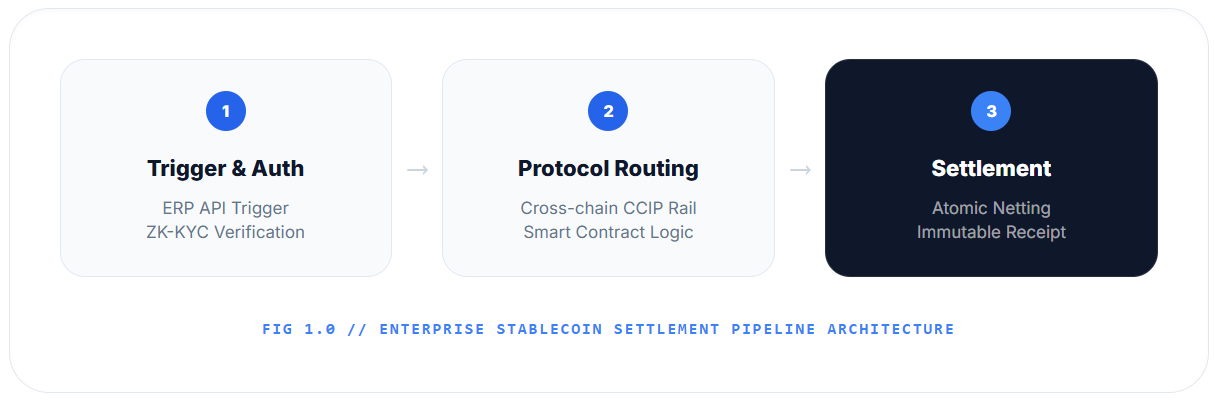
TECHNICAL LAYERS OF STABLECOIN INFRASTRUCTURE 2026
A robust stablecoin infrastructure 2026 implementation requires several critical layers:
1. The Issuance Layer: This foundational layer is where compliant minting and burning occurs. In 2026, this involves Proof-of-Reserve (PoR) oracles that attest to the custodial backing of the stablecoin in real-time. This prevents the “de-pegging” risks of the past by providing 24/7 transparency into the assets held in regulated custody.
2. The Compliance Engine: Our systems include built-in KYC/AML tools that meet regional regulatory requirements such as MiCA in the EU and the GENIUS Act in the US. The MiCA (Markets in Crypto-Assets) framework, in particular, requires significant technical overhead for Asset-Referenced Tokens (ARTs), including mandatory redemption rights and capital reserve ratios that must be programmatically monitored.
FIG 3.0 // REGULATORY COMPLIANCE MATRIX 2026
3. The Programmability Layer: By using ERC-4626 Tokenized Vaults or custom logic, businesses can automate payroll, conditional invoicing, and escrow releases. This allows for “intent-based” finance where the payment is triggered only after the smart contract verifies that specific off-chain conditions (e.g., shipping confirmation from a logistics API) have been met.
4. The Interoperability Layer: Multi-chain support (Ethereum, Solana, Polygon, etc.) is essential. Our stablecoin platform development ensures your assets can move seamlessly to whichever chain offers the best gas fees or liquidity at a given moment. We leverage protocols like CCIP and LayerZero to ensure cross-chain messaging is secure and instant, effectively treating multiple blockchains as a single, unified liquidity matrix for the business.
COMMON BUSINESS USE CASES IN 2026
Businesses that implement enterprise stablecoin solutions are not just “using crypto.” They are upgrading their entire financial operation. Here are the primary use cases we support at Blockchain App Factory:
Global Vendor Settlements
Eliminate wait times for overseas supply deliveries. Instant payments trigger immediate shipping.
Treasury Cash Management
Optimise idle cash by moving it into yield-bearing stablecoin vaults that outperform traditional corporate bank accounts.
Automated Payroll 2.0
Pay global remote teams in their preferred stablecoin, with taxes and compliance handled by the smart contract automatically.
We also see a rising trend in customer refund automation. Large retailers are using programmable stablecoins to issue instant refunds to customer wallets, which can then be redeemed or spent elsewhere. This dramatically improves the customer service cycle and reduces chargeback friction for the merchant.
HOW WE SUPPORT STABLECOIN ADOPTION
At Blockchain App Factory, our focus is to make stablecoin adoption simple, secure, and highly beneficial for businesses of all sizes. Our methodology is built on three pillars: Technical Excellence, Regulatory Alignment, and System Integration.
-
✓Custom Platform Development: We don’t just provide a generic wallet. We build a white-label treasury management suite that integrates with your existing ERP (Oracle, SAP, etc.).
-
✓Compliance Guardrails: Our infrastructure includes automated circuit breakers and freezing logic to ensure you are never in violation of global AML policies.
-
✓End-to-End Auditing: Every smart contract we deploy is audited by multiple third-party firms to ensure institutional-grade security.
CONCLUSION: THE INFRASTRUCTURE OF TOMORROW, TODAY
In March 2026, stablecoins have become a strategic business infrastructure rather than just a crypto asset. Companies that have embraced this change are already seeing the benefits of faster payments, lower costs, and reduced risk. The path toward stablecoin treasury management is the path toward a more efficient global economy.
At Blockchain App Factory, we specialize in developing enterprise-grade stablecoin infrastructure that combines technical excellence with practical business value. Whether you want to implement stablecoin payments, build a treasury management system, or create a custom stablecoin solution, our team provides the depth and foresight needed to scale in 2026.
Ready to Build the Future of Payments?
Scale your project with the technical leaders in 2026 stablecoin development.
Contact the stablecoin infrastructure team at Blockchain App Factory for a free technical consultation and customized development roadmap.