
Key Insights
- X is not just a social platform. It shapes narratives, impacts token prices, and builds investor trust within minutes. Brands that stay active and responsive gain a clear edge.
- High-performing crypto accounts focus on clear messaging, frequent engagement, and strong community interaction. Threads, replies, and timely updates outperform static promotional posts.
- X works best when combined with Discord, Telegram, and LinkedIn. Each platform supports a different stage of the user journey, from discovery to conversion and long-term retention.
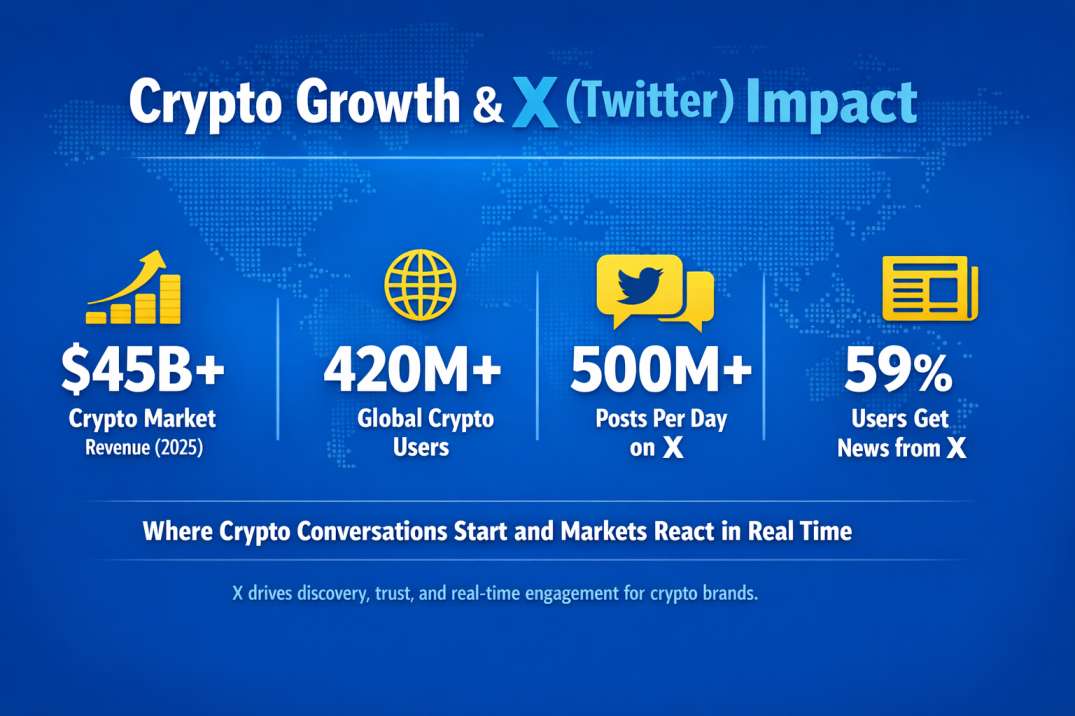
X still holds a special place in crypto marketing. It acts as the market’s live wire. News breaks there first, traders react there first, and communities often decide what matters there before blogs, podcasts, or email newsletters catch up. Pew Research found that 59 percent of X users regularly get news on the platform, and most users say news is at least a minor reason they use it. At the same time, the global crypto market is projected to generate over $45 billion in revenue in 2025, with more than 420 million users worldwide. That scale turns X into more than a social channel. It becomes a primary gateway to a fast-growing financial ecosystem.
X processes more than 500 million posts per day, and a large share of crypto conversations begin or trend there. That makes it a public trading floor, media desk, customer support line, and reputation engine in one place. The platform compresses information cycles from days into minutes, which changes how brands compete and communicate.
That speed creates real upside for brands. A strong X presence can lower paid acquisition costs, sharpen product messaging, and build trust with investors, users, and partners. It can shape a project’s story in real time. It can drive traffic to listings, staking products, wallets, and developer docs. But the same speed raises the stakes. In January 2024, a fake post on the U.S. SEC’s X account briefly sent bitcoin near $48,000 before it fell below $45,000 after the agency denied the message. One compromised post moved a global market within minutes. For crypto teams, that is the clearest proof that X is not a side channel. It is a business-critical channel.
The Crypto Marketing Landscape on X
What Makes Crypto Twitter Unique?
Crypto Twitter, now crypto X, runs on speed, open discussion, and public proof. A token launch, exchange listing, protocol update, or exploit alert can reach millions of users in minutes. X says its recommendation systems sort through more than 500 million daily posts and use signals tied to follows, likes, reposts, replies, watched media, and network activity. That setup rewards content that sparks fast reaction and repeat engagement. For crypto brands, that means plain news is rarely enough. The best posts carry a clear point of view, strong timing, and a reason for users to respond.
The culture on X shapes that behavior. Crypto users value speed and public accountability. They expect founders to post from their own accounts. They watch reply sections for sentiment, not just headlines. They judge projects by how they handle hard moments, not just launch days. Coinbase made that link explicit in 2025 when it moved listing-related content to a dedicated X account, @CoinbaseMarkets, and framed X as the home for listing updates. That move reflects how deeply crypto operations and X communication now overlap.
Trust cuts both ways. Chainalysis reported that crypto scams took in at least $9.9 billion on-chain in 2024, with the estimate likely to rise as more scam addresses are identified. That scam pressure makes every post part of a trust audit. A brand that posts vague claims, deletes context, or ignores impersonation risk pays a price fast. Clear language, verified accounts, and fast correction matter more in crypto than in most sectors.
Key Audiences for Crypto Brands
Most crypto firms speak to four groups on X, and each group reads posts through a different lens. Retail traders want speed, listings, token news, and market context. Builders want roadmaps, code updates, and technical clarity. Institutional watchers want governance, compliance posture, liquidity signals, and executive credibility. Existing community members want recognition, direct replies, and proof that the team is active.
That mix shapes editorial choices. A post about a protocol upgrade can serve all four groups, but only with smart framing. The main post can state the business value. A threaded reply can add technical detail for builders. A follow-up quote post from the founder can translate the change into market relevance. This layered style works well on X since discovery often starts with one short post and deepens through replies, reposts, and profile visits. X states that posts can reach users outside a brand’s direct follower graph through the “For You” timeline, Explore, notifications, and topic recommendations.
Algorithm and Visibility Factors on X
Visibility on X comes from relevance and reaction. X says recommendations draw from signals such as accounts and topics a user follows, posts they liked or replied to, content popular in their network, and models that predict positive engagement. The platform’s help pages state that reply ranking can rise when the original author responds, when the reply comes from an account the user follows, or when the reply comes from a subscriber. X says post quality models weigh reposts, replies, quotes, active minutes, and negative feedback such as abuse reports.
For brands, that creates a clear operating rule. Posts need to earn interaction, not just impressions. A launch graphic with no context may get seen and then die. A concise post with a sharp claim, useful numbers, and active replies from the team has a better chance of travel. Third-party benchmark data supports that focus on engagement depth. Sprout Social reported that average inbound engagements for brands rose from 70 to 83 per day between 2023 and 2025. Hootsuite found that technology brands on X hit their top engagement rate, 2.59 percent, at a posting pace of 19 posts per week in its 2025 benchmark set. The message is simple. Consistent posting matters, but response quality matters more.
Are you ready to build a high-performance crypto X marketing strategy?
Build a high-performance crypto X strategy to grow reach, trust, and engagement fast.

Setting Business Goals for Crypto Social Media Marketing
Defining Clear KPIs
A crypto brand should not judge X by follower count alone. Followers can be bought, inactive, or poorly matched to a product. Better KPIs tie social activity to business outcomes. Start with share of voice, engagement rate, profile visits, link clicks, and community response time. Then connect those numbers to pipeline metrics such as exchange sign-ups, wallet downloads, waitlist joins, event registrations, or demo requests.
The best KPI sets split into three layers. Awareness metrics show reach and discovery. Engagement metrics show message-market fit. Conversion metrics show revenue value. That structure helps teams spot where performance breaks down. High impressions with weak clicks point to weak calls to action. Strong clicks with weak sign-ups point to landing-page friction. Strong sign-ups with weak retention point to product or onboarding issues.
Aligning Social Strategy with Business Objectives
Business goals should drive channel behavior. A new exchange may need trust and account acquisition. A layer-2 network may need developer interest and ecosystem partners. A tokenized asset platform may need a compliance-first voice for institutions. X can support all three, but each one calls for a different content mix, posting rhythm, and executive presence.
The strongest teams treat X as part of revenue operations. Product, legal, community, and growth teams all shape the calendar. That reduces risk and keeps campaigns tied to launches, partnerships, and market moments that matter.
ROI of Crypto Marketing on X
ROI on X comes from speed, reach, and compounding reputation. One strong account can distribute product news, answer objections, seed thought leadership, and support customer success at the same time. Few channels do all of that in public view. X remains one of the few places where market participants actively look for breaking updates, and that behavior gives crypto brands a direct path to decision-makers and users.
The return grows once a brand earns trust. Posts travel farther, communities defend the project, and announcements convert faster. In crypto, that trust often starts with one habit: say something clear, say it fast, and stand behind it in public.
Building a High-Performance X (Twitter) Strategy Framework
A strong crypto X strategy starts with a simple truth. X is still the fastest public channel for price-sensitive news, token chatter, founder commentary, and community reaction. X says its recommendation systems feed the Home timeline, Explore, Notifications, Search, and the Spaces tab, and it ranks posts through signals tied to likes, reposts, replies, followed accounts, followed topics, and other network behavior. For crypto firms, that means the channel is not just for distribution. It shapes discovery and trust at the same time.
Content Strategy for Crypto Brands
Content should match the way crypto users read X. They scan fast, check replies, and look for proof. A brand account that posts only polished launch graphics will lose ground to teams that explain market events, answer hard questions, and show product progress in public. X states that posts gain recommendation strength from positive user activity such as reposts, replies, quotes, and user active minutes. That pushes brands toward content that creates discussion, not just views.
For most crypto brands, the highest-value content falls into four buckets. First comes market education. This includes threads on token utility, staking mechanics, fees, governance, treasury policy, or security design. Second comes product proof. Teams should post screenshots, release notes, roadmap progress, and user stories. Third comes founder and operator commentary. Posts from named executives often carry more weight than anonymous brand copy in crypto circles. Fourth comes reactive commentary tied to live events such as listings, exploits, macro news, and policy changes. This mix builds authority and keeps the account useful between launch moments. X’s own guidance on threads supports this format, since threads give brands a native way to add context and continue a point without losing the short-post format that drives discovery.
The best crypto content feels native to X. It opens with a clear line, delivers one strong claim, then supports it with numbers, screenshots, or direct explanation. A DeFi protocol can post, “Swap volume rose 38% this week after fee routing changes,” then add the breakdown in a thread. An exchange can post fast list updates, then pin risk details in replies. That structure respects how users read on the platform, and it turns the reply section into a second layer of content rather than a neglected comment field.
Content Calendar and Posting Frequency
A calendar matters, but rigid scheduling does not win crypto attention on its own. Crypto moves on market hours, rumors, governance votes, and product incidents. So brands need a two-track model. One track covers planned publishing such as education, product updates, team commentary, and campaign assets. The second track covers rapid response. If the team waits until tomorrow to explain a wallet issue or answer a false rumor, the market fills the gap first.
Frequency should follow data, not habit. Hootsuite’s 2025 benchmark data found that technology brands on X reached their top engagement rate, 2.59 percent, at a pace of 19 posts per week. Sprout Social reported that brands posted an average of 9.5 social posts per day across networks in 2024, yet the broader lesson in its benchmark data was that volume alone does not create better performance. X users are active and fast, but quality still sets the ceiling.
Timing matters too. Sprout Social’s 2026 posting guide says peak engagement windows on X stretch from noon to 6 p.m. on weekdays, based on its current data. Crypto brands should treat that as a baseline, then adjust for audience geography and market focus. A token project with a heavy U.S. retail base will post at different hours than a protocol courting Asian traders and European developers. The right posting calendar is not “daily at 10.” It is a map of audience attention by region, product line, and market event.
Brand Voice and Positioning
Voice matters more in crypto than in many other sectors. Users watch for signs of evasion, hype, and vague claims. They reward teams that sound informed, calm, and direct. The account voice should reflect the business model. A custody platform should sound precise and risk-aware. A meme-driven consumer wallet can post with more humor, but it still needs clarity on product and security. One account can sound human without sounding sloppy.
Positioning follows the same rule. The strongest crypto brands claim a narrow space in the market and repeat it until the audience remembers it. That space might be “the safest way to access staking,” “the fastest bridge for active traders,” or “the compliance-first tokenization platform for institutions.” Once that position is set, the content calendar should reinforce it every week. Random topical posting creates noise. Repeated category ownership creates recall.
Growth Strategies to Scale Your Crypto Twitter Presence
Organic Growth Tactics
Organic growth on X comes from relevance and public interaction. X warns against account metric inflation and bans behavior such as paid engagement exchanges, follow churn, and other fake-growth tactics. That matters in crypto, where weak follower quality often hides under large numbers. A smaller account with strong replies, regular founder posts, and steady link clicks is worth more than an inflated profile with silent followers.
The most effective organic tactic is still reply-driven distribution. Smart teams comment early on major market posts, exchange news, policy updates, and founder threads. They add a useful point, not a sales pitch. This places the brand inside active conversations where discovery already exists. Then they convert attention with profile pins, strong post archives, and fast follow-up replies. Organic growth on X is less about isolated “viral posts” and more about repeated presence in the right public rooms.
Influencer and KOL Marketing
KOL campaigns work in crypto, but only when the creator actually fits the audience. Sprout Social reported in 2025 that 67 percent of B2B brands use influencer marketing to raise awareness, and 54 percent use it to build credibility and trust. Those goals matter even more in crypto, where trust is fragile and technical products need translation. A niche creator with strong credibility in DeFi, security research, or market structure will often outperform a broad crypto personality with a larger but looser audience.
Disclosure rules now matter more on X. The platform’s Paid Partnerships Policy defines paid partnerships as content where a brand gives compensation or incentives to a creator to promote a product or service. X states that such content must follow its specific rules, and its ads policies place financial products, crypto products, and NFTs under restricted categories based on region and product type. For crypto brands, that means KOL work needs contract terms, review steps, and clear labels.
Community-Led Growth
Community-led growth is not just moderation. It is public relationship management. Teams should reply to users, surface smart community posts, host Spaces, and reward informed participation. X includes the Spaces tab within its recommendation system, which gives crypto brands another live format for founder Q&As, market recaps, and launch events. A well-run Space can turn passive followers into active members in one session.
Community work carries a security burden too. Chainalysis estimated that crypto scams and fraud reached $17 billion in 2025, with impersonation scams rising 1400 percent year over year. That figure changes how brands should run support and community accounts. Teams need clear account verification, pinned security notices, and public warnings about fake support agents and giveaway scams. Community trust is earned in the same place where scams spread.
Paid Marketing and Promotion on X for Crypto Projects
X Ads for Crypto Brands
Paid media on X can extend reach fast, but crypto advertisers face policy checks. X’s financial services policy says the platform allows promotion of cryptocurrency products and services with restrictions tied to product type and target region. That means campaign planning must start with legal review and audience targeting, not creative first. A token issuer, exchange, NFT project, and blockchain game do not face the same ad path.
Sponsored Content and Promotions
Sponsored creator posts work best when they mirror native behavior on X. The strongest ones look like informed commentary with clear disclosure, not ad copy pasted into a creator’s voice. X’s advertising page defines promoted ads as regular posts that advertisers pay to amplify to broader audiences or to boost engagement with followers. That makes the best paid crypto posts look close to strong organic posts. Clear hook, one claim, one proof point, then a direct link or next step.
Budget Allocation and Performance Tracking
Budget should follow funnel stage. Brands should place more spend behind posts that already show strong organic traction, then test retargeting, creator amplification, and event-driven campaigns in smaller blocks. Track cost per profile visit, cost per site visit, cost per sign-up, and post-save or reply depth where relevant. Engagement rate alone does not tell the full story. Hootsuite’s 2026 guidance puts a good social engagement rate in the 1 percent to 5 percent band, but crypto teams need harder business metrics tied to accounts, wallets, deposits, or demo requests. Paid spend earns its place only when it moves those numbers.
Comparing Crypto Marketing Strategies Across Channels
Crypto teams rarely win with one channel alone. Each platform shapes user behavior in a different way, and that changes what a brand can achieve. X drives discovery and public conversation. Discord keeps active members close to the team. Telegram pushes fast updates into a direct channel. LinkedIn reaches partners, investors, and B2B buyers. A strong crypto marketing plan starts with that division of labor, then assigns each channel a clear job.
X vs. Discord vs. Telegram
X remains the fastest place for crypto news, debate, and narrative control. Posts spread beyond a brand’s follower base through recommendations, search, and quote posts. Spaces adds live audio, so founders and growth teams can address the market in real time. That makes X the best channel for launches, listing news, policy reaction, and thought leadership. It is weak at deep community retention. Public feeds move too fast, and serious users drift into smaller spaces once they want support, status updates, or direct access to the team.
Discord serves a different purpose. Discord says it had more than 90 million daily active users in late 2025 and over 200 million monthly active users globally. Those numbers matter less than the product design. Servers support roles, channels, gated access, bots, events, and long-lived threads. That structure fits crypto communities that need segmented conversations for traders, developers, moderators, NFT holders, beta users, and governance members. Discord works best once a project has an active base that wants to stay close and talk to one another, not just to the brand.
Telegram sits closer to the announcement end of the spectrum, but it has broader reach than many firms assume. Telegram says it passed 1 billion monthly active users in 2025, and its public groups can hold up to 200,000 members. Channels make one-to-many broadcasting simple. Group chats create a faster and looser community layer than Discord. Telegram fits token communities, trading groups, regional updates, and support flows that depend on speed. It is less suited to complex documentation, multi-team coordination, or large-scale moderation that demands rich permissions and structure.
So which platform should lead? For most crypto brands, X should lead top-of-funnel attention. Discord should carry community depth. Telegram should handle direct alerts, regional groups, and high-frequency updates. Teams that swap those jobs usually create friction. A Discord-first launch often stays trapped inside the existing community. A Telegram-first B2B push rarely builds trust with investors or partners. An X-only strategy creates reach but weak retention.
X vs. LinkedIn for Web3 Businesses
LinkedIn plays a very different role from X. LinkedIn says it has more than 1 billion members across more than 200 countries and territories. Users arrive there with a business mindset. They expect case studies, hiring news, product analysis, executive commentary, and industry proof. For Web3 firms that sell custody, infrastructure, compliance tools, analytics, tokenization services, or enterprise blockchain products, LinkedIn often produces higher-quality commercial attention than consumer-heavy crypto channels.
X still matters for those firms, but for a different reason. X shows how a company thinks under pressure. It reveals whether the founders understand the market, answer criticism, and publish fast. LinkedIn shows whether the same company can explain its value in boardroom language. That distinction matters for Web3 businesses with long sales cycles. A chief marketing officer or head of partnerships may discover the brand on X, then validate it on LinkedIn through company pages, executive posts, hiring signals, and customer proof.
Recent B2B content research supports that split. Content Marketing Institute reported that use of X among B2B marketers fell to 61 percent in the last year, down from 73 percent the year before. The same report says 27 percent of B2B marketers expect their content teams to grow in 2025, and 56 percent say they lack a scalable content creation model. Those numbers point to a practical lesson. B2B teams want channels with clearer conversion paths and content they can repeat with a small team. LinkedIn often fits that need better for enterprise Web3 firms, but X still carries weight for market credibility and live industry relevance.
Omnichannel Strategy for Maximum Impact
The best crypto teams do not copy the same post to every platform. They adapt one core message to different user intent. A token launch can start with an X thread that frames the news and draws attention. That same launch can move into Discord for AMA sessions, role-gated perks, and technical follow-up. Telegram can push alerts to holders and regional groups. LinkedIn can publish the institutional angle, such as market demand, compliance posture, or enterprise use cases. This system turns one campaign into four channel-specific assets.
This channel design helps with risk control too. X is public and fast, so rumor spreads there first. Discord and Telegram let the team answer loyal users in tighter spaces. LinkedIn creates a calmer archive for investor and partner review. Crypto brands need all three layers: public visibility, community depth, and formal credibility.
Start Your X Growth Strategy Today?
Outsourcing vs. In-House Crypto Social Media Management
The management model shapes speed, quality, and risk. Crypto social media is not ordinary brand publishing. Teams need market awareness, policy awareness, moderation discipline, and product fluency. They often need to publish on weekends, respond during volatility, and clear sensitive posts with legal or compliance staff. That pressure exposes weak staffing choices fast.
Benefits of Hiring a Crypto Marketing Agency
An agency can bring speed, channel expertise, and campaign range from day one. That matters for early-stage firms and lean growth teams. Agency staff often know creator pricing, community playbooks, paid media setup, reporting systems, and launch sequencing across X, Telegram, Discord, and LinkedIn. They can move faster on execution than a new internal hire who still needs time, tools, and process. CMI’s 2025 benchmark data shows that 56 percent of B2B marketers lack a scalable content creation model. That gap explains why outside help often works well for launch-heavy or content-heavy crypto firms.
Agencies are strongest in three cases. First, the brand needs fast market entry. Second, the company needs specialist support for paid media, KOL work, or multilingual community growth. Third, the internal team lacks crypto-native writers, moderators, or analysts. The tradeoff is product depth. Outside teams need strong briefs and direct access to internal stakeholders or the content starts to sound generic.
Building an In-House Team
An internal team owns the product story at a deeper level. It can move in lockstep with engineering, product, and support. That is a major advantage in crypto, where one unclear post can trigger panic or legal scrutiny. In-house teams usually perform best for mature projects with daily product updates, active communities, and strict approval needs. They build institutional memory and keep tone consistent across market cycles.
The cost is structure. A serious in-house function needs more than one social media manager. It needs content, design, analytics, moderation, and leadership support. CMI reports that only 27 percent of B2B marketers expect team growth in 2025, even though many still struggle with scale. That mismatch explains why some crypto firms burn out small internal teams. They expect 24-hour performance from two people and then wonder why output slips.
Choosing the Right Solution for Your Business
The right choice starts with business stage. Seed and Series A projects often benefit from an agency or hybrid model. The company gains speed and specialist support without building a full team. Growth-stage and enterprise Web3 firms usually need internal ownership, then agency partners for paid media, launches, or specific regions. Hybrid setups often work best. Internal staff owns voice, risk, and product truth. Agency staff extends reach, reporting, and campaign execution.
Conclusion
Crypto marketing works best when each channel has a clear role and the team behind it matches the company’s stage. X wins attention and public trust. Discord builds durable community ties. Telegram moves fast updates at scale. LinkedIn supports enterprise credibility and B2B demand. Firms that connect these channels with one clear narrative build stronger recall and stronger conversion paths.
Execution matters as much as strategy. Teams that align content, community, and paid efforts across platforms see better results in user growth, engagement, and conversions. A well-structured crypto social media marketing plan turns scattered activity into measurable business impact.
For businesses that want faster growth and expert execution, working with a specialized partner can shorten the learning curve. Companies like Blockchain App Factory offer tailored crypto social media marketing services, helping projects build a strong X strategy, scale community engagement, and drive real adoption in competitive markets. A focused, data-driven crypto social media marketing strategy is no longer optional. By mastering Crypto Twitter Marketing alongside other key channels, a Web3 business can transform its presence into a core growth engine

Vimal J is the Head of Sales at Blockchain App Factory, with 10+ years of experience in sales, client strategy, and Web3 business growth. He helps startups, enterprises, and project founders choose the right blockchain solutions for their goals, bringing a practical market perspective to topics like token development, crypto launches, and Web3 adoption.