Key Insights
- A comprehensive smart contract audit goes beyond basic code review, focusing on identifying logic flaws, reentrancy risks, gas inefficiencies, and vulnerabilities that could compromise funds or protocol integrity.
- Security standards in 2026 emphasize continuous auditing, including pre-deployment reviews, real-time monitoring, and post-launch updates to adapt to evolving threats in the Web3 ecosystem.
- Founders must prioritize transparency and trust by leveraging third-party audits, publishing reports, and integrating security best practices early in development to prevent costly exploits and build user confidence.
Smart contract vulnerabilities cost Web3 projects over $3.8 billion in 2025. Your project doesn’t have to become another statistic.
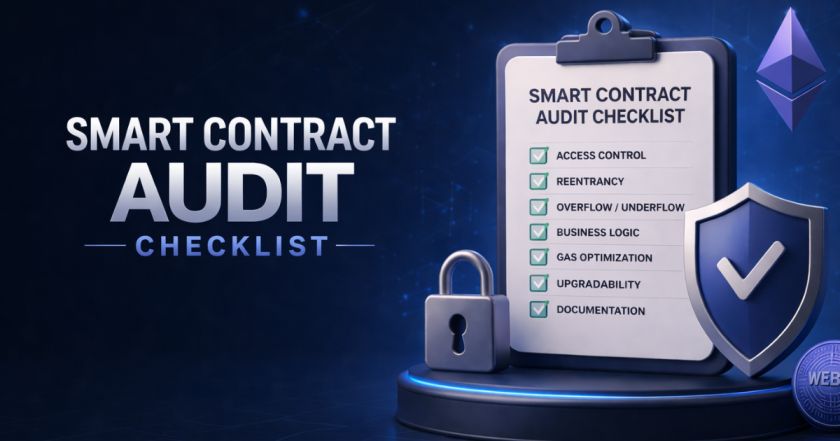
A comprehensive smart contract audit protects your code, your investors, and your reputation before launch. This checklist covers the security standards, audit process, and partner selection criteria that separate successful Web3 projects from those that fail due to preventable security flaws.
Why Smart Contract Audits Matter More Than Ever
Smart contract security has become non-negotiable in 2026. Institutional investors now require audited contracts before funding rounds. Major exchanges demand security reports for token listings. Insurance protocols won’t cover unaudited projects.
The stakes are higher because the attack vectors are more sophisticated. Hackers target flash loan vulnerabilities, cross-chain bridge exploits, and governance token manipulations that didn’t exist five years ago.
Your audit serves three purposes:
- Risk mitigation: Identifies vulnerabilities before they become exploits
- Investor confidence: Demonstrates security-first approach to stakeholders
- Compliance readiness: Meets regulatory requirements in major markets
Core Security Vulnerabilities to Check
Access Control Issues
Your smart contract audit must verify proper permission structures. Common access control vulnerabilities include:
- Missing ownership validation: Functions lack proper admin checks
- Privilege escalation: Lower-tier accounts can access admin functions
- Unprotected initialization: Contract setup functions remain callable after deployment
Reentrancy Attacks
Reentrancy remains the top exploit vector in DeFi protocols. Your audit checklist should include:
- External call ordering: Verify state changes happen before external calls
- Reentrancy guards: Confirm proper mutex implementation
- Cross-function reentrancy: Check for vulnerabilities across multiple functions
Integer Overflow and Underflow
Math operations can break your contract logic. Essential checks include:
- SafeMath implementation: Verify overflow protection in arithmetic operations
- Boundary conditions: Test edge cases for maximum and minimum values
- Precision loss: Confirm decimal handling in token calculations
Flash Loan Vulnerabilities
Flash loan attacks exploit price manipulation and governance flaws. Your audit must examine:
- Oracle dependencies: Verify price feed security and manipulation resistance
- Governance token exposure: Check for voting power concentration risks
- Liquidity pool interactions: Assess AMM integration security
Gas Optimization Issues
Poor gas optimization creates denial-of-service risks and user experience problems:
- Gas limit vulnerabilities: Ensure functions can execute within block limits
- Unbounded loops: Identify operations that could hit gas limits
- Storage optimization: Verify efficient data structure usage
Essential Pre-Audit Preparation
Code Documentation Requirements
Your development team should prepare comprehensive documentation before the audit begins:
- Function specifications: Clear descriptions of each function’s purpose and parameters
- Architecture diagrams: Visual representation of contract interactions
- Business logic documentation: Detailed explanation of tokenomics and governance mechanisms
Testing Coverage Analysis
Auditors need visibility into your testing approach:
- Unit test coverage: Aim for 90%+ code coverage with meaningful test cases
- Integration testing: Demonstrate cross-contract interaction testing
- Edge case scenarios: Document stress testing and failure condition handling
Dependency Review
Third-party integrations introduce additional risk vectors:
- Library versions: Use latest stable versions of OpenZeppelin and other dependencies
- External contract interfaces: Document all external contract calls and their security assumptions
- Upgrade mechanisms: Clearly define proxy patterns and upgrade procedures
The Complete Audit Process Breakdown
Phase 1: Automated Analysis (Days 1-2)
Professional audit teams start with automated security scanning:
- Static analysis tools: Slither, Mythril, and Securify scan for common vulnerabilities
- Formal verification: Mathematical proof of contract correctness for critical functions
- Gas optimization analysis: Identification of expensive operations and optimization opportunities
Phase 2: Manual Code Review (Days 3-7)
Human auditors examine business logic and complex interactions:
- Logic flow analysis: Verification that contract behavior matches specifications
- Economic attack vectors: Assessment of MEV opportunities and game theory implications
- Integration security: Cross-contract interaction and composability risks
Phase 3: Testing and Validation (Days 8-10)
Auditors validate findings through comprehensive testing:
- Exploit development: Proof-of-concept attacks for identified vulnerabilities
- Regression testing: Verification that fixes don’t introduce new issues
- Performance benchmarking: Gas cost analysis and optimization recommendations
Phase 4: Report Generation (Days 11-14)
The final audit report includes:
- Executive summary: High-level findings for non-technical stakeholders
- Detailed vulnerability analysis: Technical descriptions with severity ratings
- Remediation recommendations: Specific code changes and implementation guidance
Compliance and Regulatory Requirements
Regulatory Frameworks in 2026
Smart contract audits must consider evolving regulatory requirements:
- EU MiCA compliance: Market manipulation and operational resilience standards
- US SEC guidance: Securities classification and disclosure requirements
- Singapore MAS frameworks: Operational risk management for digital assets
Documentation Standards
Regulatory compliance requires specific audit documentation:
- Risk assessment matrices: Quantified risk ratings for all identified vulnerabilities
- Remediation tracking: Evidence of vulnerability fixes and validation
- Ongoing monitoring procedures: Post-deployment security monitoring protocols
Choosing the Right Audit Partner
Technical Expertise Requirements
Your audit partner needs specific blockchain security expertise:
- Protocol specialization: Experience with your blockchain network and token standards
- DeFi knowledge: Understanding of AMM mechanics, yield farming, and governance protocols
- Track record verification: Portfolio of successfully audited projects without post-launch exploits
Audit Methodology Assessment
Evaluate potential partners based on their audit approach:
- Tool diversity: Multiple automated analysis tools plus manual review
- Team credentials: Certified blockchain security professionals with relevant experience
- Reporting quality: Clear, actionable reports with specific remediation guidance
When selecting an audit partner, consider firms that offer both development and security services. Teams like Blockchain App Factory combine smart contract development with comprehensive audit capabilities, providing continuity from build to security validation. This integrated approach reduces miscommunication and ensures security considerations are built into the development process from day one.
Timeline and Budget Considerations
Plan your audit timeline to avoid rushed security reviews:
- Standard audit duration: 2-3 weeks for typical DeFi protocols
- Complex protocol requirements: 4-6 weeks for novel mechanisms or cross-chain functionality
- Re-audit scheduling: Budget time for follow-up audits after major code changes
Ready to eliminate risks from your smart contract?
Secure your code, prevent exploits, and launch with confidence.

Post-Audit Implementation and Monitoring
Vulnerability Remediation Process
Systematic approach to addressing audit findings:
- Prioritize by severity: Address critical and high-severity issues first
- Implement fixes systematically: Make changes in isolated branches with thorough testing
- Validate remediation: Confirm fixes resolve issues without introducing new vulnerabilities
- Document changes: Maintain clear records of all modifications and their rationale
Ongoing Security Monitoring
Smart contract security doesn’t end at deployment:
- Monitoring tools: Implement automated alerting for unusual contract behavior
- Community bug bounties: Incentivize ongoing security research by white-hat hackers
- Regular re-audits: Schedule periodic security reviews for protocol upgrades
Incident Response Planning
Prepare for potential security incidents:
- Emergency procedures: Clear protocols for pausing contracts and protecting funds
- Communication plans: Stakeholder notification procedures for security incidents
- Recovery mechanisms: Upgrade paths and fund recovery procedures where possible
FAQs
How long does a smart contract audit typically take?
A standard smart contract audit takes 2-4 weeks depending on code complexity. Simple token contracts may complete in 1-2 weeks, while complex DeFi protocols with multiple integrations can require 4-6 weeks. The timeline includes automated analysis, manual review, testing, and report generation.
What’s the average cost of a professional smart contract audit?
Smart contract audit costs vary based on code complexity and audit scope. Basic token audits start around $5,000-$15,000, while comprehensive DeFi protocol audits range from $20,000-$100,000. The investment protects against potential losses that far exceed audit costs.
Can I perform a smart contract audit internally?
Internal audits can supplement but shouldn’t replace professional third-party audits. External auditors bring specialized security expertise, objective perspectives, and credibility with investors and exchanges. Internal reviews are valuable for catching obvious issues before professional auditing.
How do I verify an audit firm’s credentials?
Verify audit firms through their track record of successfully audited projects, team credentials (certified blockchain security professionals), methodology transparency, and references from previous clients. Look for firms with experience in your specific protocol type and blockchain network.
What happens if vulnerabilities are found during the audit?
When vulnerabilities are discovered, the audit team provides detailed remediation recommendations. You’ll implement fixes, conduct additional testing, and may require a follow-up audit to verify the fixes. Most audit firms include one round of re-review in their initial engagement.
Do I need multiple audits from different firms?
Multiple audits provide additional security assurance, especially for high-value protocols. Different audit teams may identify unique vulnerabilities. However, one comprehensive audit from a reputable firm is typically sufficient for most projects, with additional audits recommended for protocols handling significant value.
How often should I re-audit my smart contracts?
Re-audit smart contracts after any significant code changes, major protocol upgrades, or integration of new external dependencies. For actively developed protocols, annual security reviews help identify new vulnerability classes and ensure ongoing security posture.
Conclusion
Smart contract security determines your project’s success or failure in 2026. This checklist provides the framework for comprehensive security validation, but execution matters more than theory.
Start your audit process early in development. Budget adequate time and resources for thorough security review. Choose audit partners with proven expertise in your protocol type and blockchain network.

Vimal J is the Head of Sales at Blockchain App Factory, with 10+ years of experience in sales, client strategy, and Web3 business growth. He helps startups, enterprises, and project founders choose the right blockchain solutions for their goals, bringing a practical market perspective to topics like token development, crypto launches, and Web3 adoption.