
Key Insights
- Cryptocurrency development cost in 2026 depends on much more than token creation, with pricing shaped by scope, security, compliance, infrastructure, and post-launch needs.
- A basic crypto build may need a modest budget, but full-scale platforms such as wallets, exchanges, and tokenization systems require far more time, planning, and investment.
- Businesses that define their goals early and budget in phases make better build decisions, avoid expensive rework, and launch with stronger long-term value.
A crypto project in 2026 is not just a token contract and a launch page. It is a business product with code, security, infrastructure, user flows, and post-launch upkeep. That shift has changed how companies need to budget.
Many teams still start with the wrong number. They look at the cost of token creation and assume that is the project budget. Then they run into audit fees, wallet integration, admin controls, backend work, testing, hosting, and launch support. The budget rises late, and that usually leads to delays or cut corners.
A better budget does more than control spending. It helps a business plan the right scope, avoid rework, and launch with fewer risks. In 2026, that matters more than ever. Users expect working products. Investors look for structure. Businesses want commercial value, not just a token on-chain.
What Cryptocurrency Development Means in 2026
The term “cryptocurrency development” covers very different kinds of work. That is why pricing varies so much. One business may want a token. Another may want a full platform with wallets, dashboards, payment flows, or exchange functions.
Token Development
This is the most basic entry point. It includes creating a fungible token on networks such as Ethereum, BNB Chain, Solana, Polygon, Base, or Arbitrum. A simple token may only need supply settings and ownership controls.
Still, many business projects need more than a standard token. They often ask for vesting, staking hooks, burn logic, treasury controls, governance rights, or claim systems. Each added function raises cost and testing time.
Smart Contract Product Development
This goes beyond token creation. Here, the project includes contracts for staking, vesting, presales, referrals, rewards, escrow, or voting. At this stage, the business is no longer paying only for a token. It is paying for product logic.
That changes the budget. The work now includes architecture planning, admin flows, testing, failure-case review, and audit preparation. The scope becomes broader and more sensitive.
Platform Development
Many companies need a full product layer around the token. That may include a wallet, investor dashboard, presale portal, OTC interface, treasury panel, or payment app. These products need frontend and backend work, APIs, role management, analytics, wallet connections, and cloud setup.
This is the point where many teams realize they are building software with blockchain features inside it, not just launching a token.
Large-Scale Builds
At the higher end, cryptocurrency development may mean a DEX, centralized exchange, tokenization platform, or custom blockchain. These projects need deeper engineering, heavier security review, and much longer timelines.
That is why one quote may be a few thousand dollars and another may cross six figures. The project label may sound the same, but the scope is not.
Why Costs Changed in 2026
Development costs have changed in 2026 for one main reason. The market now expects more complete, safer, and more usable products.
Security Now Sits at the Center
A smart contract bug can freeze funds, break rewards, expose treasury controls, or damage user trust overnight. So teams now spend more on testing, security review, audit prep, and remediation.
The cost is no longer just about writing contracts. It is about proving that the contracts behave correctly under real conditions.
Compliance Affects Product Scope
Legal review now changes technical planning much earlier. A token sale may need buyer checks. A platform may need region-based restrictions. A tokenized asset product may need transfer controls and investor records.
This adds scope, yet it also prevents expensive rebuilds later.
User Expectations Are Higher
Crypto users now compare products with fintech apps, trading platforms, and digital payment tools. They expect clean onboarding, smooth wallet support, clear dashboards, and stable performance.
That means businesses need to budget for product design and usability, not just blockchain code.
Commercial Use Cases Need Better Planning
More businesses now use crypto for payments, loyalty, treasury movement, settlement, tokenized assets, and gated access. These are stronger use cases than vague launch narratives, but they also need tighter product logic.
A token tied to real commercial activity needs better architecture than a token launched only for attention. That makes the build more serious, and the budget must reflect that.
Cryptocurrency Development Cost in 2026 at a Glance
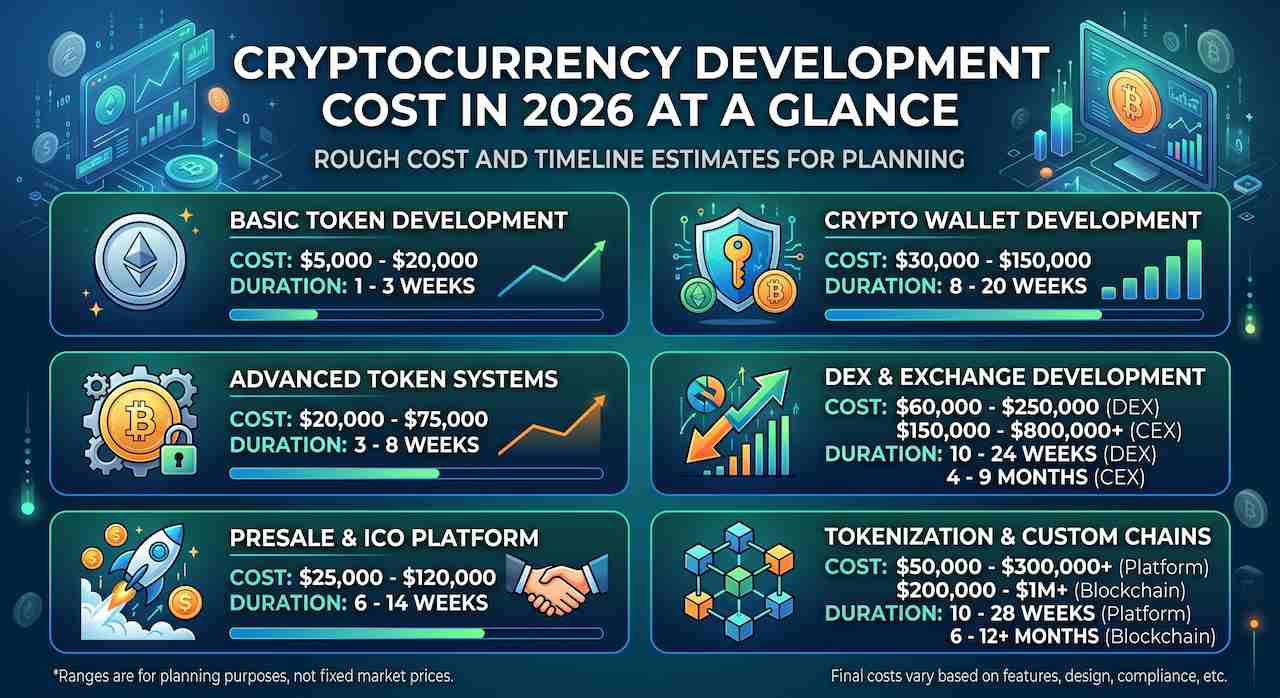
Before going deeper, it helps to set rough cost and timeline ranges. These are planning ranges, not fixed market prices. Final cost changes based on feature depth, chain selection, security review, product design, compliance scope, and post-launch needs.
Basic Token Development
A standard token project usually falls between $5,000 and $20,000. This often covers token contract creation, deployment, testing, and basic ownership controls.
Estimated duration: 1 to 3 weeks
This works for teams that only need a token contract and a simple release process. It does not usually cover advanced token logic, dashboards, audits, or product layers around the token.
Advanced Token Systems
A more detailed token build usually ranges from $20,000 to $75,000. This type of project may include vesting, staking hooks, governance rights, treasury controls, airdrop logic, claim systems, or tax logic.
Estimated duration: 3 to 8 weeks
This is where many business-led token projects sit. The token is still central, but it now supports a broader commercial or community function.
Presale and ICO Platform Development
A token sale platform often costs $25,000 to $120,000. The range changes based on investor dashboards, allocation rules, KYC flow, admin controls, vesting display, claim logic, and backend work.
Estimated duration: 6 to 14 weeks
The higher end usually applies when the sale needs stronger investor management, custom workflows, or stricter access control.
Crypto Wallet Development
Crypto wallet development often falls between $30,000 and $150,000. The cost depends on custodial or non-custodial design, supported assets, security layers, mobile support, transaction history, and recovery flow.
Estimated duration: 8 to 20 weeks
Wallets often look simple from the outside, yet the actual work includes product design, backend services, wallet connection logic, and security testing.
DEX and Exchange Development
A decentralized exchange usually starts around $60,000 and can move past $250,000. A centralized exchange often starts around $150,000 and can move beyond $800,000.
Estimated duration:
- DEX: 10 to 24 weeks
- CEX: 4 to 9 months
These projects sit in a very different class. They need trading logic, liquidity tools, admin controls, monitoring, user flows, and much deeper operational planning.
Tokenization Platforms and Custom Blockchain Builds
A tokenization platform usually ranges from $50,000 to $300,000 or more. A custom blockchain or appchain can start around $200,000 and move past $1 million.
Estimated duration:
- Tokenization platform: 10 to 28 weeks
- Custom blockchain: 6 to 12 months or more
These are longer builds with more architecture work, governance rules, integration demands, and infrastructure planning.
Planning your cryptocurrency project in 2026?
Get a clear view of budget, timeline, and the right build scope for your business.

What Drives Cryptocurrency Development Costs
The price of a crypto project is rarely decided by one factor. Cost usually rises from the interaction between business goals, technical depth, risk level, and launch expectations.
Project Type and Scope
A token launch costs far less than a wallet, exchange, or tokenization platform. The broader the product scope, the more design, testing, infrastructure, and support it needs.
This is why project definition matters early. A team that says “we need a token” may later add staking, dashboards, sale modules, analytics, treasury controls, and mobile support. That changes the budget fast.
Blockchain Network Selection
Chain choice affects both development and maintenance cost. EVM-based chains often support faster builds for many common products. Solana has a different development stack and may require a team with different technical skill. A custom chain raises cost sharply.
Chain choice also affects wallet compatibility, tooling, user access, deployment process, and future expansion.
Smart Contract Complexity
A standard token is much cheaper than a system with vesting, staking, governance, referral logic, yield mechanics, or cross-contract interaction. Each contract function adds more code paths to test and more room for failure.
This is one of the biggest cost drivers in crypto token development services. A project may still look like “one token” from the outside, yet the contract layer underneath may be doing much more.
Security Requirements
Security work includes internal testing, third-party review, remediation, staging, and final deployment checks. This part of the budget is often underplanned by first-time founders.
Projects that move funds, lock value, or manage treasury controls need stronger security discipline. That work adds cost, but removing it creates much larger risk.
Product Design and User Experience
Crypto products now need better usability. A business product with weak onboarding, confusing wallet actions, or unclear admin flows will struggle after launch.
Design work adds cost, yet it also affects conversion, retention, and support load. For many teams, this is no longer optional polish. It is part of the product itself.
Compliance and Integrations
Some projects need KYC, geographic restrictions, investor records, reporting systems, or third-party service connections. Others need wallet APIs, price feeds, analytics tools, payment gateways, notifications, or custodial integrations.
These items often sit outside the first budget estimate, even though they have a direct impact on final cost.
Cost Breakdown by Development Stage
Looking at the project in stages gives a clearer budget view. It shows where money is actually spent and helps businesses avoid treating crypto development as a single line item.
Discovery and Architecture
Estimated cost: $3,000 to $20,000
Estimated duration: 1 to 3 weeks
This stage covers business goals, feature definition, chain selection, token logic planning, architecture mapping, and delivery scope. Teams that skip this stage often pay more later through change requests and rebuilds.
UI and UX Design
Estimated cost: $3,000 to $25,000
Estimated duration: 1 to 4 weeks
This part covers user journeys, dashboards, investor screens, admin workflows, and design systems. A lighter internal tool sits at the lower end. A polished public-facing product moves higher.
Smart Contract Development
Estimated cost: $5,000 to $100,000 or more
Estimated duration: 2 to 12 weeks
This is the technical core for token contracts, staking modules, sale logic, treasury rules, vesting structures, rewards systems, and governance functions. Price changes based on how much logic the contracts carry.
Backend and Frontend Development
Estimated cost: $16,000 to $140,000 or more
Estimated duration: 3 to 12 weeks
This stage covers APIs, dashboards, admin panels, wallet-connected interfaces, user roles, analytics views, and transaction handling. The frontend is what the user sees. The backend is what keeps the product running in a stable way.
QA, Security Review, and Launch Preparation
Estimated cost: $7,000 to $60,000 or more
Estimated duration: 2 to 8 weeks
This covers testing, bug fixing, deployment checks, audit preparation, remediation, mainnet rollout, and monitoring setup. Teams often try to compress this stage. That usually creates more problems than savings.
Hidden Costs Businesses Often Miss
Many first budgets focus on visible development work. The trouble starts with the items that sit outside the first quote but still shape launch quality and operating cost.
Audit and Security Fix Costs
A smart contract audit is not just a review fee. It often leads to code changes, retesting, and another round of checks. A project may budget for development, then realize the audit and remediation cycle adds a new layer of cost and time.
For smaller contracts, this may stay manageable. For DeFi systems, treasury modules, or multi-contract platforms, the security phase can become one of the most serious budget items.
Legal and Compliance Costs
A business may need legal structuring, token classification review, sale restrictions, disclosure drafting, KYC flow planning, or investor eligibility checks. These items are often handled outside the engineering quote, yet they directly affect the product.
A token sale, for example, may need buyer controls and region limits. A tokenization platform may need transfer restrictions and recordkeeping. These are not side issues. They shape how the product is built and launched.
Listing, Liquidity, and Market Readiness
Projects that plan public trading often miss the cost of market readiness. This may include:
- exchange application preparation
- market making support
- liquidity allocation
- token distribution planning
- community and launch communications
A token can be deployed cheaply. A token that is ready for public trading usually needs a much wider budget.
Infrastructure and Vendor Costs
Many projects rely on third-party tools. These may include node providers, analytics platforms, KYC vendors, notification systems, cloud hosting, monitoring tools, wallet APIs, or price feed services.
Each tool may look affordable on its own. Together, they form a recurring operating cost that must be included in the real project budget.
Maintenance and Post-Launch Support
A crypto product does not stop costing money after launch. Teams often need bug fixes, updates, performance checks, support coverage, contract monitoring, and feature improvements.
This is one of the biggest differences between a demo build and a live business product. A live product needs ongoing care.
In-House Team vs Freelancers vs Cryptocurrency Development Company
The cost of a crypto project is shaped not just by scope, but by who builds it. The team model changes speed, control, quality, and long-term risk.
In-House Team
An in-house team gives the business more direct control. It suits companies that want long-term product ownership and regular feature development. Yet this model is also the most expensive to build and maintain.
Hiring blockchain developers, backend engineers, frontend developers, designers, QA staff, and DevOps talent takes time. Salaries, hiring delays, and internal management load raise the true cost far beyond a single project quote.
Freelancers
Freelancers often look attractive at the start. The entry cost is lower, and the hiring process is faster. This can work for small tasks such as token deployment, UI changes, or limited smart contract work.
The problem appears when the project grows. Coordination becomes harder. Documentation may be thin. Support may disappear after delivery. Security and testing quality can vary widely. A business can save money upfront and still lose more later through rework.
Cryptocurrency Development Company
A specialist cryptocurrency development company usually sits between the two models. It gives the business a delivery team, structured workflow, broader skill coverage, and clearer accountability.
This model often works best for businesses that want predictable execution, launch support, and access to blockchain-specific experience without building a full internal department from scratch.
Which Model Fits Best
The right model depends on project size and business intent.
- In-house team fits long-term product companies with steady build demand
- Freelancers fit small, limited, low-risk tasks
- Cryptocurrency development company fits businesses that want speed, structure, and launch-ready delivery
For most business-led crypto builds in 2026, the real decision is not “Who is cheapest?” It is “Who can build this without creating expensive risk later?”
Which Blockchain Is Most Cost-Effective in 2026?
Blockchain choice has a direct effect on development cost, deployment speed, maintenance effort, and future growth options. The cheapest chain is not always the best business choice.
Ethereum
Ethereum remains one of the strongest ecosystems for tokens, DeFi, and digital asset products. It offers mature tooling, broad wallet support, and deep market trust.
The trade-off is cost. Gas fees can be higher, and production use cases may need stronger planning around transaction costs. Ethereum often suits projects that value ecosystem depth and market visibility.
BNB Chain, Polygon, Base, and Other EVM Chains
These chains often support faster development for standard token and app builds. They use familiar EVM tooling, which makes them attractive for businesses that want quicker deployment and easier developer access.
They are often cost-effective for token launches, staking systems, sale platforms, and wallet-connected apps.
Solana
Solana suits projects that want high throughput and low transaction cost. It can be a strong fit for payment-heavy products, gaming systems, or high-volume user activity.
The development stack is different from EVM chains, so the business may need more specialized engineering talent. That can shift the budget upward even if network usage costs are lower.
Custom Blockchain or Appchain
A custom blockchain gives the business maximum control over rules, fees, and network structure. It also creates the highest development burden.
This model usually makes sense only when the project needs chain-level control, unique economic rules, or a dedicated ecosystem. For most standard business cases, it is more expensive than necessary.
How to Choose the Right Chain
The right chain depends on product goals, user type, cost tolerance, compliance needs, and feature plans. A payment product, a community token, a tokenized asset platform, and a trading system may all land on different chain choices.
The best decision comes from business fit first, then technical fit. Projects that pick a chain only from trend value often end up rebuilding sooner than expected.
Industry Use Cases and What Businesses Usually Budget For
The cost of cryptocurrency development changes with the business model. A payment product, a loyalty system, and an asset issuance platform do not carry the same build pattern. The user journey is different. The contract logic is different. The compliance burden is different.
Payments and Fintech Products
Businesses using crypto for payments often need wallet flows, transaction tracking, settlement logic, admin controls, and reporting. Some need stablecoin support. Some need merchant dashboards or payout systems.
These projects often start in the $30,000 to $150,000 range for a focused product and move higher with stronger integrations, mobile support, and deeper backend logic.
Loyalty and Rewards Systems
A blockchain-based rewards system can be lighter than a trading product, but it still needs careful planning. The business may need token issuance, redemption logic, customer dashboards, partner rules, and expiry or reward controls.
These builds often fall between $20,000 and $80,000, based on whether the system stays simple or connects with existing business software.
Asset Tokenization Platforms
Tokenized real estate, commodities, funds, and private assets need a more structured build. The platform may need onboarding flows, role-based access, issuance controls, transfer restrictions, reporting, investor views, and document handling.
These projects often start around $50,000 and can move past $300,000. The wider range comes from compliance depth and platform complexity.
Gaming and Digital Asset Ecosystems
Gaming products often need token rewards, in-app asset logic, marketplace links, wallet support, and a smooth user experience. The challenge is not just contract deployment. The challenge is making the blockchain layer work without creating friction.
Budgets can range from $25,000 to $200,000 or more, based on whether the token is a small in-game layer or part of a broader digital economy.
Trading and Exchange Products
Trading products sit at the high end of the range. A DEX, broker panel, swap app, or exchange system needs liquidity logic, order or routing functions, admin tooling, security review, analytics, and monitoring.
This class of project often starts at $60,000 and can move far beyond that, especially once custody, operations, and compliance enter the picture.
Need help figuring out your crypto development budget?
Budgeting Framework for Businesses Planning a Crypto Project in 2026
A better crypto budget starts with structure. Companies that budget in phases make better decisions than teams that ask for one large quote and treat it as final.
Start With the Business Goal
The product goal should come first. Is the project meant for fundraising, payments, customer rewards, digital ownership, asset issuance, or user access? The answer changes the architecture.
A business that wants better customer retention does not need the same product stack as a business launching a trading platform. Clarity at this stage prevents wasted features later.
Separate Build Cost From Launch Cost
Many teams mix these two numbers together. That creates confusion. The build cost covers design, development, testing, and deployment. The launch cost may include audits, legal review, listing preparation, liquidity, and marketing support.
Keeping these budgets separate makes planning cleaner and helps leadership see where money is actually going.
Break the Project Into Phases
A phased budget lowers risk. A common pattern looks like this:
- Phase 1: product discovery and architecture
- Phase 2: MVP development
- Phase 3: audit, launch prep, and production release
- Phase 4: post-launch support and feature expansion
This structure gives the business more control over spending and helps the team release value earlier.
Hold a Contingency Reserve
Most live products change during development. User flow adjustments, audit fixes, new integrations, or compliance updates can shift the scope. A reserve of 10% to 20% gives the project room to absorb those changes without panic.
The reserve is not wasted money. It is part of realistic planning.
Decide What Must Be in the First Release
A strong first release is focused. It does not try to carry every possible feature. Teams that load too much into version one often stretch timelines and weaken the product.
The better path is simple: release what the market needs first, then expand after the product proves itself.
Conclusion
In 2026, the real cost of cryptocurrency development goes far beyond token deployment and depends on the full build scope, including chain selection, smart contract logic, product design, infrastructure, compliance planning, security review, and post-launch support. That is why crypto project development cost can range from a modest budget for a basic token to a far larger investment for a live platform with deeper operational needs. Businesses that plan well define the commercial goal early, align the technical build with that goal, and budget properly for launch readiness and future growth. A rushed budget often leads to delays, weaker execution, and added costs later, but a structured plan creates a stronger path to launch. For companies looking to build with clarity and long-term business value in mind, Blockchain App Factory provides cryptocurrency development services tailored to different project scopes, from token creation to full-scale crypto platforms.

Vimal J is the Head of Sales at Blockchain App Factory, with 10+ years of experience in sales, client strategy, and Web3 business growth. He helps startups, enterprises, and project founders choose the right blockchain solutions for their goals, bringing a practical market perspective to topics like token development, crypto launches, and Web3 adoption.