Governance tokens are no longer just voting assets. In 2026, they sit at the center of how DAOs approve treasury spending, manage upgrades, reward contributors, fund ecosystem grants, and keep communities involved after launch.
That is why businesses now treat DAO governance design as a serious product decision. DAO treasuries have been reported at more than $25 billion, and governance tokens are estimated to hold nearly $30 billion in combined market value. Those numbers show one thing clearly: governance is no longer a side feature.
For Web3 startups, DeFi protocols, gaming ecosystems, RWA platforms, creator communities, and enterprise blockchain networks, a governance token can move decision-making away from one founding team and into a structured participation model. Users gain a voice. Contributors gain a role. The project gains a more accountable way to make decisions.
But poor design can create real problems. Whale control, weak voter turnout, unclear token rights, treasury misuse, and regulatory risk can damage trust fast. In this blog, we’ll look at how to create a governance token for a DAO in 2026, from token standards and voting models to smart contracts, compliance checks, and business use cases.
What Is a DAO Governance Token?
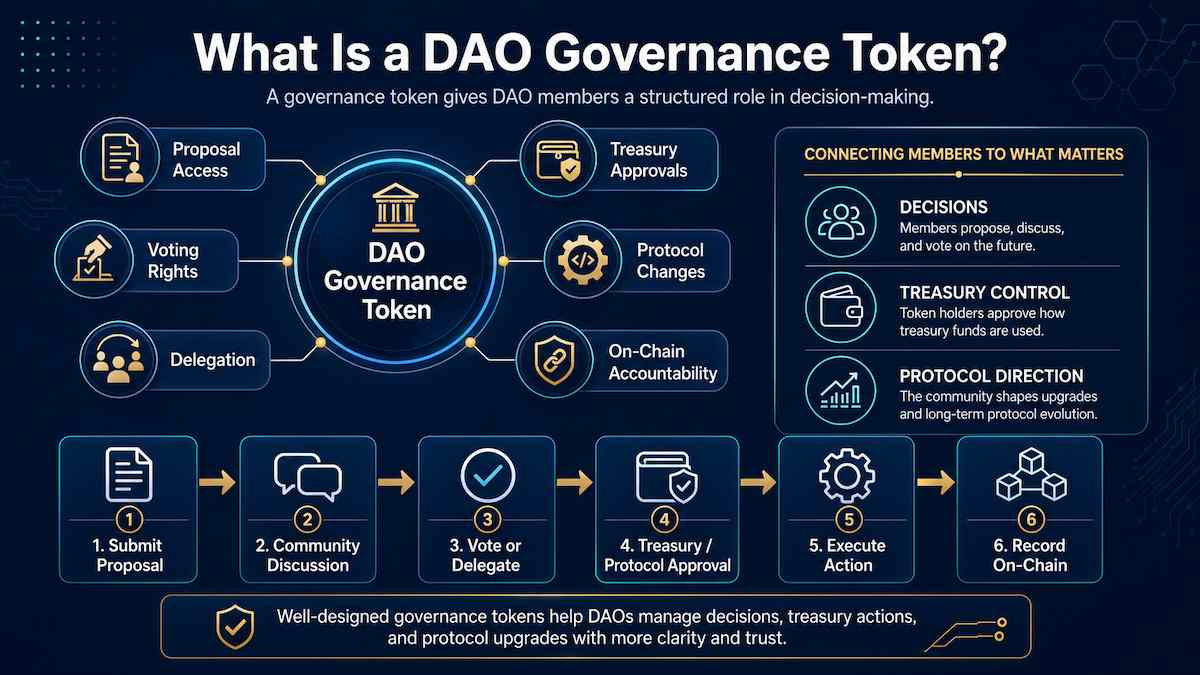
A DAO governance token gives members a formal role in how a decentralized autonomous organization makes decisions. It connects token ownership with voting power, proposal rights, delegation, treasury control, and protocol direction.
For a DAO, the token is not just a digital asset. It is part of the decision system. It decides who can vote, what they can vote on, how proposals move, and how approved actions are carried out.
This matters more in 2026 because DAOs now manage larger treasuries, broader communities, and more complex products. A DeFi protocol may use governance tokens to vote on fees and liquidity incentives. A gaming DAO may use them for reward pools and NFT utility. An RWA platform may use governance to review issuer rules, validator roles, and treasury allocations.
A well-designed DAO governance token usually supports:
- Proposal access: Members can submit ideas for budgets, upgrades, partnerships, or ecosystem programs.
- Voting rights: Token holders approve or reject proposals based on set rules.
- Delegation: Passive holders can assign voting power to trusted delegates.
- Treasury approvals: The DAO can vote on grants, payments, liquidity programs, and development budgets.
- Protocol changes: Governance can approve upgrades, fee changes, and parameter updates.
- Accountability: Votes, proposals, and treasury actions can be tracked publicly.
The strength of a DAO governance token depends on how clearly these rights are designed. Vague voting power creates confusion. Clear rules, fair distribution, quorum checks, and treasury safeguards help the DAO build trust over time.
Governance Token vs Utility Token vs Security Token
Governance tokens, utility tokens, and security tokens often get grouped together, but they serve different roles.
| Token Type | Main Purpose | Common Use |
|---|---|---|
| Governance Token | Voting and decision rights | DAO proposals, treasury votes, protocol upgrades |
| Utility Token | Access and usage | Payments, app access, platform fees, rewards |
| Security Token | Regulated financial rights | Equity, debt, profit share, asset-backed rights |
A governance token gives holders a say in DAO decisions. It is tied to control, participation, and protocol direction.
A utility token gives access to a product or network. Users may spend it for services, credits, memberships, platform fees, or in-app functions.
A security token represents regulated financial rights. This can include equity, debt, dividends, revenue share, or claims linked to assets.
The line is not always clean. A governance token can create legal risk if the project markets it as an investment, links it to profit expectations, gives holders financial claims, or keeps too much issuer control. That is why token design should involve legal, compliance, finance, product, and technical teams before launch.
Why Governance Tokens Matter for DAOs in 2026
DAO governance has moved beyond simple community polls. Earlier DAOs often used voting to choose between basic options. In 2026, governance tokens support treasury control, contributor coordination, protocol upgrades, ecosystem funding, and long-term accountability.
The stakes are higher now. A DeFi DAO may control liquidity incentives worth millions. A gaming DAO may decide reward rules that affect player behavior. An enterprise DAO may coordinate multiple companies under shared infrastructure.
Strong governance tokens now support three layers:
- Community voice: Members can vote, discuss, delegate, and challenge proposals.
- Execution control: Smart contracts, timelocks, and multisigs help approved actions move safely.
- Public accountability: Proposals, votes, and treasury movements can be tracked on-chain.
This is why governance token development is no longer only about deploying a smart contract. It needs tokenomics, voting design, treasury rules, legal review, user education, and post-launch monitoring.
Why Businesses Are Creating Governance Tokens for DAOs
Web3 users no longer care only about launch hype. They want to know who controls the project, how funds are used, and whether the community has any real say after launch.
A governance token gives users, builders, investors, partners, and contributors a defined role in decision-making. It helps a project move from founder-only control to a more accountable model.
Community-Led Decision-Making
Governance tokens let the right people vote on the right decisions. A DeFi protocol can involve liquidity providers. A gaming DAO can involve players. An RWA platform can involve issuers, verifiers, and approved participants.
The value is not voting for everything. The value is a clear process where ideas are proposed, reviewed, voted on, and executed with proper records.
Treasury Control and Funding Allocation
DAO treasuries often fund grants, audits, liquidity programs, partnerships, and contributor rewards. A governance token helps decide how those funds are used.
With spending limits, multisig wallets, timelocks, and public treasury reports, businesses can show that funds are not controlled by one hidden team.
Better User Retention and Ecosystem Participation
Rewards can bring users in, but governance can keep them involved. Token holders can vote, delegate, suggest proposals, and follow how decisions affect the project.
This turns users from short-term participants into people with a reason to stay active.
Commercial Value for Web3 Startups and Enterprises
For startups, governance tokens can support community growth, contributor activity, and market trust. For enterprises, they can support partner voting, private governance, and controlled participation.
A governance token makes sense when a business has real decisions to share, funds to protect, and a community that deserves a voice.
Key Components of a DAO Governance Token
A DAO governance token needs more than a supply number and smart contract address. It needs rules that decide who can vote, what they can vote on, how proposals move, and how treasury actions are protected.
Token Standard Selection
The token standard decides how the governance token works on-chain. It affects wallet support, voting tools, smart contract compatibility, exchange access, and user experience.
Common options include:
- ERC-20: Used across Ethereum and EVM chains, with strong wallet, DeFi, and governance tool support.
- BEP-20: Suitable for BNB Chain projects that want lower fees and broad user access.
- SPL: Used for Solana-based DAOs that need fast transactions and Solana-native wallets.
- Custom extensions: Useful for delegation, locked voting, non-transferable rights, reputation scoring, or permissioned access.
The choice should not be based only on fees. A business should ask where members will hold tokens, vote, review proposals, and interact with the DAO.
Voting Power Logic
Voting power decides how influence is measured. Poor design can hand control to whales.
Common voting models include:
- One-token-one-vote: Simple, but large holders gain more control.
- Quadratic voting: Reduces whale dominance by making extra voting power cost more.
- Reputation-weighted voting: Gives more weight to contribution, activity, or expertise.
- Delegated voting: Lets passive holders assign votes to trusted delegates.
- NFT-based voting: Works well for creator DAOs, gaming DAOs, and gated communities.
- veToken-style voting: Rewards users who lock tokens for longer periods.
The goal is simple: voting should be useful, fair, and hard to manipulate.
Proposal Rights
Proposal rights decide who can bring decisions to the DAO. Open proposal systems encourage community input, but they can also create spam and voter fatigue.
A good proposal system usually includes:
- Discussion in a forum or governance channel
- Informal community signal vote
- Formal proposal submission
- Fixed voting period
- Quorum check
- Timelock, multisig, or contract-based execution
The best systems make it easy to participate without making governance careless.
Treasury Permissions
Treasury permissions decide how governance connects to real funds. A DAO treasury may fund grants, audits, liquidity programs, contributor rewards, partnerships, or emergency reserves.
To protect those funds, many DAOs use multisig wallets, timelocks, treasury contracts, execution contracts, and role-based admin controls.
This gives every major spending decision a public record. It also shows users and partners that treasury control is not hidden inside one private wallet.
Token Transferability
Transferability decides whether the governance token can move freely between wallets.
A transferable governance token can be bought, sold, and traded. It works well for public DAOs, DeFi protocols, gaming ecosystems, and open Web3 communities.
A non-transferable governance token stays tied to a verified member, contributor, employee, partner, or institution. It works better for private DAOs, enterprise DAOs, membership DAOs, and compliance-sensitive networks.
A strong DAO treats transferability as a governance decision, not just a market feature.
Ready to Create a DAO Governance Token?
Build your governance token with smart contract development, DAO setup, treasury controls, and launch-ready support.

Step-by-Step Process to Create a Governance Token for a DAO
Creating a governance token for a DAO needs planning before a smart contract goes live. The token must support voting, protect the treasury, fit the legal structure, and match the real decisions the DAO will make.
Step 1: Define the DAO’s Governance Purpose
Start by deciding what the DAO will govern. A DeFi DAO may govern fees and liquidity incentives. An RWA DAO may govern issuer rules and asset standards. A gaming DAO may govern reward pools and community events.
Keep the first version focused. A new DAO does not need to govern everything on day one.
Step 2: Choose the Blockchain Network
The blockchain affects cost, security, wallet access, governance tools, and user experience.
- Ethereum: Best for high-value governance and mature tooling.
- BNB Chain: Useful for lower fees and broad retail access.
- Polygon: Good for EVM compatibility and lower-cost Web3 apps.
- Arbitrum: Strong for DeFi and Ethereum-linked governance.
- Base: Suitable for consumer-facing Web3 communities.
- Solana: Strong for fast gaming, social, and app-based DAOs.
- Avalanche: Useful for enterprise, RWA, and custom network models.
The right chain should match how members will vote, hold tokens, and use the product.
Step 3: Design DAO Tokenomics
DAO tokenomics decides supply, allocation, vesting, treasury reserves, team share, rewards, liquidity, and contributor grants.
The design should answer:
- Who receives tokens?
- How much goes to the treasury?
- What is locked or vested?
- How are contributors rewarded?
- How is voting power protected from concentration?
- How does the token support long-term governance?
Tokenomics should be designed around responsibilities, not hype.
Step 4: Define Governance Rights
Governance rights explain what token holders can vote on.
Common voting areas include:
- Treasury spending
- Protocol upgrades
- Fee changes
- Grant approvals
- Validator onboarding
- Partnership approvals
- Tokenomics changes
- Emergency actions
Routine decisions and sensitive decisions should not follow the same process. A small grant can move faster. A major treasury withdrawal should need formal voting, multisig review, and timelock execution.
Step 5: Build the Governance Token Smart Contract
The governance token smart contract turns the design into code. It controls supply, balances, voting power, delegation, permissions, and transfer behavior.
Core decisions include:
- Minting rules
- Capped supply
- Burn logic
- Pause functions
- Role-based permissions
- Delegation
- Snapshot compatibility
- Upgradeability
Security should guide every smart contract choice. A token that controls treasury voting carries more risk than a simple utility token.
Step 6: Set Up DAO Governance Infrastructure
The token alone does not create a working DAO. Members need a place to discuss, vote, delegate, review proposals, and track outcomes.
Common tools include:
- Snapshot
- Tally
- Governor contracts
- Safe multisig
- Timelocks
- Voting dashboards
- Forums
- Discord or Telegram channels
- Proposal templates
A poor voting interface lowers participation. Clear proposal formats and simple dashboards make governance easier to follow.
Step 7: Audit the Smart Contracts
The governance token, treasury contracts, voting contracts, and timelock modules should be audited before launch.
Audit checks should cover:
- Minting and supply logic
- Voting power calculation
- Proposal thresholds
- Quorum rules
- Timelock execution
- Treasury permissions
- Admin roles
- Upgrade risks
- Emergency pause behavior
A governance token audit gives users, partners, and investors more confidence before launch.
Step 8: Launch the Token and Governance Portal
The launch phase should make governance easy to understand. Users need a clean wallet connection, claim flow, voting interface, proposal guide, treasury overview, and governance documentation.
The first proposals matter. They teach members how governance works. Early proposals should be clear, low-risk, and useful.
Step 9: Monitor Governance Health
Governance does not end at launch. The DAO should track whether the token creates real participation or only symbolic voting.
Track:
- Voter turnout
- Proposal quality
- Delegation activity
- Treasury usage
- Whale concentration
- Quorum failures
- Governance attacks
A good DAO publishes regular governance reports so members can see what passed, what failed, how funds moved, and what comes next.
DAO Governance Token Architecture
A DAO governance token sits inside a larger system. The token gives voting power, but the architecture decides how that power turns into action.
A strong architecture includes:
- Token contract: Manages supply, balances, transfers, delegation, and voting power.
- Governance contract: Handles proposals, voting periods, quorum checks, vote counting, and execution.
- Treasury layer: Connects approved decisions with fund movement through multisigs, timelocks, and spending rules.
- Governance dashboard: Lets members view proposals, vote, delegate, track quorum, and review treasury activity.
- Security and compliance layer: Adds audits, admin controls, emergency functions, KYC rules, legal terms, and disclosures where needed.
This section should stay short. The detailed explanation already appears in the components and process sections.
Governance Models to Consider in 2026
The governance model decides how power moves inside a DAO. The right choice depends on product type, treasury size, user base, compliance needs, and decision speed.
Token-Based Governance
Token-based governance gives voting power based on token ownership. It works well for open DeFi protocols, public Web3 communities, and large ecosystems.
Best used for:
- Fee changes
- Liquidity incentives
- Treasury grants
- Product upgrades
- Ecosystem funding
The risk is whale control. Strong safeguards include vesting, quorum rules, proposal thresholds, delegation, treasury limits, and timelocks.
Delegated Governance
Delegated governance lets token holders assign voting power to trusted representatives. It works well when many holders are passive but a smaller group reviews proposals actively.
Best used for:
- Technical proposals
- DeFi upgrades
- Infrastructure decisions
- Treasury reviews
- Frequent voting cycles
A good delegate system needs public profiles, voting history, conflict disclosures, community calls, and redelegation options.
Reputation-Based Governance
Reputation-based governance gives voting weight based on contribution, expertise, role, or verified activity.
Reputation can come from:
- Completed tasks
- Code contributions
- Grant reviews
- Technical expertise
- Governance activity
- Community trust
This model works best when work history matters more than wallet size.
Hybrid Governance
Hybrid governance combines token voting with delegates, multisig review, expert councils, legal checks, or permissioned voting.
It fits enterprise DAOs, RWA DAOs, regulated ecosystems, and foundation-led networks.
A hybrid model may include:
- Token voting for public proposals
- Delegate voting for technical matters
- Multisig review for treasury movement
- Council review for high-risk decisions
- KYC-gated voting for regulated users
- Emergency roles for exploit response
The key is clarity. The DAO must state which powers belong to the community and which require expert or legal review.
Multisig-to-DAO Transition Model
Many projects begin with a founding team or multisig, then shift control to token holders as the product matures.
A clean transition path may include:
- Team-led early development
- Treasury held in multisig
- Snapshot voting
- Delegate introduction
- On-chain governance
- Timelocks for major actions
- Treasury permissions moved to DAO approval
- Admin roles reduced or transferred
This model suits early-stage projects that need speed first and decentralization later. The risk is delay. A serious project should publish transfer milestones.
Common Governance Token Use Cases Across Industries
Governance tokens are no longer limited to DeFi. They help DAOs manage asset platforms, games, creator communities, partner networks, and enterprise blockchain systems.
DeFi Protocol Governance
DeFi protocols use governance tokens to manage financial decisions such as:
- Fee changes
- Liquidity incentives
- Pool approvals
- Risk parameters
- Protocol upgrades
- Treasury grants
- Security budgets
A small DeFi parameter change can affect liquidity, user risk, and protocol revenue, so voter education matters.
RWA and Asset Tokenization Governance
RWA platforms need more controlled governance because they deal with issuers, real assets, legal documents, compliance rules, and verification standards.
Governance may cover:
- Issuer approval rules
- Asset listing standards
- Validator onboarding
- Compliance policies
- Valuation and audit rules
- Treasury decisions
- Oracle provider review
This model works best with hybrid governance. Token holders can vote on broad rules, while legal teams or verifiers review asset-level details.
Gaming DAO Governance
Gaming DAOs use governance tokens to involve players, guilds, creators, and marketplace users.
Useful voting areas include:
- Reward pool allocation
- Tournament rules
- Game economy updates
- NFT utility changes
- Guild programs
- Creator grants
The studio should not send every game decision to public voting. Governance works better for rewards, events, community funds, and selected economy rules.
Creator and Fan DAOs
Creator and fan DAOs turn audiences into active communities. Members can help fund ideas, vote on access, support events, and guide community programs.
Common uses include:
- Content funding
- Event access
- Community voting
- Membership tiers
- Creator grants
- Collaboration approvals
This model works best when governance supports the creator, not replaces them.
Enterprise and Consortium DAOs
Enterprise and consortium DAOs use governance tokens for controlled coordination between companies, departments, suppliers, or network members.
Governance tokens can support:
- Partner governance
- Shared infrastructure rules
- Data access policies
- Operational voting
- Member permissions
- Vendor approvals
- Cost-sharing rules
For enterprise use, non-transferable governance tokens often make sense because voting stays tied to verified roles.
Need Expert Help to Launch Your DAO Token?
Compliance Considerations Before Launching a Governance Token
Compliance planning should begin before the token contract is written. Token rights, marketing language, transfer rules, treasury access, investor expectations, and jurisdiction can all affect risk.
A governance token is not automatically low-risk because it gives voting rights. Poor messaging, vague disclosures, public sale structures, or profit-focused claims can still create legal exposure.
Avoid Profit-First Token Messaging
A governance token should not be promoted mainly as an investment asset, yield tool, or guaranteed profit opportunity.
Safer messaging should focus on:
- Voting rights
- Proposal access
- Delegation
- Treasury oversight
- Governance limits
- Risk disclosures
- Ecosystem participation
Good messaging tells users what they can do, not what they may earn.
Review Securities and Crypto-Asset Rules
Every governance token needs classification review before launch. The result can change based on token rights, sale terms, issuer control, transferability, and promotional claims.
Legal review should cover:
- Token rights
- Sale method
- Marketing claims
- Treasury structure
- Governance control
- Team control
- Transfer rules
- Airdrop mechanics
- Exchange plans
This review should happen before public promotion.
Consider MiCA for EU-Facing Projects
EU-facing projects must review MiCA before issuing or marketing a governance token in Europe. MiCA covers disclosure, authorization, supervision, and crypto-asset trading rules for assets not already regulated under existing financial laws.
MiCA review should cover:
- Token scope
- White paper needs
- Required disclosures
- Marketing rules
- Service provider authorization
- Market abuse rules
- User protection duties
Clear disclosures should explain token rights, risks, governance limits, treasury controls, and transfer rules.
Add KYC or Permissioned Governance Where Needed
Not every DAO should be fully open. Private DAOs, investment DAOs, RWA DAOs, enterprise DAOs, and region-restricted communities may need permissioned governance.
This can include:
- Verified wallet access
- KYC or KYB checks
- Region restrictions
- Role-based voting
- Non-transferable tokens
- Member-only proposals
- Approved delegate lists
- Restricted treasury voting
Permissioned governance does not remove transparency. The DAO can still publish proposals, vote records, treasury reports, audit summaries, and governance rules.
Prepare Legal Documentation
Legal documentation gives the DAO a written foundation. It explains what the token does, what it does not do, how governance works, and what risks members accept.
Key documents include:
- Token terms
- Governance charter
- DAO constitution
- Risk disclosures
- Treasury policies
- Contributor agreements
- Voting rules
- Delegate rules
- Grant policies
- KYC or access policy
For commercial DAO projects, documentation is not just a legal task. It is a trust tool.
Conclusion
A DAO governance token gives businesses a practical way to involve users, partners, contributors, and approved members in real decision-making. The strongest projects do not treat governance as a launch feature alone. They design token rights, voting rules, treasury permissions, compliance controls, and user education as one connected system. For Web3 startups, DeFi protocols, RWA platforms, gaming ecosystems, creator communities, and enterprise networks, this can build stronger trust and long-term participation. Blockchain App Factory provides governance token development services for businesses that need token design, smart contract development, DAO infrastructure, treasury setup, compliance-aware planning, audits, launch support, and post-launch governance management under one structured development process.

Vimal J is the Head of Sales at Blockchain App Factory, with 10+ years of experience in sales, client strategy, and Web3 business growth. He helps startups, enterprises, and project founders choose the right blockchain solutions for their goals, bringing a practical market perspective to topics like token development, crypto launches, and Web3 adoption.