Key Insights
- Influencer campaigns generate fast visibility, user signups, and community growth. They work best for launches, hype cycles, and short-term acquisition goals.
- Media coverage, backlinks, and founder visibility strengthen brand credibility. This leads to higher user retention and stronger interest from investors and partners.
- Combining PR and influencer marketing connects trust with attention. This results in better conversion rates, stronger positioning, and more sustainable growth.
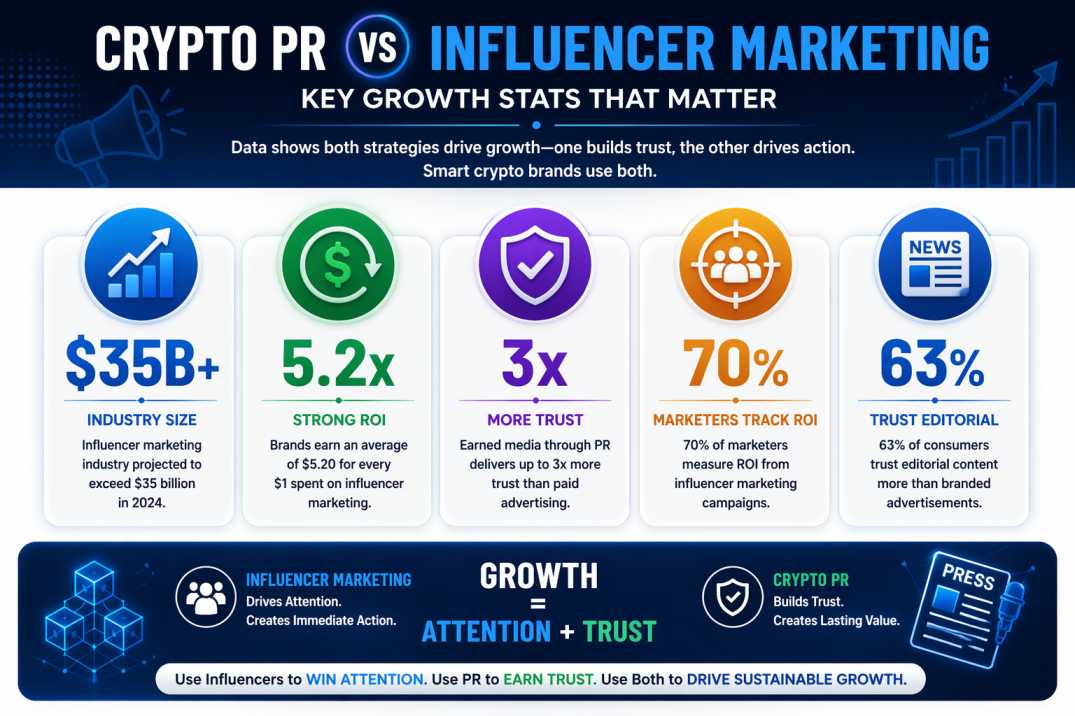
Crypto brands face a hard growth question: should they invest in public relations or pay influencers to drive attention fast? The stakes are high. The influencer marketing industry alone is projected to exceed $35 billion in 2024, and brands report earning an average of $5.20 for every $1 spent on influencer campaigns. At the same time, earned media through PR delivers up to three times more trust than paid promotion, which makes credibility a key factor in long-term growth.
The right answer starts with the business goal. A token launch needs reach, trust, and speed. A DeFi protocol needs users and liquidity. An exchange needs credibility with traders, partners, and regulators.
Crypto PR and influencer marketing serve different jobs. PR builds authority through media coverage, founder commentary, press releases, crisis response, and search visibility. Influencer marketing creates direct attention through creators on X, YouTube, Telegram, TikTok, Discord, and podcasts. One earns trust through editorial channels. The other borrows trust from a creator’s audience.
What Is Crypto PR?
Definition and Core Functions
Crypto PR is the practice of shaping how the market views a blockchain or Web3 business. It covers media outreach, press release writing, founder interviews, analyst briefings, event publicity, reputation management, and crisis communication. A crypto PR agency works with publications, podcasts, newsletters, and reporters to place stories that support a clear business goal.
Good PR does more than announce news. It explains why the company matters. A layer-2 network may use PR to explain lower transaction costs or new developer grants. A custody platform may use PR to stress security and compliance.
Key Benefits of Crypto PR for Businesses
PR builds credibility through media validation. Coverage in respected outlets gives investors and partners a reason to trust the company. It also drives search growth. Published articles and backlinks help brands rank for key terms and increase organic traffic.
PR also gives control over the narrative. Founders can explain complex ideas before critics shape public opinion. This matters in crypto, where sentiment can shift fast.
Common Crypto PR Services
Crypto PR agencies offer a range of services that support visibility and trust:
- Press release distribution across crypto media
- Media pitching and journalist outreach
- Founder interviews and podcast placements
- Thought leadership articles and opinion pieces
- Crisis communication and reputation repair
Many agencies now link PR work with SEO goals. This adds long-term value through search rankings and domain authority.
When Businesses Should Invest in Crypto PR
Timing plays a key role in PR success. Businesses gain the most value during key milestones:
- Token launches and exchange listings
- Funding announcements and partnerships
- Protocol upgrades or product releases
- Security audits and compliance updates
PR is also critical during negative events such as hacks or legal issues. Clear communication protects user confidence and limits damage.
What Is Crypto Influencer Marketing?
Definition and Ecosystem Overview
Crypto influencer marketing uses creators to promote a project to their audience. These creators share content through posts, videos, livestreams, and community channels. They can explain a product, review a token, or host discussions that drive user interest.
The ecosystem includes platforms like X, YouTube, Telegram, Discord, and TikTok. Each channel serves a different role, from quick updates to deep technical reviews.
Types of Crypto Influencers
Crypto influencers vary by size and focus:
- Nano influencers with small but loyal communities
- Micro influencers with strong engagement rates
- Macro influencers with large reach
- Niche experts focused on DeFi, NFTs, or trading
A smaller creator with an active audience often delivers better results than a large account with low engagement.
Key Benefits for Growth-Focused Companies
Influencer marketing delivers fast results. Campaigns can generate traffic, signups, and community growth within days. It works well for launches, NFT drops, and retail-focused products.
It also builds social proof. Users trust creators they follow, which increases the chance of conversion. Many crypto investors rely on influencer opinions before making decisions.
Performance Metrics in Influencer Campaigns
Strong campaigns rely on clear data. Teams track metrics that connect attention to revenue:
- Engagement rate and click-through rate
- Cost per acquisition and conversion rate
- Wallet connections and on-chain activity
- Referral traffic and community growth
Tracking tools such as UTM links and promo codes help measure results. On-chain data adds another layer of accuracy for crypto campaigns.
Learn how to choose the right growth strategy for crypto
Compare crypto PR and influencers to pick the best growth strategy for your project.

Which Channel Drives More Growth?
Influencer marketing drives short-term growth. It creates attention fast and pushes users into the funnel. PR builds long-term value through trust and search visibility.
The strongest strategy combines both. PR creates proof and authority. Influencers amplify that message and bring users into the ecosystem.
A DeFi project can announce an audit through PR, then work with creators to explain its impact. A wallet company can secure media coverage, then use influencers to show how the product works in real use.
Crypto growth depends on both trust and attention. PR builds belief in the brand. Influencers drive action. Businesses that align both channels gain stronger and more sustainable growth.
Crypto PR vs Influencer Marketing
Growth Impact Comparison
Crypto PR and influencer marketing drive growth in different ways. PR builds public trust through media coverage, founder interviews, analyst comments, and search visibility. Influencer marketing drives direct attention through creators on X, YouTube, Telegram, Discord, and TikTok.
A crypto PR campaign helps a business look credible before investors, users, exchanges, and partners. This matters for DeFi protocols, wallets, exchanges, and infrastructure firms. A media feature can support a funding round, listing, or product launch. It can also help buyers understand a complex product.
Influencer marketing works closer to the point of action. A trusted YouTuber can explain a staking product. A trader on X can send users to a launch page. A Telegram host can push users into a community. This makes influencer campaigns strong for user acquisition and hype.
ROI and Cost Efficiency
Influencer marketing often gives faster ROI data. Brands can track clicks, signups, deposits, wallet connections, and token purchases. The 2024 Influencer Marketing Benchmark Report found that 70 percent of marketers measure ROI from influencer campaigns, with views, reach, and impressions still used as common success metrics.
Crypto PR has a longer payback cycle. A strong article can rank in search for months or years. Backlinks can lift domain authority. Media coverage can support sales calls, investor decks, and exchange applications. The return is less direct, but it compounds.
Costs vary by goal. A micro-influencer campaign can start with a small budget. A major YouTube creator or X account can charge far more. PR retainers often cost more upfront, since they include strategy, pitching, writing, and media relations.
Speed vs Longevity
Influencer marketing wins on speed. A post can send traffic within minutes. A YouTube review can drive search and community joins for weeks. This works well for token launches, NFT drops, airdrops, and exchange promotions.
PR moves slower. Reporters need a strong story, proof, and timing. Editors care about news value. The process can take days or weeks. Yet PR often lasts longer. A media feature can keep ranking in Google. It can become proof for paid ads, investor outreach, and partner pitches.
Trust and Credibility
Trust works differently in each channel. Influencers create trust through familiarity. Audiences follow them for calls, analysis, education, and market views. That trust can turn into fast action.
PR creates trust through third-party validation. A business featured in a respected crypto outlet gains a different kind of authority. This matters for institutional buyers and risk teams.
Measurement & Attribution
Influencer campaigns are easier to measure at the campaign level. Teams use UTM links, promo codes, landing pages, referral dashboards, and on-chain data. These tools show which creator drove traffic, signups, and deposits.
PR uses a wider set of metrics. These include media mentions, backlinks, branded search volume, referral traffic, share of voice, and ranking gains. PR also supports sales activity. A founder can send media coverage to investors or partners before a meeting.
Which Strategy Drives More Growth?
Short-Term Growth
Influencer marketing dominates short-term growth. It delivers faster engagement, higher conversion potential, and viral reach. A project can run a creator campaign during a token sale and measure wallet connections the same day.
This makes the channel useful for retail products. Meme coins, NFT projects, trading tools, gaming tokens, and DeFi apps often depend on fast social motion. The creator acts as a bridge between product and user.
The best short-term campaigns focus on fit, not follower count. A DeFi educator with 40,000 active followers can outperform a celebrity with passive reach. Crypto buyers trust people who understand the product.
Long-Term Growth
Crypto PR leads long-term growth. It supports search rankings, investor trust, and institutional adoption. A media article can rank for branded terms. A strong backlink can improve search strength. A founder interview can explain the company’s market role.
This value matters in serious buying cycles. An exchange, custodian, analytics platform, or infrastructure provider must pass trust checks. Buyers ask direct questions: Who backs the team? Has the product been audited? Has the founder spoken in credible media? PR helps answer those questions.
Implementation Process for Both Strategies
Crypto PR and influencer marketing work best with a clear plan. Many crypto firms fail at both channels for the same reason. They chase attention before they define the message. A token, exchange, wallet, or DeFi product needs more than exposure. It needs trust, proof, timing, and a path from awareness to action.
A strong campaign starts with one business goal. The goal can be user signups, wallet connections, deposits, developer adoption, token sale interest, or investor meetings. Each goal needs a different mix of media, creators, landing pages, and tracking tools.
Crypto PR builds authority through earned coverage and search value. Influencer marketing builds attention through trusted voices. The strongest growth plan links both. PR gives the market proof. Influencers turn that proof into clicks, joins, trials, and deposits.
Crypto PR Campaign Workflow
A crypto PR campaign starts with positioning. The team defines what the project does, who it serves, and why the market should care. Many crypto brands skip this step and rely on vague claims. Clear messaging sets the foundation for every media interaction.
A strong PR message answers three questions:
- What problem does the project solve?
- What proof supports the claim?
- Why does the news matter now?
After positioning, the team maps media targets. Crypto media includes general outlets, technical publications, newsletters, and podcasts. Each serves a different audience. A funding round suits business media. A protocol upgrade fits technical outlets.
The team then prepares assets. These include press releases, pitch emails, founder bios, fact sheets, and visual materials. Well-prepared assets reduce confusion and improve coverage quality.
Search value must guide the campaign early. Digital PR can earn backlinks from trusted publications. These links improve search rankings and organic traffic. Over time, this builds authority that supports long-term growth.
Outreach follows asset creation. PR teams pitch stories to selected journalists and editors. Timing and relevance matter. A well-timed pitch tied to market trends often gains more traction.
After coverage, distribution becomes critical. The company should reuse media mentions across marketing channels. This includes social posts, newsletters, investor decks, and website content.
Measurement closes the process. Teams track media mentions, backlinks, referral traffic, and branded search growth. These metrics show how PR supports business goals beyond immediate conversions.
Influencer Marketing Campaign Workflow
Influencer campaigns begin with audience alignment. The team must match the product with creators who speak to the right users. A mismatch wastes budget and weakens results.
The next step is influencer vetting. Teams review follower quality, engagement rate, past collaborations, and content style. Fake engagement remains a common issue in crypto marketing, so careful review is essential.
Campaign goals shape the content plan. A project focused on user growth needs creators who drive signups. A product launch may require demos and walkthroughs. Community campaigns may rely on AMAs and live sessions.
The content brief sets clear rules. It defines key messages, approved claims, disclosure guidelines, and tracking links. Creators should keep their authentic voice, but they must stay within compliance boundaries.
Tracking tools must be ready before launch. These include UTM links, referral codes, and dedicated landing pages. Crypto projects can also track wallet activity and transaction data.
Campaign execution should follow a coordinated schedule. Multiple creators posting within a short window can amplify reach and create momentum.
After launch, teams analyze performance. They compare creators based on conversion quality, not just reach. High-quality traffic leads to better retention and revenue.
Explore the impact of PR vs influencers in Web3 marketing
Commercial Value for Businesses
Crypto PR and influencer marketing create value by reducing user hesitation. Crypto users often worry about security, trust, and legitimacy. Marketing must address these concerns before users act.
Influencer marketing builds familiarity. PR builds credibility. Together, they shorten the path from awareness to conversion.
Revenue Growth Opportunities
Faster customer acquisition via influencers
Influencers can reach active crypto users quickly. Their audiences trust their opinions and act faster than general audiences. This makes influencer campaigns effective for launches, token sales, and product rollouts.
A YouTube creator explaining a trading platform can drive account registrations within hours. A Telegram host can bring users into a community during a live session. These actions translate into measurable growth.
Higher LTV through trust built via PR
PR supports long-term value. Media coverage builds trust that encourages users to stay longer. Users who trust a brand are more likely to deposit funds, trade frequently, and recommend the platform.
Institutional buyers rely heavily on public credibility. They review media mentions, audits, and leadership visibility before making decisions. PR helps build this trust layer.
Competitive Advantage
Integrated marketing = stronger market positioning
A business that combines PR and influencer marketing creates a stronger presence. Media coverage shows credibility. Influencer content shows activity and user engagement. This combination builds a balanced brand image.
Competitors often rely on one channel. This creates gaps. A brand that connects both channels can control its narrative and reach.
Better capital efficiency with diversified channels
Diversified marketing reduces risk. If one channel underperforms, the other can support growth. This makes marketing spend more stable and predictable.
Reusing content across channels also improves efficiency. A press release can become social content. Influencer feedback can guide future PR messaging. This reduces content creation costs.
ROI Optimization Strategy
Continuous testing and budget reallocation
ROI improves through constant testing. Teams should run short campaigns, measure results, and adjust spend based on performance. This prevents wasted budget.
A 60 to 90 day testing cycle works well for most crypto projects. It provides enough data to compare channels and refine strategy.
Data-driven campaign scaling
Scaling should follow proven results. Teams should invest more in creators and PR strategies that deliver strong outcomes. Weak channels should be reduced or removed.
Accurate tracking supports better decisions. Metrics should connect marketing activity to real business results such as signups, deposits, and revenue.
Regular performance reviews help teams stay aligned with goals. Weekly analysis allows quick adjustments and steady improvement.
Conclusion

Vimal J is the Head of Sales at Blockchain App Factory, with 10+ years of experience in sales, client strategy, and Web3 business growth. He helps startups, enterprises, and project founders choose the right blockchain solutions for their goals, bringing a practical market perspective to topics like token development, crypto launches, and Web3 adoption.