Key Insights
- ICO marketing focuses on reach and community growth, while STO marketing focuses on compliance, investor trust, and regulated fundraising.
- The target audience shapes the entire campaign. ICOs attract retail crypto users and early adopters, while STOs target accredited investors, funds, and asset-focused buyers.
- A professional crypto marketing agency helps align strategy, messaging, and channels so businesses can attract qualified investors, reduce wasted spend, and build credibility.
ICO and STO marketing both promote token fundraising, but they speak to different buyers. ICO marketing sells access, speed, and early community growth. STO marketing sells trust, compliance, and investor protection.
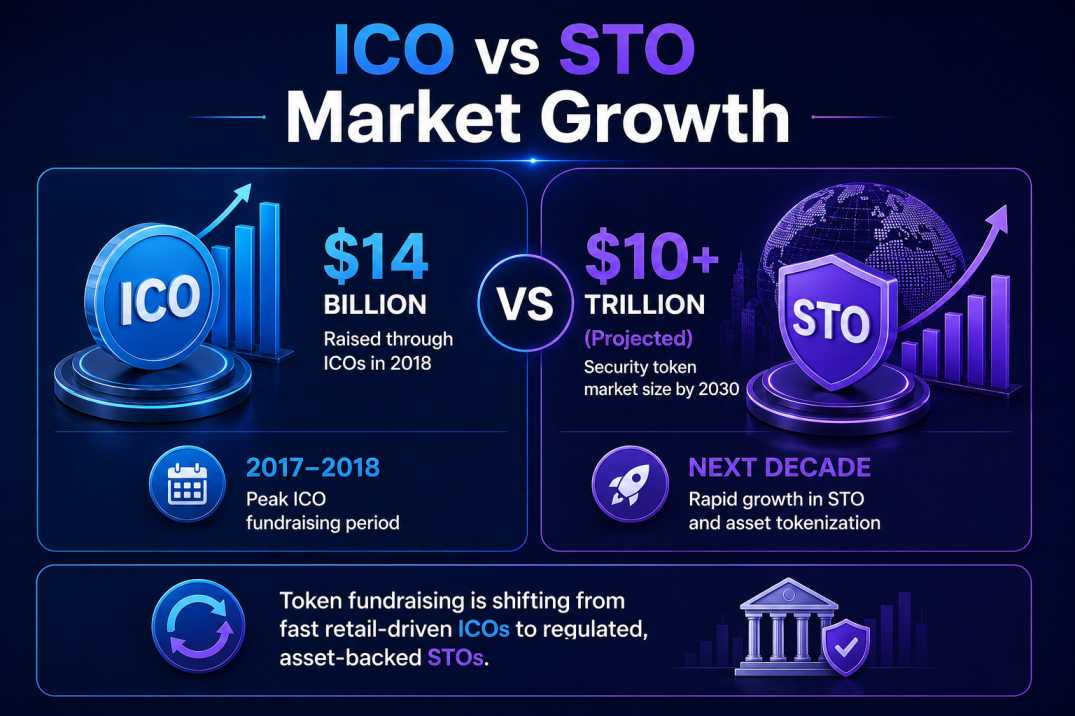
The scale of token fundraising highlights why this distinction matters. ICOs raised over $14 billion in 2018 alone, marking the peak of retail-driven crypto investment. At the same time, the global security token market has gained steady traction, with projections estimating it could reach over $10 trillion by 2030 as real-world assets move onto blockchain.
The difference matters for founders, Web3 firms, fintech brands, and asset tokenization companies. A poor match can waste ad spend and harm investor confidence. The SEC warned as early as 2017 that ICOs can offer lawful opportunities, but they can also expose investors to fraud and false return claims.
What is ICO Marketing?
ICO marketing promotes an Initial Coin Offering. A project sells digital tokens to raise capital. These tokens often give access to a network, product, app, or protocol. PwC defines an ICO as a limited sale of digital tokens to the public in exchange for crypto or fiat currency.
The core message in ICO marketing is future utility. Buyers want to know what the token does, why demand will grow, and how the project will build a strong user base.
Key ICO Marketing Strategies
ICO marketing usually depends on speed and reach. Campaigns often start months before the token sale. The goal is to build trust before asking people to buy.
Common ICO marketing tactics include:
- Whitepaper promotion
- Tokenomics explainers
- Crypto PR campaigns
- Telegram, Discord, Reddit, and X community growth
- Founder interviews and podcast placements
- Airdrops, referral campaigns, and bounty programs
- SEO pages targeting terms like “ICO marketing agency” and “token launch marketing”
The best ICO campaigns avoid empty hype. They explain the product, show the team, publish audits, and answer investor concerns. Ethereum, Filecoin, and Polkadot became well-known ICO-era examples that tied fundraising to clear technical goals. Investopedia lists Filecoin at $233 million and Polkadot at $145 million in token fundraising.
ICO Marketing Funnel
An ICO funnel starts with awareness. The project builds traffic through search, PR, social media, and crypto communities. The next stage is education. Readers study the whitepaper, token use, roadmap, and team.
Then comes conversion. Users join allowlists, complete KYC where required, and buy tokens. After the sale, marketing shifts to exchange listings, product adoption, and community updates.
This post-sale stage is often weak. Many ICOs raised money fast but failed to build working products. CoinMarketCap reported that the ICO market reached about $2.6 billion in 2017 and $14 billion in 2018, and it cited research that labeled 78 percent of 2017 ICOs as scams.
Advantages of ICO Marketing
ICO marketing can create fast global demand. A strong campaign reaches retail crypto buyers across many markets. It can work well for Web3 apps, DeFi platforms, NFT tools, gaming tokens, and open-source protocols.
The lower entry barrier attracts smaller investors. The community model can turn early buyers into promoters. A clear referral plan, active Telegram group, and public roadmap can create strong launch momentum.
For businesses, ICO marketing can reduce reliance on venture capital. It can fund product growth and build a user base at the same time.
Challenges and Risks
The main ICO challenge is trust. Many buyers now view ICOs with caution. Regulators have taken a strict view of token sales that look like securities offerings. Former SEC Chair Jay Clayton stated in December 2017 that no ICO had been registered with the SEC at that time.
Marketing teams must avoid promises of profit. They must not present weak products as investment opportunities. Clear legal review, risk language, token utility, and transparent founder communication are core parts of a safer ICO campaign.
Still confused about ICO vs STO marketing?
Understand key differences between ICO and STO marketing to choose the right strategy.

What is STO Marketing?
STO marketing promotes a Security Token Offering. The token represents an investment contract, equity, debt, revenue share, real estate interest, or another regulated asset. PwC describes an STO as a token sale with features comparable to classic securities, fully regulated and accepted within at least one jurisdiction.
The core message is different from an ICO. STO marketing does not center on hype or broad retail reach. It centers on compliance, asset value, investor rights, governance, and exit paths.
Key STO Marketing Strategies
STO marketing targets qualified investors, family offices, funds, real estate groups, fintech firms, and institutional buyers. The content must look more like capital markets communication than crypto promotion.
Strong STO campaigns use:
- Investor decks
- Legal disclosures
- Asset valuation reports
- Token rights summaries
- Compliance landing pages
- Private investor outreach
- Webinars for accredited investors
- Search pages for terms like “STO marketing services” and “security token offering agency”
The tone is measured. Claims need proof. A real estate STO, for example, should explain the property, income model, token holder rights, lockups, fees, and resale limits.
STO Marketing Funnel
An STO funnel starts with legal structure. The issuer defines the asset, investor rights, jurisdiction, KYC rules, and transfer restrictions. Marketing begins after those points are clear.
The next stage is investor education. Prospects review the offer, compliance documents, risk factors, and financial model. Then they enter qualification. This step filters investors by location, accreditation status, and legal rules.
Conversion often happens through direct sales calls, private placement channels, or regulated issuance platforms. After purchase, communication shifts to reporting, asset updates, distributions, and secondary market access where allowed.
Advantages of STO Marketing
STO marketing builds stronger trust with serious investors. The offer links the token to rights or assets. This can make the pitch easier to assess. The World Bank describes STOs as a funding model where tokens can be backed by tangible assets and follow regulatory rules.
This structure fits real estate tokenization, private equity, venture funds, debt products, commodities, and revenue-backed assets. It attracts buyers who care less about short-term token buzz and more about legal standing, yield, ownership, and liquidity.
For businesses, STO marketing can support larger checks and deeper investor relationships. It can improve brand credibility in regulated markets.
Challenges of STO Marketing
STO campaigns cost more and take longer. Legal work, compliance review, investor checks, and platform selection all add time. The audience is smaller than a typical ICO crowd.
The marketing message must pass legal review. Teams cannot rely on memes, vague claims, or viral urgency. They need credible numbers, audited documents, and careful investor communication.
This makes STO marketing harder, but it can produce better-qualified leads. The right agency will combine crypto knowledge, capital markets content, investor outreach, SEO, PR, and compliance-aware messaging.
A business should choose ICO marketing for broad utility-token adoption. It should choose STO marketing for regulated capital raising and asset-backed investment offers.
The right campaign starts with the token type, investor profile, legal path, and growth target. A specialized ICO and STO marketing partner can turn that plan into content, traffic, qualified leads, and investor trust.
ICO vs STO Marketing: Key Differences Explained
ICO and STO marketing serve the same broad goal: raising capital through tokens. Their methods differ sharply. ICO marketing speaks to wide crypto communities. STO marketing speaks to qualified investors, funds, and buyers who expect legal clarity.
PwC defines an ICO as a limited sale of digital tokens to the public. It defines an STO as a sale of tokens with features like classic securities, regulated in at least one jurisdiction. That legal split changes the audience, message, channels, and sales process.
1. Target Audience
ICO marketing usually targets retail crypto buyers, early adopters, developers, traders, and online communities. These buyers often care about token utility, exchange listings, staking, governance, and future platform growth.
STO marketing targets a narrower group. It focuses on accredited investors, family offices, venture funds, real estate investors, asset managers, and private market buyers. These investors ask harder questions. They want audited records, legal documents, issuer background, investor rights, and exit terms.
2. Regulatory Compliance
Regulation creates the largest gap between ICO and STO campaigns. The SEC warned in 2017 that ICOs can create lawful opportunities, but bad actors can use them to attract investors with false high-return claims.
ICO marketing teams must avoid language that makes the token sound like a passive investment. STO teams take the opposite route. They build campaigns around compliance. Their materials include offering documents, risk notices, investor checks, and transfer limits.
For STOs, legal review shapes every ad, email, landing page, and investor deck. This slows the campaign, but it can increase trust.
3. Marketing Channels
ICO campaigns rely on broad digital reach. Common channels include X, Telegram, Discord, Reddit, crypto news sites, influencer content, SEO, token launchpads, and community AMAs.
STO campaigns use fewer public hype channels. They rely on investor webinars, private outreach, LinkedIn, financial PR, regulated platforms, conference meetings, and direct sales calls.
The content differs too. ICO content often explains the roadmap, token utility, and community rewards. STO content explains asset value, legal rights, cash flow, governance, and reporting.
4. Trust and Credibility
Trust remains the weak point for ICO marketing. CoinMarketCap cited research that marked 78 percent of 2017 ICOs as scams. The same article noted that the ICO market still raised billions during 2017 and 2018.
That history changed buyer behavior. Serious ICO campaigns now need stronger proof. They need audits, public founders, product demos, token vesting, clear treasury plans, and regular updates.
STO marketing starts with stronger trust signals. The World Bank notes that tokenized securities differ from virtual currencies as they are based on tangible assets and follow legal rules in relevant jurisdictions.
5. Campaign Duration
ICO campaigns often run in short bursts. A team may spend 8 to 16 weeks building hype, growing channels, and pushing token sale dates.
STO campaigns take longer. Legal setup, investor checks, document review, and capital calls can extend the timeline to several months. This suits larger ticket sizes. It does not suit quick retail-style launches.
6. Conversion Strategy
ICO conversion depends on volume. The campaign pushes many users into a sale portal or allowlist. Speed, clarity, and community pressure matter.
STO conversion depends on trust and relationship depth. A qualified investor may review the offer, join a webinar, speak with the issuer, study the documents, and then commit capital.
What converts better? ICOs can convert faster. STOs can convert fewer people at higher deal values.
ICO vs STO Marketing Strategy Framework
ICO Marketing Framework
A strong ICO marketing plan starts with product clarity. The team must explain what the token does and why users need it.
The core framework includes:
- Whitepaper, tokenomics, and roadmap
- Community growth across Telegram, Discord, and X
- PR across crypto media
- Founder-led content and AMAs
- Security audit communication
- Token sale landing pages
- Post-sale exchange and product updates
The best ICO marketing avoids empty price talk. It sells participation in a network. Buyers need to see product progress before the sale ends.
STO Marketing Framework
An STO framework starts with legal structure. The offer must define the asset, investor rights, jurisdiction, KYC rules, and transfer limits.
The core framework includes investor decks, legal documents, asset reports, compliance pages, gated investor materials, webinar funnels, and private outreach.
The sales team plays a larger role. STO buyers often need direct answers from management. They care about custody, distributions, governance, resale rules, and reporting cycles.
Commercial Value of ICO vs STO Marketing for Businesses
ROI Considerations
ICO marketing can produce fast fundraising results. It works best for utility tokens, Web3 apps, DeFi products, gaming projects, and open-source networks.
STO marketing can produce steadier capital from serious investors. It fits real estate tokenization, private equity, debt products, funds, revenue-share models, and asset-backed offers.
Investor Acquisition Cost
ICO campaigns often reach more people at lower cost per lead. The tradeoff is lead quality. Many users join for airdrops or short-term gains.
STO campaigns cost more per lead. Legal content, direct outreach, and investor education raise the cost. The reward is higher deal quality and larger checks.
Brand Positioning
ICO marketing positions a company as community-led, open, and growth-focused. STO marketing positions a company as regulated, asset-backed, and investor-grade.
A business should choose the model that fits its token, buyer, and funding goal. A marketing agency with ICO and STO experience can shape the message, build the funnel, and attract the right investors without weakening trust.
Learn how ICO and STO marketing impact token success?
How a Professional Crypto Marketing Agency Can Help
A professional crypto marketing agency gives token projects structure, speed, and market control. ICO and STO campaigns involve more than ads. They need investor research, legal-aware messaging, strong content, community trust, and clear sales tracking.
For ICOs, an agency builds early demand before the token sale opens. This work often includes whitepaper promotion, community management, founder interviews, crypto PR, SEO pages, token launch announcements, and exchange listing communication. The goal is simple: attract real buyers, not empty traffic. This matters since the ICO market raised billions in 2017 and 2018, but many weak projects damaged investor trust. CoinMarketCap cited research that labeled 78 percent of 2017 ICOs as scams.
For STOs, the agency plays a more careful role. Security token campaigns need a compliance-first message. The agency works with legal teams, then turns complex documents into clear investor materials. These include landing pages, decks, email campaigns, webinar scripts, and investor FAQs. PwC describes STOs as token sales with features similar to traditional securities, regulated in at least one jurisdiction.
The best agencies also separate retail interest from qualified investor demand. ICO marketing often needs volume. STO marketing needs better screening and larger commitments. A strong team tracks source quality, cost per lead, wallet activity, booked calls, KYC completion, and committed capital. These metrics show which channels create real value.
A crypto marketing agency can help with:
- ICO and STO campaign planning
- SEO and content strategy
- PR and media outreach
- Community growth and moderation
- Investor lead generation
- Token sale landing pages
- Analytics and campaign reporting
Conclusion

Vimal J is the Head of Sales at Blockchain App Factory, with 10+ years of experience in sales, client strategy, and Web3 business growth. He helps startups, enterprises, and project founders choose the right blockchain solutions for their goals, bringing a practical market perspective to topics like token development, crypto launches, and Web3 adoption.