Key Insights
- ICO PR in 2026 must focus on proof, not hype. Investors now check audits, tokenomics, founder profiles, media mentions, and community activity before they trust a token launch.
- A strong ICO PR strategy uses layered media coverage. Crypto media builds Web3 trust, fintech media adds financial credibility, and business media builds founder authority.
- PR works best when it connects with SEO, KOL content, and community updates. Each channel should guide investors from awareness to trust, then toward action.
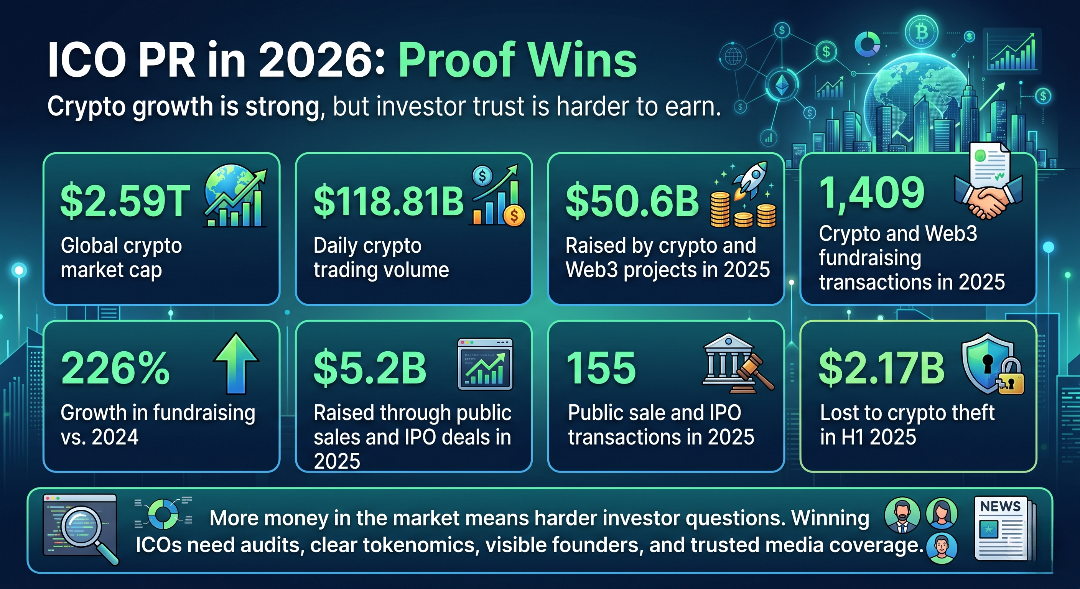
The ICO market in 2026 rewards proof, not noise. Crypto remains a large market, with total market value near $2.59 trillion and daily trading volume around $118.81 billion. Funding stayed active too. In 2025, crypto and Web3 projects raised $50.6 billion across 1,409 transactions, up 226% from 2024. Public sales and IPO activity reached $5.2 billion across 155 transactions. These numbers show real demand, but they raise the bar for every new launch. A token sale now needs a real use case, a public team, clear tokenomics, audit proof, and media coverage that feels earned.
Trust is the real fight. Chainalysis reported that crypto services lost more than $2.17 billion to theft in the first half of 2025, already above the full-year total for 2024. That risk has changed investor behavior. Buyers now check every claim before they commit. They look for coverage in crypto outlets like Cointelegraph, Decrypt, and CoinMarketCap. Then they review fintech articles, founder interviews, community channels, and search results. A winning ICO PR strategy ties these trust signals together. It builds awareness, then credibility, then investor action.
Why ICO PR Strategy Matters More in 2026
The ICO market has more money, more noise, and more doubt in 2026. Crypto and Web3 projects raised $50.6 billion across 1,409 transactions in 2025. Public sales and IPO activity reached $5.2 billion across 155 transactions. That shows strong demand, but it also shows a crowded field. Investors now compare projects side by side. They look at the team, token use, audit status, media coverage, and community health.
Investors Are More Skeptical Than Ever
ICO buyers no longer invest after reading one launch post. They research the project name, founder name, token name, and audit history. They check LinkedIn profiles. They read the whitepaper. They scan Telegram, Discord, X, Reddit, and YouTube. They look for real traction, not loud claims. This makes PR a trust tool, not just a traffic tool. Good ICO PR answers one direct question: Why should investors trust this project? The answer must show up across every public channel. A clear press article, a founder interview, a tokenomics explainer, and an audit update all support the same message.
Crypto Media Visibility Is a Trust Signal
Crypto investors pay attention to crypto-native media. A mention in Cointelegraph, Decrypt, CoinMarketCap Academy, The Block, CryptoSlate, BeInCrypto, or Bitcoin.com News gives the project a stronger public record. These sites reach readers who already understand wallets, exchanges, token sales, staking, and market risk. CoinMarketCap Academy describes its role as a source for crypto research and education. Decrypt publishes news, deep dives, explainers, market coverage, and Web3 stories. For an ICO, these platforms help shape early trust. They give investors more than a sales page. They give them a third-party place to review the project.
PR Connects Crypto Investors and Mainstream Buyers
Crypto-native PR builds Web3 trust. Fintech PR adds financial credibility. Business and entrepreneur PR builds founder authority. Each channel plays a different role in the ICO funnel. A crypto article can explain token utility. A fintech feature can explain the market gap. A founder interview can explain the mission, team, and business plan. Together, these placements help the ICO look more stable, more public, and more serious. That matters in 2026, as investors expect proof before they commit funds.
The 2026 ICO PR Framework: A Media Layering Strategy
A strong ICO PR plan does not start with one press release sent to every outlet. That looks rushed. A better plan builds trust in stages. Each stage targets a different reader and serves a clear business goal.
What Is Media Layering in ICO PR?
Media layering means placing your ICO story across different types of media in a planned order. The goal is simple. Build credibility one step at a time.
Start with crypto publications. Then move into fintech and finance media. Then pitch startup and entrepreneur outlets. After that, use community channels to spread the best coverage. This creates a steady flow of public proof. It also gives investors more reasons to keep researching your project.
The Four Main Media Layers
- Crypto-native media for Web3 credibility
Start with outlets like Cointelegraph, Decrypt, CoinMarketCap Academy, The Block, CryptoSlate, BeInCrypto, and Bitcoin.com News. These platforms help you reach crypto investors, traders, builders, and token buyers. Use them for token utility, roadmap updates, audit news, exchange plans, and founder interviews.
- Fintech and finance media for investor confidence
Move next to fintech and finance platforms. Target sites that cover payments, digital assets, banking, investing, and financial technology. Use this layer to explain market size, revenue plans, partnerships, user demand, and risk controls.
- Entrepreneur and startup media for founder authority
Business readers want to know who leads the project. Pitch founder stories, leadership lessons, product vision, and startup growth angles. This layer helps the ICO feel more human. It also supports partner outreach, investor calls, and brand search results.
- Community and social media for action
Use X, Telegram, Discord, Reddit, LinkedIn, YouTube, and AMAs to spread every media win. Pin articles in community groups. Add media logos to the website. Share quotes in investor emails. Turn each placement into proof that helps move people from interest to action.
Layer 1: Publish in Crypto-Focused Media First
Crypto-focused media should come first in your ICO PR plan. These readers already know how token sales work. They understand wallets, exchanges, audits, vesting, and token utility. They want proof that your project solves a real problem. This layer helps your ICO build early trust with Web3 investors. A strong crypto media mention can support your landing page, investor emails, community posts, and pitch deck. It gives your project a public reference outside your own website.
Target Crypto Publications Investors Already Trust
Crypto publications play different roles in an ICO PR campaign. Some help with broad awareness. Some work better for technical stories. Some suit explainers, market updates, or founder interviews. Pick the outlet that matches your story.
Cointelegraph
Cointelegraph is one of the most recognized crypto media brands. It works well for major ICO announcements, market stories, founder interviews, and token utility pieces. A placement here can help your project reach traders, founders, investors, and Web3 communities.
Decrypt
Decrypt suits clear, reader-friendly crypto stories. It works well for product explainers, founder views, Web3 culture, AI crypto, gaming, DeFi, and consumer-facing blockchain projects. Use Decrypt for stories that need simple language and strong public appeal.
CoinMarketCap Academy or Announcements
CoinMarketCap works well for education-led content and project updates. Many investors already use CoinMarketCap to track tokens, market data, and project details. An Academy article or announcement can help explain token use, roadmap plans, and market purpose.
The Block
The Block attracts serious crypto readers, builders, analysts, and funds. It works best for funding news, infrastructure stories, exchange topics, institutional adoption, and market research angles. Pitch The Block only with strong data, real milestones, and clear business value.
CryptoSlate
CryptoSlate covers crypto news, market updates, project launches, and Web3 trends. It fits ICO stories with clear token utility, product traction, audit updates, or ecosystem growth. It can help your project reach investors who follow token and market news daily.
BeInCrypto
BeInCrypto works well for token launch coverage, market updates, founder quotes, and project education. It can support both earned and sponsored PR goals. Use it to explain your ICO in a simple way for retail crypto readers.
Bitcoin.com News
Bitcoin.com News reaches readers interested in crypto markets, adoption, payments, and blockchain use cases. It suits ICO stories tied to payments, DeFi, real-world assets, and wider crypto adoption. A strong use case matters more than a launch claim here.
CryptoBriefing
CryptoBriefing fits projects with strong research, security, DeFi, and token analysis angles. It works well for tokenomics breakdowns, audit news, protocol updates, and technical explainers. Use this outlet to show depth, not hype.
NewsBTC
NewsBTC often covers market trends, Bitcoin, altcoins, token news, and crypto project updates. It can help your ICO gain visibility among traders and retail investors. It works best for launch news, exchange plans, and market-facing stories.
AMBCrypto
AMBCrypto reaches readers who follow token markets, crypto news, and project updates. It suits ICO stories tied to community growth, token demand, roadmap progress, and market interest. Keep the pitch clear and focused on one strong update.
Blockworks
Blockworks has a strong audience across crypto, finance, and institutional markets. It works well for infrastructure, DeFi, tokenization, policy, and investment stories. Use Blockworks for mature ICO narratives backed by product proof, data, and founder credibility.
Best Story Angles for Crypto Media
Crypto journalists see many ICO launch pitches. Most of them sound the same. Your story needs a clear reason for coverage. The best angles show progress, proof, or market value. A token utility announcement can explain why the token exists. A smart contract audit update can reduce security concerns. A testnet or mainnet milestone can show product progress. A partnership announcement can add outside credibility. An exchange listing roadmap can help investors understand future access.
Founder interviews work well too. They put a real person behind the project. They help readers understand the team, mission, and long-term plan. Strong topic angles can include DeFi, AI, real-world assets, gaming, infrastructure, payments, security, community growth, and tokenomics. Avoid vague claims. Do not pitch your ICO as the next big crypto project. Show facts, dates, names, product updates, and clear use cases. Crypto readers trust proof more than promises.
Crypto PR Content Assets to Prepare
Prepare your PR assets before outreach starts. Editors and writers move faster when your team gives them clear material. A complete media kit saves time and reduces confusion. Your ICO press release should explain the project, token use, launch timeline, and core announcement. Your founder bio should show relevant experience and public credibility. Your tokenomics one-pager should explain supply, vesting, allocation, utility, and sale terms in plain language.
Your whitepaper summary should make the project easier to understand. Your audit report summary should highlight security checks and key findings. Product screenshots, demo links, and roadmap graphics help journalists see progress. A journalist FAQ can answer common questions about the team, token, sale process, risk, and compliance. A compliance-safe messaging sheet is a must in 2026. It should remove claims about guaranteed returns, future price growth, or risk-free gains. Use careful language around eligibility, utility, risks, audits, and sale terms.
Ready to launch your ICO with trusted media coverage?
Get crypto media outreach, founder PR, press releases, and community promotion built for investor trust.

Layer 2: Move Into Fintech and Finance Publications
After crypto media builds early Web3 trust, fintech and finance media can widen the audience. This layer helps your ICO reach investors, analysts, funds, fintech founders, and finance decision-makers. These readers care about market need, risk, revenue logic, and legal clarity. They want to know how the project fits into payments, banking, trading, DeFi, tokenization, or financial access. Your story must sound like a serious business case, not a token sales pitch.
Why Fintech Media Matters for ICOs
Fintech media helps frame your ICO as a financial technology project. This matters for readers who do not follow every crypto trend. They still care about digital assets, payment rails, settlement speed, liquidity, identity, and new investment models.
A fintech feature can explain the real problem your project solves. It can show how the token supports access, payments, governance, rewards, or network use. It can also help partners and investors see the business logic behind the ICO. This layer works best after your project has strong basics. Your website, whitepaper, audit status, team page, and tokenomics should already look clear. Finance readers ask hard questions. Your PR must answer them with plain facts.
Target Fintech and Finance Media
Fintech and finance publications can help your ICO reach a more business-focused audience. They work best for market stories, payment use cases, investment angles, compliance topics, and founder commentary. Finextra suits banking, payments, and financial infrastructure stories. Finance Magnates fits trading, broker, exchange, and digital asset topics. FinTech Futures and The Fintech Times work well for fintech product stories, startup news, and digital finance trends.
Yahoo Finance, Benzinga, Investing.com, and MarketWatch press release distribution can support wider investor visibility. Business Insider contributor opportunities can help with founder-led business stories. Nasdaq sponsored or syndicated content can support authority with finance-minded readers. Do not pitch these outlets with crypto slang. Use business language. Explain the market gap, user problem, product role, and revenue path. Then explain where the token fits.
Best Story Angles for Fintech Media
Fintech editors want practical value. They want to know what financial problem your ICO solves. They also want to see a clear market, clear users, and clear risk controls. Strong fintech angles include payments, remittance, DeFi, real-world assets, identity, banking, trading, and infrastructure. A payments ICO can focus on speed and cost. A real-world asset ICO can focus on access and settlement. A DeFi project can focus on liquidity, transparency, and user control.
Market opportunity matters here. Your PR should explain the size of the problem, the business model, and the reason blockchain adds value. Founder commentary can help too. A clear founder quote can connect the project to wider trends in digital finance. Regulatory-ready messaging also matters. Finance readers want to see risk controls, KYC details, audit work, legal review, and clear user terms. This does not make the story boring. It makes the project look serious.
Layer 3: Build Founder Authority Through Entrepreneur and Business Media
A strong ICO needs more than token buzz. Investors want to know who leads the project. They study the founder’s record, public voice, past work, and ability to explain the business in simple terms. Founder PR helps put a human face on the ICO. It turns a token launch into a company story. That matters for investors, partners, advisors, and media editors who want to see real leadership behind the project.
Why Founder PR Matters in 2026
Investors do not only invest in tokens. They invest in teams. A founder with a clear public profile can build trust faster than a project with no visible leadership. In 2026, anonymous teams face more doubt. Investors want names, photos, interviews, LinkedIn profiles, past results, and direct comments. They want to know who takes responsibility for the roadmap and the token sale. Founder PR can answer questions before investors ask them. Who started the project? What problem did they see? What experience do they bring? What plan comes after the ICO? Clear answers make the project easier to trust.
Target Entrepreneur and Startup Publications
Entrepreneur and startup publications help your ICO reach business readers. These readers care about leadership, company growth, funding, product-market fit, and long-term plans. They may not follow crypto daily, but they understand strong founders and real business problems.
- Entrepreneur
Entrepreneur works well for founder stories and business lessons. Use it to explain why the founder started the ICO, what market gap the project serves, and how the company plans to grow after the token sale.
- Forbes Contributor Network
Forbes contributor articles can support founder authority. A strong byline or interview can help the founder speak about blockchain, digital assets, tokenization, or startup growth. The story must feel useful, not promotional.
- Inc.
Inc. fits stories about company building, leadership, and startup growth. Use it to show how the founder built the team, shaped the product, and handled market pressure. Keep the story practical and business-focused.
- Fast Company
Fast Company suits product vision, technology trends, and brand stories. It can work well for ICOs tied to payments, identity, AI, gaming, climate, health, or real-world assets. The pitch needs a clear human or market angle.
- Startup.info
Startup.info works well for founder interviews and startup profiles. It gives the founder space to explain the idea, team, traction, and plans. This type of coverage can help early investors learn the story fast.
- TechRound
TechRound fits startup news, founder interviews, fintech stories, and Web3 updates. Use it for ICOs with a clear business model, strong founder voice, and product progress.
- EU-Startups
EU-Startups works best for European Web3 teams or projects entering European markets. It can help with founder authority, funding news, product updates, and market entry stories.
- HackerNoon
HackerNoon reaches builders, developers, founders, and Web3 readers. It works well for technical founder posts, product explainers, token utility articles, and lessons from building the project.
- Authority Magazine
Authority Magazine fits long-form founder interviews. It helps founders explain their story, values, market view, and leadership style. This can support trust for investors who want more than a short press quote.
- FoundersBeta
FoundersBeta works well for startup founder visibility. It can support early traction stories, founder lessons, team growth, and product plans. Use it to make the ICO feel like a real company, not only a token sale.
- StartupBeat
StartupBeat suits startup news, founder features, and product stories. It can help introduce the ICO to readers who follow new companies and early-stage business growth.
Best Founder-Led PR Angles
Founder-led PR works best when the story teaches something. A plain “we launched an ICO” pitch will not stand out. A stronger pitch explains the founder’s reason, market problem, and business plan. Strong founder angles include the story behind the project, the problem that led to the token model, and the reason the team chose blockchain. Founders can talk about trust in crypto, lessons from past market cycles, and the need for clearer token utility. A founder can also explain the company’s post-ICO plan. Investors want to know what happens after the sale. A clear founder story can cover product milestones, hiring plans, partnership goals, exchange plans, and community growth.
Founder Thought Leadership Assets
Founder PR needs strong assets. A short bio is not enough. The founder needs clear talking points, article ideas, interview answers, and proof of expertise. Useful thought leadership assets include a founder bio, headshot, LinkedIn profile, quote bank, interview sheet, byline topics, podcast pitch, and company story page. These assets help media teams pitch faster and keep the message steady. The founder should write or approve views on key topics. These can include token utility, Web3 trust, fundraising ethics, community growth, product use, and market direction. A clear public voice can make the ICO feel more credible and more stable.
Layer 4: Use Press Releases Strategically, Not Randomly
Press releases still matter in ICO PR, but they need a clear purpose. A press release should mark a real milestone. It should not exist only to create noise. A good ICO press release gives journalists, investors, and community members one clean update. It states what happened, why it matters, who is involved, and what comes next. Keep it factual. Avoid hype and price claims.
When to Publish ICO Press Releases
Press releases work best for events that deserve a public record. They should support the PR calendar, not replace the full campaign. Strong press release moments include the ICO pre-sale launch, public token sale opening, smart contract audit completion, major partnership, product beta launch, exchange listing announcement, funding milestone, community milestone, mainnet or testnet launch, and strategic advisor appointment. Each release should answer a clear question. What changed today? Why should investors care? What proof supports the claim? What is the next step? A release that answers these questions can support media outreach, SEO, and community updates.
Use Crypto Newswires for Distribution
Crypto newswires help spread ICO announcements across crypto and finance sites. They can place your press release in front of readers who follow token launches, blockchain funding, and Web3 market updates. Use newswires for official news, not every small update. A smart campaign saves distribution for moments that matter. Audit completion, sale launch, exchange news, and major partnerships deserve wider reach. A newswire can create reach, but outreach still matters. Send personal pitches to selected journalists after the release goes live. Share the release with your community. Add it to your website. Use it in investor emails and partner updates.
Build a Strong ICO Narrative Before Pitching Media
A strong ICO PR campaign starts with the story. Journalists do not want a random token announcement. Investors do not want a vague promise. They want to understand the problem, the product, the token, the team, and the reason the project matters now. Your ICO narrative should connect every public message. The website, whitepaper, founder interviews, press releases, social posts, and investor emails should all tell the same story. This makes the project easier to trust and easier to remember.
Define the Core PR Message
Your core PR message should explain the project in plain language. It should answer the questions investors ask first. What problem does the project solve? Why does the token exist? Who uses the product? What proof shows progress? A strong ICO message includes a clear problem, a simple product story, a real token use case, and visible team credibility. It should also mention audit status, roadmap progress, and community traction. These details make the project feel real. Avoid broad claims. Do not say the project will change crypto forever. Say what it does, who it helps, and what milestone comes next. Clear beats loud in 2026.
Create Different Messages for Different Audiences
Every audience reads your ICO story through a different lens. Crypto investors look for token utility, vesting, audits, liquidity, and exchange plans. Fintech readers look for market demand, risk control, and business use. Startup readers look for founder strength, product direction, and long-term growth. Your team should adjust the message for each audience. The core story should stay the same, but the angle should change. A crypto pitch can lead with tokenomics and audit news. A fintech pitch can lead with payment, settlement, or asset access. A founder interview can lead with the problem that pushed the team to build. This keeps the message focused without sounding copied. It also helps each publication see why the story fits its readers.
Create a 90-Day ICO PR Timeline
A strong ICO PR plan needs time. A rushed campaign often feels forced. A 90-day timeline gives your team enough space to build trust, secure media coverage, grow community interest, and guide investors toward action. The best timeline covers three stages: pre-ICO, launch, and post-ICO. Each stage has a different goal. First, build awareness. Then drive action. After the sale, keep trust alive.
-
Phase 1: Pre-ICO PR: Build Awareness and Credibility
The pre-ICO phase should start at least 60 to 90 days before the sale. This stage builds the proof investors need before they commit funds. It also gives journalists enough time to review the project. Start with the basics. Finalize your PR message, founder bio, media kit, whitepaper summary, tokenomics page, and audit update. Then build your first wave of content. Publish explainers on your website. Share founder posts on LinkedIn and X. Start community updates on Telegram and Discord. Media outreach should begin during this phase. Pitch crypto publications with product progress, token utility, audit status, or founder interviews. If your ICO has fintech value, prepare finance media angles too. The goal is to create early credibility before the token sale opens.
-
Phase 2: ICO Launch PR: Drive Visibility and Investor Action
The launch phase should focus on visibility, clarity, and action. This is the period where interested readers become active investors. Your message must stay simple and consistent. Publish the official ICO launch press release. Share clear sale details, eligibility rules, token utility, roadmap milestones, and risk disclosures. Push media coverage across your website, X, LinkedIn, Telegram, Discord, Reddit, and email list. Run AMAs during the launch window. Use them to answer real questions about tokenomics, audits, vesting, product status, and post-sale plans. Keep founder communication active. Investors want to see the team present, alert, and ready to respond.
-
Phase 3: Post-ICO PR: Maintain Trust and Momentum
Post-ICO PR matters as much as launch PR. Many projects lose trust after the sale because they go quiet. Silence creates doubt. Regular updates keep investors informed and community members engaged. Share product progress, roadmap updates, listing news, partnership details, audit updates, and community milestones. Publish monthly reports if possible. Keep the founder visible through interviews, posts, and community sessions. The post-ICO stage should prove that the project has a plan after fundraising. Investors want to see delivery, not just a successful sale. A steady PR rhythm helps protect reputation and supports long-term growth.
Use SEO Content to Support ICO PR
SEO content gives your ICO a stronger search presence. Investors rarely act after seeing one article. They search the project name, founder name, token name, and phrases like “is this ICO legit?” Your content should help them find clear answers. PR brings attention, but SEO keeps that attention alive. A media mention can send traffic for a short time. A strong blog post can keep bringing readers for months. Together, PR and SEO help your ICO build trust across search, media, and community channels.
Why SEO Matters for ICO PR
SEO matters because investors do their own research. They want to compare your claims with public information. If search results show clear pages, useful explainers, media mentions, and founder content, the project feels easier to trust. Good SEO content also supports every PR pitch. Journalists can read your tokenomics guide, audit summary, roadmap page, and founder story before writing. This gives them better context and reduces confusion. Your website should answer the main investor questions. What does the token do? Who leads the project? Has the contract been audited? What is the roadmap? How does the sale work? Clear answers help both search readers and media contacts.
SEO Blog Topics for ICO Campaigns
ICO blog content should educate, explain, and support trust. Do not publish thin posts stuffed with keywords. Write useful pages that answer real investor questions. Strong ICO blog topics include token utility, tokenomics, audit status, roadmap updates, founder story, product use cases, and market problem. You can also publish guides on how to join the ICO, how the token works, and what buyers should know before the sale. A good content plan can include articles like “What Is [Project Name]?”, “[Token Name] Tokenomics Explained”, “How to Join the [Project Name] ICO”, “Smart Contract Audit Summary”, and “Roadmap for 2026”. These topics help investors move from awareness to research, then from research to action.
Transactional Keywords to Include
Transactional keywords help attract readers with buying or service intent. These readers often search for ICO support, crypto marketing help, or token launch services. Use these terms naturally in service pages, landing pages, case studies, and call-to-action sections. Useful transactional keywords include ICO PR agency, ICO marketing agency, crypto PR services, Web3 PR agency, blockchain marketing services, token launch marketing, crypto press release distribution, ICO investor marketing, crypto media outreach, and ICO promotion services. Do not force these terms into every paragraph. Place them where they fit the reader’s intent. A service page can target “ICO PR agency”. A blog section can mention “crypto media outreach”. A landing page can explain “token launch marketing” in clear terms.
Informational Keywords to Include
Informational keywords help attract readers who are still learning. These readers ask questions before they trust a project. Your content should guide them with simple, useful answers. Helpful informational keywords include how to promote an ICO, ICO PR strategy, ICO marketing strategy 2026, how to launch an ICO, crypto PR strategy, blockchain PR campaign, token launch PR, and Web3 media strategy. These keywords work best in blog posts, guides, FAQ pages, and explainer content. Use them to answer common questions and build search authority. The goal is not only to rank. The goal is to make investors feel informed before they speak with your team.
Add Community PR to Build Investor Confidence
Community PR turns public interest into real discussion. In crypto, investors do not only read articles. They join Telegram groups, scan Discord channels, follow X threads, read Reddit comments, and watch AMAs before they act. A quiet community can hurt trust. A clear, active, well-managed community can support the ICO story. It shows that the team listens, answers questions, and shares updates in public.
Why Community Is Part of PR
Community is part of PR because every public chat shapes reputation. A confused Telegram group can damage trust faster than a weak article. A clear Discord channel can help investors understand the project faster than a long whitepaper. Community members ask the hard questions. They ask about vesting, audits, token supply, listings, roadmap delays, and fund use. Your team should answer these questions with calm, clear, and consistent messages. Media coverage also performs better with community support. A strong article should not sit alone. Share it, discuss it, pin it, and use it to answer investor questions.
Community PR Tactics for ICOs
Strong community PR needs a steady rhythm. Post weekly founder updates. Run live AMAs. Share tokenomics explainers. Pin audit summaries. Create FAQ channels. Use moderators who understand the project and can answer basic questions. X Spaces can help founders speak directly to the market. Telegram works well for fast updates and investor questions. Discord works well for structured channels, technical discussions, and community roles. Reddit can help with honest discussion, but it needs careful monitoring. Use community content to reduce doubt. Share roadmap progress, product demos, media mentions, partner news, and security updates. Keep the tone calm. Do not overpromise. Investors trust steady communication more than constant hype.
How to Turn Media Coverage Into Community Momentum
Every media placement should feed your community channels. Share the article on X, LinkedIn, Telegram, Discord, Reddit, and email. Add a short note that explains why the coverage matters. Pin strong coverage inside Telegram and Discord. Add media logos to the ICO landing page. Use quotes from articles in investor emails. Turn founder interviews into short social posts. Use press mentions during AMAs to answer trust questions. This keeps the PR cycle active. Media coverage brings attention. Community discussion builds confidence. Clear calls to action move serious investors toward the ICO page, whitepaper, audit summary, or sign-up form.
Want your ICO to gain trusted media coverage?
Use Influencer and KOL PR Carefully
Influencer and KOL PR can help an ICO reach active crypto buyers fast. It can also damage trust fast. The difference comes down to who speaks, what they say, and how clearly they disclose paid work. A strong ICO does not chase every loud account. It works with credible educators, analysts, builders, and community voices. The goal is simple: explain the project, answer doubts, and guide serious investors toward proper research.
Why KOLs Still Matter
Crypto audiences still follow trusted voices on X, YouTube, Telegram, Discord, newsletters, and podcasts. Many investors hear about a new ICO through these channels before they read a full article. KOLs matter because they already have audience trust. A good creator can explain token utility, audit details, roadmap plans, and sale terms in a way people understand. This helps your ICO reach readers who ignore press releases and ads. Bad KOL campaigns create the opposite effect. Paid hype, price claims, and fake urgency can make a project look weak. Investors spot these patterns fast. In 2026, credibility matters more than follower count.
Best KOL Strategy for ICOs in 2026
The best KOL plan starts with careful selection. Choose creators who understand crypto, speak clearly, and match your project category. A DeFi ICO needs different voices than a gaming, AI, RWA, or payments ICO. Work with KOLs who can explain the project without making reckless claims. Give them a clear brief, tokenomics details, audit notes, roadmap points, and disclosure rules. Ask them to focus on education, not price talk.
A strong KOL campaign should include:
- Clear sponsorship disclosure
- No guaranteed return claims
- No fake scarcity
- No price prediction promises
- Simple token utility explanation
- Audit and risk information
- Founder or team reference
- Link to the official ICO page
- Reminder to do personal research
The best KOLs help people understand the project. They do not pressure people to buy. That difference protects your brand and builds cleaner investor interest.
Content Formats That Work
KOL content works best when it explains one idea at a time. Short hype posts rarely build trust. Clear content with facts, visuals, and founder input performs better. Strong formats include tokenomics review videos, founder interviews, X threads, newsletter features, podcast mentions, AMA sessions, project walkthroughs, and use case explainers. Each format should answer a real investor question. A YouTube review can explain the product and token model. An X thread can break down the roadmap. A newsletter can explain market fit. An AMA can answer live questions about vesting, audits, and sale rules. Repurpose the best creator content across your own channels. Share it in Telegram, Discord, LinkedIn, X, and email updates. This turns one KOL post into wider PR support.
Compare Earned Media, Sponsored Media, and Press Releases
ICO PR works better when each media type has a clear role. Earned media builds trust. Sponsored media gives faster reach. Press releases create an official public record. A strong campaign uses all three with care. Each one serves a different stage of the ICO. The mistake is treating them as the same thing.
Earned Media
Earned media means a journalist, editor, podcast host, or publication covers your ICO based on news value. You do not buy the article placement. You earn attention through a strong story, proof, and timing. This type of media carries high trust. Investors respect coverage that feels independent. It works well for founder interviews, product milestones, audit updates, funding news, partnership stories, and market commentary. Earned media takes more work. Your pitch must be sharp. Your assets must be ready. Your team must respond fast. The reward is stronger credibility and better long-term brand value.
Sponsored Media
Sponsored media gives your ICO guaranteed space on a publication or platform. It can include paid articles, newsletter placements, native ads, podcast sponsorships, or banner campaigns. This format works well for controlled messaging. You can explain token utility, sale details, roadmap plans, and product value in your own words. It also helps during launch week, when timing matters. Sponsored media should still feel useful. A paid article that reads like a sales pitch will lose readers fast. Make it educational, clear, and honest. Add risk details, audit notes, and real product information.
Press Releases
Press releases give your ICO an official announcement format. They work best for real milestones. Examples include pre-sale launch, public sale opening, audit completion, partnership news, beta launch, funding update, mainnet launch, or exchange listing news. A press release should answer four questions. What happened? Why does it matter? Who is involved? What comes next? Keep the tone factual and clear. Press releases can support SEO, investor updates, and media outreach. They should not carry the full PR campaign alone. Use them as proof points, then build deeper stories around them.
Best 2026 Approach
The strongest 2026 ICO PR strategy mixes all three media types. Use earned media to build trust. Use sponsored media to control timing and reach. Use press releases to mark official milestones. A good campaign can start with a press release, then follow with crypto media pitches, founder interviews, KOL content, fintech coverage, and community discussion. Each piece should point back to the same core story. This creates a cleaner public trail for investors. They can see the announcement, read third-party coverage, watch founder content, and ask questions in the community. That kind of PR builds confidence without relying on hype.
Conclusion
A winning ICO PR strategy in 2026 needs more than a press release and a few social posts. It needs clear messaging, trusted media coverage, founder visibility, SEO content, community trust, KOL support, and regular updates before and after the token sale. Investors now look for proof across every channel. They check audits, tokenomics, media mentions, founder profiles, and community activity before they act. Blockchain App Factory provides ICO PR services that help crypto projects build this trust from the ground up. From crypto media outreach and press release distribution to founder PR, investor-focused content, and community promotion, the team helps your ICO gain visibility, earn credibility, and turn market attention into investor action.

Vimal J is the Head of Sales at Blockchain App Factory, with 10+ years of experience in sales, client strategy, and Web3 business growth. He helps startups, enterprises, and project founders choose the right blockchain solutions for their goals, bringing a practical market perspective to topics like token development, crypto launches, and Web3 adoption.