
Key Insights
-
- Web3 teams can move beyond hype, follower counts, and generic campaigns by using AI to track wallet connects, staking, voting, retention, referrals, and other business-linked actions.
- With hundreds of millions of crypto owners worldwide and strong adoption across markets like India, the United States, Pakistan, Vietnam, and Brazil, Web3 projects need AI tools to segment audiences, personalize messages, and support multilingual communities.
- AI can speed up content creation, community support, campaign testing, sentiment tracking, and reporting, but the strongest results come when teams pair AI with clean data, human review, and clear business goals.
Crypto marketing has changed fast. In 2021, many Web3 projects grew through hype, token launches, influencer threads, and Discord invite contests. That model no longer works on its own. Buyers, users, exchanges, investors, and partners now ask harder questions. They want proof of utility, active communities, clear security practices, and real growth numbers.
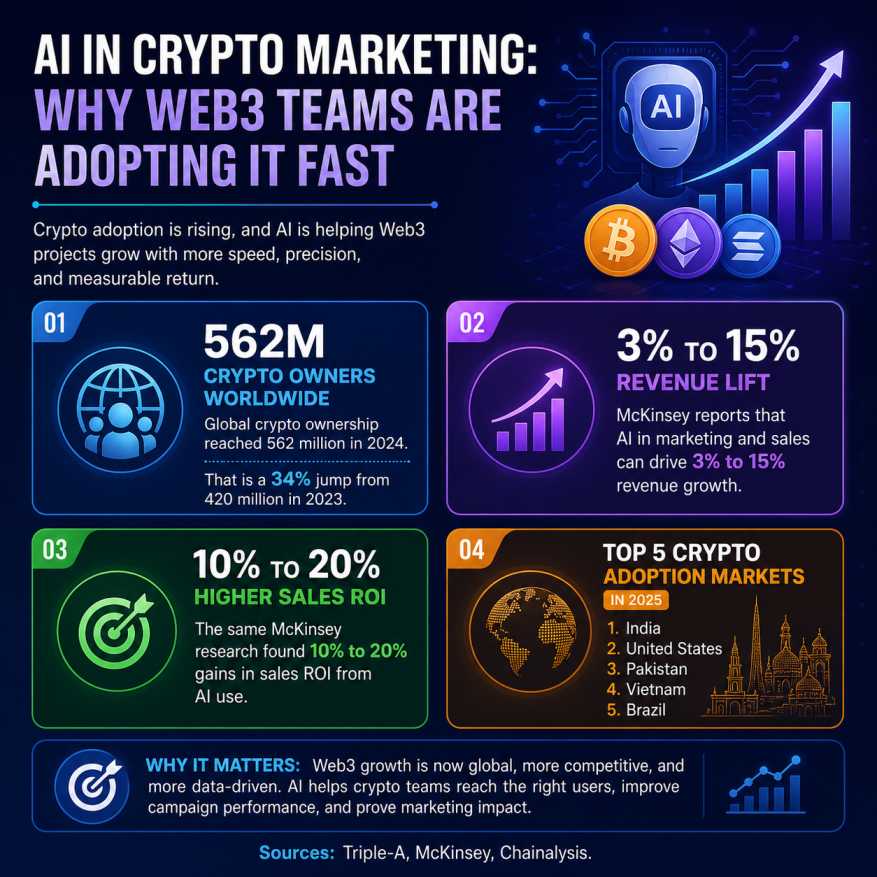
The market is large, and it is still growing. Triple-A estimates that 562 million people owned crypto in 2024, up 34% from 420 million in 2023. Chainalysis ranked India first in its 2025 Global Crypto Adoption Index, followed by the United States, Pakistan, Vietnam, and Brazil. These numbers show that crypto growth is broad, global, and no longer limited to a small group of early users.
AI gives crypto teams a sharper way to compete. It helps them study wallet behavior, spot user intent, write and test content faster, support global communities, and measure campaign results with more accuracy. The business case is strong. McKinsey found that AI in marketing and sales can produce 3% to 15% revenue uplift and 10% to 20% sales ROI gains. For Web3 teams, that means AI is not just a productivity tool. It is a direct growth tool.
What Is AI in Crypto Marketing?
Defining AI Marketing for Web3 Projects
AI in crypto marketing means the use of machine learning, natural language processing, generative AI, prediction models, and automation tools to improve Web3 growth. IBM defines AI marketing as the use of data collection, data analysis, NLP, and machine learning to produce customer knowledge and automate key marketing decisions.
For a Web3 project, this can include wallet segmentation, community sentiment tracking, SEO content planning, chatbot support, KOL analysis, campaign reporting, and fraud detection. A DeFi protocol can use AI to find users likely to provide liquidity. A wallet app can use AI to guide new users through setup. A gaming project can use AI to group players by NFT ownership, quest activity, and spending patterns.
The key shift is simple. AI turns scattered data into action. Crypto teams already have data from wallets, websites, Discord, Telegram, X, email, governance forums, and ad platforms. The challenge is reading that data fast enough to guide campaigns. AI helps teams see patterns that manual reporting often misses.
How AI Differs from Traditional Crypto Marketing Automation
Traditional marketing automation follows fixed rules. A user signs up, then receives a welcome email. A person joins Discord, then gets a preset message. A campaign launches, then reports arrive at the end of the week.
AI works in a more adaptive way. It can score leads, group users by behavior, suggest content themes, test copy variants, detect negative sentiment, and recommend better timing for outreach. It does not only send messages. It helps decide who should receive which message, and why.
This difference has commercial value. Klarna told Reuters that generative AI helped cut marketing costs by about $10 million per year. The company said AI reduced image production costs by $6 million and shortened image development time from six weeks to seven days. It created more than 1,000 images in the first three months of 2024.
Crypto teams can learn from that example. A token project preparing a launch needs landing pages, ads, explainers, social posts, graphics, email flows, and community answers. AI can reduce production time. The team still needs human review, legal checks, and strategy. Yet the work moves faster, and each campaign can be tested with more variants.
Why Web3 Marketing Needs AI More Than Web2 Marketing
Web3 marketing has extra complexity. Users are not just email addresses or website visitors. They are wallet holders, voters, traders, stakers, liquidity providers, NFT collectors, builders, and community members. One person can use several wallets. One wallet can show rich behavior across chains and apps.
This makes segmentation harder. It also makes it more valuable. A user who bridged assets last week needs different messaging than a user who only reads blog posts. A DAO voter needs different content than a short-term trader. A developer evaluating an L2 needs proof, documentation, and ecosystem support.
AI helps connect these signals. It can group users by activity, score interest, flag churn risk, and help teams send more relevant content. That means fewer generic posts and better user journeys from awareness to wallet action.
Why AI Matters for Web3 Growth in 2026 and Beyond
Crypto Marketing Is Moving from Hype to Performance
Web3 growth teams now face a harder question: what did the campaign produce? Follower growth alone is weak proof. Serious teams track wallet connects, token holder retention, staking activity, governance votes, developer signups, trading volume, referral quality, and community support load.
AI supports this shift from noise to performance. It can compare campaigns, identify which channels bring active users, and show which content leads to real wallet activity. This helps founders and CMOs spend with more discipline.
AI Helps Teams Grow Without Growing Headcount
Many crypto startups run lean teams. One person may manage content, social, email, partnerships, and community. AI reduces pressure on that team.
It can help with:
- Blog briefs and SEO drafts
- Social post testing
- Telegram and Discord FAQs
- Multilingual content
- Campaign reports
- Sentiment alerts
- Lead scoring
- Influencer screening
The benefit is not just faster output. It is better focus. Marketers spend less time sorting raw data and more time choosing the right message, offer, and channel.
AI Supports Trust, Transparency, and Risk Monitoring
Trust is central in crypto. Scams, fake accounts, phishing, token rumors, and poor communication can hurt a project fast. AI can scan community channels for repeated concerns, scam links, impersonation attempts, and sudden sentiment changes. It can alert moderators before a small issue becomes a public crisis.
AI can also improve education. Many users still struggle with wallets, gas fees, staking, bridging, private keys, and smart contract risk. AI chatbots can answer common questions at any hour. Good bots route sensitive issues to humans and avoid financial advice. That balance matters.
For decision-makers, AI in crypto marketing is not just a content tool. It is a growth system. It connects audience data, campaign execution, community care, and performance measurement. Web3 businesses that adopt it with clear rules, clean data, and human review will grow faster, spend smarter, and build stronger user trust.
Is AI the Future of Crypto Marketing?
Leverage AI tools to attract users, boost engagement, and scale your Web3 growth.

Core Ways Web3 Projects Are Using AI to Grow Faster
Web3 marketing now runs on two types of data: human behavior and wallet behavior. A project can see who joined Discord, who read a blog post, who connected a wallet, who staked tokens, and who stopped using the product. AI helps teams turn these signals into better campaigns.
IBM describes AI marketing as the use of data collection, data analysis, natural language processing, and machine learning to guide customer decisions and automate marketing work. That definition fits crypto well, since Web3 teams deal with scattered data across wallets, social channels, websites, apps, and exchanges.
AI-Powered Audience Research and Wallet Segmentation
The strongest use case starts with segmentation. Traditional crypto marketing often treats all followers the same. AI changes that. It groups users by behavior, not by broad labels.
A DeFi project can separate long-term liquidity providers from short-term yield hunters. An NFT brand can group holders by mint date, rarity, resale activity, and community posts. A wallet app can study new users who connect once, then disappear.
Good segmentation creates better offers. A dormant holder may need education. A frequent user may respond to staking rewards. A DAO voter may care about governance tools. AI helps teams find these groups faster and speak to each one with more care.
Predictive Analytics for User Acquisition and Retention
Predictive analytics helps Web3 teams estimate future action. A model can score users by their chance to stake, vote, mint, bridge assets, or churn. This gives growth teams a clearer view of where to spend time and budget.
McKinsey reported that companies investing in AI for marketing and sales have seen revenue uplift of 3 to 15 percent and sales ROI uplift of 10 to 20 percent. Crypto teams should not copy those numbers blindly, but the business logic applies. Better targeting reduces wasted spend. Better timing raises conversion. Better retention protects community value.
Personalized Campaigns Based on On-Chain and Off-Chain Data
Web3 personalization works best when teams combine wallet data with off-chain behavior. A user who reads developer docs needs different content than a user who watches token price updates. A person who bridges assets to a chain shows stronger intent than someone who only follows the project on X.
This allows projects to shape campaigns around real actions. For example, a Layer-2 network can send technical tutorials to developers who visited API pages. It can send ecosystem updates to users who bridged funds. It can send governance explainers to token holders who never voted.
The goal is simple: send fewer generic messages and more useful ones.
AI-Generated Content for SEO, Social, Email, and Community
AI speeds up content work across crypto SEO, social posts, email flows, product pages, FAQs, and community replies. Teams can create drafts, test headlines, translate posts, and repurpose long articles into short social updates.
Klarna offers a clear commercial example outside crypto. Reuters reported that the company used generative AI to cut marketing costs by about $10 million per year. It reduced image production time from six weeks to seven days and created more than 1,000 images in the first three months of 2024.
Crypto teams can use the same lesson. AI lowers production time, but humans still need to review claims, risk language, token details, and technical facts.
AI Chatbots and Community Support for Discord and Telegram
Crypto communities run all day. Users ask about wallets, gas fees, staking, airdrops, bridges, token claims, and scams. Human moderators cannot answer every question at every hour.
AI chatbots can handle repeated questions in Discord, Telegram, websites, and help centers. They can explain setup steps, summarize docs, share links, and route complex problems to staff. This reduces response time and keeps moderators focused on safety, conflict, and high-value users.
The best bots do not pretend to be financial advisers. They answer product questions, share approved content, and flag risky topics for human review.
Sentiment Analysis for Crypto Communities
Sentiment analysis helps teams read the mood of a community. AI can scan X, Reddit, Telegram, Discord, news, and governance forums. It can detect rising complaints, scam rumors, confusion about token mechanics, or anger after a delayed launch.
This matters in crypto, where trust can change fast. A small issue can spread across social channels within hours. AI alerts give teams time to respond with facts, updates, and support.
AI for Influencer and KOL Campaign Optimization
AI helps teams judge KOLs beyond follower count. It can review engagement quality, audience overlap, bot risk, tone, and past campaign fit. This matters because crypto influencer campaigns can look successful on the surface yet bring low-quality traffic.
A strong AI review checks who engages with the influencer, not only how many people follow them. It can flag repeated bot comments, sudden follower spikes, weak click behavior, and poor audience match. This helps Web3 teams spend on creators who can drive real users, not empty attention.
AI for Paid Ads and Crypto Ad Network Optimization
Paid crypto ads need tight control. Ad rules change often, and many platforms limit token-related claims. AI helps teams test safer copy, compare landing pages, study audience behavior, and adjust budgets based on conversion quality.
The main value is faster learning. A project can test several headline angles, offers, and landing page messages. Then it can compare wallet connects, signups, and first actions. This gives paid teams a clearer link between ad spend and actual product use.
AI for Airdrop, Referral, and Loyalty Campaign Design
Airdrops and referral campaigns attract attention, but they often attract bots too. AI helps teams score user quality before rewards go out. It can review wallet age, transaction history, community activity, referral links, and repeated behavior patterns.
A better reward model favors real contribution. Users who stake, vote, test features, refer active users, or provide liquidity should rank above wallets that only chase rewards. AI gives teams a stronger way to reduce sybil activity and build loyalty around product use.
Technical Framework: How AI Works in a Crypto Marketing Stack
A strong AI marketing stack starts with clear data. Web3 projects need systems that collect, clean, score, activate, and measure user behavior across many channels. This process turns scattered signals into growth decisions.
Step 1 – Data Collection Across Web3 and Web2 Channels
Teams pull signals from wallets, analytics tools, CRMs, email platforms, ad accounts, websites, Discord, Telegram, and governance forums. Each source shows a different part of user intent.
Wallet data shows product behavior. Website and email data show interest. Community data shows questions, objections, and trust levels. AI works best when these sources feed one shared view.
Step 2 – Data Cleaning, Identity Mapping, and Wallet Enrichment
Raw data is messy. One user can have several wallets. One wallet can interact across chains. A community member may use a different email than the one tied to a campaign.
Data cleaning connects wallet addresses, profiles, campaign tags, and activity records. Wallet enrichment adds context, such as token holdings, transaction frequency, protocol use, and NFT activity. Poor data creates weak segments. Clean data gives AI better inputs.
Step 3 – AI Modeling and Segmentation
Once the data is ready, teams can build models for clustering, churn scoring, lead scoring, sentiment analysis, and recommendations. These models help marketers find high-intent users, dormant holders, loyal advocates, and risky traffic.
Segmentation should stay tied to business goals. A DeFi protocol may care about liquidity growth. A DAO may care about voting. A gaming project may care about repeat play. AI should rank users by actions that matter to that business.
Step 4 – Campaign Automation and Personalization
AI models feed campaign systems. Email tools, ad platforms, chatbots, and CRM workflows then deliver the right message to the right group.
A new wallet user may receive onboarding content. A dormant token holder may receive a product update. A developer may receive technical docs. A governance voter may receive proposal summaries. This creates a smoother path from interest to action.
Step 5 – Measurement, Attribution, and Optimization
The final step is measurement. Web3 teams should track wallet connects, first transactions, staking rate, governance votes, referral quality, trading volume, support tickets, and retention.
Vanity numbers have value, but wallet-level metrics show real growth. A campaign with fewer clicks can still win if it brings higher-value users. AI-driven reporting helps teams see that difference faster.
AI vs Traditional Crypto Marketing: What Changes?
Traditional crypto marketing relies on manual planning, broad community posts, delayed reports, and surface metrics. AI shifts the work toward prediction, personalization, and faster feedback.
Manual Campaign Planning vs Predictive Growth Planning
Manual planning asks, “What campaign should we run?” Predictive planning asks, “Which users show the strongest intent right now?”
This changes how teams set priorities. Instead of guessing which audience matters, AI can point to users with recent wallet activity, high engagement, or churn risk. Teams can then plan campaigns around real demand.
Generic Community Posts vs Personalized Engagement
Generic posts speak to everyone. Personalized engagement speaks to holders, developers, traders, voters, and new users in different ways.
A project can still publish public updates. Yet its strongest growth often comes from targeted messages. New users need education. Active users need deeper product value. High-value contributors need recognition and access.
Vanity Metrics vs Wallet-Level Performance Metrics
Old reporting celebrates impressions, likes, and follower count. These metrics show reach, but they do not prove product growth.
AI-driven reporting links campaigns to wallet actions. Founders can see which content drove wallet connects, which KOLs brought active users, and which channels produced loyal customers. This gives marketing a clearer role in revenue and retention.
Reactive Reporting vs Real-Time Optimization
Traditional reports often arrive after a campaign ends. AI gives teams faster signals. It can show weak conversion, rising support tickets, negative sentiment, or sudden traffic from low-quality sources.
This helps teams fix campaigns during the run. They can adjust copy, shift budget, update FAQs, brief moderators, or pause poor channels. The result is smarter spending and stronger trust.
AI gives Web3 teams a clear edge. It helps them spend smarter, support users faster, and build trust with better timing. The projects that win will not publish more noise. They will use data to guide better marketing decisions, then pair AI speed with human judgment.
AI-Powered Web3 Marketing Framework for Businesses
AI works best in Web3 marketing when teams treat it as a business system, not a set of random tools. A crypto project needs clear goals, clean data, approved messages, and a way to measure wallet action. The same rule applies to exchanges, DeFi apps, NFT brands, gaming projects, DAOs, and Layer-2 networks.
McKinsey’s 2025 State of AI report found that revenue gains from AI appear most often in marketing and sales, strategy, finance, product work, and service operations. That matters for Web3 teams. Marketing no longer ends with social reach. It now links content, community, data, and product use.
Phase 1 – Audit
The audit phase shows what the business already has. Teams review website traffic, wallet connects, token holder data, email lists, ad accounts, Discord activity, Telegram chats, CRM records, and governance forums. They look for weak points in the funnel.
A strong audit asks simple questions. Which users take action after reading content? Which channels bring real wallet activity? Which community questions appear every week? Which campaigns attract bots or low-value traffic?
This phase also checks data quality. Many Web3 teams track followers and impressions, but miss wallet-level events. That creates blind spots. A project cannot improve staking, voting, bridging, or minting rates without clear tracking.
Phase 2 – Strategy
Strategy turns the audit into a growth plan. The team sets commercial goals. These can include more wallet connects, lower support load, higher staking volume, stronger DAO turnout, better developer signups, or more enterprise leads.
Then the team defines its core audiences. A DeFi protocol may target liquidity providers, traders, and governance voters. A gaming project may target NFT holders, free players, guilds, and paying users. A Layer-2 network may target developers, dapps, ecosystem partners, and active bridge users.
AI supports this work by finding patterns across user behavior. It helps teams rank segments by value, intent, and churn risk. The result is a sharper plan with fewer broad campaigns.
Phase 3 – AI Stack Setup
The AI stack should match the business goal. Most teams need tools for analytics, content, community support, CRM, social listening, and reporting. Larger teams may add fraud scoring, wallet enrichment, and AI agents for campaign work.
The stack needs rules. Who approves AI content? Which claims are banned? What happens when a chatbot gets a token price question? Who reviews community alerts? These rules protect the brand and reduce legal risk.
Data privacy also matters. Ethereum describes its network as a place where users control assets, data, and identity. That value should guide Web3 marketing. Projects should collect only useful data and explain how they use it.
Phase 4 – Campaign Execution
Execution brings the plan to market. AI can help draft SEO articles, test ad copy, segment email flows, build chatbot answers, summarize governance content, and scan community sentiment.
What makes a campaign strong? Clear targeting. A new wallet user needs onboarding. A long-term token holder needs product updates. A developer needs technical proof. A DAO voter needs proposal summaries. AI helps deliver these messages without forcing every user into the same path.
This is where speed matters. AI shortens research, drafting, testing, and reporting cycles. Human teams still make the final calls on accuracy, tone, risk, and budget.
Phase 5 – Optimization
The fifth phase studies performance. Teams compare campaign results against wallet-level metrics. They track first transaction, staking rate, bridge use, trading volume, governance votes, referral quality, churn, and support tickets.
McKinsey has reported that AI use in marketing and sales can produce revenue uplift of 3 to 15 percent and sales ROI uplift of 10 to 20 percent. Web3 teams should treat those numbers as a business reference point, not a guaranteed result. The lesson is clear: better targeting and faster testing can raise returns.
Phase 6 – Scale
The final phase expands what already works. Teams can add new regions, new languages, new community channels, new partners, and new product campaigns. Chainalysis ranked India first in its 2025 Global Crypto Adoption Index, followed by the United States, Pakistan, Vietnam, and Brazil. Global reach now matters for many Web3 brands.
Growth at this stage needs discipline. More content and more channels can create noise. AI should help teams repeat proven work, not flood communities with generic posts.
Ready to Grow Faster with AI?
Future of AI in Crypto Marketing
AI Agents for Campaign Operations
AI agents will take on more campaign tasks. They can create briefs, draft reports, watch sentiment, suggest email segments, check campaign tags, and alert teams to weak performance. The best use case is not full control. It is guided support. Humans set goals, rules, and approvals. Agents handle repeated work.
Wallet-Native Personalization
Wallet-native personalization will change Web3 user journeys. A website can adapt based on wallet history. A DeFi app can show different education to a new user and an active liquidity provider. A DAO can send proposal summaries to voters who missed recent activity.
This must stay respectful. Users value control. Projects that use wallet data should explain the benefit and avoid invasive targeting.
AI-Powered Reputation and Trust Scoring
Reputation will become a stronger marketing asset. AI can help score community health, KOL quality, phishing risk, wallet behavior, and smart contract trust signals. It can spot fake engagement and weak traffic before a campaign wastes budget.
For users, trust scoring can reduce confusion. For teams, it can protect brand safety.
Multilingual, Global Community Growth
Global crypto adoption creates a language challenge. Web3 users join from India, Brazil, Vietnam, Nigeria, Turkey, the United States, and many other markets. AI helps teams translate content, localize support, and watch region-specific concerns.
This work still needs local review. Literal translation can miss cultural meaning. Strong teams pair AI speed with native speakers and market specialists.
Privacy-Preserving AI and Decentralized Data
The future will push AI toward privacy-first data use. Web3 users care about ownership, consent, and transparency. Privacy tools, zero-knowledge proofs, decentralized identity, and user-owned data can shape safer personalization.
A 2025 academic paper on privacy-preserving cross-chain crypto transfers discussed zk-SNARK-based methods for confidential transactions. That type of research shows how privacy tools can support more trusted blockchain systems.
Conclusion

Vimal J is the Head of Sales at Blockchain App Factory, with 10+ years of experience in sales, client strategy, and Web3 business growth. He helps startups, enterprises, and project founders choose the right blockchain solutions for their goals, bringing a practical market perspective to topics like token development, crypto launches, and Web3 adoption.