Key Insights
- DAO marketing does more than attract attention. It guides token holders toward voting, delegation, contribution, and long-term community action.
- Low turnout weakens trust, token utility, and proposal legitimacy. Strong governance participation shows holder conviction and a healthier Web3 community.
- The best DAOs attract aligned holders who use the product, understand the token, and take part in governance. This creates stronger retention and better protocol growth.
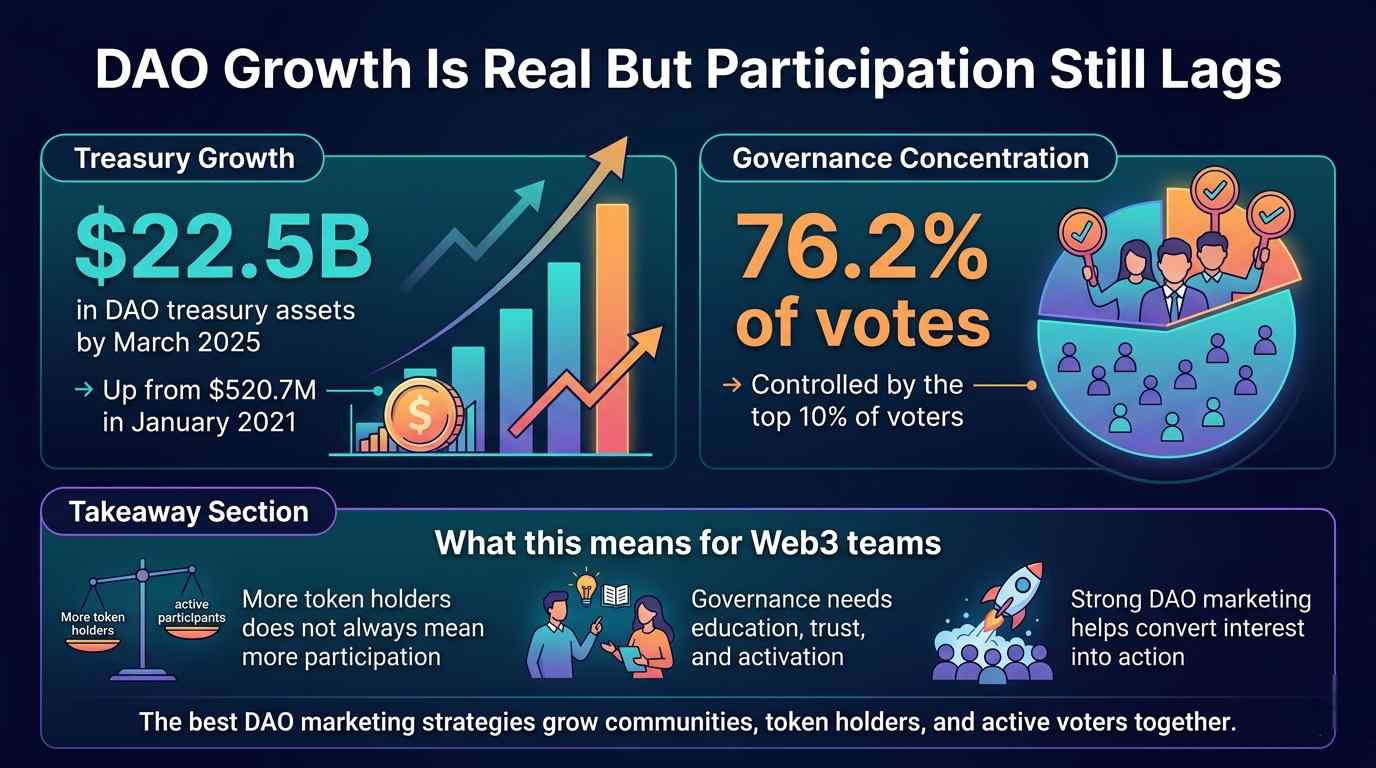
DAO marketing connects community building, token holder growth, governance participation, and long-term protocol growth. It turns attention into action: a follower joins the community, a holder learns the protocol, a voter studies proposals, a delegate earns trust, and a contributor starts useful work. DAOs have moved far beyond early Web3 experiments, with research showing DAO treasury assets growing from $520.7 million in January 2021 to $22.5 billion by March 2025.
At the same time, participation remains a major challenge. Research found that the top 10% of voters control 76.2% of total votes, showing that many ecosystems still struggle to turn token ownership into active governance. This creates a clear opening for founders, growth teams, and crypto marketing agencies. A strong DAO marketing plan helps Web3 projects convert passive interest into active support through education, community trust, token utility, proposal awareness, and clear calls to action.
What Is DAO Marketing?
DAO marketing is the practice of growing, educating, and activating a decentralized community around a shared protocol, treasury, token, or mission. It does not stop at awareness. It moves people from first contact to deeper participation.
A standard crypto campaign often focuses on reach, token demand, and trading interest. DAO marketing goes further. It asks a direct question: are people taking part in governance?
That work covers content, social media, community management, token holder education, delegate campaigns, proposal explainers, contributor onboarding, ecosystem partnerships, and retention. Each part supports the same goal. The DAO needs more people who understand the project and act on that understanding.
For a DAO, growth means more than a larger Discord server. Real growth shows up in voter turnout, proposal discussion, delegate discovery, treasury use, contributor activity, and stronger holder trust.
DAO Marketing Definition
DAO marketing is a specialized Web3 marketing strategy focused on attracting, educating, activating, and retaining token holders who take part in decentralized governance.
It helps people understand three core points:
- What the DAO does
- Why the token matters
- How each holder can take part
A strong DAO marketing system removes friction. It explains proposals in plain language. It reminds holders about votes. It gives delegates a clear public profile. It teaches new members how governance works. It gives contributors simple entry points.
The best DAO marketing does not treat token holders like a passive audience. It treats them like owners, voters, builders, and advocates.
How DAO Marketing Differs from Traditional Crypto Marketing
Cover the difference between short-term hype campaigns and long-term governance-led growth.
| Traditional Crypto Marketing | DAO Marketing |
|---|---|
| Focuses on awareness and token demand | Focuses on ownership, voting, and participation |
| Campaign-driven | Community and governance-driven |
| Web2-style audience targeting | Wallet-based and contribution-based segmentation |
| Passive investors | Active token holders and delegates |
| Vanity metrics | Governance participation, proposal activity, retention |
Why Businesses Need a DAO Marketing Strategy
DAOs need more than Discord activity or posts on X. Attention fades fast. Governance needs repeated education, clear timing, and trust.
A DAO marketing strategy helps teams improve proposal awareness, voter turnout, delegate discovery, token utility, contributor onboarding, and treasury-backed growth. It gives the community a reason to pay attention before each vote, not after decisions pass.
Low participation remains a common DAO problem. Many holders own governance tokens but never vote or delegate. Some do not understand the process. Some miss deadlines. Some do not see the value of taking part.
For Web3 businesses, that gap creates room for better marketing. Clear proposal content can bring holders back into governance. Delegate spotlights can help voters assign power with more confidence. Token utility campaigns can give holders stronger reasons to stay active.
A good DAO marketing plan turns governance into a habit. Members know where to learn, where to discuss, where to vote, and where to contribute. That is how DAO community growth becomes real protocol growth.
Why Governance Participation Is a Growth Metric, Not Just a Governance Metric
Governance participation shows the health of a DAO. It signals that holders care, understand the protocol, and can help make decisions without control from only a small group.
Voting is also a growth signal. Higher participation shows stronger education, holder trust, and token demand. Major votes often get more attention, while routine proposals need better reminders, explainers, and clear next steps.
The Problem of Passive Token Holders
Many DAOs have many holders but only a small group of voters. Some holders never join forums, read proposals, or remember vote deadlines.
Common reasons include:
- Unclear voting process
- Missed proposal deadlines
- Confusing governance forums
- Lack of trusted delegate information
- Weak token utility beyond price
- Belief that one vote does not matter
DAO marketing helps by turning complex governance into simple content, reminders, delegate profiles, and action steps.
How Low Governance Participation Hurts DAO Value
Low turnout weakens the DAO’s decentralization story and creates business risk. It can reduce trust, make proposals feel less credible, give whales more control, lower token utility, slow ecosystem work, and hurt partner or investor confidence.
Poor communication makes this worse. Clear proposal content helps holders understand what changes, who benefits, and why the vote matters.
Governance Participation as a Commercial Advantage
Active governance gives a DAO a stronger market position. It shows community health, holder conviction, product demand, and real token use beyond trading.
Strong participation can support partnerships, attract better builders to grants, improve contributor retention, and build trust with funds, exchanges, and ecosystem teams.
Not every holder must vote on every proposal. Some can delegate, some can learn first, and others can join working groups. The key is giving every holder a clear path to action.
Core Goals of DAO Marketing
DAO marketing should not chase empty attention. The main goal is to grow the number of aligned people who understand the protocol and take part in its future.
The work must connect token demand, education, governance action, and retention. A strong Web3 marketing strategy treats every holder as a future voter, delegate, builder, or advocate.
Grow Qualified Token Holders
Many teams ask how to grow DAO token holders. The better question is this: how do you grow the right holders?
A DAO does not need random wallets. It needs people who match the protocol’s mission and use case.
Qualified token holders can include:
- Product users
- Long-term investors
- Contributors
- Validators
- Liquidity providers
- Grant applicants
- Ecosystem partners
- Delegates
- Builders
- Active voters
This kind of token holder growth starts with clear positioning. People need to know what the DAO controls, what the token does, and why participation matters.
Content should explain the protocol in plain terms. Campaigns should show real use cases. Community teams should guide new holders toward forums, votes, delegate pages, and working groups.
Increase Governance Participation
The next goal is to increase DAO voting participation. Voting matters, but it is only one part of governance activity.
A healthy DAO also needs:
- Forum comments
- Proposal drafts
- Delegate discussions
- Working group updates
- Grant reviews
- Community calls
- Treasury feedback
- On-chain or off-chain votes
DAO marketing can support each step. Proposal explainers help holders understand choices. Vote reminders reduce missed deadlines. Delegate content helps busy holders assign voting power. Community recaps keep people informed without making them read every forum thread.
Improve Token Utility and Holder Retention
A DAO token needs a clear job. Marketing should keep that job visible.
Token utility can include:
- Voting rights
- Delegation
- Staking
- Access to community spaces
- Contributor reputation
- Grant access
- Rewards
- Ecosystem privileges
- Partner benefits
Holders stay longer when they understand the token’s role. They engage more when that role connects to real decisions and real benefits.
Good DAO marketing links token utility to daily community activity. A holder should know where to vote, who to delegate to, how to earn reputation, and how to join funded work.
Build a Sustainable Web3 Community Growth Engine
DAO marketing is not a launch campaign. It is an ongoing growth system.
A launch can bring attention. A real system keeps people active after the first wave fades. That system includes content calendars, proposal workflows, delegate updates, onboarding tracks, analytics, partner campaigns, and community feedback loops.
A sustainable Web3 community growth engine should answer four simple questions:
- Who should join?
- What should they learn?
- What action should they take next?
- What reason will bring them back?
The best DAO teams treat marketing and governance as connected work. They build education, reminders, and trust into every stage of the holder experience.
DAO Marketing Funnel: From Awareness to Governance Participation
DAO marketing works best as a funnel. People need context, trust, and clear next steps before they buy tokens, vote, delegate, or contribute.
A strong DAO funnel has five stages:
- Awareness: Attract the right audience
Bring relevant Web3 users into the DAO’s orbit, such as liquidity providers, builders, collectors, players, creators, or governance users. Use SEO, founder posts, contributor thought pieces, AMAs, PR, partnership news, token utility explainers, and community threads. - Education: Build trust
Help new followers and holders understand how the DAO works. Create simple guides for governance, token utility, voting, delegation, proposals, wallets, dashboards, quorum, and delegate roles. - Acquisition: Convert users into holders
Connect token ownership to real utility, product use, access, rewards, or status. Use token utility campaigns, quests, grants, referrals, partner integrations, staking education, token-gated access, and product-led acquisition. - Activation: Turn holders into participants
Move passive holders into governance and community action. Use vote reminders, proposal summaries, delegate pages, forum prompts, governance recaps, voting walkthroughs, and clear calls to action. - Retention: Keep holders engaged
Maintain long-term participation with regular updates. Share governance calendars, DAO updates, delegate reports, treasury updates, grant reports, vote recaps, contributor spotlights, and roadmap progress.
Together, these stages turn strangers into informed holders, active voters, delegates, and long-term contributors.
Need a stronger DAO community growth plan?
Create clear onboarding, governance content, holder updates, and contributor paths that keep your DAO active beyond launch.

DAO Governance Participation Framework
A DAO governance participation framework helps marketing teams increase community involvement and strengthen holder trust. The focus is on real actions like voting, delegation, comments, and contributor growth.
Key Steps in the Framework
- Segment Token Holders
Using a Web3 CRM, DAOs can group holders by wallet activity, voting history, liquidity participation, NFT ownership, and more. Different groups need different messaging. For example, new holders need onboarding, while active voters need deeper governance insights. - Identify Participation Barriers
Low participation often comes from confusion or friction. Common issues include technical proposals, complicated voting, gas fees, lack of time, and poor communication. Simplified content and better onboarding help solve these problems. - Build Proposal Awareness Campaigns
Strong campaigns explain proposals clearly before voting starts. Effective tactics include summaries, social posts, email reminders, wallet notifications, countdowns, and vote recaps. The goal is to help holders understand what changes and why it matters. - Encourage Delegation
Delegation allows token holders to assign voting power to trusted delegates while keeping token ownership. Marketing teams can support this with delegate profiles, tutorials, interviews, and voting transparency. - Measure Governance Performance
DAOs should track metrics such as voter turnout, delegation rate, forum activity, proposal engagement, holder retention, and participation cost. These insights help teams improve governance campaigns over time.
Best DAO Marketing Channels for Growing Token Holders
DAO marketing works best when each channel has a clear role. The goal is not to post everywhere, but to guide the right people from awareness to action.
SEO and content marketing
create long-term growth. DAOs can use governance guides, token utility pages, proposal explainers, case studies, ecosystem reports, and “how to participate” tutorials to attract readers and answer holder questions.
Social media
builds reach, trust, and public proof. X, LinkedIn, Farcaster, Lens, Reddit, podcasts, and short videos can share governance reminders, proposal snippets, community wins, treasury updates, founder posts, and vote recaps.
Discord and Telegram
support daily community contact. Clear channels for announcements, governance, proposals, voting help, grants, working groups, onboarding, support, and events help holders find what they need quickly.
Influencers and KOLs
can support token holder growth when they understand governance, not just price action. Strong partners include Web3 educators, DeFi researchers, validators, delegates, developer advocates, NFT leaders, and gaming guilds.
Email, newsletters, and wallet messages
bring holders back at key moments. They work well for governance digests, vote alerts, delegate updates, treasury reports, grant deadlines, product updates, and community call reminders.
PR and thought leadership
build credibility. DAO founders, contributors, and delegates can use interviews, crypto media features, ecosystem reports, partnership news, grant launches, and transparency updates to explain the DAO’s mission and progress.
Technical Components of DAO Marketing
DAO marketing is not only content and community. The technical setup matters too. Poor tools can block participation. Clear tools can make voting feel simple.
A strong technical base helps teams track holders, guide votes, manage delegation, and protect trust.
Governance Platforms and Voting Tools
Governance platforms shape the holder experience. A confusing voting page can reduce turnout. A clear one can move more holders from interest to action.
Common tools and concepts include:
- Snapshot
- Tally
- Safe
- Boardroom
- Aragon
- Governor contracts
- On-chain governance
- Off-chain governance
- Multisig treasury control
- Delegated voting
Snapshot-based voting often records token balances at a specific block. This helps determine voting power and reduce risks from post-announcement token movement.
On-chain governance gives stronger transparency. Off-chain voting can reduce friction and fees. Many DAOs use both at different stages.
Wallet Analytics and On-Chain Attribution
Wallet analytics helps DAOs see which campaigns bring real holders and voters. It gives teams a clearer view than social likes or website visits alone.
A DAO can measure:
- Which campaigns attract token holders
- Which holders vote
- Which wallets delegate
- Which channels drive governance activity
- Which cohorts retain tokens longest
- Which holders join quests or grants
- Which communities bring active contributors
This data supports sharper DAO marketing. A campaign may bring many wallets but few voters. Another campaign may bring fewer holders but stronger governance activity. The second campaign may be more valuable.
Token-Gated Marketing Campaigns
Token-gated campaigns give holders a reason to stay close to the DAO. They can reward participation, create access, and strengthen community ties.
Useful examples include:
- Holder-only webinars
- Token-gated reports
- Governance bootcamps
- Private contributor channels
- Early product access
- Partner rewards
- Grant workshops
- Beta testing groups
These campaigns work best when they match the token’s purpose. A governance token should unlock governance education, delegate access, proposal support, or contributor paths.
Smart Contract and Governance UX
Governance UX can make or break participation. Holders leave when they get lost. Turnout drops when voting takes too many steps.
DAOs can improve the experience with:
- Clear vote buttons
- Simple delegation path
- Gasless voting where suitable
- Mobile-friendly voting pages
- Proposal summaries
- Delegate discovery pages
- Governance notification system
- Clear quorum and deadline details
- Plain vote result pages
Small UX changes can create large gains. A short proposal summary can save a holder 20 minutes. A clear delegate page can turn an inactive holder into a represented holder.
Security, Compliance, and Reputation Management
DAO marketing must protect trust. Misleading token promotion can damage the project. Fake engagement can harm credibility. Unrealistic ROI claims can create legal and reputational risk.
Strong DAO marketing avoids:
- Guaranteed return claims
- Misleading token demand claims
- Fake followers or fake comments
- Hidden paid promotions
- Wash trading narratives
- Non-compliant incentive programs
- Pressure-based token campaigns
Good marketing focuses on utility, governance rights, product value, community access, and public contribution. It explains risks in plain language. It keeps records clear and claims grounded.
DAO Marketing Strategies to Increase Governance Participation
Governance participation grows through clear education, steady reminders, and trust. Token holders need to understand each vote before they act. They need simple paths, clear deadlines, and proof that their voice matters.
A strong DAO marketing strategy treats every proposal like a product campaign. The team explains the issue, shows the stakes, and guides holders toward the next action.
Create Proposal Explainer Campaigns
A proposal can fail to gain attention if it feels too technical. Many holders skip votes that look complex. A proposal explainer fixes that problem.
Each explainer should answer six questions:
- What is being proposed?
- Why does it matter?
- Who is affected?
- What are the risks?
- What happens after approval?
- How can token holders vote?
Use short posts, email alerts, forum summaries, and video explainers. Keep the language simple. Avoid legal or developer-heavy terms where possible.
Build a Delegate Marketing Program
Delegates help busy holders take part in governance. They review proposals, share public views, and vote with assigned power. This helps DAOs reach holders who care but lack time.
A delegate marketing program can include:
- Delegate profiles
- Delegate interviews
- Voting history pages
- Delegate scorecards
- Community debates
- Delegate office hours
- “Choose your delegate” campaigns
Each delegate profile should explain voting values, areas of skill, past votes, and public contact links. Holders should compare delegates in minutes, not hours.
Launch Governance Education Sprints
Governance education works best in short bursts. A sprint gives holders a clear start and finish. It creates a shared learning moment across the community.
Useful sprint ideas include:
- 7-day governance onboarding challenge
- “How to vote” video series
- DAO governance bootcamp
- Proposal review workshops
- Contributor onboarding sessions
- Delegate discovery week
- Treasury education sessions
Each sprint should end with a clear action. Vote on a live proposal. Delegate voting power. Join a working group. Comment on a forum thread.
Use Incentives Without Creating Low-Quality Participation
Incentives can raise participation, but they need care. Paying people for empty votes can damage trust. It can fill governance with low-quality activity and weak opinions.
Better incentive models reward effort, learning, and long-term contribution. Strong options include:
- Reputation points
- Contribution badges
- Governance NFTs
- Non-transferable credentials
- Delegate recognition
- Contributor grants
- Attendance-based rewards
- Long-term participation rewards
Reward holders for reading proposals, joining workshops, writing useful comments, and staying active across several votes. Do not pay people to vote without context.
Gamify DAO Participation
Gamification can make governance feel less dry. It gives holders visible progress and simple goals. Used well, it turns participation into a habit.
DAO participation campaigns can use:
- Governance leaderboards
- Participation streaks
- Proposal review quests
- Delegate badges
- Working group achievements
- Contributor levels
- Forum reputation scores
- Voter milestone rewards
Gamification should support serious action. A leaderboard should reward helpful comments, proposal reviews, and repeated participation. It should not reward spam.
Improve Proposal Timing and Communication Cadence
Many holders miss votes through poor timing. They hear about a proposal too late, or they never see the deadline. Better communication can raise turnout fast.
Best practices include:
- Announce proposals before voting opens
- Use plain-language summaries
- Send reminders before voting closes
- Host live discussions
- Publish post-vote outcomes
- Explain next steps after execution
- Keep a public governance calendar
A simple cadence works well. Share the proposal preview. Open discussion. Announce the vote. Send two reminders. Publish the result. Share execution progress.
Want your DAO proposals to get more attention?
DAO Marketing Strategies to Grow Token Holders
Token holder growth should focus on quality. A DAO needs people who understand the mission and use the product. It needs holders who vote, delegate, contribute, and stay through market cycles.
More wallets can look good on a chart. Better holders create real growth.
Position the Token Around Utility, Not Speculation
A DAO token needs a clear purpose. Marketing should explain utility before price talk. Holders should know what the token lets them do.
Token utility can include:
- Governance rights
- Product access
- Staking
- Ecosystem rewards
- Reputation
- Contributor access
- Grant access
- Partner perks
- Community status
Strong positioning answers one question: what can a holder do with this token today?
Speculation attracts short-term attention. Utility attracts better holders. A clear utility story helps people understand why ownership matters beyond trading.
Build Product-Led Token Holder Acquisition
Product-led token growth starts with use. People discover value through the product, then become holders through access, rights, or rewards.
Examples include:
- DeFi users earning governance rights
- NFT holders receiving DAO access
- Game players becoming ecosystem voters
- SaaS users joining protocol governance
- Developers receiving contribution-based tokens
- Liquidity providers receiving voting power
- Creators joining tokenized community programs
This model works well since users already understand the product. They have a reason to care. The token becomes part of their deeper role.
Use Partner Ecosystems to Reach Qualified Holders
Partnerships help DAOs reach people who already understand Web3. These audiences often need less basic education and can act faster.
Strong partner channels include:
- Layer 1 ecosystems
- Layer 2 ecosystems
- DeFi protocols
- NFT marketplaces
- Gaming guilds
- Developer communities
- Launchpads
- Wallet providers
- Analytics platforms
The best partnerships connect to real utility. A wallet partner can help with holder onboarding. A DeFi partner can bring liquidity users. A developer community can bring contributors.
Create SEO Landing Pages for Commercial Intent
SEO landing pages help DAOs and Web3 service firms capture high-intent search traffic. These pages target people ready to compare vendors, services, or growth support.
Useful landing pages include:
- DAO marketing services
- DAO community growth agency
- Token holder acquisition services
- Web3 governance marketing
- Crypto community management services
- DAO launch marketing
- DeFi marketing agency
- Web3 PR services
- Blockchain marketing services
Each page should explain the service, target audience, process, proof, and expected outcomes. Use plain examples. Show how the work supports token holder growth and governance participation.
Run Retargeting Campaigns for High-Intent Audiences
Retargeting brings warm audiences back. These people already showed interest. They read a guide, joined a webinar, visited a proposal page, or connected a wallet.
Useful retargeting audiences include:
- Website visitors
- Governance guide readers
- Webinar attendees
- Proposal page visitors
- Wallet-connected users
- Previous voters
- Inactive token holders
- Delegate page visitors
- Grant program visitors
Retargeting should match the person’s last action. A governance guide reader can receive a voting tutorial. A proposal page visitor can receive a deadline reminder. An inactive holder can receive a delegation prompt.
Conclusion
DAO marketing turns token holders into active voters, delegates, contributors, and long-term supporters. It works best with clear education, strong community systems, useful token positioning, proposal awareness campaigns, and steady holder communication. For DAOs that want to grow governance participation and attract better token holders, expert support can make the process faster and more focused. Blockchain App Factory provides DAO marketing services that help Web3 projects build stronger communities, improve token holder growth, and create practical campaigns for long-term governance activity.

Vimal J is the Head of Sales at Blockchain App Factory, with 10+ years of experience in sales, client strategy, and Web3 business growth. He helps startups, enterprises, and project founders choose the right blockchain solutions for their goals, bringing a practical market perspective to topics like token development, crypto launches, and Web3 adoption.