


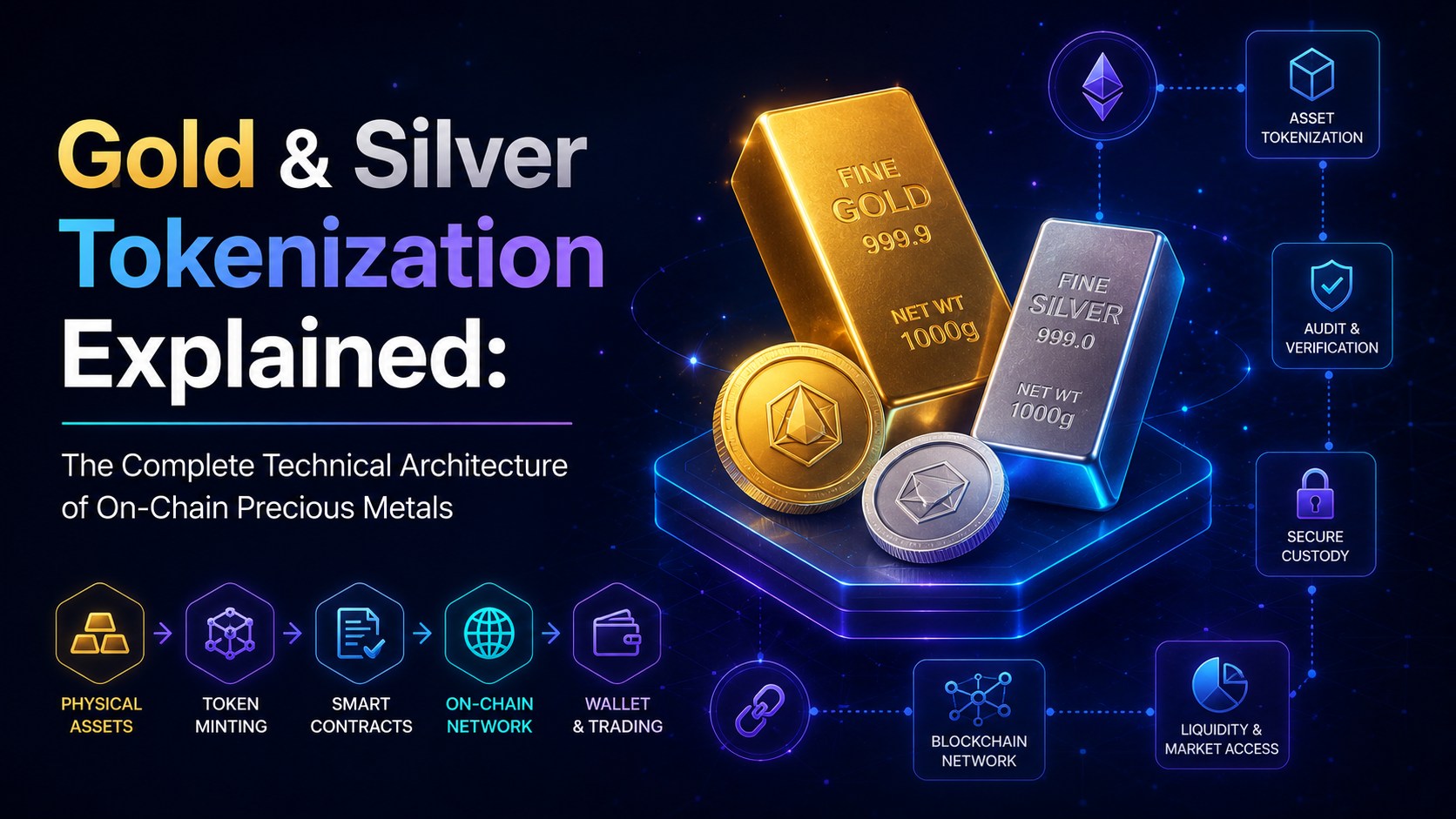

Commodities like gold and silver have served as foundational stores of value for thousands of years. Throughout economic cycles, periods of hyperinflation, and systemic banking crises, physical precious metals have remained the ultimate hedge. However, the traditional infrastructure surrounding the storage, trading, and settlement of these physical metals is notoriously inefficient and outdated.
2025 proved to be a watershed year for Real World Assets (RWAs), with the sector’s total market capitalization tripling to reach $19.3 billion by the end of Q1 2026. While the broader RWA ecosystem encompasses a vast array of assets including real estate, private credit, government treasuries, and equities, this guide focuses exclusively on the tokenization of physical gold and silver. By creating immutable digital representations of physical bullion on blockchain networks, investors are now combining historic stability with the programmable efficiency, fractional ownership, and instant settlement of modern decentralized finance.
Understanding Commodity Tokenization
Tokenization is the process of issuing a digital token on a blockchain that represents a specific unit of an underlying physical asset. In the context of precious metals, a single token typically represents one troy ounce, one gram, or one kilogram of physical gold or silver stored in a secure, audited vault.
Unlike synthetic price trackers or algorithmic stablecoins, true gold and silver tokens are fully asset-backed. The physical metal exists in the real world, and the digital token acts as a cryptographic deed of ownership. When the token is transferred between wallets on the blockchain, the legal ownership of the physical metal in the vault transfers simultaneously. This seamless transfer of value eliminates the need to physically transport heavy bullion across borders.
This innovation bridges the gap between the tangible security of hard assets and the borderless liquidity of digital networks. Investors no longer have to choose between the safety of physical commodities and the convenience of modern financial technology.
2026 Market Analysis: The Commodity Tokenization Surge
The growth of tokenized commodities has accelerated at an unprecedented pace over the last fifteen months. According to recent market reports, tokenized commodities rose from $1.4 billion to over $5.5 billion by Q1 2026, a growth rate of 289%. This expansion signals a deep institutional confidence in on-chain precious metals as a core component of the global financial stack.
$90.7B
Q1 2026 Gold Spot Volume
289%
Commodity Market Growth
Key highlights from the Q1 2026 commodity landscape include:
- Gold Token Dominance: Gold-backed tokens like XAUT and PAXG continue to lead the sector, with XAUT reaching a market capitalization of $2.52 billion and PAXG reaching $2.32 billion.
- Silver Token Expansion: Kinesis’ silver-backed token (KAG) more than doubled in value during this period, reaching $0.35 billion as investors seek diversified precious metal exposure.
- Unprecedented Liquidity: Spot trading on tokenized gold reached a staggering $90.7 billion in the first quarter of 2026 alone, already surpassing the total trading volume recorded for the entire year of 2025.
- Institutional Access: Centralized exchanges (CEXs) are now the primary drivers of adoption, providing specialized infrastructure for trading tokenized commodities with the same ease as traditional stocks.
The Flaws of Traditional Gold and Silver Markets
To fully appreciate the necessity of tokenization, one must understand the friction points inherent in traditional precious metal investments. Historically, investors had two main options for gaining exposure to gold and silver, and both come with significant drawbacks.
The Problem with Physical Bullion
Purchasing physical coins or bars provides direct ownership, but it requires the investor to manage security. Storing metals at home poses a massive security risk, while utilizing professional vaulting services incurs high recurring storage and insurance fees. Furthermore, selling physical bullion is a slow process that often requires shipping the metal back to a dealer and accepting significant dealer premiums that erode profit margins.
The Problem with ETFs and Paper Commodities
Exchange-Traded Funds (ETFs) solved the storage issue by allowing investors to buy shares of a fund that holds the physical metal. However, an ETF is merely a paper claim. Investors do not actually own the underlying gold or silver. Instead, they are unsecured creditors of the fund. In a severe financial crisis, retail investors generally do not have the right to redeem their ETF shares for physical bullion. Additionally, ETFs trade only during standard market hours and involve layers of intermediary fees.
Tokenization solves the flaws of both systems. It provides the direct legal ownership of physical bullion without the personal burden of storage, alongside 24/7 liquidity and borderless transferability.
The Foundation: LBMA Standards and Legal Structures
For a tokenized precious metal ecosystem to be credible, it must adhere to the highest institutional standards. Legitimate tokenization platforms strictly utilize metals that meet the specifications of the London Bullion Market Association (LBMA).
LBMA Good Delivery Specifications:
- Gold Purity: Gold bars must have a minimum fineness of 995.0 parts per thousand.
- Silver Purity: Silver bars must have a minimum fineness of 999.0 parts per thousand.
- Provenance: Metals must be sourced from certified refiners to ensure ethical supply chains and prevent the introduction of conflict minerals.
- Serialization: Every bar must have a unique serial number stamped onto it for precise tracking and auditing.
Beyond physical purity, the legal structure is equally vital. Top-tier RWA issuers utilize a legal concept known as a Special Purpose Vehicle (SPV) or establish a direct bailment relationship with the token holder. This means the issuer never actually owns the metal on their balance sheet. Instead, the issuer acts strictly as a technology provider bridging the vault and the blockchain. If the token issuing company goes bankrupt, the physical gold and silver remain safe in the vault, legally belonging to the token holders. This bankruptcy remoteness is a critical security feature for institutional adoption.
Deep Dive: The Technical Architecture of Tokenized Metals
Creating a secure environment for tokenized gold and silver requires a sophisticated technology stack that links physical custody with smart contract execution. The architecture must guarantee that digital representations always accurately reflect real-world holdings.
Here is a visual representation of how this robust infrastructure connects physical vaults to the decentralized ecosystem:
Gold & Silver Tokenization Architecture
Layer 1: Physical Custody and Verification
LBMA Vaults
Brinks / Loomis
Independent Auditors
Layer 2: The Data Bridge and Security
Fetching Vault APIs
Automated Transparency
Layer 3: On-Chain Ecosystem
Secure Minting Engine
DeFi Integration
Global Investors
This multi-layered approach ensures that the digital tokens are fundamentally tethered to physical reality. The absolute separation of physical custody from the digital tokenization engine is crucial for maintaining systemic security and preventing single points of failure.
Proof of Reserves: Solving the Trust Problem
The most significant challenge in tokenizing physical assets is institutional trust. How can an investor holding a digital token halfway across the world be absolutely certain that the corresponding physical gold or silver actually exists in a vault in London or Switzerland?
In the past, financial markets relied on periodic, manual audits. These audits were expensive, slow, and often became outdated the moment they were published. This opacity is exactly what led to historical issues in traditional commodity trading. Today, modern Real World Asset architecture utilizes automated Proof of Reserves mechanisms powered by decentralized oracle networks.
How Decentralized Proof of Reserves Works:
- Highly respected independent auditors physically inspect the vaults to verify the exact quantity, purity, and serial numbers of the stored bullion.
- Decentralized oracle networks continually fetch this verified audit data directly from the custodian’s secure application programming interfaces.
- This data is pushed to the blockchain in real time, creating an immutable and transparent record of the off-chain reserves.
- On-chain smart contracts are programmed to compare the total circulating supply of the digital token with the reported physical reserves.
- If the smart contract detects that the physical reserves have fallen below the token supply, it automatically triggers a circuit breaker to halt further minting. This prevents any possibility of an infinite mint exploit and ensures absolute 1:1 collateralization at all times.
This trust-minimized verification system is the dividing line between true commodity tokens and unbacked digital claims. It provides unprecedented transparency, allowing anyone with an internet connection to verify the backing of their assets directly on the blockchain without trusting a central authority.
The Lifecycle of a Tokenized Commodity
To grasp the operational efficiency of this system, it is helpful to walk through the exact lifecycle of how tokenized gold and silver are created and retired.
The Minting Process
The process begins when an authorized participant deposits fiat currency with the tokenization platform. The platform uses these funds to purchase physical gold or silver from a certified liquidity provider. The purchased bullion is securely transported to an institutional vault. Once the vault confirms receipt and the independent auditor verifies the serial numbers, the decentralized oracle updates the total reserve count on the blockchain. Only after this rigorous verification is complete does the smart contract mint the corresponding tokens and deliver them to the user’s digital wallet.
The Redemption Process
True tokenized commodities must offer physical redemption. When a user wishes to redeem their tokens, they initiate a burn request through the platform. The smart contract destroys the digital tokens, reducing the circulating supply. The user must then pass rigorous Know Your Customer and Anti-Money Laundering checks. Once verified, the user can either have the equivalent physical bullion securely shipped to their registered address or choose to collect it directly from the vaulting facility. This direct redemption mechanism tightly pegs the digital token’s value to the physical spot price of the metal, eliminating arbitrary price premiums.
Unlocking Decentralized Finance with Gold and Silver
Once a precious metal is represented as an ERC-20 token or an equivalent standard, its utility expands exponentially. Rather than sitting dormant in a vault, the metal becomes productive capital within the decentralized financial ecosystem. Key applications include the following operational models.
Stablecoin Collateralization
Gold-backed tokens are frequently used to collateralize new forms of stablecoins. By backing a currency with physical commodities rather than fiat reserves, protocols can create decentralized money that inherently resists fiat inflation and central bank monetary dilution.
Lending and Derivatives Markets
Investors can deposit tokenized silver or gold into lending protocols to earn interest yields. Furthermore, the rise of RWA perpetuals has seen volumes jump to $524.8 billion in Q1 2026, allowing sophisticated traders to gain leveraged exposure to precious metals on-chain.
On-Chain Treasury Management
DAOs and corporate entities use tokenized commodities to diversify their on-chain treasuries. This allows them to manage risk and protect capital reserves from both crypto market volatility and traditional banking sector contagion while maintaining high liquidity.
Overcoming Regulatory and Security Challenges
While the architectural benefits are profound, tokenizing precious metals involves navigating intense regulatory compliance. Asset issuers must operate strictly within the bounds of securities laws, commodity trading commission guidelines, and international financial regulations.
To address these challenges, leading tokenization platforms embed compliance directly into the token’s smart contract logic.
- Enforcing geographic restrictions to prevent residents of sanctioned countries from holding the tokens.
- Integrating identity verification layers so tokens can only be transferred between whitelisted addresses when required by law.
- Maintaining comprehensive vault insurance and physical security audits to satisfy institutional risk committees.
- Ensuring the legal framework absolutely protects token holders in the event of corporate liquidation.
By addressing these regulatory hurdles proactively, platforms build the necessary institutional trust required for mass adoption.
Final Thoughts on the Future of Commodity RWAs
The tokenization of gold and silver represents a monumental leap forward in how global markets interact with historical stores of value. By merging institutional-grade physical custody with blockchain-based Proof of Reserves, investors gain unparalleled transparency, ironclad security, and limitless liquidity.
As decentralized finance continues to mature and traditional financial systems seek greater efficiency, tokenized commodities will undoubtedly serve as the bedrock collateral for a new generation of on-chain financial products. For modern enterprises and financial institutions, building the robust infrastructure to support these real-world assets is not just an optional technological upgrade; it is an absolute necessity. Blockchain App Factory stands as the ultimate hub for this transition, providing the foundational architecture required to bring legacy assets onto the blockchain.
Launch Your Tokenized Commodity Platform
Connect with Blockchain App Factory, the central hub for RWA development. Build secure, compliant, and transparent infrastructure for precious metals with our elite tokenization experts today.


