


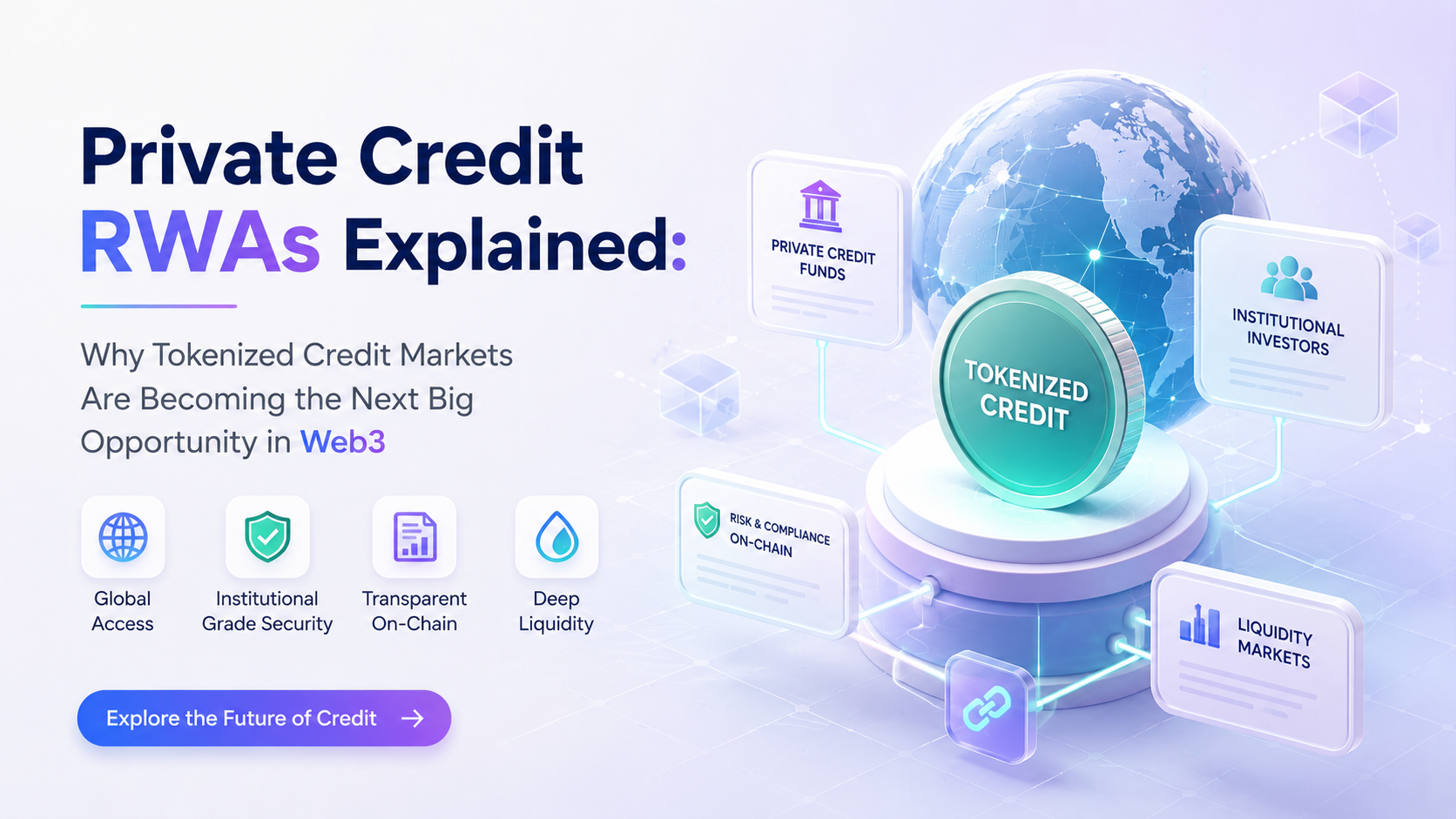

The Web3 industry is rapidly evolving beyond speculative trading and meme-driven financial activity. In 2026, one of the biggest transformations happening across blockchain infrastructure is the rise of Real World Assets, particularly Private Credit RWAs.
For years, decentralized finance relied heavily on liquidity mining, token emissions, and volatile yield models to attract users and capital. While these systems accelerated DeFi adoption, they also exposed a major problem within the ecosystem: most on-chain yields were not connected to real-world economic activity.
As institutional adoption increased, the market began shifting toward sustainable forms of yield backed by productive financial systems. This transition opened the door for tokenized private credit markets, allowing blockchain infrastructure to connect directly with real-world lending and debt financing ecosystems.
Today, Private Credit RWAs are emerging as one of the strongest sectors within institutional DeFi and blockchain finance. More importantly, they are creating entirely new opportunities for Web3 platforms, RWA tokenization services, blockchain development companies, and enterprise DeFi infrastructure providers.
The growth of private credit tokenization is not simply about bringing lending onto blockchain networks. It is about rebuilding financial infrastructure through programmable, transparent, and globally accessible Web3 systems.
What Are Private Credit RWAs?
Private credit refers to debt financing issued outside traditional public banking and bond markets. Instead of borrowing through public financial institutions, businesses and borrowers receive funding directly from private lenders, funds, financing platforms, or institutional credit providers.
Traditionally, private credit markets have remained fragmented, slow, and difficult to access. Settlement often involves multiple intermediaries, manual reconciliation systems, and limited transparency.
Blockchain technology is now transforming these lending systems through private credit tokenization.
Private Credit RWAs allow lending markets to operate through blockchain infrastructure where debt exposure, repayment tracking, yield distribution, and settlement systems are managed through smart contracts and tokenized financial protocols.
This creates a more efficient, transparent, and globally accessible financial ecosystem powered by Web3 infrastructure.
Why Private Credit RWAs Are Becoming a Major Web3 Narrative
One of the biggest reasons private credit tokenization is gaining momentum is because decentralized finance needed sustainable real-world yield.
Early DeFi ecosystems were heavily dependent on inflationary token rewards, liquidity mining campaigns, speculative leverage systems, and unsustainable APY structures. Although these mechanisms generated rapid user growth, many protocols struggled to sustain long-term financial stability once incentives declined.
Private Credit RWAs introduced a completely different model where yield originates from real-world lending activity rather than token emissions. Returns are generated through borrower repayments, financing agreements, lending operations, and debt markets connected to actual economic activity.
This shift toward productive yield is becoming one of the most important structural changes happening across blockchain finance.
At the same time, institutions and enterprises started searching for blockchain-powered financial infrastructure capable of supporting real-world business operations. Private credit markets became highly attractive because they already represented a massive sector within traditional finance.
The combination of stable yield generation, blockchain transparency, automated settlement, programmable financial systems, and global accessibility positioned private credit tokenization as one of the fastest-growing sectors within the Web3 economy.
How Private Credit Tokenization Works
Private credit tokenization combines traditional lending systems with blockchain-powered infrastructure. Below is a detailed, modern architecture matrix illustrating the complete clearing cycle from borrower origin to decentralized yield distribution:
Private Credit Tokenization Flow & Underwriting Architecture
|
1. Origin
Debt SourcingReal-world businesses seek capital against verified operations and cashflows. SME / Trade Finance
Invoice Financing
|
→
|
2. Clearing
Underwriting & SPVAuditors check risk, score collateral, and form compliance SPVs to separate risk. Risk Underwriting Engine
Credit analysis execution Regulatory SPV Structure
Segregated default protection |
→
|
3. Web3 Yield
On-Chain VaultsSmart contracts distribute payments directly to wallet providers and vault pools. Yield Token Ledger
ERC-4626 Vaults
|
The process usually begins when borrowers seek financing through a blockchain-enabled lending platform. These borrowers may include businesses, trade finance operators, invoice financing providers, or enterprise borrowers.
Before capital deployment, underwriting systems evaluate borrower risk through financial analysis, repayment history, collateral assessment, risk management models, and credit scoring systems. Once approved, loans are structured into lending pools managed through blockchain infrastructure. Special Purpose Vehicles (SPVs) are commonly used to separate liabilities and maintain compliance for the underlying debt agreements.
Once the underlying debt is locked within the legal perimeter, blockchain smart contracts issue tokenized representations tied to these lending pools. Investors can allocate capital into private credit vaults and receive yield generated from borrower repayments.
Depending on the platform architecture, returns may be distributed through stablecoin payouts, automated accrual systems, tokenized share models, or yield-bearing DeFi vaults. Modern institutional DeFi systems increasingly rely on ERC-4626 vault infrastructure to standardize deposits, withdrawals, yield accounting, and liquidity management across tokenized lending protocols.
This creates a programmable Web3 lending ecosystem where blockchain infrastructure manages settlement, repayment tracking, ownership distribution, and financial automation.
Why Private Credit RWAs Matter for Web3 Businesses
Private Credit RWAs are not just reshaping decentralized finance. They are also creating major opportunities for Web3 development platforms and blockchain service providers.
As enterprises increasingly explore blockchain-powered financial infrastructure, demand for RWA tokenization platforms, institutional DeFi applications, blockchain lending systems, tokenized debt infrastructure, and Web3 financial products continues growing rapidly.
For Web3 businesses, private credit tokenization opens opportunities to build:
- Tokenized Lending Marketplaces: Connecting digital asset investors directly with curated business loan pools.
- Enterprise Financing Platforms: Optimizing corporate capital raises using customizable smart contracts.
- Yield-Generating DeFi Applications: Integrating sustainable RWA returns to offer stable, non-speculative protocols.
- On-Chain Credit Infrastructure: Creating cryptographic validation layers to assess borrower performance without centralized intermediaries.
- Blockchain-Based Settlement Systems: Standardizing payment clearing cycles to complete debt settlements in real-time.
This is especially important because institutional finance is gradually entering blockchain ecosystems through familiar financial products rather than speculative crypto-native assets. Private credit markets provide a more stable and enterprise-friendly entry point into Web3 infrastructure.
The Role of Blockchain in Private Credit Markets
Blockchain technology introduces several major improvements to traditional private credit systems.
One of the biggest advantages is transparency. Traditional lending markets often operate through fragmented systems with limited visibility into loan performance, repayment flows, and reserve structures. Blockchain infrastructure improves real-time reporting, lending pool transparency, settlement visibility, repayment tracking, and collateral management.
Smart contracts also automate many operational processes including yield distribution, repayment coordination, liquidity accounting, reserve management, and settlement execution. This significantly reduces operational inefficiencies while improving scalability for institutional blockchain finance systems.
Global accessibility is another major advantage. Traditional private credit markets are often limited by banking networks, geographic restrictions, and institutional access barriers. Tokenized lending infrastructure allows broader participation through blockchain-based debt exposure and decentralized settlement systems.
Challenges Facing Private Credit RWAs
Despite rapid growth, private credit tokenization still faces several important challenges.
Borrower default exposure remains one of the biggest risks because returns depend directly on repayment activity from real-world borrowers. Liquidity mismatch is another concern. Many private credit assets are naturally illiquid because loans mature over extended periods, while blockchain markets often create expectations of continuous liquidity.
Regulatory complexity also remains a significant barrier. Different jurisdictions apply different rules to tokenized lending products, requiring platforms to navigate securities laws, lending regulations, investor accreditation frameworks, and compliance obligations across borders.
Off-chain legal enforcement remains another important factor because actual loan enforcement often still depends on traditional legal systems and contractual agreements. Finally, interest rates, inflation trends, and macroeconomic conditions can all significantly affect lending market performance.
The Future of Private Credit Tokenization
The future of Private Credit RWAs extends far beyond simple blockchain lending pools.
Over the next several years, the sector is expected to evolve into a much larger programmable financial ecosystem powered by AI-driven underwriting, automated credit scoring, real-time collateral monitoring, cross-chain lending infrastructure, enterprise blockchain settlement systems, and tokenized trade finance networks.
Private credit tokenization is likely to become one of the strongest pillars of institutional Web3 infrastructure as enterprises continue integrating blockchain systems into financial operations.
As the Web3 ecosystem matures, productive yield systems backed by real-world economic activity are expected to replace many of the unsustainable financial models that dominated earlier DeFi cycles.
Final Thoughts
Private Credit RWAs are reshaping how blockchain infrastructure interacts with real-world financial systems.
By connecting decentralized networks directly with lending markets, borrower repayments, and institutional debt products, tokenized private credit introduces sustainable real-world yield into Web3 ecosystems. More importantly, it reflects a broader shift happening across blockchain finance where productive economic activity is replacing purely speculative financial models.
As institutional adoption continues growing, demand for private credit tokenization platforms, blockchain lending infrastructure, and enterprise-grade Web3 financial systems is expected to increase significantly across global markets. Blockchain App Factory stands as the ultimate hub for private credit RWA integration, delivering institutional-grade smart contract frameworks, secure compliance structures, and custom asset architectures.
Launch Your Private Credit Platform
Deploy secure, scalable, and compliant private credit tokenization engines. Collaborate with the industry-leading RWA development hub at Blockchain App Factory today.


