Key Insights
- Top centralized exchanges processed trillions in trading volume during 2025 and 2026. Strong liquidity and faster trade execution keep CEX platforms in high demand.
- A basic exchange can start around $40,000, but enterprise-grade platforms can exceed $1 million. Features like futures trading, fiat support, and risk engines increase the budget.
- Modern exchanges need strong KYC, wallet security, and fraud monitoring from the start. Users and regulators now expect safer and more transparent trading platforms.
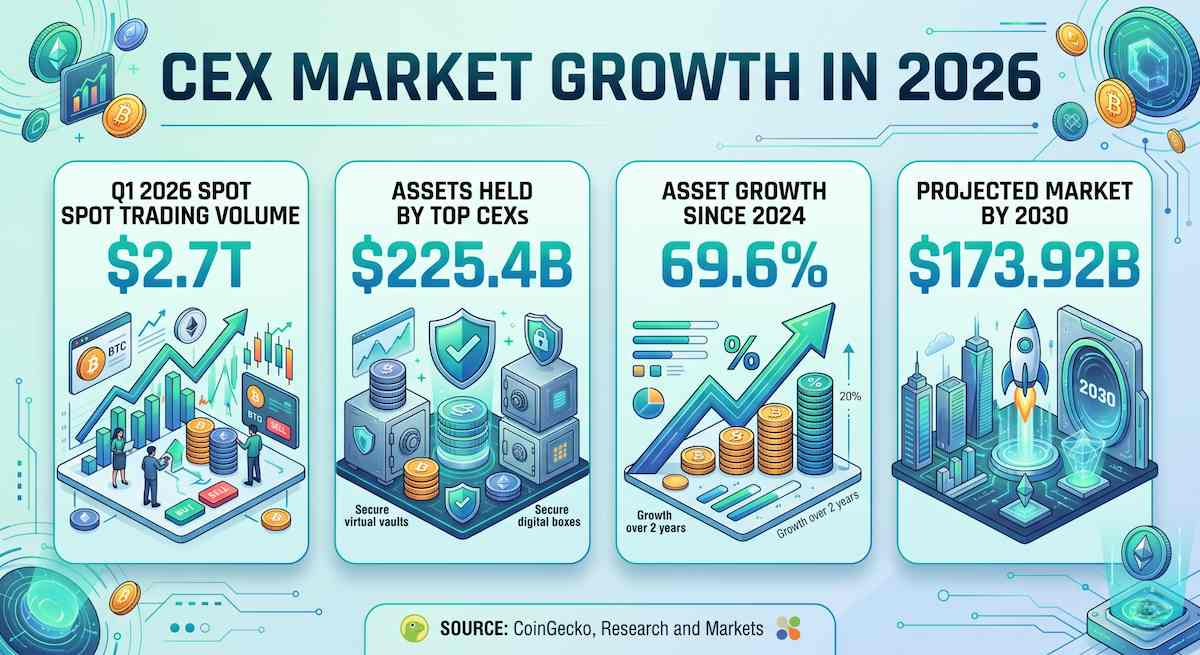
Centralized exchange development is gaining more attention in 2026, and the numbers show why. Centralized exchanges still handle a huge share of crypto trading activity across the world. CoinGecko reported that the top 10 spot centralized exchanges processed $2.7 trillion in trading volume in Q1 2026. The same report found that the top 12 centralized exchanges held $225.4 billion in underlying assets by the end of February 2026. That figure stood at $152.1 billion at the start of 2024, which means assets on these platforms grew by 69.6% in a little over two years. These figures show that traders and investors still rely on centralized exchanges for liquidity, speed, and easy access to digital assets.
The business outlook is just as strong. Research and Markets values the cryptocurrency exchange platform market at $68.85 billion in 2026 and projects it to reach $173.92 billion by 2030, at a 26.1% CAGR. This steady growth is pushing more startups, fintech brands, and enterprise firms to invest in centralized exchange development. A modern exchange now needs more than a buy and sell screen. It needs wallet systems, KYC checks, liquidity access, admin controls, risk tools, and strong security from day one. That is why budgeting for centralized exchange development in 2026 takes careful planning.
Why Businesses Prefer Centralized Exchange Development
Businesses prefer centralized exchange development because it offers speed, liquidity, control, and a simple trading experience. Traders want platforms where orders execute quickly, deposits are easy, and support is available when needed.
Centralized exchanges also give businesses more control over users, fees, trading pairs, wallets, security, and compliance. Features like KYC, AML checks, admin panels, and withdrawal controls help build user trust.
A CEX can also create several revenue streams through trading fees, listing fees, withdrawal charges, staking, futures trading, and institutional APIs. This makes centralized exchange development a strong choice for startups and enterprises entering the crypto market.
How Centralized Exchange Development Is Growing in 2026
Centralized Exchanges Still Lead High-Volume Crypto Trading
Centralized exchange development is gaining fresh demand in 2026. Traders still choose CEX platforms for speed, liquidity, fiat access, support, and account recovery. These factors matter to retail users and large trading desks alike.
The numbers show the market strength. CoinGecko reported that top centralized exchanges handled $18.7 trillion in trading volume in 2025. CoinMarketCap tracks more than 240 spot exchanges, which shows strong competition and steady user demand. Chainalysis ranked India and the United States among the leading crypto adoption markets in 2025. This matters for exchange owners. More users mean more demand for safer wallets, faster trading engines, and local payment support.
Regulation Is Raising Platform Standards
Regulation is another reason CEX platforms keep growing. Users want exchanges that check identity, monitor transactions, protect funds, and follow local rules. Institutional traders expect even more. They need audit logs, custody controls, reporting tools, and risk checks. A simple trading website no longer meets that standard.
Stablecoins, Fiat Access, and AI Are Driving New Demand
Stablecoins and fiat payments are pushing this growth too. Many users enter crypto through bank transfers, cards, UPI, or stablecoin deposits. This creates demand for fiat gateways, payment partner links, treasury tools, and strong withdrawal controls.
AI is entering exchange operations in 2026. Exchanges use it to flag fraud, review risky withdrawals, study trading patterns, and reduce support load. Coinbase’s 2026 workforce changes were tied to AI use and cost control, which shows how large crypto companies are changing their operations.
Higher Demand Means Higher Development Budgets
For builders, this growth raises the budget. A basic exchange now needs trading, wallets, KYC, admin tools, liquidity, and security from day one. A serious 2026 CEX project starts near $40,000 to $150,000. Larger platforms often move past $350,000.
Types of Centralized Exchanges
Spot Trading Exchange
A spot trading exchange is the most common model. Users buy and sell crypto at current market prices. It suits startups, regional exchanges, and retail trading platforms. Development usually costs $40,000 to $150,000 and takes 3 to 6 months.
Fiat-to-Crypto Exchange
A fiat-to-crypto exchange lets users buy crypto with bank transfers, cards, UPI, or wire payments. This model needs payment partners, KYC, AML checks, and fiat settlement controls. The cost ranges from $70,000 to $220,000, with a timeline of 4 to 8 months.
Crypto-to-Crypto Exchange
A crypto-to-crypto exchange supports digital asset pairs without direct fiat access. It is easier to launch than a fiat platform, but it still needs wallets, liquidity, trading charts, and secure withdrawals. The usual budget is $50,000 to $180,000, and development takes 3 to 7 months.
Margin Trading Exchange
A margin trading exchange lets users trade with borrowed funds. It needs collateral checks, liquidation rules, risk controls, and advanced account logic. Cost usually falls between $120,000 and $350,000, with a build time of 6 to 10 months.
Derivatives Exchange
A derivatives exchange supports futures, perpetual contracts, options, and leverage. This is a high-cost model built for experienced traders and enterprise teams. The budget often ranges from $250,000 to $800,000+, with a timeline of 8 to 14 months.
OTC Exchange
An OTC exchange handles large private trades for institutions and high-net-worth clients. It reduces market impact and supports custom pricing. Cost ranges from $100,000 to $300,000, with 5 to 9 months of development.
White-Label Centralized Exchange
A white-label centralized exchange uses a pre-built base with custom branding and selected features. It is the fastest route to launch. Cost usually ranges from $25,000 to $120,000, and delivery takes 4 to 12 weeks.
Want to Build a Centralized Crypto Exchange in 2026?
aunch a secure and scalable centralized exchange with advanced trading features, strong liquidity support, wallet integration, and enterprise-grade security tailored to your business goals.

How a Centralized Exchange Works
Centralized Exchange Workflow
A centralized exchange sits between buyers and sellers. It manages accounts, wallets, trades, fees, risk checks, and withdrawals from one controlled system. This model still leads crypto trading. CoinGecko tracks 181 crypto exchanges with about $96 billion in 24-hour trading volume, and the top 10 centralized exchanges handled $18.7 trillion in 2025 trading volume.
User Registration and KYC Verification
The process starts with user registration. A trader signs up through email, phone, or social login. The platform then runs KYC checks. Users upload ID proof, address proof, and face verification data. This step helps the exchange block fake accounts, fraud, and restricted users.
Wallet Creation and Fund Deposits
After approval, the system creates custodial wallets for supported assets like BTC, ETH, and USDT. Users deposit crypto or fiat money into their account. This deposit then becomes available for trading inside the exchange.
Order Placement and Matching
Users place a market, limit, or stop order. The trading engine checks the order book and matches buyers with sellers. This part must work fast, since delays can affect trade prices and user trust.
Trade Settlement and Fee Deduction
Once the trade completes, the system updates both balances. It deducts trading fees, records the transaction, and displays the trade history. Users can then withdraw funds to a bank account or an external wallet.
Admin Monitoring and Risk Control
The admin team monitors liquidity, failed transactions, suspicious logins, user complaints, and system health from the backend. This is why exchange development costs vary so much. A simple trading site needs fewer checks. A high-volume exchange needs stronger wallets, faster matching, deeper liquidity, and tighter control.
Basic Features of a Centralized Exchange With Cost and Duration
| Feature | Description | Estimated Cost | Development Duration |
|---|---|---|---|
| User Registration & Login | Allows users to sign up, log in, reset passwords, and manage accounts. Includes email, phone, and two-factor authentication support. | $3,000 – $8,000 | 1 – 3 weeks |
| KYC/AML Verification | Enables identity verification, document upload, fraud checks, and compliance approval workflows. | $8,000 – $25,000 | 2 – 5 weeks |
| User Dashboard | Displays balances, trading history, deposits, withdrawals, open orders, and profile details. | $5,000 – $15,000 | 2 – 4 weeks |
| Crypto Wallet Integration | Supports deposit and withdrawal wallets for cryptocurrencies such as BTC, ETH, USDT, and other assets. | $15,000 – $50,000 | 4 – 8 weeks |
| Trading Engine | Core system that matches buy and sell orders in real time. This is one of the most important exchange modules. | $25,000 – $100,000 | 6 – 12 weeks |
| Order Book | Shows live buy and sell orders, market depth, and price levels for each trading pair. | $8,000 – $25,000 | 2 – 5 weeks |
| Trading Charts | Provides price charts, candlestick views, indicators, and market data visualization. | $5,000 – $20,000 | 2 – 4 weeks |
| Buy/Sell Module | Allows users to place market, limit, and stop-limit orders. | $10,000 – $35,000 | 3 – 6 weeks |
| Liquidity Integration | Connects the exchange with external liquidity providers, market makers, or other exchanges. | $15,000 – $60,000 | 4 – 8 weeks |
| Admin Panel | Gives admins control over users, assets, fees, transactions, KYC approvals, trading pairs, and reports. | $10,000 – $40,000 | 4 – 8 weeks |
| Deposit & Withdrawal Module | Manages crypto and fiat deposits, withdrawal requests, transaction status, and limits. | $10,000 – $35,000 | 3 – 6 weeks |
| Security Features | Includes 2FA, anti-phishing codes, IP whitelisting, withdrawal confirmation, rate limiting, and encryption. | $15,000 – $60,000 | 4 – 10 weeks |
| Fee Management | Allows the exchange owner to configure trading fees, withdrawal fees, maker/taker fees, and discounts. | $4,000 – $12,000 | 1 – 3 weeks |
| Notification System | Sends email, SMS, push, and in-app alerts for logins, trades, deposits, and withdrawals. | $4,000 – $15,000 | 1 – 4 weeks |
| CMS Pages | Includes static pages such as About Us, Terms, Privacy Policy, Fees, FAQs, and Support. | $3,000 – $10,000 | 1 – 3 weeks |
| Customer Support Module | Enables ticket creation, dispute handling, user queries, and support tracking. | $5,000 – $18,000 | 2 – 4 weeks |
| API Integration | Provides APIs for market data, trading bots, institutional clients, and third-party systems. | $10,000 – $40,000 | 3 – 8 weeks |
| Reporting & Analytics | Tracks revenue, user activity, trading volume, deposits, withdrawals, and compliance metrics. | $8,000 – $30,000 | 3 – 6 weeks |
Cost by Development Method
White-Label Exchange
Centralized exchange development in 2026 has no single price tag. The cost changes with launch speed, ownership goals, trading depth, and compliance work. The market is still large enough to support new entrants. CoinMarketCap tracks 248 spot exchanges, with reported daily spot exchange volume above $821 billion. CoinGecko’s 2026 Spot CEX Report says the top 12 centralized exchanges processed nearly $21 trillion in spot volume during 2025.
A white-label exchange is the fastest route. It usually costs $25,000 to $120,000 and takes 4 to 12 weeks. This model suits startups that need a tested trading platform, standard admin controls, user wallets, KYC, and basic liquidity links. The trade-off is limited product control. Branding, fees, trading pairs, and interface changes are possible, but deep backend changes raise the budget.
Custom Exchange From Scratch
A custom exchange built from scratch costs $150,000 to $800,000 or more. Development takes 6 to 14 months. This path fits companies that need full control over the trading engine, custody setup, risk checks, APIs, compliance rules, and user flow. It costs more, but the business owns the architecture and can shape the platform around long-term plans.
Hybrid Exchange Development
A hybrid build sits between both models. It costs $80,000 to $300,000 and takes 3 to 8 months. The team starts with ready exchange components, then customizes trading, wallets, admin tools, mobile apps, or liquidity modules. This works well for companies that want faster entry without a generic product.
Optional Advanced Features or Modules With Cost and Duration
| Advanced Module | Description | Optional Cost | Development Duration |
|---|---|---|---|
| Mobile Apps | Native or cross-platform Android and iOS apps for trading, deposits, withdrawals, and notifications. | $40,000 – $150,000 | 3 – 6 months |
| Margin Trading | Allows users to trade with borrowed funds and manage collateral. | $60,000 – $200,000 | 3 – 6 months |
| Futures Trading | Enables futures and perpetual contract trading with leverage. | $120,000 – $400,000 | 5 – 10 months |
| OTC Trading Desk | Supports large private trades for institutional or high-net-worth users. | $50,000 – $180,000 | 3 – 6 months |
| Staking Module | Allows users to earn rewards by staking supported assets. | $25,000 – $100,000 | 2 – 5 months |
| Launchpad Module | Enables token launches, fundraising campaigns, and early user participation. | $40,000 – $150,000 | 3 – 6 months |
| Copy Trading | Allows users to follow and copy professional traders. | $40,000 – $120,000 | 3 – 5 months |
| Trading Bot Integration | Supports automated trading strategies through APIs or built-in bots. | $25,000 – $90,000 | 2 – 5 months |
| AI Fraud Detection | Uses AI models to detect suspicious logins, withdrawals, and trading behavior. | $50,000 – $200,000 | 4 – 8 months |
| Proof of Reserves | Provides transparency into exchange reserves and liabilities. | $30,000 – $120,000 | 2 – 5 months |
| Institutional API Suite | Offers advanced APIs for funds, brokers, and algorithmic traders. | $40,000 – $180,000 | 3 – 7 months |
| Market Maker Dashboard | Helps liquidity teams manage spreads, inventory, and trading pairs. | $50,000 – $200,000 | 4 – 8 months |
| Advanced Risk Engine | Monitors exposure, leverage, liquidation risk, withdrawal risk, and suspicious activity. | $75,000 – $300,000 | 5 – 10 months |
| Multi-Language Support | Adds localization for different regions and languages. | $8,000 – $40,000 | 1 – 3 months |
| Multi-Currency Fiat Support | Supports bank, card, and payment integrations for multiple fiat currencies. | $40,000 – $180,000 | 3 – 7 months |
Overall Centralized Exchange Development Cost in 2026
Basic Centralized Exchange Cost
A basic centralized exchange needs $40,000 to $150,000 and takes 3 to 6 months. This covers spot trading, user accounts, wallets, KYC, admin tools, notifications, and basic security.
Mid-Level Centralized Exchange Cost
A mid-level exchange costs $120,000 to $350,000 and takes 5 to 9 months. This budget supports mobile apps, fiat payments, stronger liquidity, better reporting, referral tools, and deeper compliance checks.
Enterprise Centralized Exchange Cost
An enterprise exchange costs $350,000 to $1,000,000 or more and takes 9 to 18 months. This tier includes high-volume trading systems, advanced APIs, institutional controls, risk engines, audit trails, and stronger infrastructure.
Advanced Derivatives or Institutional Exchange Cost
Advanced derivatives or institutional platforms cost $700,000 to $2,000,000 or more and take 12 to 24 months. These builds support futures, leverage, liquidation engines, market maker tools, and complex compliance. CoinGecko reported $2.7 trillion in top 10 spot CEX volume in Q1 2026 alone, so serious platforms still need strong systems from day one.
Conclusion
A centralized exchange is a serious build, so the budget must match the platform’s trading goals, security needs, compliance scope, and growth plans. A basic exchange can start with core trading, wallets, KYC, and admin tools, but larger platforms need stronger liquidity, mobile apps, risk controls, fiat support, and advanced trading modules. Blockchain App Factory provides Centralized Exchange Development for startups, growing crypto businesses, and enterprise clients that need secure, scalable, and feature-rich exchange platforms built around their business model.

Vimal J is the Head of Sales at Blockchain App Factory, with 10+ years of experience in sales, client strategy, and Web3 business growth. He helps startups, enterprises, and project founders choose the right blockchain solutions for their goals, bringing a practical market perspective to topics like token development, crypto launches, and Web3 adoption.