Key Insights
- Centralized exchanges generate income quickly through trading fees, listings, and fiat services. They suit businesses that need full control over users, transactions, and compliance.
- Decentralized exchanges lower server and custody expenses since users control their funds. The main risk comes from contract flaws, so audits and testing are critical.
- CEX fits retail users and institutions that expect ease of use and support. DEX fits Web3 users who prefer self-custody, transparency, and token-based ecosystems.
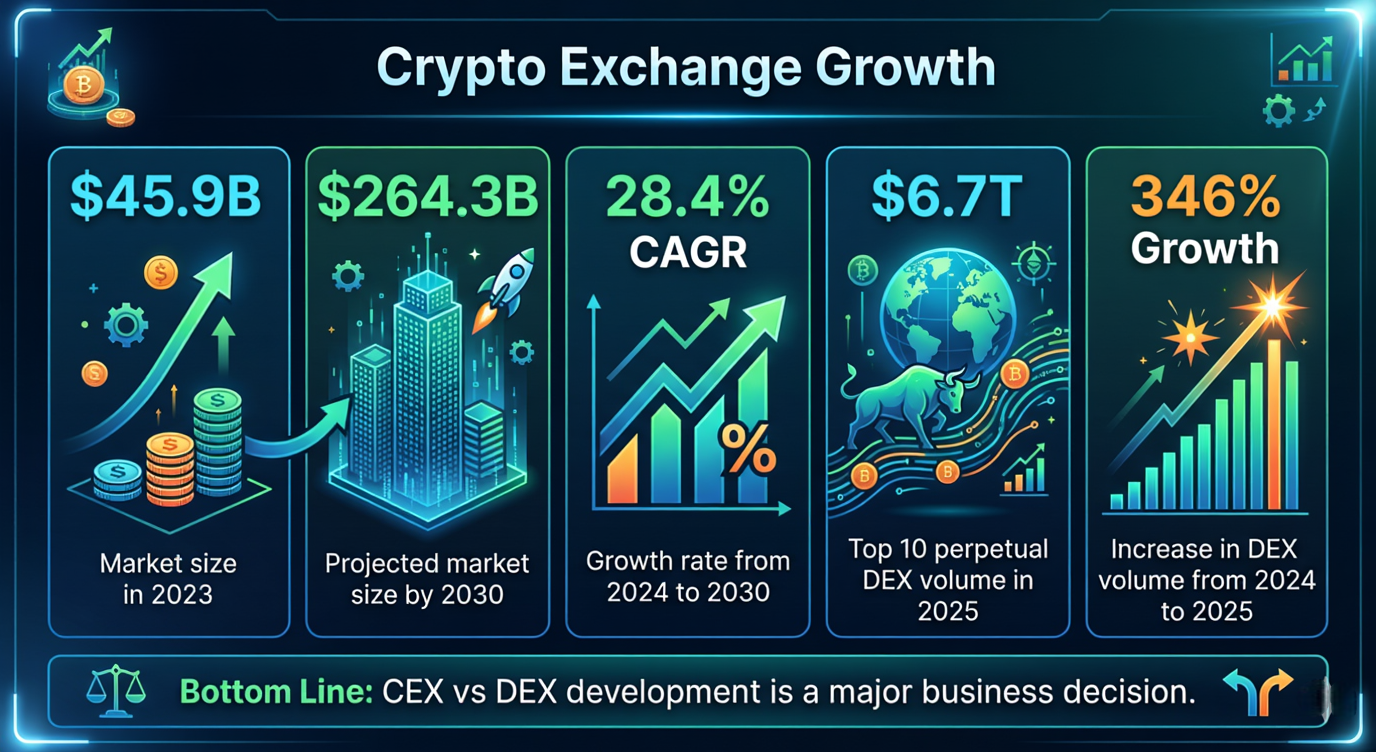
Crypto exchange development has become a serious growth play for startups, fintech brands, and large enterprises. More companies now want to build a crypto exchange that can attract users, generate fee income, and secure a place in a fast-growing market. The market data makes that clear. The global cryptocurrency exchange platform market was valued at $45.9 billion in 2023 and is projected to reach $264.3 billion by 2030, with a 28.4% compound annual growth rate from 2024 to 2030. Decentralized trading is rising fast too. The top 10 perpetual DEXs recorded $6.7 trillion in trading volume in 2025, which marked a 346% increase from 2024.
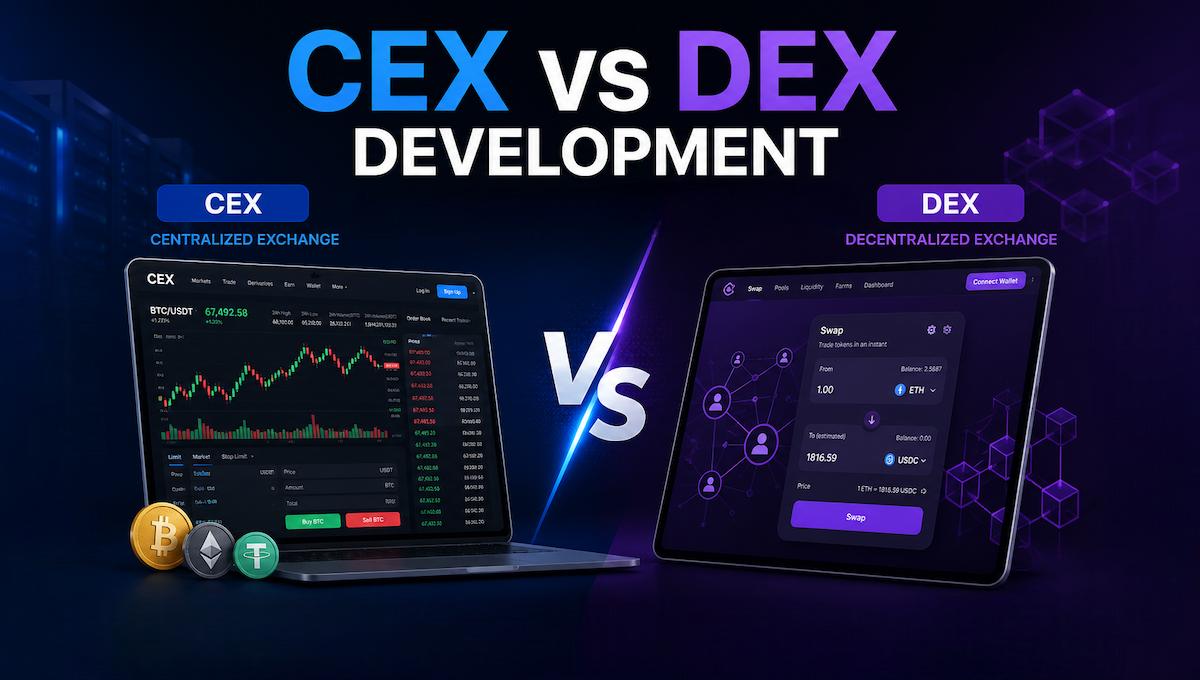
These numbers show why the CEX vs DEX development choice matters early in the planning stage. A centralized exchange gives a business more control over user accounts, liquidity, custody, and transaction flows. A decentralized exchange gives users self-custody, direct wallet access, and on-chain execution. Each model serves a different business goal. Companies need to weigh revenue models, regulatory position, user growth plans, and market fit before they choose between CEX and DEX development.
CEX vs DEX Development: A Business-Centric Overview
What Does Building a CEX Involve?
CEX development means building and running the full trading business. The company owns the backend, matching engine, user accounts, custodial wallets, admin panel, liquidity systems, and compliance stack. This model fits platforms that want high-volume trading, fiat deposits, market maker access, and controlled user onboarding.
A CEX can earn from spot fees, withdrawal fees, token listings, staking, lending, margin trading, and VIP accounts. It also carries heavier duties. Reuters reported that EU regulators flagged crypto trading concentration as a concern, with ten exchanges processing around 90% of trades. That shows why compliance, risk checks, and custody controls matter for CEX builders.
What Does Building a DEX Involve?
DEX development starts with smart contracts. The product runs through liquidity pools, wallet connections, token swaps, and on-chain settlement. The business focuses less on account control and more on protocol design, audits, liquidity rewards, and community growth.
Core Development Differences That Impact Your Business
A CEX gives ownership and control. A DEX gives transparency and user custody. Pick CEX for managed growth, fiat access, and strong revenue control. Pick DEX for DeFi reach, lower custody risk, and blockchain-native users.
Key Factors to Consider Before Choosing CEX or DEX Development
Business Model and Revenue Strategy
A CEX gives the business more control over revenue. The platform can charge trading fees, withdrawal fees, token listing fees, and premium account fees. It can add margin trading, derivatives, staking, lending, launchpads, and fiat services. That wider product mix matters. CoinGecko reported that centralized exchanges processed close to $80 trillion in spot and perpetual trading volume in 2025, which shows the size of the commercial opportunity.
A DEX earns in a different way. Revenue often comes from swap fees, protocol fees, liquidity pool activity, and governance token models. Perpetual DEX activity grew fast in 2025, with top perp DEX volume reaching $6.7 trillion, up 346% from 2024. This makes DEX development attractive for DeFi brands, token projects, and Web3 firms that want community-led growth.
Target Audience and Market Positioning
A CEX works best for retail users, new traders, and institutions. These users expect fast deposits, fiat payment options, account recovery, customer support, and simple screens. A DEX fits crypto-native users who prefer wallet-based trading, self-custody, and direct access to DeFi assets.
Regulatory and Compliance Requirements
A CEX needs KYC, AML checks, licensing, transaction monitoring, and clear jurisdiction planning. This adds cost but builds trust with banks, payment firms, and larger investors. A DEX has fewer account-level controls, but scrutiny is growing. Teams still need legal review, smart contract audits, and clear risk notices.
Time-to-Market Considerations
A white-label CEX can shorten launch time, but deeper customization needs more engineering. A DEX can launch faster through smart contract libraries and existing blockchain networks. The tradeoff is protocol risk, liquidity design, and audit cost.
Technical Development Comparison: CEX vs DEX
CEX Development Architecture
A CEX runs on a centralized stack. Its core is the trading engine, which matches buy and sell orders in milliseconds. The platform also needs secure databases, user accounts, custodial wallets, admin panels, risk controls, KYC tools, and reporting systems. The build needs backend engineers, DevOps teams, security experts, compliance staff, and support teams.
DEX Development Architecture
A DEX runs through smart contracts. Trades happen through AMMs, on-chain order books, or hybrid matching models. Users connect wallets such as MetaMask or WalletConnect. Liquidity pools replace the central market maker in many DEX models. Every trade settles on-chain, so gas fees, chain speed, and contract safety shape the user experience.
Development Complexity and Resource Requirements
CEX development costs more to operate. Servers, custody, compliance, fraud checks, and support create long-term expense. DEX development reduces infrastructure load, but it raises smart contract risk. A single contract flaw can drain liquidity. For that reason, DEX teams need blockchain developers, auditors, token economists, and security testers from day one.
Pros and Cons of Building a CEX vs DEX
Advantages of CEX Development
A centralized exchange fits businesses that need speed, liquidity, and a familiar trading flow. Users create accounts, deposit funds, trade through an order book, and get support from the platform team. This model works well for retail users and institutions that expect fast execution, fiat payments, account recovery, and clear reporting.
CEXs still lead most crypto trading activity. CoinGecko reported that top centralized exchanges handled $5.1 trillion in spot volume in Q3 2025, up 31.6% from Q2. That volume gives a new CEX a stronger base for spreads, market-maker programs, and advanced products such as margin trading, staking, and launchpads.
Limitations of CEX Development
A CEX demands heavy spending. The business must fund custody systems, hot and cold wallets, trading engines, security teams, KYC tools, and legal work. Regulators now expect tighter monitoring in major markets. India’s FIU rules in January 2026 added live selfie checks and geo-tracking for crypto exchange users. That raises compliance cost and onboarding friction.
Custody creates another risk. A CEX holds user assets, so it becomes a target for theft, insider abuse, and wallet breaches. Strong security is not optional. It is a core operating cost.
Advantages of DEX Development
A decentralized exchange gives users control of their funds. Trades run through smart contracts, and users connect wallets instead of depositing assets with the platform. This design builds trust with crypto-native traders who prefer self-custody and public transaction records.
DEX growth is clear. CoinGecko reported that top perpetual DEX volume reached $6.7 trillion in 2025, up 346% from 2024.
Limitations of DEX Development
A DEX faces liquidity gaps, smart contract risk, and harder onboarding. New users often struggle with wallets, gas fees, approvals, and failed transactions. Transaction speed changes by chain, so the wrong network choice can hurt adoption.
Want to Launch your crypto exchange platform?
Launch a secure, scalable CEX or DEX tailored to your business goals with expert guidance from start to finish.

When Should You Build a CEX?
Choose CEX Development If You:
Build a CEX if you want mass adoption, fiat deposits, and advanced trading features. It suits businesses that target retail traders, institutions, brokers, and payment partners.
A CEX gives users familiar features: accounts, password recovery, fiat payments, order books, and support. This makes onboarding easier for new crypto users.
It also works well for spot trading, margin trading, futures, OTC desks, staking, and market-making tools. The trade-off is higher responsibility. You manage custody, liquidity, KYC, AML, security, servers, and licenses.
Choose CEX development if your team has capital, legal support, banking access, and a clear security plan.
When Should You Build a DEX?
Choose DEX Development If You:
Build a DEX if you serve DeFi users, token communities, DAOs, or Web3 projects. Users trade through smart contracts and keep control of their funds.
A DEX fits products built around swaps, liquidity pools, governance tokens, launch pools, and fee-sharing models. It needs less centralized infrastructure than a CEX, but smart contract risk is higher.
Choose DEX development if you want open access, self-custody, token-based growth, and lower operating overhead. Use audits, testnets, and bug bounties before launch.
Hybrid Exchange Development: The Emerging Business Model
What is a Hybrid Exchange?
A hybrid exchange blends the strongest parts of CEX and DEX development. It uses centralized systems for speed, liquidity, user accounts, support, and fiat payments. It uses decentralized components for wallet control, smart contract settlement, and clearer asset movement.
This model fits businesses that want more than a basic trading app. A CEX gives strong trade execution, but users must trust the platform with funds. A DEX gives self-custody, but many users still struggle with wallets, gas fees, and liquidity depth. A hybrid exchange closes that gap. It can offer fast order matching, deep liquidity, and non-custodial trading paths in one product.
The market signal is clear. CEXs still lead spot trading, but DEX share has grown. CoinGecko reported that DEX spot market share rose from 6.9% in January 2024 to 13.6% in January 2026. DEX spot volume rose from $95.86 billion to $231.29 billion in the same period. That growth gives businesses a reason to build products that support both user habits.
Why Businesses Are Moving Toward Hybrid Models
Businesses choose hybrid exchange development for three practical reasons: trust, control, and revenue. A hybrid model supports KYC, admin controls, fiat rails, and risk checks. It can still give users on-chain settlement and wallet-based ownership.
This matters for founders, fintech firms, and enterprises. Regulators keep pressing crypto firms to improve compliance, reporting, and monitoring. FATF reported in June 2025 that only 40 of 138 reviewed jurisdictions were largely compliant with its crypto standards. That gap makes compliance planning a core build choice, not a late-stage task.
Development Process: From Idea to Launch
Building a crypto exchange starts with one hard choice: custody or code. A CEX asks the business to control user accounts, assets, liquidity, and compliance. A DEX shifts execution to smart contracts and lets users trade from their own wallets. This choice shapes the budget, legal plan, product design, and launch timeline.
The commercial case remains strong for both models. CoinGecko reported that Binance led centralized exchanges in 2024 with $7.35 trillion in trading volume and a 39% market share. That shows the revenue pull of CEX platforms with deep liquidity and familiar trading tools. Yet DeFi demand keeps growing too, with Chainalysis tracking retail DeFi activity as part of its global crypto adoption index. Businesses need to match the build to the audience, not copy the largest exchange in the market.
Steps to Build a CEX
Define the Business Model
A centralized exchange starts with the business model. The team must decide whether the platform will serve retail traders, institutions, token projects, or regional fiat markets. Each route changes the feature list. Retail users need simple onboarding, card payments, mobile apps, and fast support. Institutions need APIs, deep order books, reporting, and account controls.
Choose the Right Tech Stack
The next step is the tech stack. A CEX needs a trading engine, admin panel, user database, wallet system, liquidity links, market data feeds, and risk controls. The trading engine is the core asset. It must match buy and sell orders with low delay, even during price spikes. Poor matching speed can cause slippage, failed trades, and user loss.
Develop the Trading Engine
The trading engine should support limit orders, market orders, stop orders, order books, trade history, and real-time price updates. It also needs strong testing under peak load. A serious exchange cannot fail during high-volume trading hours. The engine must process trades fast and record every action with accuracy.
Integrate Wallets and Payment Gateways
Wallet and payment gateway work comes next. A CEX must support deposits, withdrawals, hot wallets, cold wallets, and internal ledger updates. This part needs strict controls. A CEX team needs multisig controls, cold storage rules, withdrawal checks, and clear incident plans from day one.
Payment gateway integration matters for exchanges that support fiat. Card payments, bank transfers, and local payment rails help users enter the platform faster. This also raises compliance demands, so the payment plan must match the target region.
Implement KYC and AML
Compliance then becomes a product feature, not just a legal task. A CEX must build KYC, AML screening, transaction monitoring, sanctions checks, and audit trails into the user flow. This adds cost, but it helps the exchange work with banks, payment firms, and licensed partners.
Launch, Monitor, and Grow
Launch should begin with a limited market, a controlled asset list, and tested liquidity sources. The first release should prove deposits, trades, withdrawals, support, and reporting. Then the team can add pairs, fiat routes, staking, or margin products.
Steps to Build a DEX
Choose the Blockchain Network
A DEX build starts with the blockchain network. Ethereum gives strong liquidity and developer depth. Layer 2 networks cut fees and speed up trades. BNB Chain, Solana, Polygon, and Avalanche suit teams that want lower costs or a specific user base. The chain choice affects gas fees, wallet support, liquidity, security, and token listings.
Design Tokenomics and Liquidity Model
The next task is tokenomics and liquidity design. Most DEX platforms need a fee model, pool rules, liquidity provider rewards, and governance plans. An AMM model suits simple swaps. An order book model fits advanced traders, but it needs stronger infrastructure and market maker support.
Develop Smart Contracts
Smart contract work is the main build stage. Contracts handle swaps, pools, fees, routing, staking, and governance. Once deployed, contract bugs can become costly. A DEX has lower infrastructure cost than a CEX, but it carries higher protocol risk. The business owns less server burden, yet a contract flaw can drain funds in minutes.
Conduct Security Audits
Security audits are not optional for a serious launch. Teams should run internal tests, third-party audits, testnet trials, bug bounties, and formal reviews for key contracts. Each review should check access controls, pool logic, oracle use, fee rules, and upgrade paths.
Build Frontend and Integrate Wallets
The frontend then connects wallets such as MetaMask and WalletConnect. It displays token prices, trade routes, pool depth, and gas costs. The interface must be clear enough for active traders and simple enough for new DeFi users. Confusing screens create failed transactions and support issues.
Deploy and Grow Liquidity
A DEX launch succeeds through liquidity. The team needs token partners, liquidity incentives, community campaigns, and analytics. Without enough liquidity, users face slippage and leave fast. A strong DEX is not just code. It is a market with active traders, trusted contracts, and enough depth to make swaps feel reliable.
Conclusion

Vimal J is the Head of Sales at Blockchain App Factory, with 10+ years of experience in sales, client strategy, and Web3 business growth. He helps startups, enterprises, and project founders choose the right blockchain solutions for their goals, bringing a practical market perspective to topics like token development, crypto launches, and Web3 adoption.