Key Insights
- Copper demand continues to increase across energy, infrastructure, and technology sectors. Supply expansion remains slower, which raises the importance of better asset management.
- Large copper holdings can be divided into smaller digital units for easier participation. This allows investors and businesses to interact with copper without handling bulk physical contracts.
- Tokenized copper can support lending, collateral use, and faster transfers. This turns stored inventory into an active financial asset rather than a passive holding.
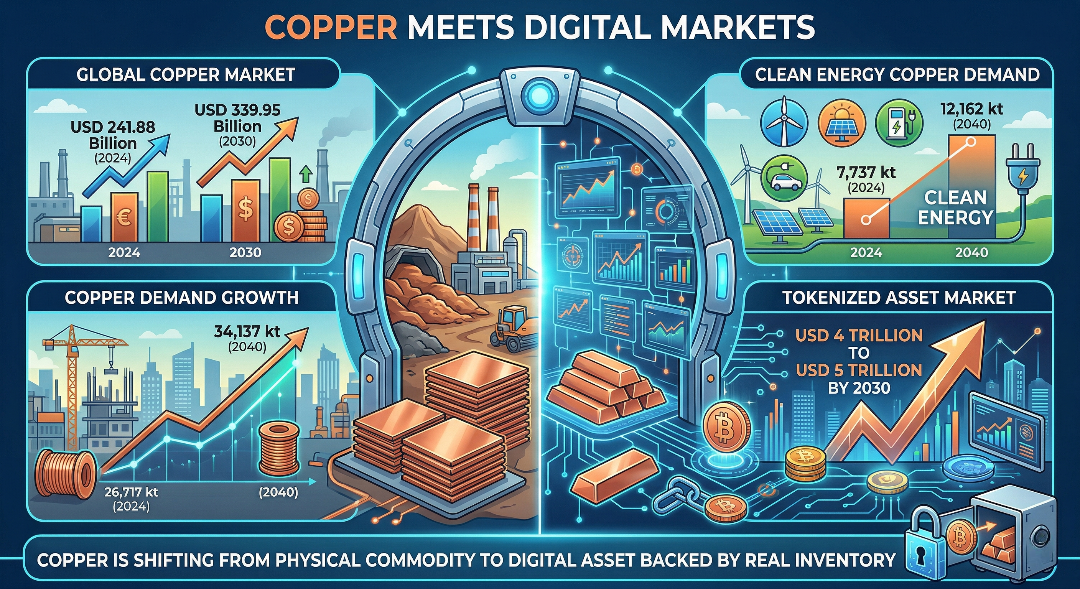
Copper demand is rising fast, and the reason is clear. It sits inside systems that economies rely on every day. Electric vehicles need it. Solar and wind projects depend on it. Power grids, data centers, and AI infrastructure all use large amounts of it. The International Energy Agency projects copper demand to rise from 26,717 kilotonnes in 2024 to 31,348 kilotonnes by 2030. By 2040, that number reaches 34,137 kilotonnes. Clean energy demand alone grows from 7,737 to 12,162 kilotonnes in the same period.
The commercial scale behind this demand is just as important. The global copper market was valued at USD 241.88 billion in 2024 and is expected to reach USD 339.95 billion by 2030, growing at a steady pace. This shows that copper is not only critical for infrastructure but also a major economic asset with expanding market value.
Supply is not keeping up at the same pace. UNCTAD expects demand to grow by more than 40% by 2040. Meeting that demand may need around 80 new mines and close to $250 billion in investment by 2030. That gap changes how people look at copper. It is no longer just a raw material moving through factories. It is becoming a financial asset that sits inside global trade and infrastructure funding.
This shift explains why copper is moving onchain. Traditional ownership is expensive and slow to transfer. Access often stays with large institutions. Blockchain models offer smaller ownership units, continuous market access, and rule-based settlement. Ownership records stay digital and easy to track.
At the same time, digital asset markets are expanding quickly. Estimates suggest tokenized financial assets could reach between USD 4 trillion and USD 5 trillion by 2030. This creates a larger context for real-world assets like copper to move into digital formats.
Copper is no longer limited to storage and shipping. It can now exist as a digital asset linked to real inventory, ready to move across markets with less friction.
What Tokenized Copper Really Means
Tokenized Copper in Plain English
Tokenized copper is a digital token linked to real copper stored offchain. Each token represents a share of physical metal. Think of it as a digital claim tied to copper sitting in a warehouse. The token itself holds no value without that backing. Its worth comes from the metal and from the rights attached to it.
Not all tokens offer the same rights. Some track price only. Others give a legal claim on stored copper. A smaller group allows redemption for physical delivery or cash. This difference matters. A price-tracking token behaves like a financial product. A redeemable token behaves closer to ownership. Buyers need to know exactly what they hold before they commit capital.
Why It Counts as a Real-World Asset
A token qualifies as a real-world asset when it connects clearly to physical copper. That link depends on a few factors. The metal must exist and be accounted for. Storage must be handled by a third party. Audits must confirm quantity and quality. Issuance records must match the inventory. Redemption rules must be written and clear.
The structure works in two layers. The blockchain records ownership and transfers. Custody and legal agreements control the physical metal. If either layer fails, the product loses credibility. That is why serious copper token models focus heavily on storage data, audit records, and strict issuance rules.
Tokenized Copper vs Traditional Market Instruments
Tokenized copper often gets grouped with older products, but each works differently.
- Futures contracts
These are agreements to buy or sell copper at a future date. Standard LME contracts use 25-tonne lots. Smaller contracts still use 5 tonnes. These sizes fit large players but remain too big for many participants. - ETFs
These provide exposure through a fund. Investors do not own physical copper. They own shares linked to price movement. - CFDs
These track price changes without ownership. They settle in cash and never involve real metal. - Warehouse receipts
These show stored inventory ownership. They lack digital transfer features and do not support fractional trading.
Tokenized copper sits apart. It can combine real metal backing with smaller units and digital transfer. It fits users who want both exposure and a link to physical inventory.
Why Copper Is the Right Metal to Tokenize Before Many Others
Copper Has Demand Across Multiple Industries
Copper already plays a role in many parts of the economy. It is used in buildings, electrical systems, transport, electronics, and machinery. In the United States alone, building construction accounts for 42% of copper use. Electrical and electronic products take 23%. Transportation uses 18%, followed by consumer products at 10% and industrial machinery at 7%.
This wide spread of usage gives copper a clear advantage. It is not tied to one industry or one demand cycle. It moves with construction, energy systems, and manufacturing at the same time. That makes it easier for investors and businesses to understand its value. People already see copper in everyday systems, so a token linked to it feels grounded in real economic activity rather than abstract exposure.
Copper Faces Access Limits, Not Demand Issues
Most participants do not question copper’s value. The challenge lies in how they access it. Traditional markets operate with large contract sizes and structures designed for institutions. A standard copper contract on the London Metal Exchange is 25 tonnes. Even smaller versions still require 5 tonnes.
These sizes exclude many potential participants. Smaller investors, digital asset users, and even some businesses cannot easily engage at that scale. Tokenization changes this by dividing ownership into smaller units. The physical copper remains stored in bulk, but ownership becomes easier to split and transfer. This shift allows more people to take part without changing how the metal is handled in the real world.
Supply Constraints Increase the Need for Better Market Structure
Copper supply is concentrated in a small number of countries. More than half of global reserves are held by Chile, Australia, Peru, the Democratic Republic of the Congo, and Russia. China imports around 60% of global copper ore and produces over 45% of refined copper.
This concentration adds pressure to global supply chains. It affects pricing and availability across markets. The International Energy Agency expects this pattern to continue, with the top three mining countries increasing their share to 53% by 2040. Refining concentration also remains close to 60%.
When supply sits in a few regions, market structure becomes more important. Clear ownership records, faster transfers, and flexible financing start to matter more. Tokenization does not increase supply, but it improves how existing copper is held and moved. That improvement becomes valuable in a market where access and flow already face constraints.
How Tokenized Copper Works From Warehouse to Wallet
Starting With the Right Copper
Every tokenized copper project begins with identifying the exact material behind the token. Copper can exist in different forms such as cathodes, powder, concentrates, or stored warehouse inventory. Each form carries its own pricing method and handling requirements.
Cathodes are widely accepted in global trade, which makes them easier to connect to token models. Concentrates involve extra processing, which adds complexity. Grade, origin, and ownership history must be clear from the beginning. If these details are unclear, the token becomes harder to value and harder to trust.
Form factor also affects how redemption works. Copper that is already in a deliverable state is easier for buyers. Material that requires further processing adds steps and delays. This is why projects focus not only on how much copper exists but also on what type of copper sits behind each token.
Verifying Quantity, Quality, and Ownership
Once the copper is selected, verification becomes the next step. The quantity must match records, and the quality must meet the stated specifications. Legal ownership must be confirmed before any tokens are issued.
Custodians review inventory records, and independent auditors check stock levels and documentation. The chain of title must confirm that no disputes or claims exist. Insurance coverage also plays a role. Stored copper must be protected against damage or loss.
This stage builds trust. It confirms that the physical asset matches the digital representation. Without proper verification, the entire structure becomes unreliable.
Moving Copper Into Approved Custody
After verification, the copper is placed in a controlled storage environment. This includes insured warehouses and professional metals custodians that follow strict handling standards.
The goal is not just storage. It is consistent and verifiable storage. Market participants need confidence that the copper exists and meets defined specifications. Systems used by established exchanges provide a useful reference for how storage and documentation should work.
If custody is weak, confidence drops. If custody is well managed, the token gains credibility in the market.
Issuing Tokens Linked to Physical Inventory
Tokens are created only after the copper is verified and stored. Each token represents a fixed amount of copper, such as one kilogram or one tonne.
Clear denomination helps users understand value. If the unit is unclear, pricing becomes difficult. Smart contracts control how tokens are issued and removed. New tokens appear when new copper enters storage. Tokens are removed when copper is redeemed.
This keeps digital supply aligned with physical inventory. It prevents gaps between what is recorded onchain and what exists in storage.
Providing Reserve Proof and Pricing Data
Reserve reporting plays a key role in building confidence. Token holders need confirmation that the copper exists in the stated quantity. This can be done through audits, regular reports, or data feeds linked to custody systems.
Pricing follows established market benchmarks. Copper price feeds allow users to track value in real time. For financial use cases, net asset value and collateral ratios help determine how the token can be used in lending or financing.
Clear data makes the token easier to trust and easier to use across different financial activities.
Allowing Transfer, Trading, and Redemption
Once issued, tokens can move between users. They can be traded, held, or used as collateral without moving the physical copper.
Redemption rules define how holders can convert tokens into physical copper or cash. These rules include fees, minimum amounts, and delivery methods. Some systems remove tokens from circulation when redemption occurs to maintain balance with reserves.
This final step shows how the system works in practice. A functional token must support smooth transfers and clear redemption. Without that, it remains only a concept rather than a usable asset.
Looking to bring copper assets into digital markets?
Turn physical copper inventory into a structured digital asset with clear ownership, custody, and transfer models. Build a platform that supports investment, financing, and real-world use.

The Business Case for Building a Copper Tokenization Platform
Why the Model Makes Commercial Sense
A copper tokenization platform addresses a simple issue. Large amounts of copper sit in storage with limited flexibility. A warehouse may hold inventory for months. A manufacturer may keep stock for production needs. A trader may control a large position that takes time to move or divide.
The value exists, but it is not easy to use. Traditional processes rely on paperwork, approvals, and large transactions. This slows down movement and limits financing options. Tokenization changes how that value is handled. It converts stored copper into smaller digital units that can move between parties with fewer steps.
The physical metal stays in place. Ownership becomes easier to transfer. That shift improves how the asset can be used across trading, financing, and allocation.
Idle Inventory Can Support Financial Activity
Stored copper often behaves like locked capital. It holds value, but accessing that value takes time. Businesses need paperwork, negotiations, and coordination before they can use it in financing.
Tokenization changes this behavior. Inventory can be divided into smaller units and used in financial arrangements. It can support lending, collateral structures, or transfers between counterparties. This reduces delays and improves capital movement.
For traders and manufacturers, this matters. They often deal with tight working capital cycles. Faster access to inventory value can improve day-to-day operations.
Large Positions Become Easier to Handle
Traditional copper markets favor large participants. Transactions often involve bulk quantities that smaller players cannot manage. Tokenization breaks these large positions into smaller parts.
This makes allocation easier. Investment platforms can offer smaller exposure units. Fintech firms can design products around real copper holdings. Industrial buyers can access inventory-linked positions without taking on full-scale contracts.
The total value of the copper does not change. What changes is how that value is distributed and used.
Settlement and Cross-Border Movement Become Simpler
Legacy systems involve multiple steps. Documents move between parties. Banks review transactions. Compliance checks add delays. Cross-border trade introduces customs and regulatory layers.
Tokenized systems simplify the ownership layer. Transfers can occur with clearer records and fewer manual steps. This does not remove all processes tied to physical delivery, but it reduces complexity in ownership changes.
Clearer records also improve auditability. Businesses that handle frequent transactions benefit from faster and more organized processes.
Who Benefits First
The early users of copper tokenization are likely to be businesses already involved with the metal. Traders can divide and distribute positions more easily. Refiners can connect inventory to financing channels. Warehousing firms can offer digital services linked to stored metal.
Fintech platforms can package copper-backed products for investors who prefer exposure tied to real assets. Manufacturers can use their working inventory more effectively on the balance sheet.
These groups already face challenges with inventory, settlement, and financing. Tokenization becomes useful when it reduces those challenges.
Why Traditional Copper Trading Is Ready for a Digital Upgrade
The Market Still Carries Too Much Friction
Copper trading has worked for decades, but it comes with operational weight. Trade sizes are large. Documentation stacks grow quickly. Verification often depends on separate systems and manual checks.
Cross-border movement adds more layers. Banking procedures, compliance checks, and customs requirements slow transactions. These delays increase costs and reduce efficiency.
The issue is not demand or pricing. It is the effort required to move and manage the asset.
Pricing Works Well, Movement Does Not
Copper markets already handle pricing effectively. Benchmarks are widely used, and exchanges provide clear price signals. Market participants understand how to value copper across different forms and contracts.
The challenge appears after pricing. Turning stored copper into a flexible financial asset remains difficult. Ownership transfers can take time. Financing structures often require extensive documentation.
Tokenization addresses this gap. It keeps pricing systems intact while improving how ownership and value move between participants.
Verified Inventory Becomes More Usable
Traditional systems treat copper inventory as something to store or deliver. Its role often stops there. Tokenization adds another layer of use. The same inventory can support transfers, collateral arrangements, and financial transactions.
This change increases the utility of stored copper. It allows businesses to use inventory in more ways without moving the physical metal. Ownership becomes easier to manage, and value becomes easier to access.
Copper trading already has the demand, pricing, and storage systems in place. What it needs is a better link between physical inventory and flexible ownership. Tokenization provides that link and expands how the asset can be used.
Copper Tokenization Use Cases That Go Beyond Trading
Fractional Investment Access Becomes Practical
Tokenized copper makes large market exposure easier to break down. Traditional commodity access often requires large capital and bulk transactions. Many participants simply cannot enter at that level. Tokenization changes this by allowing smaller ownership units linked to real copper.
This creates new entry points for investors. Retail users in supported markets can participate. Accredited investors can adjust exposure more precisely. Digital wealth platforms can include copper in portfolio products without forcing users to deal with physical handling.
It also changes how commodity allocation products are designed. Copper can sit alongside other real assets in a structured portfolio. Investors are not just tracking price movement. They are linked to actual stored metal. That difference makes the asset easier to understand and easier to position within long-term allocations.
Trade Finance Moves Closer to Real-Time Needs
Copper stored in warehouses holds value, but using that value often takes time. Financing cycles depend on paperwork, verification, and coordination between multiple parties. Tokenized inventory reduces that delay. It presents copper as a digital asset that lenders and counterparties can assess faster.
This has a direct impact on working capital. Traders often need liquidity between purchase and sale. Manufacturers may need funds while holding raw materials for production. When tokenized copper is accepted as collateral, these gaps become easier to manage.
The change is simple in concept. Stored copper moves from being idle stock to being part of active financial operations. That shift helps businesses manage cash flow with fewer delays.
Treasury Teams Gain Better Control Over Inventory
Companies that hold copper often treat it as a buffer against supply risk or price changes. This inventory can tie up capital for long periods. Tokenization offers a different way to manage it. The same stock can be tracked, allocated, and used with more clarity.
Digital records allow treasury teams to see how inventory is used at any moment. They can track pledged amounts, available stock, and positions tied to financing. This reduces reliance on manual tracking systems and scattered reports.
The benefit is not just visibility. It is control. Inventory becomes easier to manage as part of the balance sheet rather than sitting as a static asset.
Onchain Credit Expands the Role of Copper
Tokenized copper can also enter digital credit markets. Once it is backed by verified inventory and linked to pricing data, it can support lending and borrowing. A holder can use it as collateral to borrow stable assets or participate in structured credit arrangements.
This introduces new financial use cases. Repo-style agreements become possible. Short-term borrowing against copper positions becomes easier. External price feeds can support margin checks and collateral monitoring.
At this stage, copper stops being just a stored commodity. It becomes part of a broader financial system where assets can support multiple activities beyond ownership.
Why These Use Cases Matter
These use cases connect directly to real business needs. Investors want flexible entry points. Traders need faster financing cycles. Manufacturers want better use of inventory. Treasury teams need accurate tracking. Lenders want collateral tied to real assets.
Tokenized copper addresses each of these needs in a practical way. It does not rely on theory. It builds on how copper is already used and improves how that usage fits into modern financial systems.
Implementation Roadmap for Copper Asset Tokenization Development
Phase One Focuses on Market Fit
The first step is to define who the platform serves. It could target traders, manufacturers, investment platforms, or digital asset users. This decision shapes every part of the product.
The copper form must also be selected early. Cathodes, warehouse stock, and other forms each come with different handling and pricing rules. Jurisdiction matters at this stage. Legal frameworks for commodity ownership and token issuance vary across regions.
Pricing assumptions and custody plans need testing before moving forward. If these assumptions fail, the structure will not hold under real conditions.
Phase Two Builds Legal and Reserve Structure
The next phase establishes the legal base. The issuer entity must be set up in a jurisdiction that supports the model. This entity connects the token to the physical copper and defines the rights of holders. Custody agreements are finalized here. Storage providers, insurance coverage, and reporting methods must be clearly defined. Token-holder rights must be written in direct terms. This includes whether holders have price exposure, ownership claims, or redemption rights. Clear documentation at this stage reduces confusion later. It defines how the system operates before any tokens are issued.
Phase Three Develops the Technical System
Once legal and reserve structures are in place, technical development begins. Smart contracts are written to match the defined rules. They control token issuance, transfers, and redemption processes. Price data integration is required for valuation and collateral use. Dashboards provide visibility into holdings and reserves. Compliance checks are integrated into the system from the start. Wallet compatibility must also be tested. Users need a smooth way to hold and transfer tokens. Poor user experience can limit adoption, even if the underlying model is sound.
Phase Four Tests the Model With a Pilot
A pilot launch introduces the system to a controlled group of users. Token issuance remains limited. The goal is to observe how the system performs under real conditions. Reserve reporting must align with token supply. Users need to see that records match actual inventory. Redemption processes are tested to confirm they work as expected. This stage identifies gaps before wider release. It allows adjustments without exposing the system to full market pressure.
Phase Five Expands Distribution and Access
After a successful pilot, the platform can expand. Exchange integrations can support trading activity. Institutional custody can attract larger participants. Cross-chain availability may be added if users operate across different blockchain networks. API access allows fintech platforms and investment apps to integrate the token into their systems. This phase focuses on reaching more users and increasing practical use. The goal is not just visibility, but active participation across different market segments.
Why the Roadmap Must Follow Order
The sequence of steps matters. Market validation comes first. Legal and reserve structures follow. Technical systems come after that. Testing happens before scaling.
Skipping steps creates risk. A strong structure depends on each phase supporting the next. Copper tokenization combines physical assets, legal frameworks, and digital systems. Each part must align for the platform to function in real markets.
Conclusion
Copper is no longer limited to industrial use. It now sits at the intersection of infrastructure demand and digital asset ownership. Tokenization connects real copper inventory with flexible financial use, from investment access to trade finance and onchain credit. It removes many of the delays tied to traditional systems and makes the asset easier to divide, transfer, and manage. The shift is not about replacing existing markets but improving how copper moves within them. As demand rises and supply remains concentrated, better ownership structures become more relevant. This is where platforms like Blockchain App Factory step in, offering Copper Asset Tokenization Development Services that help businesses bring physical copper into a structured digital format, backed by proper custody, legal clarity, and practical market use.