


Key Insights
- They connect assets, wallets, and communities across many blockchain networks.
- Teams must plan message passing, liquidity flow, security checks, and chain support early.
- Bridges, smart contracts, oracles, and relayers need strong audits and live monitoring.
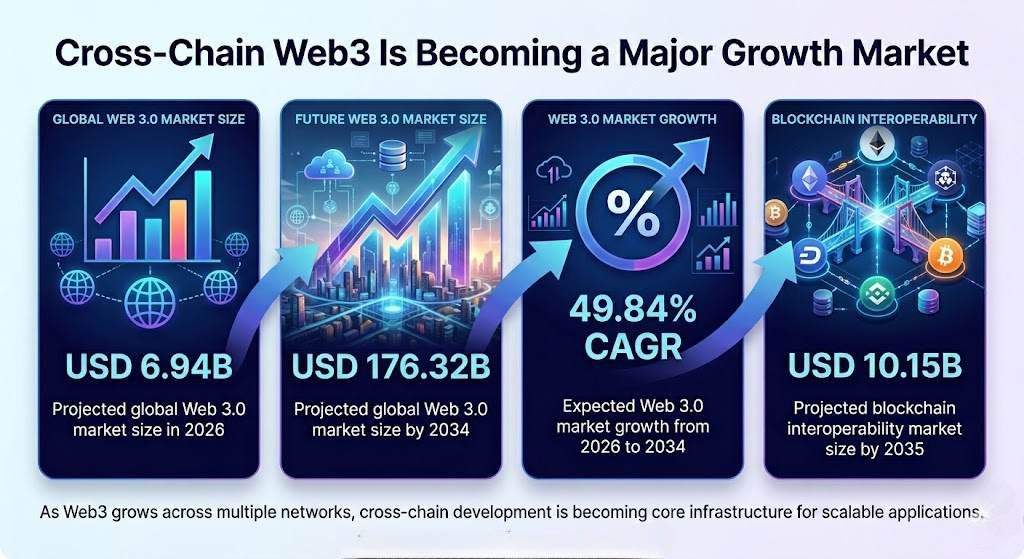
Web3 is growing fast, but most applications still remain trapped on one chain. The global Web 3.0 market is projected to grow from USD 6.94 billion in 2026 to USD 176.32 billion by 2034, and blockchain interoperability alone is forecast to reach USD 10.15 billion by 2035. That growth points to a clear shift: users, assets, and liquidity now move across many networks.
Single-chain apps struggle in this new setup. They limit your audience, reduce liquidity access, and weaken long-term product value. Cross-chain development fixes this gap, but it adds technical complexity that can slow down even skilled Web3 teams. This article breaks down how interoperable Web3 applications are built in 2026. You will learn which architecture choices matter, which tools teams use, and where the real risks hide.
What Is Cross-Chain Development?
Cross-chain development is the process of building Web3 applications that can read, write, and transfer value across more than one blockchain network. Instead of locking your product to Ethereum, Solana, BNB Chain, or any single Layer 1, you design it to operate across multiple networks at once.
That covers a wide range of functionality: moving tokens between chains, reading state from a remote chain, triggering smart contract calls on a destination network, and syncing data across ecosystems all without a centralized intermediary. The goal isn’t just technical compatibility. It’s giving your product access to every user, every liquidity pool, and every ecosystem, regardless of which chain they prefer.
Why Interoperability Matters in 2026
The multi-chain reality is already here. In 2026, activity is spread across dozens of active Layer 1 and Layer 2 networks Ethereum mainnet, its rollup ecosystem (Arbitrum, Optimism, Base, zkSync), Solana, Avalanche, BNB Chain, and Cosmos-based chains all carry meaningful user bases and capital.
Building on one chain means ignoring the rest. That’s a product decision with real consequences:
- Liquidity fragmentation: DeFi protocols that only exist on one chain miss liquidity sitting on others.
- User friction: Requiring your audience to bridge manually before using your app adds steps that kill conversion.
- Competitive exposure: Protocols that support multiple chains attract more integrations, more partners, and more composability.
Single-chain products are increasingly at a disadvantage. Cross-chain architecture is now a baseline expectation for serious Web3 products not an advanced feature.
Core Components of a Cross-Chain Architecture
Before writing a line of code, you need to understand the building blocks. Every interoperable application relies on some combination of the following.
Bridges
A bridge locks assets on a source chain and mints equivalent representations on a destination chain or burns and releases, depending on the model. Bridges handle token transfers. They’re the most visible piece of cross-chain infrastructure.
Three main bridge models exist:
- Lock and mint: Assets are locked in a smart contract on the source chain; wrapped versions are minted on the destination.
- Burn and mint: Native tokens are burned on the source chain and minted natively on the destination.
- Liquidity pools: Pools on both chains enable atomic swaps without locking or burning.
Each model carries different trust assumptions and security tradeoffs. Lock-and-mint bridges have historically been the most targeted in exploits the locked assets represent a concentrated honeypot that attracts attackers.
Messaging Protocols
Token bridges only move value. Messaging protocols move arbitrary data smart contract calls, state updates, governance votes, NFT metadata. This is what makes truly composable cross-chain applications possible.
Key messaging protocols in active use in 2026:
- LayerZero: Uses ultra-light nodes and configurable security settings. Widely adopted across DeFi and NFT projects.
- Wormhole: Supports a broad set of chains; uses a guardian network for message verification.
- Axelar: General message passing with a proof-of-stake security model; strong Cosmos ecosystem integration.
- Chainlink CCIP: Cross-chain interoperability protocol backed by Chainlink’s oracle network; favored in enterprise contexts for its established trust model.
Choosing a messaging protocol is one of the most consequential architectural decisions you’ll make. It determines which chains you can reach, how quickly messages settle, and what your attack surface looks like.
Relayers and Oracles
Relayers are off-chain agents that pick up messages from a source chain and submit them to a destination chain. Oracles provide external data that cross-chain contracts often need price feeds, proof of events, identity verification.
In most architectures, you won’t build relayers or oracles from scratch. You’ll integrate existing infrastructure. The risk is in how you configure trust: who can relay messages, what happens if a relayer goes offline, and whether your oracle data can be manipulated.
How to Build an Interoperable Web3 Application: Step by Step
Here’s a practical sequence for approaching cross-chain development from scratch.
- Define your cross-chain scope
Not every feature needs to be cross-chain. Start by mapping which functions actually require multi-chain support token transfers, governance, NFT portability. Narrowing scope early reduces complexity and shrinks your attack surface before you’ve written a single contract.
- Select your target chains
Choose chains based on where your audience already is and where your liquidity exists. In 2026, most DeFi products target Ethereum mainnet plus at least one major rollup. NFT projects often add Solana or Base. Your chain selection drives every infrastructure decision that follows.
- Choose a messaging or bridging protocol
Match your protocol to your use case. If you only need token transfers, a battle-tested bridge may be enough. If you need arbitrary message passing cross-chain governance, multi-chain yield strategies, composable NFTs you need a general messaging protocol. Evaluate each option’s security model, supported chains, and finality times before committing.
- Design your smart contract architecture
Cross-chain contracts require careful thinking about state management. You need to decide:
- Where canonical state lives (which chain is the source of truth)
- How contracts on different chains stay synchronized
- What happens when a message fails or a chain goes offline
Use modular contract design. Keep your core business logic separate from the cross-chain communication layer so you can upgrade or swap the messaging layer without rewriting your entire protocol.
- Handle message failures and edge cases
Cross-chain messages can fail. Networks go down. Gas prices spike. Relayers miss messages. Your application needs explicit failure handling built in retry logic, refund mechanisms, fallback states. This is where many teams cut corners, and it’s where they pay for it later.
- Audit before you launch
Cross-chain contracts are significantly harder to audit than single-chain contracts. The attack surface spans multiple environments, and interactions between chains create edge cases that static analysis tools miss. Manual audits by reviewers who understand cross-chain attack vectors specifically are not optional they’re the difference between a secure protocol and a headline-making exploit.
- Test on testnets across all target chains
Run end-to-end tests on every chain you plan to support. Cross-chain message delays, gas estimation differences, and chain-specific quirks only surface in realistic testing environments. Don’t skip this step.
Choosing the Right Cross-Chain Protocol
There’s no universal right answer. The decision depends on your chains, your use case, and your risk tolerance. Here’s a simplified comparison to guide your thinking:
| Protocol | Best For | Security Model | Chain Coverage |
|---|---|---|---|
| LayerZero | DeFi, NFTs, broad chain support | Configurable (DVN-based) | 50+ chains |
| Wormhole | High-throughput messaging | Guardian network | 30+ chains |
| Axelar | Cosmos + EVM interoperability | Proof-of-stake validators | 50+ chains |
| Chainlink CCIP | Enterprise, high-value transfers | Decentralized oracle network | 20+ chains |
Evaluate each against your specific requirements. A protocol that works well for a DEX aggregator may be a poor fit for a cross-chain NFT marketplace. The security model matters as much as the feature set.
Security Risks You Cannot Ignore
Cross-chain development concentrates risk in ways that single-chain development doesn’t. The most common failure modes:
- Bridge exploits: Vulnerabilities in bridge contracts have produced some of the largest losses in Web3 history. Concentrated locked assets remain a persistent target.
- Message replay attacks: Without proper nonce management, an attacker can re-submit a valid cross-chain message to drain funds or manipulate state.
- Oracle manipulation: If your cross-chain logic depends on price data or external state, a manipulated oracle feed can trigger unintended behavior across multiple chains at once.
- Finality assumptions: Some chains have probabilistic finality. Acting on a message before the source chain transaction is truly final creates exploitable windows.
- Upgradeability risks: Proxy patterns that allow contract upgrades are common in cross-chain systems. Poorly secured upgrade mechanisms give attackers a path to replace contract logic entirely.
Mitigation for all of these starts with a thorough smart contract audit conducted by reviewers who understand cross-chain attack vectors specifically, not just general Solidity security.
Common Cross-Chain Use Cases in 2026
Cross-chain development isn’t a solution looking for a problem. These are the use cases driving real adoption right now:
Multi-chain DeFi protocols
Lending, borrowing, and yield strategies that draw liquidity from multiple chains. A protocol that only accepts Ethereum collateral misses capital sitting on Arbitrum, Base, and Avalanche.
Cross-chain NFT portability
NFTs that can move between chains while preserving provenance, metadata, and royalty logic relevant for gaming assets, digital identity, and collectibles with multi-platform utility.
Cross-chain governance
DAOs with token holders spread across multiple chains need governance systems that aggregate votes without requiring everyone to bridge to a single chain first.
Real-world asset (RWA) tokenization
Tokenized assets real estate, treasuries, private credit often need to be accessible across chains to reach institutional and retail buyers on their preferred networks.
Cross-chain wallet and payment systems
Wallets that abstract chain selection from the end experience, routing transactions to the lowest-cost or fastest chain automatically.
Build Cross-Chain Right the First Time
Cross-chain development is one of the more demanding areas of Web3 engineering. The architectural decisions you make early which messaging protocol to use, where canonical state lives, how you handle message failures shape everything that follows. Getting them wrong is expensive.
The teams that ship successful cross-chain products treat security as a design constraint from day one, not something to address before launch. They audit early, test across every target chain, and choose infrastructure with proven security models.
If you’re planning a cross-chain product and want a development partner with experience across 50+ blockchain frameworks and 800+ delivered projects, learn more at blockchainappfactory.com.
FAQs
What is cross-chain development in Web3?
Cross-chain development means building blockchain applications that operate across multiple networks transferring assets, passing messages, and syncing state between chains like Ethereum, Solana, BNB Chain, and Layer 2 rollups without relying on a centralized intermediary.
What is the difference between a bridge and a messaging protocol?
A bridge moves tokens between chains. A messaging protocol moves arbitrary data smart contract calls, governance votes, NFT metadata, or any structured information. Most modern cross-chain applications need both: a bridge for value transfer and a messaging protocol for logic and state.
Which cross-chain protocol should I use in 2026?
It depends on your chains and use case. LayerZero and Axelar offer broad chain coverage for general messaging. Chainlink CCIP is strong for enterprise or high-value transfers. Wormhole handles high-throughput use cases well. Evaluate each against your security requirements and the chains your audience actually uses.
How do you secure a cross-chain application?
Security starts at the architecture level: proper nonce management, finality checks, and separation of business logic from the messaging layer. It requires thorough auditing by reviewers who understand cross-chain attack vectors and it means choosing messaging protocols with strong, decentralized security models rather than small validator sets.
What are the biggest risks in cross-chain development?
Bridge exploits, message replay attacks, oracle manipulation, and finality assumption errors are the most common failure modes. Cross-chain contracts carry a larger attack surface than single-chain contracts because vulnerabilities can propagate across multiple networks simultaneously.
How long does it take to build a cross-chain application?
Scope varies widely. A basic cross-chain token bridge can be built in 4 to 8 weeks. A full multi-chain DeFi protocol with governance, yield strategies, and audited contracts typically takes 3 to 6 months. Timeline depends on chain count, messaging protocol complexity, and the depth of your security review.
Do I need to audit cross-chain smart contracts separately for each chain?
Yes. Your core logic may be consistent, but each chain has different execution environments, gas models, and edge cases. A thorough audit covers the contracts on each target chain and the cross-chain interaction patterns between them not just the source chain contracts in isolation.

Vimal J is the Head of Sales at Blockchain App Factory, with 10+ years of experience in sales, client strategy, and Web3 business growth. He helps startups, enterprises, and project founders choose the right blockchain solutions for their goals, bringing a practical market perspective to topics like token development, crypto launches, and Web3 adoption.
Article Reviewed by:
Arun Kamala Santhanath
Marketing Head, Blockchain App Factory


