Key Insights
- A focused MVP with core trading features helps you enter the market quickly. It reduces cost, limits risk, and proves demand before scaling.
- Strong security measures and KYC/AML checks are required from day one. They protect user funds and build trust with traders and regulators.
- Liquidity, community, and early users decide your exchange success. A clear go-to-market plan ensures your platform has active trading at launch.
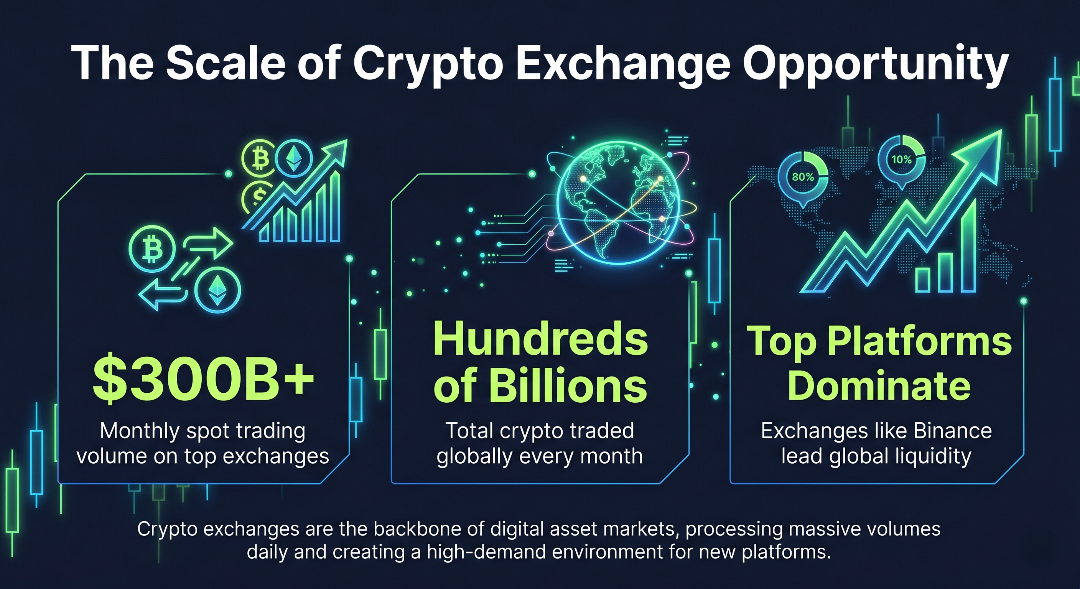
Centralized cryptocurrency exchanges handle hundreds of billions of dollars in trading volume every month, with platforms like Binance alone processing over $300 billion in spot trades in a single month. This level of activity highlights just how massive and competitive the opportunity is.
But if you’re planning to launch a cryptocurrency exchange, the biggest mistake you can make is trying to build everything at once. A crypto exchange MVP a minimum viable product with the features traders actually need on day one lets you reach the market faster, validate demand, and attract early liquidity without burning your entire budget before a single trade is placed.
This guide walks you through exactly what to build, in what order, and how to do it in 90 days.
What Is a Crypto Exchange MVP?
A crypto exchange MVP is a working version of a trading platform built with only the core features needed for launch. It is not a clickable prototype or a test demo. It supports real users, real orders, real funds, deposits, withdrawals, and trade execution.
The purpose of an MVP is to test the market without spending months building features traders may not use. At this stage, the platform should focus on one main goal: can users sign up, complete verification, deposit crypto, place orders, and withdraw funds safely?
A strong exchange MVP usually includes these core features:
- User registration and login
- KYC and identity verification
- Crypto wallet integration
- Deposit and withdrawal system
- Spot trading engine
- Buy and sell order placement
- Basic order book
- Trade history
- Admin dashboard
- Security controls
The best method is to start with one trading model, one or two crypto pairs, and a clean user flow. For example, you can launch with BTC/USDT and ETH/USDT first. This keeps liquidity easier to manage and reduces technical risk.
Features like margin trading, futures, advanced charting, mobile apps, referral programs, and multi-country fiat payments can come later. They add cost, time, and risk before the core platform has proved itself.
Your MVP should answer one market question: can this exchange handle real trades safely and smoothly? Once the answer is yes, you can expand with more pairs, more order types, and more advanced tools.
Why 90 Days Is a Realistic Target
Launching a crypto exchange in 90 days sounds fast, but it can work with a controlled scope and an experienced team. The key is not to build a full Binance-style platform from day one. The key is to launch a focused spot trading platform that does the basics well.
The 90-day method works best when the team breaks the build into clear workstreams. Backend developers work on the trading engine and APIs. Frontend developers build the user dashboard and trading screen. Security teams review wallets, access controls, and transaction flows. Compliance teams set up KYC, AML checks, and admin review steps.
A practical 90-day build usually depends on three methods:
- Use pre-built exchange components where possible
- Limit the first version to must-have features
- Run development, security, compliance, and testing in parallel
Pre-built tools save time. Matching engines, wallet systems, KYC APIs, liquidity APIs, and admin panels do not need to be coded from zero for every new exchange. A team can customize proven components and focus on the parts that make the platform different.
Scope control matters even more. Each feature should pass one test: does it help users trade safely at launch? If not, move it to the next phase. This protects the timeline and keeps the product clean.
Most 90-day exchange launches fail for one reason: the team keeps adding features. The first version does not need every tool. It needs to work, protect funds, process trades, and give early users a reason to trust the platform.
Core Features Your Exchange MVP Needs
A crypto exchange MVP should include only the features needed to support real trading. The platform must let users register, verify their identity, deposit funds, place orders, track trades, and withdraw assets safely.
The most important feature is the order matching engine. It matches buy and sell orders and keeps the order book accurate. You also need crypto wallets, with hot wallets for active balances and cold storage for larger fund reserves.
Your MVP should include:
- User registration and KYC
- Order matching engine
- Crypto wallets
- Trading interface
- Deposit and withdrawal system
- Admin panel
- Two-factor authentication
- Smart contract integration for DEX or hybrid models
Some features can wait until version 2. These include margin trading, futures, mobile apps, advanced charts, referral programs, bot APIs, and support for many fiat currencies.
The method is simple: launch with the tools users need to trade safely. Add advanced features only after the core platform works well.
Ready to launch your crypto exchange in 90 days?
Build a secure, scalable trading platform with the right MVP strategy, expert development, and a clear go-to-market plan from day one.

The 90-Day Build Timeline, Phase by Phase
A 90-day crypto exchange build works best when the team follows three clear phases.
Days 1 to 20 focus on planning and design. During this stage, the team chooses the exchange type, supported chains, first trading pairs, tech stack, and UI structure. This phase should end with approved wireframes, development setup, and a clear build plan.
Days 21 to 55 focus on core development. The team builds the matching engine, wallet system, trading screen, KYC flow, deposit and withdrawal process, and admin panel. For DEX or hybrid exchanges, smart contract work should start here.
Days 56 to 90 focus on testing and launch prep. This stage covers smart contract audits, penetration testing, load testing, compliance checks, liquidity setup, and soft launch testing with early users.
The method is to run work in parallel. Backend, frontend, wallet, compliance, and security teams should build at the same time. This keeps the timeline realistic and prevents delays before launch.
Security Requirements You Cannot Skip
Security must be built into the exchange before it handles real funds. A weak security setup can lead to stolen assets, frozen withdrawals, legal issues, and permanent loss of user trust.
Start with a third-party smart contract audit for any DEX or hybrid exchange. Every contract that controls funds, swaps, fees, or withdrawals must be reviewed before launch. The team should fix all high-risk issues before public testing.
Your platform also needs penetration testing. Security experts should test the web app, APIs, admin panel, wallet flows, and server setup. This helps find weak points before attackers do.
Core security methods include:
- Keep most funds in cold storage
- Use hot wallets only for daily withdrawals
- Add DDoS protection for traffic spikes
- Set rate limits to stop bot abuse
- Encrypt all user data and platform traffic
- Require 2FA for logins, withdrawals, and admin actions
Do not cut security work to meet a launch date. A rushed audit or weak wallet setup can cost more than the whole MVP build.
Regulatory Compliance Basics for 2026
Crypto exchange rules are getting stricter across major markets. In 2026, most exchanges need stronger KYC, AML checks, licensing, custody controls, and reporting systems before launch.
The first step is to choose your target market. A platform serving users in the US, EU, UAE, Singapore, or India may face different rules. The compliance setup should match the country where the exchange plans to operate.
Most founders need to prepare for:
- KYC: Verify users before trading or withdrawals
- AML: Monitor transactions and flag suspicious activity
- Licensing: Check if you need VASP, MSB, or exchange approval
- Sanctions screening: Block restricted users and wallet addresses
- Legal documents: Prepare terms, privacy policy, and risk notices
The best method is to add compliance into the product flow from the start. KYC, wallet checks, withdrawal limits, activity logs, and admin review tools should be part of the MVP. Adding them after launch costs more and creates avoidable risk.
What Does a Crypto Exchange MVP Cost?
The cost of a crypto exchange MVP depends on scope, architecture, and the team building it. A focused centralized exchange with core features can start around $30,000. Costs rise as complexity increases.
A simple MVP keeps the build tight. It supports a few trading pairs, basic wallets, KYC, and a stable matching engine. A decentralized or hybrid exchange costs more. It needs audited smart contracts, deeper liquidity setup, and support for multiple chains.
Costs usually increase with:
- Multiple blockchain integrations
- Custom-built matching engine
- Fiat payment gateway setup
- Mobile apps included in MVP
- Complex smart contract logic
- Large number of trading pairs at launch
You can control costs with a clear method. Keep the MVP scope strict. Use tested components for wallets, KYC, and trading systems. Work with a team that has built exchanges before. Plan extra features for later phases instead of adding them to the first release.
The starting cost reflects a focused product. Expanding the scope early will push the budget higher and delay launch.
Go-to-Market Strategy for Your Exchange Launch
Building the exchange is only part of the job. The platform needs traders from day one. Without liquidity, users cannot trade. Without trades, users leave.
Start with a liquidity plan before launch. Work with market makers or liquidity providers who can place buy and sell orders. This keeps the order book active and reduces price gaps.
Build your community early. Create groups on Telegram, Discord, and X during development. Share updates, announce features, and collect early feedback. Your first users often become your first traders.
Growth methods to focus on:
- Partner with market makers for early liquidity
- Build a community before launch
- Work with crypto influencers in your niche
- Add referral rewards for early users
- Publish trading guides and platform content
Influencer outreach helps reach active traders fast. A few trusted voices can drive more users than broad ads. Referral programs help users bring others to the platform. Simple rewards like fee discounts work well in early stages.
Content also plays a role. Guides, tutorials, and comparisons bring users who are already searching for exchanges. This takes time but builds steady traffic.
The method is clear: build liquidity, build trust, and bring users before the public launch.
If you need both the build and the growth strategy handled by one team, Blockchain App Factory at www.blockchainappfactory.com covers exchange development, smart contract auditing, and crypto-native marketing under one roof. That matters when you are working against a 90-day clock and cannot afford handoff delays between separate vendors.
Build In-House or Work With a Development Partner?
If you have a strong in-house blockchain engineering team with prior exchange architecture experience, building in-house is viable. Most founders do not have that team.
The honest comparison:
| Factor | In-House Build | Development Partner |
| Timeline | 6–18 months typical | 90 days with right partner |
| Upfront cost | High (salaries, infrastructure) | Project-based, predictable |
| Exchange-specific experience | Depends on your team | Proven if partner has prior exchange projects |
| Smart contract audit | Requires external engagement | Can be bundled |
| Post-launch marketing | Separate vendor | Can be same vendor |
| Risk if team leaves | High | Lower |
For most founders at the pre-seed to Series A stage, a development partner with a track record in exchange builds reduces both time-to-market and execution risk. The key is choosing a partner who has built exchanges before, not one who is learning on your project.
Blockchain App Factory has delivered 800+ blockchain projects over 12+ years, with a team of 250+ professionals including 90+ certified blockchain experts. Exchange MVP development, smart contract auditing, and post-launch marketing are all services they provide. You can learn more and schedule a consultation at www.blockchainappfactory.com.
FAQs
What is a crypto exchange MVP?
A crypto exchange MVP is a working trading platform with only the features needed at launch. It supports real users, real trades, deposits, and withdrawals. Core parts include a matching engine, wallet system, KYC, trading interface, and fund management. Features like margin trading, mobile apps, and multi-fiat support can come later.
How long does it take to build a crypto exchange MVP?
A skilled team can build and launch an MVP in about 90 days. This timeline works when the scope is tight and work runs in parallel. Teams without prior exchange experience often take 6 to 18 months.
How much does crypto exchange MVP development cost?
A basic centralized exchange MVP starts around $30,000. Costs rise with more chains, complex smart contracts, fiat integrations, and a larger set of trading pairs.
Do I need a smart contract audit for my exchange MVP?
Yes, for any decentralized or hybrid exchange. Smart contracts that handle funds must be audited before launch. Even centralized platforms should review any on-chain components to reduce risk.
What regulatory requirements apply to a crypto exchange in 2026?
Rules depend on the country where the exchange operates. Most regions require KYC and AML checks. Many also require licenses such as VASP or MSB. Major frameworks include MiCA in the EU, FinCEN rules in the US, and VARA rules in the UAE. Legal guidance is needed before launch.
What is the difference between a centralized and decentralized exchange MVP?
A centralized exchange holds user funds and processes trades off-chain with a matching engine. A decentralized exchange uses smart contracts and lets users keep control of their funds. Hybrid models combine both. Centralized exchanges are faster to launch. Decentralized exchanges need audited contracts and on-chain liquidity.
Can the same team handle development and marketing?
Yes. One team can build the exchange and manage post-launch growth. This keeps timelines aligned and reduces delays between product launch and user acquisition.
Ninety days from now, you could have a live trading platform or still be in planning meetings. The difference is scope discipline, the right team, and starting today. If you are ready to move from idea to launch, www.blockchainappfactory.com is a practical starting point.

Vimal J is the Head of Sales at Blockchain App Factory, with 10+ years of experience in sales, client strategy, and Web3 business growth. He helps startups, enterprises, and project founders choose the right blockchain solutions for their goals, bringing a practical market perspective to topics like token development, crypto launches, and Web3 adoption.