
Key Insights
- YouTube works best for deep product education, X drives fast market conversation, TikTok expands reach, and Telegram or Discord helps turn attention into community action.
- Brands get better results from multi-step campaigns that connect awareness, education, conversion, and community follow-up instead of relying on a single sponsored post.
- Clear goals, creator fit, tracking, disclosures, and content review help crypto campaigns produce measurable growth and reduce legal and reputational risk.
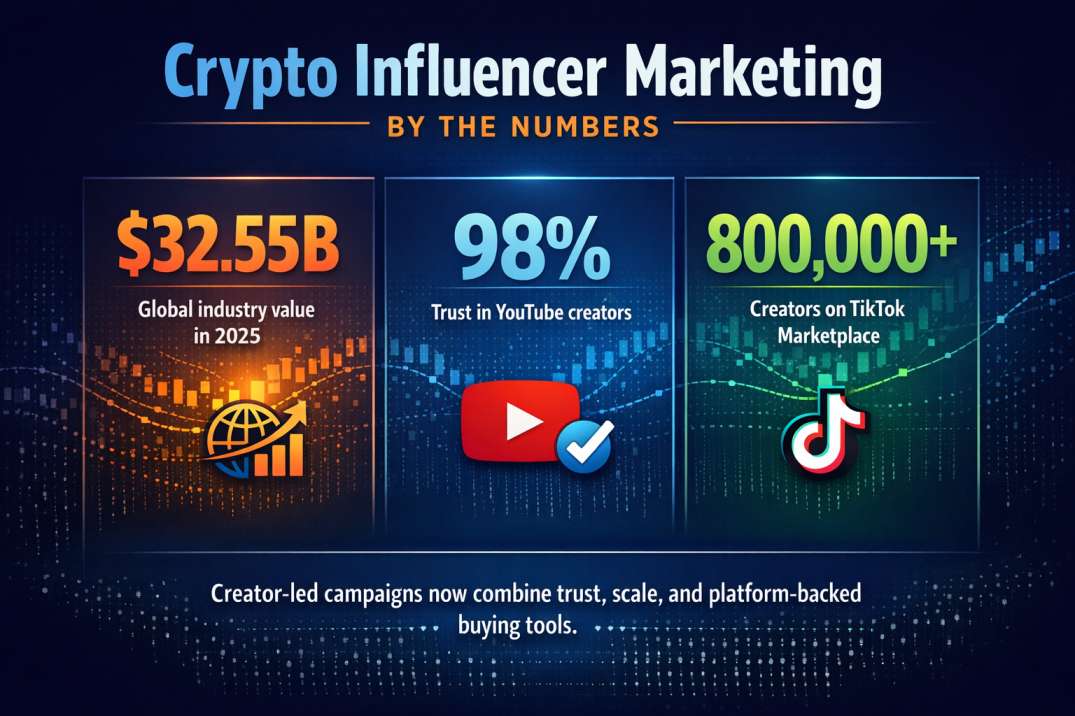
Crypto influencer marketing has moved from a fringe tactic to a core growth channel for exchanges, wallets, DeFi apps, and token launches. The shift is now backed by market size. The global influencer marketing industry reached $32.55 billion in 2025, which shows how fast creator-led promotion has become a serious budget line for brands.
The reason is simple. Most crypto products ask people to trust a new system, learn new terms, and take financial risk. A good creator can shorten that gap. They turn abstract product claims into a clear story, show the interface in use, and speak to communities that already care about trading, staking, gaming, or on-chain finance. That mix of trust and explanation is hard to match with standard display ads. YouTube says users are 98% more likely to trust creator recommendations on YouTube than on other social platforms, which helps explain why long-form creator content carries so much weight in crypto buying decisions.
Official creator tools support this shift. YouTube offers creator partnership tools inside Google’s ad system, and TikTok Creator Marketplace gives brands a direct way to discover creators and manage campaigns. TikTok has said its marketplace gives brands access to 800,000+ qualified creators globally, which shows how far influencer campaigns have moved from manual outreach to structured media buying.
What Is Crypto Influencer Marketing?
Crypto influencer marketing is paid or incentivized promotion by creators who shape opinion in Web3. That group includes YouTubers, X commentators, TikTok educators, newsletter writers, podcasters, Telegram admins, and founders with loyal followings.
Definition and how it differs from traditional influencer marketing
Traditional influencer marketing often sells fashion, beauty, or consumer goods through lifestyle content. Crypto campaigns work in a different way. They rely more on education, market context, product walkthroughs, and repeated exposure. A viewer does not open a wallet or bridge funds after one glossy mention. They need proof, explanation, and a reason to act.
The content itself is also more technical. A creator may need to explain wallet security, token utility, staking yields, or the user journey inside a trading app. That makes creator fit more important than raw audience size. In many cases, a smaller creator with real authority in crypto will drive better business results than a larger creator with a broad lifestyle audience.
Who uses it?
The companies that use this channel span the full market. Centralized exchanges use creators to drive funded accounts and first deposits. Wallet firms push app installs and wallet connections. DeFi protocols want liquidity, swaps, and governance activity. Web3 games need beta signups and community growth. Infrastructure firms and analytics tools use expert creators to reach founders and developers.
Why businesses keep spending on it
This channel works across that range since creators can speak to narrow audiences with much more credibility than a broad media buy. YouTube says users are 98 percent more likely to trust YouTube creators, and its case studies tie creator-led campaigns to stronger search lift and conversion rates.
How Crypto Influencer Marketing Pricing Works
Pricing starts with the deal structure. The most common model is a flat fee per deliverable, such as one YouTube integration, one X thread, or one TikTok video. Some brands buy on CPM, which ties cost to expected impressions. Others add a performance layer with referral codes, affiliate payouts, or cost-per-acquisition terms.
The pricing models
Retainer deals are common for ambassador programs. Token projects sometimes add token grants or vesting, though cash fees remain the cleaner option for budgeting and compliance. Each model changes risk. Flat fees shift more risk to the brand. CPA shifts more risk to the creator. Hybrid deals split that risk.
Typical cost drivers
The biggest cost drivers are audience quality, niche authority, content format, and usage rights. A mid-sized creator with a loyal crypto audience often charges more than a larger general creator with weak fit. Long-form video costs more than a short post since production takes longer and the content carries more buyer education value. Fast turnarounds raise fees. Paid media rights raise fees. Exclusivity raises fees.
Geography matters too. English-language finance audiences in the US, UK, and Gulf markets often command premium rates. The same applies to creators with a record of moving users, not just views.
Pricing by creator tier
Creator tier still matters, and it gives buyers a practical way to plan spend. Influencer Marketing Hub reports that YouTube sponsored video pricing in 2026 ranges from about $20 to $200 for nano creators and goes past $20,000 for mega creators. That is a broad market benchmark, not a crypto-only rate card. Crypto often prices above many consumer categories since the audience is more valuable and the legal review is tighter.
Pricing by platform
Platform choice changes the budget too. YouTube usually carries the highest single-post fee, and for good reason. It drives deeper product education and stronger intent. X is cheaper per post in many cases, yet a top market commentator can still command premium pricing for a thread, Space, or launch package. TikTok sits in the middle for many brands. It offers broad reach and a lower production barrier, and TikTok’s own materials position creator-led content as a strong driver of engagement and click-through.
Benchmark ranges brands commonly use
Most businesses do not buy one creator in isolation. They build a mix. A pilot may use five to ten micro creators across one platform. A larger campaign may combine YouTube, X, and TikTok with tracked links and content reuse. In practice, crypto brands often budget by creator tier, expected reach, and production load rather than by post alone.
Hidden costs businesses often miss
Brands often miss legal review. The FTC requires clear disclosure of paid relationships, and crypto marketers face more scrutiny than many other sectors. Tracking is another hidden line item. A post without custom links, landing pages, and referral logic leaves the team guessing about return. Community support matters too. Traffic from a creator post can flood Telegram or Discord in minutes, and poor follow-up wastes the spend.
Budgeting framework for businesses
A practical budget framework has three levels. A pilot campaign uses a small creator group to test message fit. A growth campaign mixes micro and mid-tier creators across several channels with reporting and content reuse. A launch campaign adds burst timing, moderation, paid amplification rights, and live events such as Spaces or AMAs.
That structure gives leadership a clean way to move from test spend to repeatable acquisition. It also helps teams compare creator cost against business outcomes such as wallet connects, first deposits, signups, and qualified leads.
The Top Platforms for Crypto Influencer Marketing
Crypto brands do not win with reach alone. They win with trust, clarity, and repeat exposure. That is why platform choice matters so much. Each channel shapes how a buyer sees risk, value, and product fit. YouTube, TikTok, Instagram, Telegram, Discord, podcasts, and newsletters all play different roles in that process. Brand teams that treat them as interchangeable usually waste budget. Teams that match platform to buyer intent get far better results. Official creator tools reflect that shift. YouTube Creator Partnerships lets brands work with creators for brand deals and promote creator videos through Google Ads. TikTok Creator Marketplace and TikTok One give brands a direct system for creator discovery, project setup, and campaign management.
YouTube for Long-Form Education and High-Intent Audiences
YouTube remains the strongest platform for complex crypto offers. A wallet tutorial, exchange review, DeFi explainer, or token thesis needs time and screen space. Short clips rarely do that job well. YouTube gives creators room to explain product setup, fees, security, and user flow in a format that buyers trust. Google states that users are 98 percent more likely to trust YouTube creators, and YouTube reports 2.3 times higher long-term return on ad spend than paid social in its brand materials. That makes the channel especially useful for high-value actions such as funded accounts, wallet installs, and B2B demo interest.
X for Real-Time Crypto Conversation and Market Sentiment
X plays a different role. It is the place for launch chatter, market reaction, founder access, and narrative spread. A strong thread can frame a token launch in minutes. A Space can turn product updates into live conversation. X works best at the top and middle of the funnel. It builds awareness and social proof fast, then pushes traffic to deeper content on YouTube, a landing page, or a community hub. Brands that treat X as the full campaign usually see weak conversion data. Brands that use it as the spark often get far better results.
TikTok for Reach, Short-Form Discovery, and Younger Audiences
TikTok offers lower-friction discovery. It is strong for simple hooks, fast explainers, and user pain points. A creator can turn a complex product into a 30-second story that earns attention from younger users who do not read long threads or watch a 15-minute review. TikTok’s official materials frame creator-led content as a driver of stronger engagement and click-through, and its creator tools let brands shortlist creators, launch projects at scale, and manage collaboration inside one system. That makes it a practical channel for app growth, waitlists, and broad retail awareness.
Instagram for Brand Positioning and Partnership Ads
Instagram works best for brand image and paid amplification. It is less central to crypto discourse than YouTube or X, yet it still matters for founders, lifestyle-led investing content, and polished creator assets that can run as partnership ads. Brand teams often use Instagram to make a crypto product look more credible and consumer-ready. That matters for wallets, fintech apps, and products aimed at newer users who want social proof before they click.
Telegram and Discord for Community-Centric Campaigns
Telegram and Discord sit closer to activation and retention. They are not just media channels. They are operating spaces for community. Telegram states that groups can hold up to 200,000 members, and the company has said its channels generate more than 1 trillion views each month. Public channels with at least 1,000 subscribers can earn ad revenue through Telegram’s own system. Those details matter for crypto marketers. They show why Telegram works for AMAs, launch alerts, local language channels, and community support at scale. Discord serves a similar role for gaming, DAO, and developer communities that need structured discussion and role-based access.
Podcasts, Newsletters, and Niche Creator Media
Podcasts and newsletters often reach smaller audiences, yet those audiences are more serious. A niche newsletter reader or podcast listener is usually deeper in the market. That makes these formats useful for infrastructure firms, B2B products, research tools, and institutional offers. They rarely drive mass signups. They often drive qualified leads and stronger conversion quality.
Planning your next big crypto campaign?
Build a focused influencer strategy that drives reach, trust, and measurable growth.

How to Choose the Right Platform Mix for Your Business
A smart platform mix starts with business goals, not content trends. The wrong channel can inflate impressions and depress revenue.
Match Platform to Campaign Goal
Use YouTube for product education and trust building. Use X for launch speed and social proof. Use TikTok for reach and app discovery. Use Telegram or Discord for onboarding and retention. That sequence mirrors the buyer funnel. One channel rarely does every job well.
Match Platform to Buyer Type
Retail traders often respond to X, TikTok, and Telegram. Developers and founders spend more time with YouTube, long-form threads, podcasts, and newsletters. Institutions want expert voices and proof of competence, so niche media often beats mass creators.
Match Platform to Product Complexity
Simple products can win with short-form content. Complex products need time. A DeFi protocol, on-chain analytics tool, or custody product needs creators who can explain process, risk, and product logic in detail. That pushes the media mix toward YouTube, podcasts, and newsletters.
Match Platform to Compliance Risk
Crypto campaigns face tougher review than many consumer categories. The FTC requires clear disclosure of paid relationships. Platforms have their own branded content rules too. High-risk offers need tighter scripting, review, and approval workflows. That often favors channels where brands can review content in advance and pair creator content with approved landing pages.
Crypto Influencer Campaign Structures That Actually Work
The best campaigns use structure, not isolated posts. A single creator mention can create noise. A planned campaign can create pipeline.
One-Off Sponsored Post Campaign
This is the fastest format to launch. It works for product updates, listing news, or small tests. It does not work well as a growth engine on its own. There is too little repetition and too little data.
Multi-Creator Burst Campaign
This model groups many creators inside a short launch window. It suits token launches, app releases, and event promotion. The goal is message density. The market sees the brand from several trusted voices in a few days, so recall rises fast.
Funnel-Based Campaign Structure
This is the strongest model for most growth teams. One set of creators drives awareness. Another set explains the product in depth. A final set pushes tracked links, referral codes, or signups. Each creator plays a defined role. Budget and reporting become much clearer.
Ambassador Program Structure
Ambassador programs build trust through repetition. The creator posts more than once, learns the product, and becomes a known voice for the brand. This structure suits exchanges, wallets, and analytics firms that need steady education and recurring launches.
Community + Influencer Hybrid Structure
This format pairs creator traffic with a managed Telegram or Discord environment. The creator brings people in. The community team answers questions, runs AMAs, and guides activation. That bridge often decides whether attention turns into users.
Performance-Led Campaign Structure
Performance-led campaigns tie fees to clicks, signups, deposits, or other tracked actions. They demand tighter attribution and stronger conversion systems, yet they give executives a cleaner view of return. This structure works best after a brand has already tested creator fit and message fit on a smaller scale.
A Proven Framework for Planning a Crypto Influencer Campaign
Crypto influencer campaigns fail for familiar reasons. The goal is vague. The wrong creators get picked. Tracking breaks. Legal review arrives too late. A better campaign starts with a clear planning process. That process turns creator marketing from a brand experiment into a measurable acquisition channel.
Step 1: Define the Business Objective
Start with one business goal. Pick funded accounts, wallet installs, app downloads, waitlist signups, demo requests, or first swaps. Do not mix every goal into one brief. A creator cannot drive awareness, education, and conversion at the same level in a single post. Clear goals shape the offer, the creator list, and the reporting model. They also help the finance team judge return with less guesswork.
Step 2: Identify the Audience and Buyer Journey
The audience needs the same level of detail. A retail trader on X behaves very differently from a founder who listens to crypto podcasts or reads research newsletters. New users need education and reassurance. Experienced users want product edge, fee clarity, and proof of liquidity or speed. The buying path matters just as much. A user who sees a TikTok clip may need a YouTube review next, then a landing page, then a Discord or Telegram touchpoint. That sequence gives the campaign structure and stops teams from asking one creator to do every job.
Step 3: Select Creators Based on Fit, Not Just Follower Count
Follower count is the weakest screening tool in crypto. Audience fit, credibility, and past sponsor behavior matter more. A creator with 40,000 followers and a loyal trading audience can beat a creator with 400,000 broad followers. The gap grows wider in technical categories such as wallets, DeFi, and infrastructure tools. YouTube’s own brand materials say users are 98 percent more likely to trust YouTube creators, which helps explain why authority inside a niche drives more value than raw reach alone.
Step 4: Design Offers and Messaging
The offer must match the user’s stage. Cold audiences respond to a simple promise and a low-friction next step. Warm audiences respond to detail, proof, and a direct incentive. Good briefs give creators room to sound natural, but they still set hard limits around claims, risks, and required disclosures. In crypto, messaging needs plain wording around fees, eligibility, lockups, and product risk. Loose copy creates legal exposure and weak conversion at the same time.
Step 5: Build Tracking and Attribution
Tracking needs to be in place before any post goes live. That means custom links, referral codes, landing pages, event tracking, and a reporting view that separates creator performance by channel and objective. Google Ads now includes a creator partnerships hub for YouTube campaigns, and Google states that organic and paid views plus engagement metrics from a creator’s brand segment can sync into Google Ads from April 2026. That kind of native reporting helps teams compare creator spend against search lift, site visits, and conversion behavior.
Step 6: Approve, Launch, Moderate, and Optimize
A clean approval process is the final planning step. Review the script, landing page, disclaimer language, and community staffing plan before launch day. Then watch comments, click quality, and conversion flow in real time. Crypto traffic can spike fast, and poor moderation can waste paid reach within hours. Teams should score creators on cost, audience quality, retention, and assisted conversions, then shift budget toward the creators who drive actual user action.
How Much Does It Cost to Build Support for Top Crypto Influencer Marketing Platforms?
For this section, I am treating the question as the cost to build support for top crypto influencer marketing platforms, not the cost to pay influencers. That means software features for campaign management across YouTube, X, TikTok, Instagram, Telegram and Discord, plus podcasts, newsletters, and niche creator media.
The total cost changes with feature depth. A simple MVP usually includes creator onboarding, campaign setup, content approvals, basic reporting, and admin controls. A more advanced build adds better analytics, attribution, messaging, moderation tools, and channel-specific workflows. The table below shows estimated development time and cost for each platform module.
Cost to Build Support for Top Crypto Influencer Marketing Platforms
| Platform / Feature | Description | Duration | Cost (USD) |
|---|---|---|---|
| YouTube integration | Creator profile sync, video campaign workflow, content submission, approval flow, and basic performance reporting | 2 to 4 weeks | $2,000 to $7,000 |
| X campaign module | Creator listing, post and thread tracking, Space support fields, link tracking, and campaign monitoring | 1 to 3 weeks | $1,500 to $5,000 |
| TikTok integration | Creator onboarding, short-form campaign setup, content approval, and basic reporting | 2 to 4 weeks | $2,000 to $6,500 |
| Instagram campaign module | Creator matching, reel and story workflow, approval steps, and engagement reporting | 1 to 3 weeks | $1,500 to $5,000 |
| Telegram and Discord community module | AMA scheduling, invite tracking, moderation flow, community reporting, and admin controls | 2 to 4 weeks | $2,500 to $8,000 |
| Podcasts, newsletters, and niche creator media module | Creator database, sponsorship workflow, campaign scheduling, tracking links, and report view | 1 to 3 weeks | $1,500 to $4,500 |
Build a high-impact campaign strategy now
Compliance, Risk, and Brand Safety in Crypto Influencer Marketing
Crypto creator campaigns carry more legal and reputational risk than most consumer categories. Financial claims get closer scrutiny, and paid promotion can trigger regulatory action if disclosure is weak or the product falls inside securities rules.
Why Compliance Matters More in Crypto
Regulators have already shown that influencer activity in finance and crypto is not a side issue. In February 2024, the SEC charged Van Eck Associates and said the firm failed to disclose a social media influencer’s role in the launch of an ETF. The firm agreed to pay a $1.75 million civil penalty. In 2022, the SEC charged Kim Kardashian for promoting EthereumMax without disclosing the payment she received, and the settlement totaled $1.26 million in penalties, disgorgement, and interest. Those cases show a clear pattern. Promotion risk does not sit only with the creator. Brands and issuers face exposure too.
Core Disclosure Requirements
The FTC states that influencers need to clearly disclose material connections to brands. That means paid fees, free products, affiliate links, equity, or any other benefit tied to the post. The disclosure must be hard to miss and easy to understand. A vague hashtag buried below the fold is not enough. The FTC’s guidance says endorsements must be truthful and not misleading, and the agency’s influencer brochure gives direct examples of good and bad disclosure practice.
Regulatory and Platform Issues Businesses Must Address
Brands need to check more than disclosure language. They need to assess whether the promoted asset or service triggers financial advertising rules in each market. TikTok’s ad policy for financial services requires enhanced transparency and compliance with local laws and regulations. TikTok also restricts or blocks some branded content categories by market. YouTube requires creators to disclose paid product placements and similar sponsorship relationships through platform tools and policy settings. Those platform controls do not replace legal review, but they are a core part of a compliant workflow.
Brand Safety Checklist
A serious crypto campaign needs a written checklist. Review creator history. Check audience quality. Screen for fake engagement. Ban unapproved claims. Lock down disclosure language. Audit landing pages. Set escalation rules for market volatility, token price swings, or user complaints. Keep takedown rights in the contract. Build a moderation plan for Telegram, Discord, and X replies. Brand safety is not a soft issue in crypto. It is part of campaign economics.
Conclusion
A strong crypto influencer campaign starts long before the first post. It starts with a clear business goal, a defined buyer path, careful creator selection, disciplined message control, and clean attribution. Then it stands or falls on compliance. Teams that build these pieces early get more than views. They get a repeatable crypto influencer marketing channel with fewer legal risks and a clearer link between creator spend and business results.
For businesses that want to launch faster and manage campaigns with more confidence, working with an experienced partner such as Blockchain App Factory can help bring structure to creator outreach, campaign planning, compliance review, and performance tracking. That makes crypto influencer marketing more than a brand play. It becomes a practical growth channel built for trust, reach, and measurable returns.