


Key Insights
- Projects with strong token utility, audited smart contracts, legal preparation, and real user demand attract more investors and exchange trust in 2026.
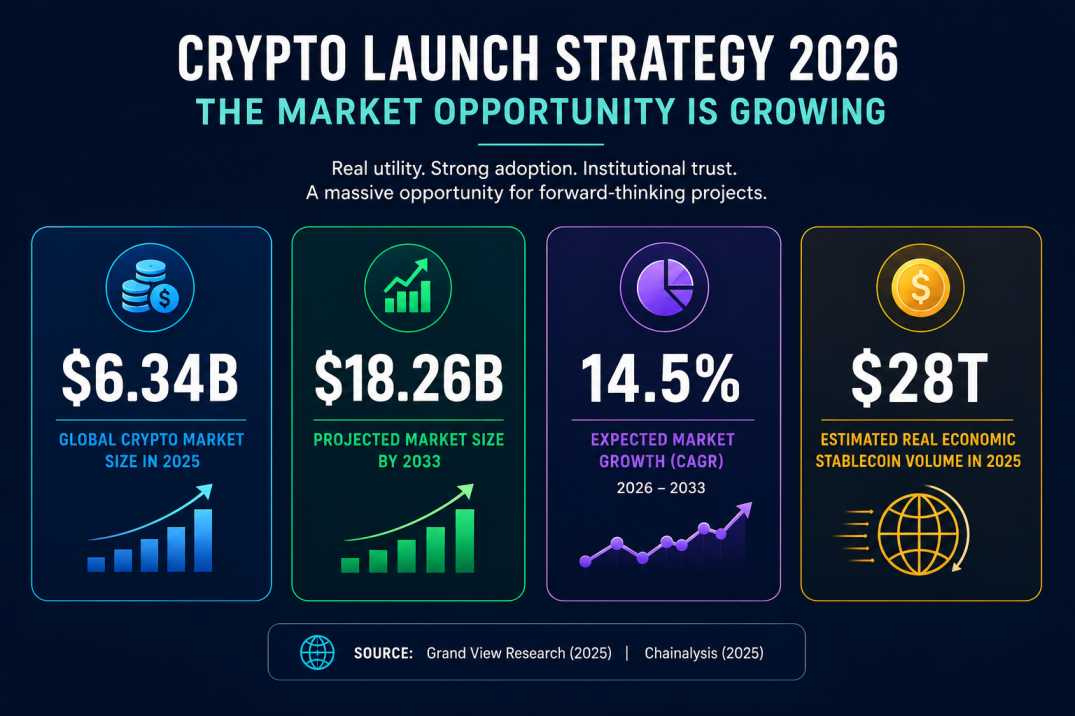
- The global cryptocurrency market is projected to grow from $6.34B in 2025 to $18.26B by 2033, with stablecoins processing trillions in transaction volume.
- Successful crypto launches focus on security, liquidity, community retention, multi-chain expansion, and real-world business use cases instead of short-term hype.
A crypto launch in 2026 needs more than a token, a website, and a social media push. Buyers, exchanges, regulators, and enterprise partners now judge projects through proof: clear utility, safe token design, public audits, legal preparation, and real user demand.
Crypto adoption has moved past early speculation. Chainalysis ranked India, the United States, Pakistan, Vietnam, and Brazil among the top crypto adoption markets in 2025, with stablecoins playing a major role in payments, savings, and remittances. The commercial case is also growing. Grand View Research estimates the global cryptocurrency market at USD 6.34 billion in 2025, with projected growth to USD 18.26 billion by 2033 at a 14.5% CAGR. Stablecoins add another signal of demand, with Chainalysis estimating $28 trillion in real economic volume in 2025. For businesses, this creates a clear opening. A strong crypto launch strategy can attract users, partners, liquidity, and capital. A weak one can burn trust in days.
What Is a Crypto Launch Strategy?
A crypto launch strategy is the full go-to-market plan for bringing a blockchain product, token, protocol, or Web3 platform to market. It covers positioning, tokenomics, compliance, community growth, exchange access, liquidity, content, PR, and post-launch retention.
The goal is not only to sell tokens. The goal is to build a market around a product. That market needs users who understand the value, investors who trust the structure, and partners who see a long-term business case.
A strong crypto launch plan answers five questions:
- Who is the product for?
- Why does the token need to exist?
- How will users get value after launch?
- Which markets and rules apply?
- How will the project keep demand after listing?
These questions matter more in 2026. Regulators now expect clearer disclosures. Investors study unlock schedules. Users check audits. Exchanges review liquidity, reputation, and legal risk before listing a token.
Why Crypto Launches Are Different From Traditional SaaS Launches
A SaaS launch sells access to software. A crypto launch often introduces a tradable asset, a community, and a governance model at the same time. That makes the launch harder.
A SaaS company can change pricing, adjust features, and fix messaging after release. A token project has less room for error. Smart contracts can lock rules into code. Token unlocks can affect market price. Poor liquidity can damage confidence. A weak community can make the project look inactive.
Trust also works in a different way. SaaS buyers trust case studies, demos, and contracts. Crypto users study wallets, audits, Discord activity, token supply, vesting terms, and on-chain data. They want proof that the team can ship and that the token has a real role.
This is why crypto launch marketing must join technical planning with commercial planning. The whitepaper, audit, token model, user funnel, exchange plan, and content strategy must support one message.
Core Components of a Successful Crypto Launch
The strongest launches start months before the token generation event. They build demand before they ask the market for liquidity.
The first component is positioning. A project must state who it serves and what pain it solves. “A new DeFi protocol” is weak. “A compliant treasury yield platform for fintech firms” is clearer and more commercial.
The second component is token utility. The token should support access, rewards, payments, staking, governance, or network security. Empty utility invites short-term trading and fast churn.
The third component is compliance. In Europe, MiCA created uniform rules for crypto assets, with requirements tied to transparency, disclosure, authorization, and supervision. That means legal review now belongs near the start of launch planning, not near the end.
The fourth component is community. Strong communities do not form through giveaways alone. They grow through education, product access, honest updates, and clear roles for early users. Airdrops and quests can help, but they must connect to real use.
The fifth component is liquidity. A project needs a plan for DEX pools, market makers, treasury controls, and exchange targets. Liquidity is not only a trading issue. It affects trust, price stability, and institutional interest.
Crypto Market Trends Shaping 2026 Launch Strategies
Institutional Adoption and Regulatory Maturity
Institutional participation has changed the standard for crypto launches. Coinbase’s 2026 market outlook points to regulation, tokenization, stablecoins, and institutional integration as core themes for the year. This matters for founders. A project now competes for attention from users who expect higher standards.
The Bullish deal to acquire Equiniti for $4.2 billion shows how fast traditional finance and blockchain infrastructure are moving toward each other. Equiniti serves about 3,000 public companies, and the deal is aimed at tokenized securities, 24-hour trading, and stablecoin settlement.
For a new crypto business, the message is clear. Compliance, custody, reporting, and institutional-grade operations are no longer optional add-ons. They are part of market entry.
Rise of Real-World Asset Tokenization
Real-world asset tokenization is one of the clearest commercial use cases for crypto in 2026. It turns assets such as treasury products, funds, credit, commodities, and property rights into blockchain-based tokens.
The market has grown fast. MetaMask reported about $29.3 billion in distributed on-chain RWA value in April 2026. CoinDesk reported that the tokenized RWA market had passed $30 billion, with growth above 200 percent over the prior year.
This trend changes launch strategy. RWA projects cannot rely on meme-style hype. They need legal structures, asset verification, investor reporting, redemption rules, and clear risk language. The buyer is often a finance team, fund manager, fintech founder, or high-net-worth investor. That buyer expects proof, not noise.
RWA launches also need content that explains yield, custody, rights, fees, and settlement. Strong SEO content can support sales here. Search terms such as “RWA tokenization platform,” “tokenized asset launch,” and “compliant token issuance” match commercial intent.
Community Utility Over Speculation
The market has learned that hype fades fast. A large Telegram group does not prove adoption. A token pump does not prove product-market fit. In 2026, serious projects need communities that use the product, test features, vote, stake, refer, create content, and bring partners.
Utility-led communities produce stronger launch signals. They create wallet activity, feedback, retention, and public proof. These signals matter to exchanges, funds, and business partners.
A strong crypto launch strategy should treat community as a product channel. Early users should receive access, status, data, and roles that connect them to the project. The team should publish product updates, treasury reports, roadmap progress, and security information on a fixed rhythm.
Ready to Build a Winning Crypto Launch Strategy?
Plan, launch & scale your crypto project with a proven 2026 strategy.

Step-by-Step Crypto Launch Framework for 2026
The crypto market in 2026 rewards preparation, transparency, and long-term execution. Projects no longer succeed through hype alone. Investors study token unlocks, treasury structure, audits, and user activity before they commit capital. Exchanges run deeper reviews, and users expect clear utility from day one.
A successful crypto launch strategy must connect product development, token economics, legal preparation, marketing, liquidity, and community growth into one coordinated plan. Weakness in one area can damage the entire launch.
Phase 1 – Market Research and Positioning
Market research shapes every decision that follows. A crypto startup must know its target users, regional demand, competitor gaps, and commercial use case before it designs a token or marketing campaign.
The strongest projects define a narrow market first. A decentralized exchange for professional traders needs different messaging than a blockchain gaming platform. A tokenized real estate platform targets different buyers than a meme coin community.
Research should focus on:
- Search demand for crypto-related keywords
- Competitor token performance
- Wallet activity across chains
- User acquisition costs
- Regulatory conditions by country
- Exchange appetite for specific sectors
Clear positioning creates trust. Buyers need a direct explanation of what the product does and why it matters.
Phase 2 – Tokenomics Design
Tokenomics determines how value moves through the ecosystem. Poor token design can destroy a project even with strong marketing and funding.
A strong token model balances supply, demand, rewards, and treasury control. Investors study vesting schedules carefully. Heavy insider allocations create fear of sell pressure. Large emissions can weaken long-term demand.
Utility matters more in 2026 than it did during earlier bull markets. Tokens now need a practical role inside the product. Common utility functions include:
- Governance voting
- Staking rewards
- Network security
- Access to premium tools
- Payment settlement
- Fee discounts
Projects such as Ethereum and Chainlink built lasting demand through active network use, not short-term speculation.
Phase 3 – Legal and Compliance Preparation
Regulation now shapes crypto launch planning across major markets. Europe’s MiCA framework introduced stricter rules for crypto-asset disclosures and service providers. Exchanges and institutional investors now expect stronger compliance standards before listing or funding projects.
Legal preparation should cover:
- Token classification
- AML and KYC rules
- Whitepaper disclosures
- Tax obligations
- Jurisdiction restrictions
- Marketing compliance
A launch without legal review can create listing problems later. Compliance preparation also improves trust with enterprise partners and institutional investors.
Phase 4 – Building the Community Before Launch
Strong crypto communities start months before token distribution. The goal is not only to grow follower counts. The goal is to attract users who understand the product and stay active after launch.
Discord, Telegram, X, Reddit, and Farcaster all serve different purposes. Telegram supports fast communication. Discord works well for developer discussions and governance groups. X helps projects reach traders, investors, and media outlets.
The best communities grow through education and participation. Teams should publish:
- Product demos
- Technical updates
- Roadmaps
- Audit results
- AMA sessions
- Early access campaigns
Projects that depend only on giveaways often attract bots and short-term traders instead of loyal users.
Phase 5 – Pre-Launch Marketing Campaigns
Pre-launch marketing builds awareness before liquidity enters the market. This stage creates momentum and helps projects gather early supporters.
A balanced campaign includes content marketing, PR, influencer outreach, SEO, and community engagement. SEO plays a major role for long-term traffic. Search terms such as “crypto launch strategy,” “IDO launch,” and “Web3 marketing agency” attract commercial buyers and investors.
Airdrops and whitelist campaigns still work, but quality matters more than size. Strong projects reward meaningful activity instead of simple social tasks.
Crypto media coverage can also increase credibility. Publications such as CoinDesk, Decrypt, and CoinTelegraph often influence retail sentiment during launch periods.
Phase 6 – Liquidity and Exchange Listing Strategy
Liquidity planning affects price stability and user confidence after launch. Thin liquidity creates volatility and damages trust quickly.
Projects must decide between decentralized exchanges, centralized exchanges, launchpads, or hybrid listing strategies. Each option has tradeoffs.
DEX launches offer speed and community access. CEX listings provide visibility and stronger liquidity, but listing requirements have become stricter and more expensive.
Market makers often help stabilize trading activity during the early stages of launch. Treasury management also matters. Poor treasury decisions can weaken long-term sustainability.
A listing strategy should include:
- Liquidity allocation plans
- Market maker agreements
- Exchange application timelines
- Trading pair selection
- Treasury reserve management
Phase 7 – Post-Launch Growth Strategy
Many crypto projects focus too heavily on launch week and ignore retention. Real growth starts after the token becomes tradable.
Post-launch strategy should track:
- Daily active wallets
- Staking participation
- Governance activity
- User retention
- Transaction volume
- Revenue generation
Teams must continue shipping features, fixing bugs, and publishing updates. Consistent development keeps communities active and builds investor confidence.
Projects such as Solana regained market trust through developer growth and ecosystem expansion after difficult market periods.
Best Go-to-Market Channels for Crypto Projects
Crypto projects need multiple acquisition channels. No single platform can support long-term growth alone.
Crypto SEO and Content Marketing
SEO brings long-term traffic from users searching for products, education, and investment research. High-quality blog content, landing pages, whitepapers, and technical guides help projects rank for valuable keywords.
Educational content performs well in crypto. Buyers want explanations before they trust a project with capital.
Social Media Growth for Web3 Brands
Social platforms drive awareness and community engagement. X remains the main platform for crypto discussions and market news. LinkedIn works well for enterprise blockchain firms and tokenization startups.
Content should match the audience. Traders respond to market updates and token announcements. Enterprise buyers respond to compliance, partnerships, and business use cases.
Influencer and KOL Marketing
Key opinion leaders can increase reach quickly, but audience quality matters more than follower count. Technical creators often produce stronger conversions than hype-driven influencers.
Projects should track engagement, wallet activity, and retention from each campaign instead of focusing only on impressions.
Web3 PR and Media Outreach
PR helps projects build authority before launch. Media coverage supports investor outreach, SEO visibility, and partnership discussions.
Strong PR campaigns focus on real announcements such as funding rounds, audits, ecosystem partnerships, or exchange listings.
Paid Advertising in Crypto
Paid advertising remains difficult in crypto due to platform restrictions. Google and Meta limit certain crypto-related promotions based on jurisdiction and licensing status.
Projects must use compliant campaigns with clear disclosures and realistic claims. Retargeting and educational ads often perform better than aggressive token promotion.
Token Launch Models Compared
Different launch models suit different business goals, risk profiles, and communities.
ICO vs IDO vs IEO vs Fair Launch
ICOs allow direct token sales from the project team. They offer control but carry legal risk.
IDOs use decentralized exchanges and launchpads. They provide fast access to retail traders and on-chain liquidity.
IEOs run through centralized exchanges. They often bring stronger visibility and trust, but exchange reviews can be expensive and selective.
Fair launches reduce insider advantages and attract community-driven participation. They work well for grassroots communities and meme-based ecosystems.
Launchpads and Incubators
Launchpads help projects gain visibility, liquidity, and investor access. Many also support marketing, token sale management, and technical preparation.
Incubators can provide funding, mentorship, exchange relationships, and developer support during early growth stages.
Meme Coin Launches vs Utility Token Launches
Meme coins rely heavily on culture, humor, and community momentum. Utility tokens depend on product usage and long-term adoption.
Meme coins can grow rapidly during speculative cycles, but they often struggle to maintain demand after attention fades. Utility-driven projects usually attract more institutional interest and partnership opportunities.
The strongest crypto launches in 2026 will combine real utility, active communities, compliant operations, and disciplined execution. Projects that treat launch planning as a business process instead of a marketing event will have the best chance of surviving beyond the first trading cycle.
Technical Infrastructure Required for a Successful Crypto Launch
A crypto launch needs more than a token contract and a landing page. The technical base must support security, payments, liquidity, user access, and future growth. In 2026, buyers and exchanges review the stack before they trust the project. Security now sits at the center of that review. TRM Labs reported that hackers stole $2.87 billion across nearly 150 crypto hacks in 2025, with the Bybit breach alone accounting for $1.46 billion.
Smart Contract Development
Smart contracts control token supply, transfers, staking, vesting, governance, and rewards. A single coding error can lock funds, drain liquidity, or break user access. For that reason, development teams should treat smart contracts as financial infrastructure.
A strong contract build starts with clear product rules. The team must define total supply, minting rights, burn rules, fees, admin controls, pause functions, and upgrade permissions. Each rule should match the public tokenomics document.
Developers often use tested libraries such as OpenZeppelin for ERC-20, ERC-721, and access control logic. Custom code still needs careful review. Complex staking, lending, bridge, and reward contracts create more attack paths.
Security Audits and Risk Management
Security audits are now a launch requirement, not a marketing bonus. Investors, launchpads, and exchanges expect audit reports before they review a project.
A strong risk plan includes:
- Smart contract audits
- Internal code reviews
- Bug bounty programs
- Multi-signature treasury wallets
- Role-based admin access
- Real-time transaction monitoring
- Incident response planning
Chainalysis reported that DPRK-linked hackers stole $2 billion in 2025, with the February Bybit exploit reaching nearly $1.5 billion. These numbers show why security planning must cover people, keys, vendors, and treasury controls, not only code.
Blockchain Selection Strategy
Blockchain choice affects speed, fees, liquidity, developer access, and user reach. Ethereum offers deep liquidity and strong developer trust. Solana offers high throughput and low fees. Base gives projects access to Coinbase-linked users. Avalanche and Polygon support enterprise and consumer use cases.
The right chain depends on the product. A payments app needs low fees and fast settlement. A high-value RWA platform needs security, compliance tooling, and institutional access. A game needs cheap transactions and strong wallet support.
Multi-chain planning now matters from the start. Users do not stay on one network. Liquidity also moves across chains. A project that starts on one chain should still plan future expansion with bridge risk, contract compatibility, and liquidity fragmentation in mind.
Wallet and Payment Integrations
Wallet access shapes user conversion. A project that forces users through a complex setup loses buyers before activation. WalletConnect, MetaMask, Coinbase Wallet, and embedded wallet tools reduce friction.
Payments also matter. Stablecoins now sit at the center of enterprise crypto use. BCG found that public blockchain data shows more than $62 trillion in annual stablecoin transfers, but real economic activity accounts for about $4.2 trillion. That gap matters. Projects should measure real payments, not inflated transfer volume.
Enterprise and Industry Use Cases for Crypto Launches
Crypto launches now serve real business goals. The strongest use cases link blockchain rails to payments, ownership, identity, settlement, and automation.
Fintech and Payments
Stablecoins have become one of the clearest business use cases. Mastercard announced a deal to acquire BVNK for up to $1.8 billion in 2026. BVNK supports fiat and stablecoin infrastructure across more than 130 countries.
For fintech firms, stablecoins can reduce settlement time and support cross-border payouts. They also help companies reach markets with slower banking rails. A crypto launch in payments must focus on compliance, reserves, transaction monitoring, and user trust.
Gaming and Metaverse
Gaming projects use tokens for rewards, asset ownership, marketplaces, and creator economies. The best models avoid pure play-to-earn mechanics. Those systems often attract users who leave after rewards fall.
Stronger gaming launches connect tokens to gameplay, digital goods, tournaments, and community ownership. Wallet setup must feel simple. Most gamers do not want to manage gas fees or seed phrases before they play.
AI and Decentralized Infrastructure
AI has increased demand for decentralized compute, data markets, model access, and agent-based payments. Crypto rails can support machine-to-machine transactions and usage-based access.
Projects in this category need technical proof. A token alone will not convince developers. The launch should show compute capacity, pricing, uptime, network supply, and working APIs.
Real Estate and Asset Tokenization
Real-world asset tokenization has grown fast. One Q1 2026 market report said on-chain RWA value rose from about $21 billion at the start of the year to about $27.5 billion by quarter end.
Real estate tokenization can support fractional ownership, faster settlement, and wider investor access. Yet it needs legal structure, asset verification, custody rules, and investor disclosures. A token must represent clear rights.
Supply Chain and Enterprise Blockchain
Supply chain launches use blockchain for traceability, certification, and settlement. Food, luxury goods, pharmaceuticals, and industrial parts benefit from shared records. The business value comes from lower fraud, faster audits, and better partner visibility.
Enterprise blockchain projects need clear governance. Partners must agree on data rules, access rights, privacy, and dispute handling.
Launch Your KOL Strategy Now
Future of Crypto Launch Strategies Beyond 2026
Crypto launch strategy will keep moving toward proof, compliance, and user value. The market has less patience for vague claims.
AI-Driven Growth Automation
AI tools will support audience research, fraud detection, support bots, content testing, and campaign analysis. Growth teams will use AI to find user segments, track wallet behavior, and detect fake engagement.
The best teams will keep human review in the loop. AI can speed research, but trust still comes from clear communication and shipped products.
Institutional-Grade Token Launch Standards
Institutions now expect clean disclosures, audited contracts, qualified custody, reporting, and legal review. Bullish agreed to buy Equiniti for $4.2 billion in 2026 to support tokenized capital markets and regulated transfer agent services.
This type of deal shows where the market is heading. Token launches will look more like regulated financial product launches.
Multi-Chain and Cross-Chain Expansion
Cross-chain systems will shape future launches. A 2025 academic review found that blockchain interoperability research now covers protocols, applications, performance, and core design patterns.
Projects must balance reach with risk. Bridges expand access, but bridge exploits have caused major losses. Safer expansion needs audits, limits, monitoring, and chain-specific liquidity plans.
Sustainable Web3 Business Models
The next phase of crypto will favor revenue, retention, and repeat use. Projects need fees, subscriptions, transaction demand, or enterprise contracts. Token price cannot be the only growth story.
Conclusion

Vimal J is the Head of Sales at Blockchain App Factory, with 10+ years of experience in sales, client strategy, and Web3 business growth. He helps startups, enterprises, and project founders choose the right blockchain solutions for their goals, bringing a practical market perspective to topics like token development, crypto launches, and Web3 adoption.
Article Reviewed by:
Arun Kamala Santhanath
Marketing Head, Blockchain App Factory


