


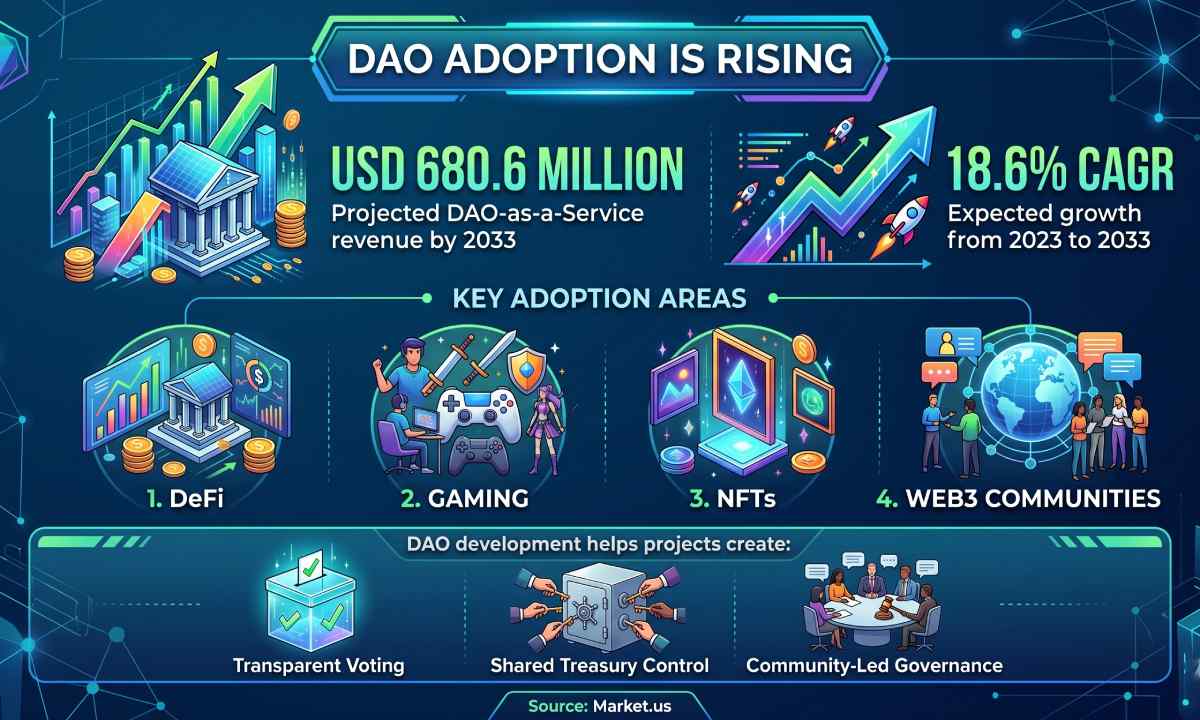
DAO adoption is growing as Web3 projects, DeFi platforms, gaming communities, and NFT ecosystems look for better ways to manage voting, ownership, and treasury decisions. The DAO-as-a-Service sector is projected to reach USD 680.6 million by 2033, growing at a 18.6% CAGR from 2023. This growth shows that more teams want ready governance systems instead of building every DAO component from scratch.
A DAO gives members a clear way to vote on proposals, control shared funds, and guide project decisions through smart contracts. The goal of DAO development is simple: build a secure, transparent, and community-owned structure that can run without central control. This guide explains how to build a DAO in 2026, covering governance design, smart contracts, token models, treasury setup, legal planning, security checks, and launch strategy.
Understanding DAO Architecture and Core Components
A DAO runs through connected smart contracts. These contracts define the rules for proposals, votes, treasury access, and member rights. Each part must work with the others.
Smart Contract Foundation
The governance contract sits at the center of the DAO. It controls how members submit proposals, cast votes, count results, and approve actions. A strong contract gives the DAO a clear decision process from start to finish.
Many teams build with tested governance contracts. OpenZeppelin Governor and Compound Governor are common choices. They give teams a ready base for proposal creation, vote counting, quorum rules, and execution.
Treasury contracts protect the DAO’s funds. They hold tokens, stablecoins, NFTs, and other assets. They release funds only after an approved vote or a multisig approval. This gives members a clear record of every major payment.
Token contracts define membership and voting power. Some DAOs use ERC-20 tokens. Some use NFTs. Others use a mix of tokens, roles, and reputation scores. The right model depends on the DAO’s purpose, community size, and voting needs.
Governance Token Design
Governance tokens give members a voice. Poor token design can hand control to a small group. Good token design spreads power and keeps members active.
A fair token launch helps build trust. Teams can use airdrops, contribution rewards, public sales, or liquidity programs. The goal is simple: give real members a real stake in the DAO.
Voting power can work in different ways. A one-token-one-vote model is simple. Larger holders get more control. Quadratic voting reduces the weight of large wallets. Delegated voting lets members assign their votes to people they trust.
Long-term holding can gain more weight too. This rewards members who stay with the DAO. It can reduce short-term voting swings and give serious contributors more influence.
The token model should match the DAO’s goals. A finance DAO needs careful risk control. A creator DAO needs broad member input. A grants DAO needs fair review and clear budget rules. Token design shapes all of those choices.
Designing Effective Governance Mechanisms
Governance decides how a DAO makes choices. Good design helps members vote with clear context. Poor design creates slow debates, low turnout, and weak decisions.
A strong governance system needs three parts: proposal rules, voting rules, and execution rules. Each part should be simple enough for new members to understand.
Proposal Lifecycle Management
Every proposal should follow a clear path. It can begin as a forum post, Discord thread, or community call. Members discuss the idea first. Then the proposer improves it before the formal vote.
This early review matters. It helps the community find weak points. It gives the proposer time to add costs, timelines, risks, and expected results.
A formal proposal should include:
- The problem the DAO needs to solve
- The action the proposer wants
- The budget needed
- The timeline for delivery
- The team or person in charge
- The result the DAO should expect
Proposal access needs limits. A DAO can ask proposers to hold a minimum number of tokens. It can ask for community support before a vote. This stops spam but keeps the door open for real contributors.
Voting periods need balance. A short vote can miss members in other time zones. A long vote can slow urgent work. Many DAOs use three to seven days for normal votes. Larger treasury votes often need more time.
Quorum and Approval Rules
Quorum sets the minimum vote count for a valid result. It stops a small group from passing major plans on low turnout.
For small DAOs, a fixed quorum can work. For larger DAOs, a changing quorum can work better. The DAO can set higher quorum for treasury use, contract upgrades, or legal changes.
Approval rules decide how many votes a proposal needs to pass. A simple majority works for routine tasks. Bigger changes need stronger support. A DAO can use 60 percent or 75 percent approval for major actions.
Emergency rules need care. Some events need fast action, such as a contract risk or treasury threat. A trusted multisig can act in these cases. The DAO should define the limits in public. It should set a clear review process after each emergency action.
Good governance does not aim for endless voting. It helps members make clear choices, act on them, and review the result.
Treasury Management and Financial Architecture
A DAO treasury can hold large value. It can include native tokens, stablecoins, ETH, BTC wrappers, NFTs, and yield assets. Weak controls can put all of it at risk.
Treasury design should protect funds and support daily work. It should make spending clear. It should give members a full view of inflows, outflows, reserves, and active budgets.
Multi-Signature Security
A multisig wallet protects the DAO from single-person control. It asks several approved signers to confirm a transaction before funds move.
A small DAO can use a 3-of-5 setup. A larger DAO can use 7-of-12 or a similar model. The right setup depends on treasury size, signer trust, and response needs.
Signer choice matters. A DAO should pick people with strong records in the community. It should include technical members and non-technical members. It should spread signers across locations and time zones.
Regular signer review keeps the setup healthy. Inactive signers should rotate out. New trusted members can join. This reduces control by old groups and keeps treasury access active.
Hardware wallets add another safety layer. They work well for high-value transactions. A DAO can keep a small hot wallet for routine payments and place reserves in a stricter wallet.
Automated Treasury Operations
Automation can reduce manual work. A DAO can use smart contracts for approved salaries, grants, and service payments. The contract follows the approved budget and sends funds on schedule.
Budget contracts can set spending limits by category. For example, the DAO can assign funds to development, audits, marketing, grants, and operations. Any request above the limit goes back to governance.
Treasury reports should stay public. Members need simple dashboards that show wallet balances, open payments, vesting schedules, and spending history. Clear reports build trust.
Some DAOs place idle funds into yield plans. This needs strict review. Members should know the risk, lockup period, asset type, and exit plan before the vote.
A strong treasury gives the DAO room to grow. It protects reserves, funds useful work, and gives members confidence in every payment.
Legal Frameworks and Compliance Considerations
A DAO can run through code, but it still meets real laws. It can hold assets, pay contributors, sign vendor deals, and face tax duties. These actions can create legal risk for members and founders.
Legal planning helps the DAO work with banks, service providers, tax teams, and regulators. It can also protect members from personal liability.
DAO Legal Wrappers
A legal wrapper gives the DAO a recognized entity. This entity can sign contracts, hold certain assets, pay invoices, and deal with courts or regulators.
Some DAOs use LLC structures. Wyoming and a few other places offer DAO-friendly models. These structures can link blockchain governance with a registered legal entity.
Nonprofit structures can fit public goods DAOs, open-source groups, and grant programs. They work better for communities that fund shared work instead of profit distribution.
Some global DAOs use offshore entities. Common choices include the Cayman Islands, the Marshall Islands, and the British Virgin Islands. These structures need careful tax and reporting review. The right choice depends on where founders, users, and treasury activity sit.
A DAO should pick its wrapper early. Late legal changes can slow token launches, exchange listings, grants, and partner deals.
Regulatory Compliance
Token design can trigger securities rules. A token with profit rights, revenue sharing, or strong founder control can face more scrutiny. A governance token with clear utility still needs review.
KYC and AML rules can apply to finance-based DAOs. Lending, trading, payments, and yield products often face stricter checks. A pure governance community can face fewer duties, but it still needs clear records.
Tax planning matters too. Token grants, contributor rewards, staking income, treasury swaps, and asset sales can create tax events. Members and core teams need records that show dates, values, wallet addresses, and payment reasons.
Legal documents should match the DAO’s actual operations. The operating agreement, token terms, grant rules, and treasury policy should all say the same thing. Conflicting documents create confusion during audits, disputes, or funding reviews.
Good compliance does not remove decentralization. It gives the DAO a safer way to grow, partner, hire, and manage funds.
Technical Implementation and Smart Contract Development
DAO smart contracts carry real power. They can move treasury funds, upgrade protocols, assign roles, and execute votes. A small bug can cause major loss.
Technical work should start with a clear contract map. The team should define each contract, its permissions, its upgrade path, and its link to governance.
Smart Contract Architecture
A modular contract setup keeps the DAO easier to manage. One contract can handle proposals. Another can count votes. A separate treasury contract can hold funds. This layout makes testing and upgrades cleaner.
Proxy contracts can support upgrades. They let the DAO change contract logic without moving every asset to a new address. This adds power, so the upgrade process needs strong controls. A timelock gives members time to review changes before execution.
Access control should stay narrow. Only approved roles should create upgrades, pause contracts, or move funds. Role changes should pass through governance or a trusted multisig with public records.
Event logs help members track activity. Each proposal, vote, transfer, role change, and contract update should emit a clear event. Dashboards and block explorers can read these logs and show the DAO’s activity in plain form.
Gas costs also matter. High fees can reduce voter turnout and block smaller holders. Off-chain voting, batched execution, and layer 2 deployment can lower costs for active communities.
Security Best Practices
Security testing should begin before launch. Unit tests check single functions. Integration tests check contract interactions. Full-cycle tests simulate proposal creation, voting, approval, and treasury execution.
Testnet trials help the community find issues early. Members can submit test proposals, vote with test tokens, and report confusing steps. This improves both security and user experience.
A professional audit gives the contracts an outside review. DAO governance contracts need reviewers with direct experience in voting systems, timelocks, proxies, and treasury flows.
Bug bounty programs add another safety layer. Skilled researchers can inspect live code and report issues for rewards. Clear bounty rules help teams handle reports fast and fairly.
Formal verification can help with high-value contracts. It checks whether contract logic matches fixed rules. Teams often use it for voting math, treasury limits, and upgrade permissions.
Security does not end at launch. The DAO should monitor contracts, treasury wallets, admin roles, and unusual voting activity. Fast alerts give signers and members time to act before damage spreads.
Community Building and Governance Culture
A DAO needs active members, not just deployed contracts. People must read proposals, discuss trade-offs, vote on time, and follow work after approval.
Strong culture makes this easier. Members need clear channels, shared rules, and simple ways to take part.
Participation Incentives
Low turnout can weaken a DAO. Members lose interest if votes feel confusing, repeated, or disconnected from real outcomes.
Token rewards can raise voting rates. They work best for careful review and useful feedback, not for blind voting. A DAO should reward quality, not just clicks.
Reputation systems can help too. They track useful work from builders, writers, reviewers, moderators, and grant evaluators. This gives active contributors more trust, even without large token holdings.
Delegation gives busy members a practical choice. They can assign votes to trusted delegates. Delegates should share their voting reasons in public. This keeps the process clear and gives token holders a way to judge their work.
Education matters at every stage. New members need short guides, sample proposals, governance calls, and voting walkthroughs. A simple onboarding page can reduce confusion fast.
What keeps people engaged? Visible results. Members stay active when they see approved proposals turn into shipped work, paid grants, product updates, or treasury growth.
Communication Infrastructure
DAO communication should support both fast chat and deep review. Discord or Telegram can handle daily talk. Forums work better for proposals, budgets, and policy changes.
A clear forum structure helps members find information. Separate spaces for ideas, live proposals, treasury updates, grants, and technical changes keep discussion organized.
Governance dashboards make voting easier. Tools like Snapshot, Tally, and custom portals can show proposal text, vote counts, quorum status, wallet history, and execution progress.
Public calls build trust. Weekly or monthly calls let members ask questions before votes. Written recaps help those who miss the call.
Global DAOs need access across time zones. Meeting notes, recorded calls, translated summaries, and clear deadlines help more members join the process.
A DAO should also set rules for conduct. Members can disagree without personal attacks. Strong moderation keeps debate useful and protects contributors from noise.
Want to Build a DAO for Your Business or Community?
Launch a secure and scalable DAO with smart contracts, governance systems, treasury controls, and token models built for long-term growth.

Deployment Strategy and Launch Planning
A DAO launch has many moving parts. The team must deploy contracts, fund the treasury, distribute tokens, open governance, and guide new members.
A rushed launch can create confusion. A clear launch plan helps members know what happens first, what comes next, and what they can do.
Progressive Decentralization
Many DAOs start with partial team control. This can reduce early risk. The team can fix setup issues, guide first votes, and protect the treasury during launch.
Control should move to the community through clear phases. For example, phase one can use a founder multisig. Phase two can add community signers. Phase three can place upgrades and treasury actions under token voting.
Each phase should have exit criteria. These can include audit completion, treasury funding, voter turnout, delegate setup, and a set number of completed proposals.
A timelock should protect major changes. It gives members time to review approved actions before execution. This matters for contract upgrades, treasury transfers, and parameter changes.
Emergency powers need a fixed end date. Early safety controls can help, but they should not become permanent team control. The DAO should publish who can pause contracts, what actions they can take, and when those powers expire.
Community Onboarding
Token distribution shapes the first community. Airdrops can reward early users. Contribution-based grants can reward builders and organizers. Public sales can fund the treasury.
The launch should explain voting rights in plain language. Members should know how to connect a wallet, read a proposal, delegate votes, submit ideas, and track results.
First proposals should be simple and useful. A DAO can vote on signer selection, grant budgets, working groups, audit payments, or community rules. Early wins teach members how governance works.
The team should publish a launch checklist. It can cover contract addresses, audit links, treasury wallets, token details, voting portal links, forum links, and support channels.
Onboarding should not end after the token launch. New members join every week. Updated guides, recorded demos, and active moderators help them enter governance without friction.
Measuring Success and Improving Governance
A DAO needs regular review. Voting rules, proposal formats, treasury controls, and member roles can weaken over time. The team and community should track what works, then adjust with clear votes.
Governance health is not only about vote count. A DAO should ask deeper questions. Are members reading proposals? Are approved plans getting done? Is the treasury being spent with care?
Key Performance Indicators
Participation rate shows how many members vote. A rising rate often means members trust the process. A falling rate can point to voter fatigue, unclear proposals, or weak community updates.
Proposal quality matters too. A DAO should track how many proposals pass, fail, stall, or miss their goals after approval. This shows whether the community votes on useful plans.
Treasury data gives another clear signal. Members should review monthly spending, runway, asset mix, grants paid, and unpaid commitments. A DAO with twelve months of runway has more room to plan than one with two months left.
Delegate activity should stay visible. Delegates need to publish voting reasons, attend calls, and respond to member questions. Inactive delegates should lose support over time.
Community support metrics can help too. Forum activity, call attendance, contributor retention, and grant completion rates show whether people still care enough to build.
Governance Review Cycles
A DAO should run governance reviews on a fixed schedule. Quarterly reviews work well for active groups. Smaller DAOs can review every six months.
Each review should cover simple points:
- Which proposals created value?
- Which votes had poor turnout?
- Which treasury payments missed targets?
- Which rules confused members?
- Which tools slowed the process?
The DAO can use this review to change quorum, voting length, proposal templates, delegate rules, or treasury limits. Small changes often work better than large resets.
Low-risk experiments can improve governance. A DAO can test new vote types, grant review panels, budget streams, or delegate reports with a small budget first. The community can keep what works and drop what fails.
Cross-DAO learning helps too. Teams can study public governance forums, audit reports, treasury dashboards, and delegate programs from other DAOs. Good ideas should be adapted to the DAO’s own goals and member base.
Governance should not stay frozen. A DAO grows, markets shift, members change, and risk changes. The rules should grow with the organization.
Conclusion
DAO development in 2026 needs a mix of smart contract skill, legal planning, treasury safety, and community trust. A strong DAO gives members a clear voice and a safe way to manage shared assets.
The best DAOs start with simple rules. They define who can vote, how proposals move, how funds get spent, and who handles urgent risks. Then they publish every key detail so members can check the process.
Smart contracts give the DAO structure. Governance gives it direction. The treasury gives it working capital. The community gives it life.
A DAO that ignores any one of these parts will struggle. Weak contracts create security risk. Poor token design can centralize power. Unclear legal planning can block growth. A silent community can leave the DAO inactive.
A well-built DAO does the opposite. It gives members clear duties, safe tools, and real control over shared work. It turns online coordination into a working organization.
Blockchain App Factory helps teams build DAO platforms, governance contracts, token models, treasury systems, and launch plans. Start your DAO development project with a team that understands both the code and the community behind it.
Frequently Asked Questions
What is a DAO in blockchain?
A DAO, or Decentralized Autonomous Organization, is a blockchain-based organization that runs through smart contracts and community voting. Members use governance tokens or NFTs to vote on proposals, treasury spending, and protocol decisions.
How does a DAO work?
A DAO works through smart contracts that define voting rules, proposal systems, treasury access, and governance actions. Community members submit proposals, vote on them, and approved actions execute through blockchain-based rules.
What are the main benefits of DAO development?
DAO development gives organizations transparent governance, community ownership, automated treasury management, and decentralized decision-making. It also creates a public record of votes, proposals, and fund movements.
What is a governance token in a DAO?
A governance token gives holders voting rights inside the DAO. Members use these tokens to approve proposals, manage treasury funds, vote on upgrades, and influence project direction.
Why are smart contract audits important for DAOs?
Smart contract audits help identify security flaws before deployment. A DAO treasury can hold large amounts of digital assets, so audits reduce the risk of hacks, fund loss, and governance exploits.
Vimal J is the Head of Sales at Blockchain App Factory, with 10+ years of experience in sales, client strategy, and Web3 business growth. He helps startups, enterprises, and project founders choose the right blockchain solutions for their goals, bringing a practical market perspective to topics like token development, crypto launches, and Web3 adoption.
Article Reviewed by:
Arun Kamala Santhanath
Marketing Head, Blockchain App Factory


