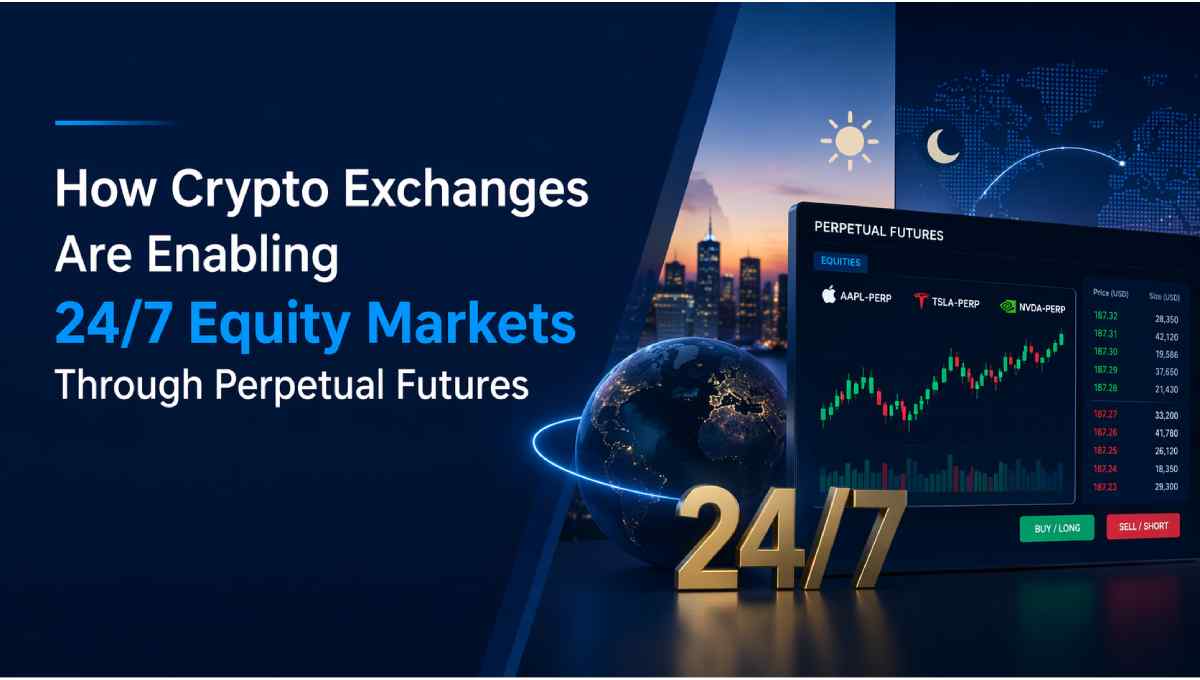
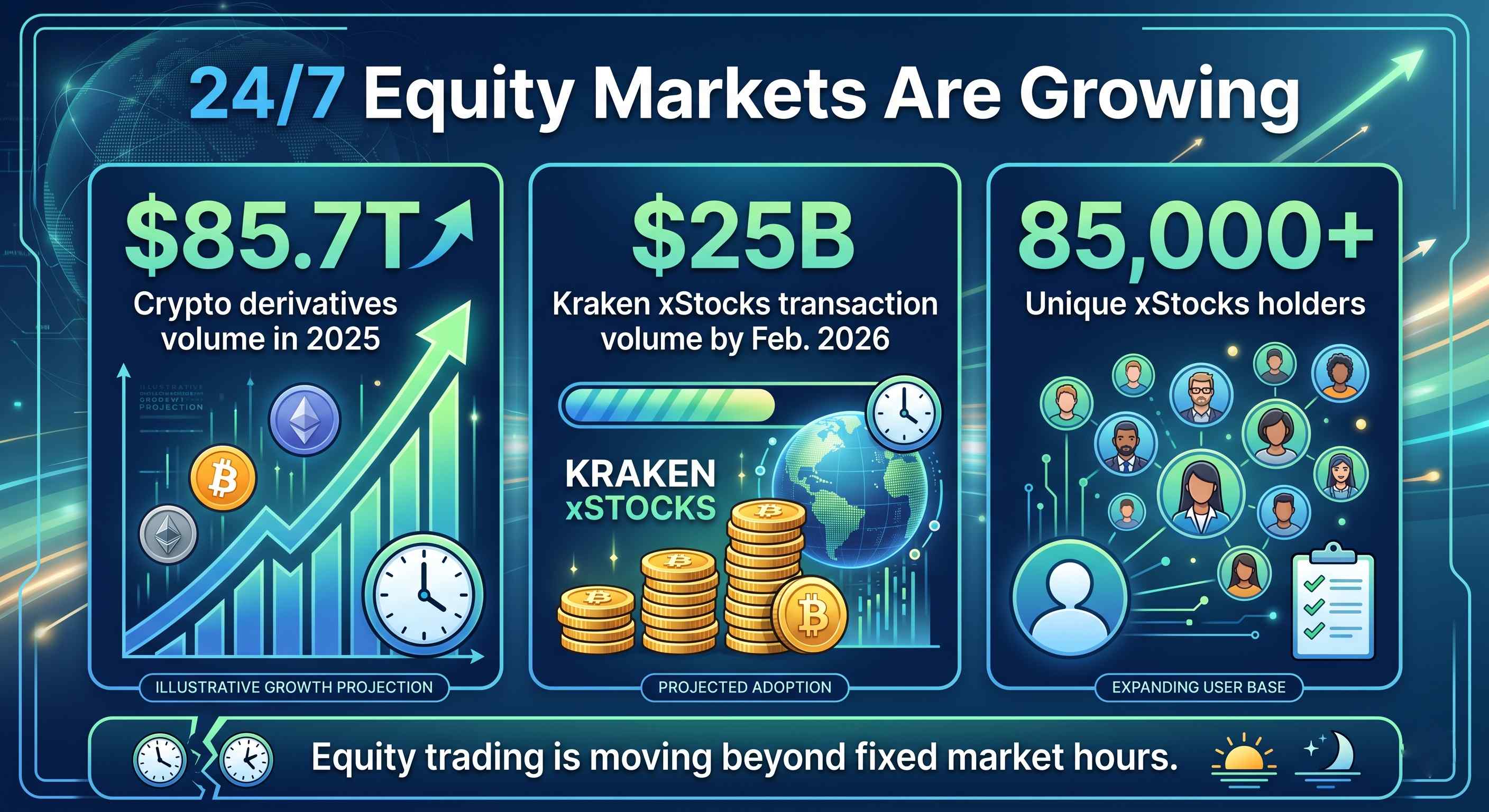
Equity trading still follows a fixed schedule. The New York Stock Exchange runs its core session from 9:30 a.m. to 4:00 p.m. ET. Crypto markets do not stop. They stay open every hour of the day, every day of the week. That difference is shaping a new class of products that gives traders stock exposure on crypto rails through perpetual futures. The demand is already clear. CoinGlass reported that crypto derivatives volume reached $85.7 trillion in 2025, with average daily turnover of $264.5 billion. Kraken said its xStocks ecosystem passed $25 billion in transaction volume by February 2026 and had more than 85,000 unique holders. These figures show that always-open trading is no longer a niche idea. It is becoming a real business model for exchanges, brokerages, and fintech platforms that want more trading activity, broader global reach, and new revenue streams.
Why the Equity Market Model Is Being Reconsidered
Traditional equity market hours no longer match how modern traders behave. Fixed sessions limit access for global users, slow reaction to overnight news, and create thin liquidity outside regular hours. At the same time, crypto markets have trained investors to expect constant access and real-time execution. That shift is pushing exchanges to look beyond spot equities and toward equity-linked perpetual futures, which keep users active longer, open new revenue streams, and bring stock exposure into the same trading system used for digital assets.
What Are Equity Perpetual Futures?
Equity perpetual futures let traders track the price of a stock or index without owning the asset. These contracts have no expiry date, so traders can hold positions for as long as margin requirements are met. Trading stays active at all hours, and prices update in real time.
This model differs from spot equity trading. In spot markets, investors buy actual shares and gain ownership rights. In equity-linked perpetuals, traders gain price exposure only. They do not receive dividends or voting rights. That makes the product simpler for exchanges to list and easier to trade on a margin-based system.
How Perpetual Futures Stay Anchored to Underlying Assets
Exchanges keep these contracts close to the underlying asset through index prices, mark prices, and funding rates. The index price tracks the stock or index across reference markets. The mark price reduces sharp swings from short-term volatility. Funding payments between long and short traders help bring the contract price back toward the reference price.
Why Perpetuals Are Attractive for Exchanges
Perpetuals generate more trading activity than many spot products. They support margin trading, create fee income, and allow exchanges to launch products tied to stocks, sectors, and indices through one trading model.
How Crypto Exchanges Are Building 24/7 Equity Markets
Tokenized Equity Exposure as the Foundation
Crypto exchanges often start with tokenized or synthetic equity exposure. This gives users digital access to stock and index price movements through crypto-based infrastructure. Since blockchain networks run all day, this structure supports trading beyond normal market hours.
Perpetual Futures as the 24/7 Trading Layer
Perpetual futures turn tokenized equity exposure into an active market. Traders can go long or short, use leverage, and react to events at any hour. This creates a market that stays open even after traditional exchanges close.
Infrastructure Components Required
A 24/7 equity perpetual market depends on a few core systems:
- Matching engine for fast order execution
- Risk engine for margin and liquidation checks
- Liquidity layer for tighter spreads
- Custody and collateral system for asset management
- Real-time settlement and monitoring tools
This structure helps exchanges offer continuous equity exposure through a crypto-native market model.
Key Benefits of 24/7 Equity Perpetual Futures for Crypto Exchanges
New Revenue Streams
Equity perpetual futures give crypto exchanges a new way to earn beyond spot crypto pairs. The first source is trading fees. Perpetual contracts drive repeat activity, and that matters at scale. In 2025, crypto derivatives volume reached about $85.7 trillion, with daily turnover near $264.5 billion. That level of flow shows why exchanges keep pushing deeper into derivatives.
A second source is funding payments. Perpetual markets use funding rates to keep contract prices close to the reference asset. Exchanges do not keep every funding payment, but the model supports active markets that generate more orders, more margin use, and more fee income. New listings add another profit path. In February 2026, Kraken launched regulated tokenized equity perpetual futures tied to major public companies, indices, and gold-linked ETFs for eligible clients in more than 110 countries. That move shows how exchanges can package equity demand into fresh contract lines.
Higher User Retention and Platform Activity
Always-open equity products keep users on the platform more often. Traditional equity futures still stop for breaks and follow a near 24-hour, six-day schedule on venues such as CME. Crypto-style equity perpetuals push past that model with round-the-clock access.
That change supports global trading across Asia, Europe, and the Americas in one continuous market. It cuts reliance on crypto-only cycles and gives traders a reason to stay active during stock-driven news events. Coinbase’s stock perpetual futures for eligible non-U.S. users now trade 24/7 and settle in USDC, which shows clear demand for equity exposure on crypto rails.
Product Diversification for Multi-Asset Exchanges
Multi-asset exchanges want more than BTC and ETH pairs. Equity-linked perpetuals widen the catalog and draw users who want stock and ETF exposure in the same account. Kraken now offers tokenized stocks 24 hours a day on weekdays, plus tokenized equity perpetual futures on a 24/7 basis. That mix helps shape a stronger multi-asset brand and gives exchanges a path into a broader trading market.
Commercial Use Cases for Businesses and Market Operators
For Crypto Exchanges
Crypto exchanges can launch equity perpetual products to lift volume, add new fee lines, and defend market share. The recent tie-up between Deutsche Börse and Kraken points to rising interest in regulated crypto derivatives, tokenized markets, and institutional liquidity. For Brokerages and Fintech Platforms
Brokerages and fintech platforms can use crypto rails to offer extended-hours equity access to younger and cross-border users. White-label platforms gain a clear sales angle here: one venue, more asset types, longer market access.
For Institutional Trading Firms
Trading firms get three direct uses. They can hedge stock exposure, run basis trades across venues, and provide market making in off-hours sessions. Continuous price discovery gives them more room to act when cash equity venues are closed.
Want to launch your own 24/7 equity trading platform?
Build a 24/7 trading platform with perpetual futures and reach global users with continuous market access.

How the Trading Flow Works in Practice
Step 1: User Onboarding and Collateral Setup
The trading flow starts with identity checks, account approval, and wallet funding. Most venues ask users to pass KYC before they can trade equity-linked perpetuals at scale. After that, the user posts collateral, often in stablecoins or other accepted assets, and the platform locks margin against the position. Futures margin is not a down payment on the stock or index. It is capital held to cover risk on an open contract.
Step 2: Market Access and Product Selection
The next step is product choice. A trader picks a stock-linked or index-linked perpetual contract, then sets position size, leverage, and order type. Perpetual futures do not expire, so traders can hold exposure without rolling contracts into a new month. Fees still matter. Funding payments can add cost or add income across the life of a trade, based on the gap between the perpetual price and the reference spot price.
Step 3: Order Execution and Risk Controls
Once the order reaches the book, the exchange matches it against resting liquidity. At that point, the risk engine checks initial margin, maintenance margin, and account exposure. If the account falls near the maintenance threshold, the system starts alerts, reduces risk, or closes positions. That is the core protection layer in perpetual markets. It keeps losses from spreading across the venue during fast moves.
Step 4: Ongoing Funding, Settlement, and Monitoring
After entry, the position stays live and marked to market in real time. Profit and loss updates with each price move, and funding payments pass between longs and shorts at set intervals. Many platforms use periodic funding to keep perpetual prices close to the underlying reference market. Operations teams then watch dashboards for margin stress, unusual order patterns, and rule breaches. That daily control loop matters more in a 24/7 venue, since the market never closes for manual resets.
Technical Framework for Launching an Equity Perpetual Futures Platform
Matching Engine and Low-Latency Execution
A live equity perpetual venue needs a fast matching engine. Nasdaq states that its trading technology can reach sub 40 microsecond latency, with one production setup at 14 microseconds door to door. That level of speed supports fair price discovery, rapid matching, and stable execution during heavy order flow. A slower stack can widen spreads and raise slippage during sharp moves.
Risk Management Architecture
Speed alone is not enough. The venue needs a real-time margin engine, auto-liquidation logic, and clear volatility controls. Insurance funds can absorb losses that remain after forced exits. Circuit breakers and trade controls can pause harmful activity during broken market conditions. Nasdaq notes that always-on market infrastructure depends on real-time risk management and surveillance, not just order matching.
Liquidity and Market Making Framework
Depth must stay strong across all hours, not just during the US session. Some venues seed internal liquidity at launch. Others rely on external market makers with fee rebates and quoting rules. The goal is simple. Keep spreads tight and the book deep enough for large orders. Funding design matters here too, since it helps align perpetual pricing with the reference market and shapes trader demand on each side of the book.
Compliance, Surveillance, and Auditability
A serious platform logs every order, fill, cancellation, margin event, and funding transfer. Those records support audits, market abuse reviews, and regulator requests across jurisdictions. Trade surveillance tools watch for spoofing, wash trading, and concentration risk. For firms that want to launch equity-linked perpetuals, compliance is not a side task. It is part of the core system design from day one.
Conclusion
Crypto exchanges are pushing equity trading toward a market that never closes, and perpetual futures sit at the center of that shift. They give traders round-the-clock access, faster price response, and a simpler way to hold market exposure without contract expiry. For businesses, this model opens new fee streams, wider global reach, and stronger user activity across all hours. It also raises the bar for platform design, risk controls, liquidity support, and compliance. Firms that act early can build products that match how modern traders already expect markets to work. Blockchain App Factory provides Perpetual DEX Development for businesses that want to launch secure, high-performance platforms built for 24/7 derivatives trading.

Vimal J is the Head of Sales at Blockchain App Factory, with 10+ years of experience in sales, client strategy, and Web3 business growth. He helps startups, enterprises, and project founders choose the right blockchain solutions for their goals, bringing a practical market perspective to topics like token development, crypto launches, and Web3 adoption.