Key Insights
- DEX trading has moved beyond early adoption, with top spot DEXs processing $1.8 trillion in 2024. This growth shows strong demand for non-custodial trading platforms.
- AMM, order book, hybrid, aggregator, and perpetual models serve different users. Founders should choose based on target traders, liquidity goals, revenue plans, and technical budget.
- A strong exchange needs deep liquidity, audited smart contracts, and clear risk controls. These factors help attract traders, partners, and serious business users.
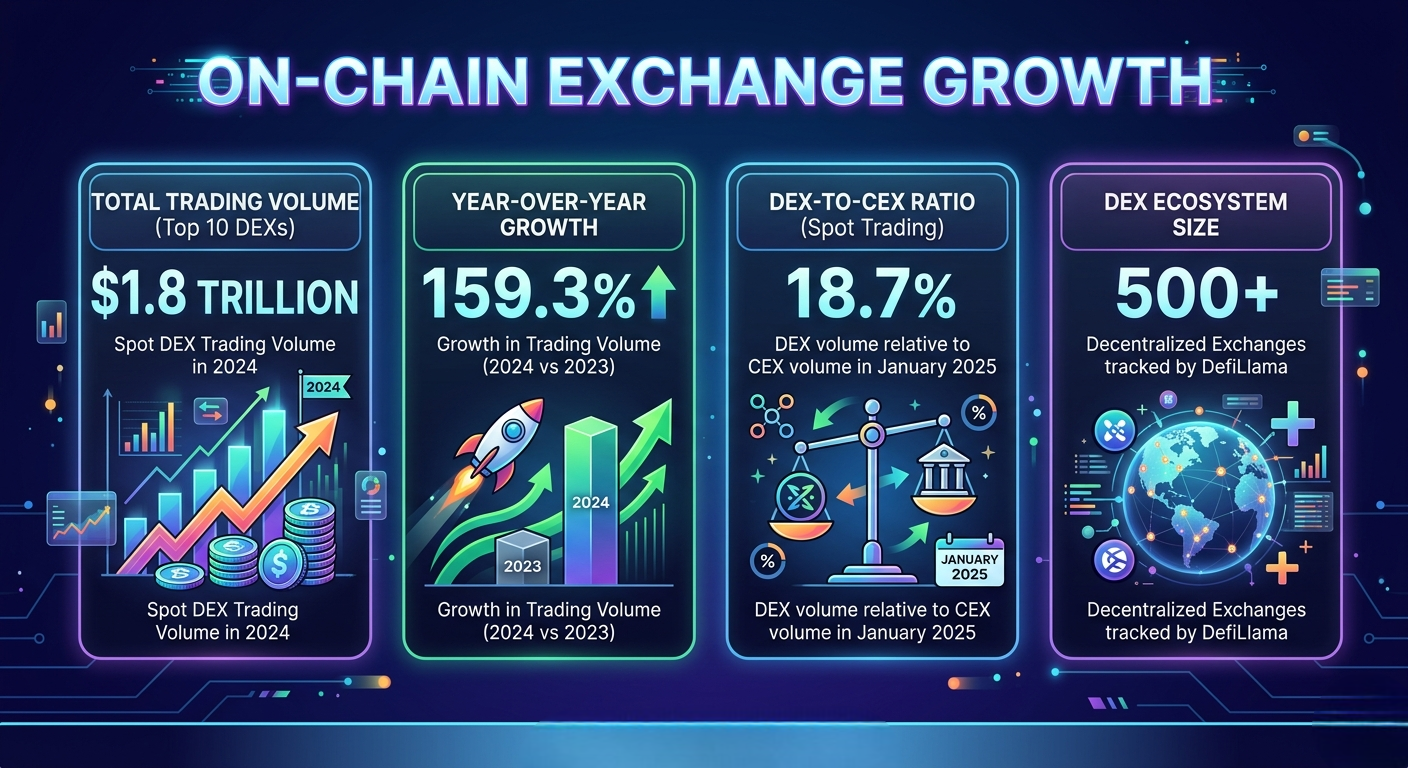
Crypto trading is shifting from closed platforms to open, programmable markets. An on-chain exchange lets users trade through blockchain transactions without handing assets to a central custodian. This model has moved far beyond the trial stage. CoinGecko reported that the top 10 spot DEXs processed $1.8 trillion in trading volume in 2024, which marked a 159.3% year-over-year increase. In January 2025, the DEX-to-CEX spot trading ratio reached 18.7%, and DEX spot trading volume rose to $413.75 billion. DefiLlama now tracks activity across 500+ decentralized exchanges. These numbers show a market with real scale, rising demand, and strong commercial potential.
For founders and business leaders, this shift opens a clear revenue path. An on-chain exchange can reach users across borders, run 24/7, and lower custody risk. Users keep control of their wallets, so the platform does not need to hold customer funds in the same way as a centralized exchange. Revenue can come from swap fees, maker and taker fees, token listings, liquidity programs, premium tools, and ecosystem partnerships. For any company planning on-chain exchange development, the business case is no longer theoretical. It is active, measurable, and growing fast.
What Is an On-Chain Exchange?
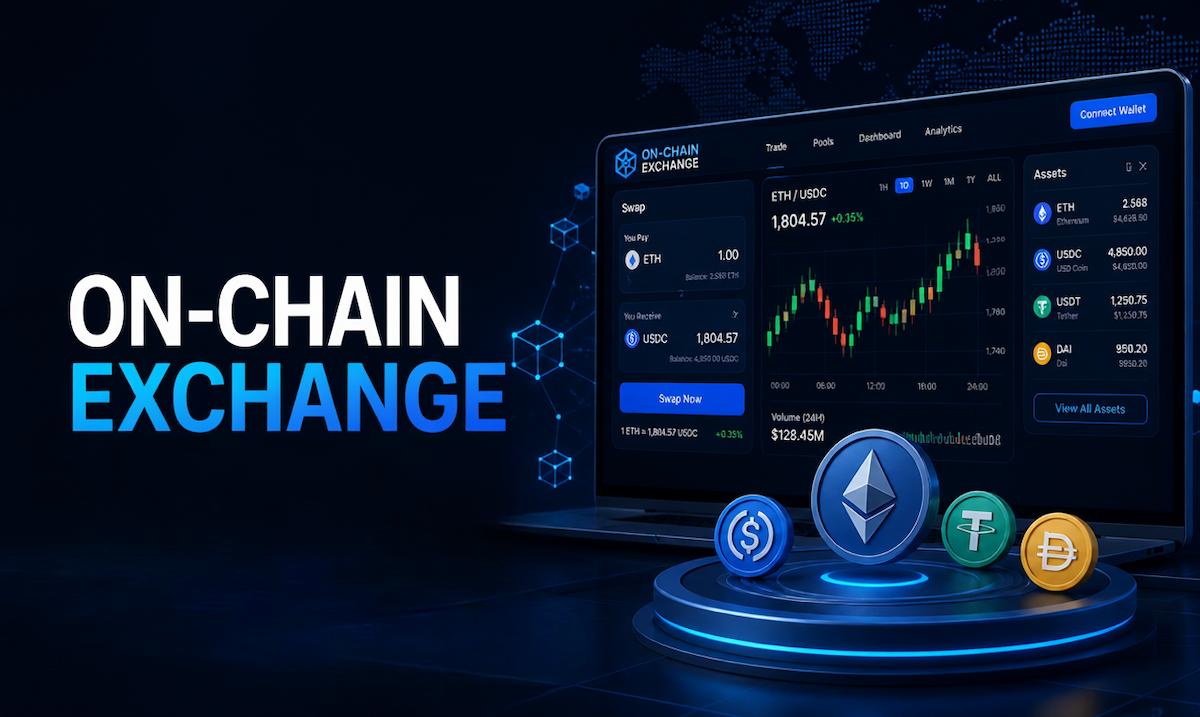
An on-chain exchange is a blockchain-based trading platform. Smart contracts handle swaps, settlement, liquidity pools, order execution, and asset custody rules. In a non-custodial crypto exchange, users connect a wallet, approve a transaction, and settle trades on-chain. The exchange interface guides the trade, but the blockchain records the final result.
This model gives businesses a programmable decentralized exchange platform. Fees, rewards, pools, listings, governance, and trading rules can be built into code.
How On-Chain Exchanges Differ From Centralized Exchanges
A centralized exchange controls user accounts, internal balances, and order matching. An on-chain exchange uses user-controlled wallets and public smart contracts. Settlement takes place on the blockchain, not only inside a private database.
The main differences are:
- Users keep wallet control instead of depositing funds with the platform.
- Trades settle through blockchain transactions.
- Smart contracts and transaction history remain public.
- Liquidity can come from pools, aggregators, market makers, or order books.
- Compliance needs vary by region, user type, token type, and operating model.
Why Entrepreneurs Are Launching On-Chain Exchanges
Founders launch on-chain exchanges to own trading flow and build lasting token utility. A DEX can create liquidity for ecosystem tokens, stablecoins, gaming assets, real-world assets, perps, and institutional DeFi products. It can also turn trading activity into recurring revenue through fees and value-added services.
The Main Types of On-Chain Exchange Models
An on-chain exchange can follow several trading models, and the best choice depends on the users, liquidity goals, trading volume, and revenue plan.
Automated Market Maker Exchange
An Automated Market Maker Exchange lets users trade against liquidity pools instead of a traditional order book. Each pool holds token pairs inside smart contracts, and prices shift based on pool balances. This model works well for instant swaps, long-tail tokens, and early-stage ecosystems that need fast market access. For entrepreneurs, AMM DEX development is a practical route for building a liquidity pool exchange or retail-focused DeFi swap platform.
On-Chain Order Book Exchange
An on-chain order book exchange follows the structure of traditional trading platforms. Traders place limit orders, view market depth, and trade with makers and takers. This model gives more control and tighter spreads in liquid markets, but it needs fast matching, high throughput, strong settlement design, and active market maker support. That makes order book DEX development a better fit for a professional crypto trading platform aimed at institutions, active traders, and high-volume assets.
Hybrid DEX Model
A hybrid DEX model combines AMM liquidity with order book features, or it uses off-chain matching with on-chain settlement. This gives casual users simple swaps and gives advanced traders better price control.
DEX Aggregator Model
A DEX aggregator routes trades across many liquidity sources to find better pricing and lower slippage. This model works well for businesses that want to improve trade execution without building all liquidity from scratch.
Perpetuals and Derivatives Exchange
A perpetuals or derivatives exchange suits founders who want to support margin trading, futures, or advanced crypto markets, but it brings added risk. These platforms need accurate oracles, liquidation systems, margin controls, and careful compliance planning.
AMM vs Order Book vs Hybrid DEX: Which Model Should You Choose?
Choosing between an AMM, order book, and hybrid DEX starts with the business model. Each model serves a different user type and needs a different technical setup.
AMM DEX for Fast Market Entry
An AMM DEX is best for swaps, long-tail tokens, and community liquidity. It uses pools, offers a simple user experience, and earns revenue from swap fees and LP fees. Its main technical work sits in smart contracts, routing, and liquidity design.
Order Book DEX for Professional Traders
An order book DEX is best for pro traders and liquid markets. It depends on makers and takers, advanced trading tools, and strong market depth. Its revenue comes from trading fees, maker fees, and taker fees, but the build is more complex. The team must handle matching, throughput, and settlement with care.
Hybrid DEX for a Broader User Base
A hybrid DEX serves a wider user base. It combines pools and orders, supports multiple fee models, and gives businesses room to serve retail users and professional traders from one platform.
When to Build Each Model
Founders should build an AMM exchange for token ecosystems, retail swaps, community-driven liquidity, and rapid launch plans. They should build an order book exchange for institutional trading, high-volume pairs, market-maker relationships, and advanced order types. A hybrid exchange fits businesses that want simple swaps and professional trading features under one brand. This route takes more planning and budget, but it can create a stronger long-term product for users with different trading needs.
Core Features Every On-Chain Exchange Needs
Wallet Connection and User Onboarding
A strong on-chain exchange starts with simple access. Traders expect MetaMask, WalletConnect, social login, MPC wallets, and fiat on-ramp support. Account abstraction can reduce wallet friction. Gas sponsorship can help new users place their first trade without buying native gas tokens first.
Smart Contract-Based Trading Engine
The trading engine sits at the center. Smart contracts handle swaps, order execution, pool creation, fee logic, settlement, token transfers, and pause controls. In an AMM model, users trade against liquidity pools instead of a central order book. Chainlink describes liquidity pools as crowdsourced token reserves locked in smart contracts, used to support trading without a central intermediary.
Liquidity Pools and Liquidity Provider Tools
Liquidity tools matter as much as the swap screen. The platform needs pool creation, LP deposits, fee tiers, yield rewards, concentrated liquidity, impermanent loss education, and clear analytics. These tools help liquidity providers measure risk, track returns, and decide where to place capital.
Token Swap Interface
Traders need a clean swap interface with slippage settings, price impact alerts, gas estimates, smart routing, transaction previews, and clear failed transaction messages. A poor swap flow creates support tickets and lost trades. A clear flow builds trust.
Order Book and Advanced Trading Tools
Order book or hybrid exchanges need more depth. Limit orders, stop orders, market depth, trade history, price charts, and maker or taker fees support active traders. These features help the platform serve retail users and professional desks.
Liquidity Aggregation
Liquidity aggregation routes trades across pools and pairs. This can reduce slippage and give users better execution. For a new exchange, better routing can help compete with larger platforms that already have deep liquidity.
Admin, Analytics, and Risk Dashboards
The admin layer supports the business. Teams need volume reports, fee dashboards, wallet risk signals, token listing controls, liquidity metrics, and protocol health checks. These dashboards help teams spot weak pools, risky wallets, and revenue changes early.
Governance and Token Utility
Governance features can add DAO voting, staking, fee sharing, emissions, treasury controls, and safer protocol upgrades. Token utility should support real platform use, not only short-term rewards.
Want to launch your own on-chain exchange?
Build a secure, scalable on-chain exchange with expert support across architecture, smart contracts, liquidity planning, and launch strategy.

Technical Architecture of an On-Chain Exchange
Smart Contract Layer
The smart contract layer includes pool contracts, router contracts, factory contracts, fee contracts, governance contracts, staking contracts, rewards contracts, upgrade design, and emergency pause functions. Each contract should have a narrow role. This keeps audits cleaner and risk easier to track.
Blockchain Network Selection
Network choice shapes the product. Ethereum offers deep liquidity. Solana offers high throughput. BNB Chain and Polygon offer lower fees. Arbitrum, Optimism, and Base suit Layer 2 trading. Avalanche works for fast settlement. Appchains give more control over fees, speed, and validator rules.
Layer 2 and Appchain Strategy
High-performance exchanges often use Layer 2 networks, rollups, or dedicated appchains. These choices can lower transaction costs and improve throughput. They also help exchanges serve active traders who will not tolerate slow or costly trades.
Frontend and Trading Interface
A serious exchange needs more than contracts. The frontend needs charts, wallet flows, trade history, portfolio views, and local language support. The interface should make trading feel clear, fast, and safe.
Backend and Indexing Infrastructure
The backend needs indexers, subgraphs, APIs, transaction monitoring, price feeds, notifications, and analytics pipelines. These systems turn raw blockchain data into useful product data for users and operators.
Oracles and Price Feeds
Oracles support asset pricing, TWAPs, margin systems, and liquidation logic. Weak oracle design can expose the exchange to price attacks. This risk grows for derivatives, lending, and margin products.
Custom Pool Logic and Hooks
Custom pool logic is now a major business advantage. Uniswap v4 introduced hooks, which let developers customize pool behavior at key points in pool activity. Uniswap also describes hooks as plugins for custom pool, swap, fee, and liquidity position behavior.
This opens room for custom fees, loyalty discounts, TWAMM-style trades, compliance gates, and specialized liquidity rules. For entrepreneurs, hooks turn a basic exchange into a tailored trading product.
Step-by-Step Process to Launch an On-Chain Exchange
Step 1: Define the Business Model and Target Market
A strong on-chain exchange starts with a narrow market choice. A platform for retail token swaps needs a simple wallet flow, fast swaps, and clear fee display. An institutional exchange needs permissioned access, trade reporting, custody rules, and deeper compliance checks. A gaming exchange needs low fees and support for high-volume micro trades. A real-world asset exchange needs stricter asset review and transfer controls.
The target market shapes the whole product. It affects chain choice, liquidity plans, token listings, and revenue design. DefiLlama tracks more than 500 decentralized exchanges, which shows how crowded the market has become. A new exchange needs a clear reason to exist, not just another swap screen.
Step 2: Choose the Exchange Model
The exchange model sets the trading experience. An AMM works well for simple swaps and token ecosystems. Users trade against liquidity pools, so the product can launch faster. An order book suits active traders who need limit orders, market depth, and tighter control. It needs stronger matching logic and steady market maker support. A hybrid model combines both. It gives casual users simple swaps and gives advanced users more trading tools.
Perpetual exchanges add another layer. They need margin rules, liquidation engines, oracles, and risk controls. This model can produce strong fee revenue, but it raises technical and legal pressure.
Step 3: Select Blockchain Infrastructure
Chain selection is a business decision. Ethereum has deep liquidity and strong developer support, but fees can hurt smaller trades. Layer 2 networks such as Arbitrum, Optimism, Base, and Polygon offer lower fees and better speed. Solana suits high-volume trading, but the team must weigh tooling, wallet coverage, and operational risk.
The exchange also needs bridges, indexers, RPC providers, analytics tools, and wallet support. These parts affect uptime and user trust.
Step 4: Design Tokenomics and Fee Structure
Fees fund the exchange. Common revenue sources include swap fees, maker and taker fees, protocol fees, referral rewards, token listing fees, and premium tools. Liquidity providers need fair rewards too. That can include LP incentives, staking, fee sharing, emissions, and treasury-backed liquidity.
Uniswap v4 hooks show how custom pool logic can support flexible fees and custom swap behavior. This matters for founders who want loyalty discounts, special pools, or new fee models.
Step 5: Build Smart Contracts
Smart contracts run the exchange. They handle swaps, liquidity deposits, routing, rewards, governance votes, and admin controls. Each contract needs a clear job. Complex contracts create more risk and slow future upgrades.
A basic AMM exchange often needs pool, router, factory, fee, and reward contracts. A larger exchange needs staking contracts, treasury controls, referral logic, and governance modules. The team should keep upgrade rights clear. Users need to know who can pause contracts, change fees, or update trading rules.
Step 6: Integrate Wallets, Oracles, Indexers, and APIs
An on-chain exchange needs more than smart contracts. Wallets connect users to the platform. Oracles feed price data into margin, derivatives, and risk systems. Indexers read blockchain events and turn them into charts, trade history, pool data, and portfolio views.
APIs support analytics, alerts, partner tools, and market maker access. The frontend must show gas costs, slippage, price impact, and failed transaction reasons in plain language. These details reduce support tickets and build user confidence.
Step 7: Conduct Smart Contract Audits and Security Testing
Security decides whether traders trust the exchange. Smart contracts often hold user funds, route trades, and control liquidity. A single contract flaw can drain pools or freeze assets.
The audit process should include internal review, automated testing, third-party audits, and a public bug bounty. The team should test oracle attacks, reentrancy, access control, price manipulation, and upgrade risks. Mainnet launch should only happen after repeated testnet trials.
Step 8: Create a Liquidity Launch Plan
Liquidity brings traders. Thin pools cause high slippage and poor trade execution. That pushes users away fast.
A launch plan can include seed liquidity, stablecoin pairs, token partnerships, liquidity mining, market makers, and treasury-owned liquidity. AMM platforms need balanced pools. Order book exchanges need active makers from day one.
Step 9: Prepare Compliance, Legal, and Risk Controls
Legal planning should begin before launch. The team needs a token listing policy, user risk notices, sanctions screening, and transaction monitoring. Some markets need KYC or wallet checks.
Step 10: Launch Beta, Mainnet, and Growth Campaigns
Start with a testnet beta. Invite traders, liquidity providers, and security testers. Then launch mainnet in phases. Track volume, slippage, failed trades, retained users, and pool health. After launch, use DAO voting, staking, fee sharing, emissions, treasury reports, and protocol upgrades to keep the exchange active and trusted.
How Much Does It Cost to Create an On-Chain Exchange?
A lean on-chain exchange can cost $45,000 to $180,000. The final price depends on the exchange model, number of chains, smart contract scope, audit depth, and compliance needs. An AMM-based MVP costs less than an order book, hybrid, or perpetuals exchange.
| Feature | Description | Duration | Cost |
|---|---|---|---|
| Planning and product scope | Defines users, trading model, chain, fees, and launch goals. | 1 to 2 weeks | $2,000 to $8,000 |
| UI and UX design | Covers swap page, pool page, wallet flow, and basic dashboard. | 2 to 4 weeks | $5,000 to $15,000 |
| AMM smart contracts | Builds pool, router, factory, swap, LP token, and fee logic. | 4 to 7 weeks | $15,000 to $45,000 |
| Wallet integration | Connects MetaMask, WalletConnect, and common Web3 wallets. | 1 to 2 weeks | $3,000 to $10,000 |
| Liquidity tools | Supports pool creation, deposits, withdrawals, and LP rewards. | 2 to 5 weeks | $8,000 to $25,000 |
| Fee and tokenomics module | Adds swap fees, protocol fees, referral rules, and treasury logic. | 2 to 5 weeks | $8,000 to $30,000 |
| Basic admin panel | Tracks users, pools, fees, trades, and platform status. | 2 to 4 weeks | $6,000 to $20,000 |
| Oracles and indexers | Adds price feeds, trade history, volume data, and pool metrics. | 2 to 5 weeks | $8,000 to $30,000 |
| Smart contract audit | Reviews contract logic, fund flow, access control, and attack risks. | 2 to 5 weeks | $15,000 to $75,000 |
| Testnet and mainnet launch | Covers testing, deployment, monitoring, fixes, and launch support. | 3 to 6 weeks | $10,000 to $35,000 |
Conclusion

Vimal J is the Head of Sales at Blockchain App Factory, with 10+ years of experience in sales, client strategy, and Web3 business growth. He helps startups, enterprises, and project founders choose the right blockchain solutions for their goals, bringing a practical market perspective to topics like token development, crypto launches, and Web3 adoption.