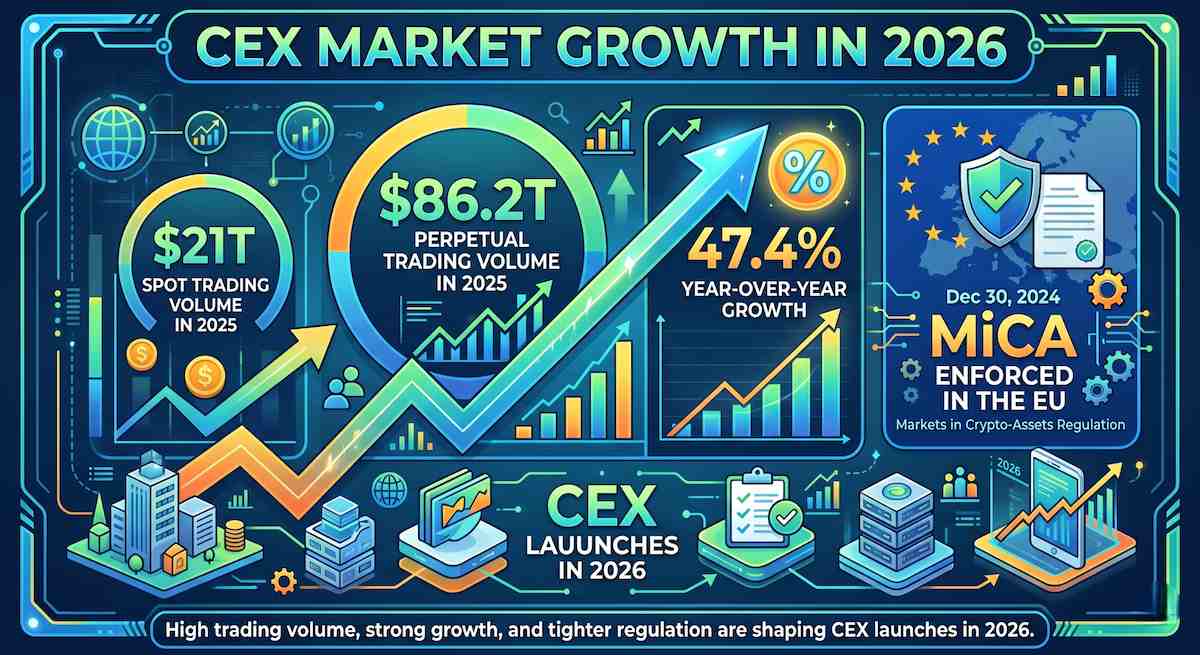
Launching a centralized crypto exchange in 2026 is a business decision backed by strong market data. Crypto trading now runs at a scale close to traditional finance. In 2025, the top centralized exchanges processed nearly $21 trillion in spot trading volume. Perpetual trading volume reached $86.2 trillion, with a 47.4 percent rise from the previous year. These numbers show clear demand and steady growth across global markets. Centralized exchanges remain the preferred model since they support high liquidity and fast trade execution.
Regulation now shapes how exchanges launch and operate. The European Union enforced MiCA on December 30, 2024, which introduced strict rules for licensing, reporting, and user protection. This shift has raised the standard for new platforms. Businesses must build compliance and security into the core system from day one. A well-structured CEX can generate steady revenue through trading fees, listings, staking, and derivatives. It also gives firms access to global trading activity through one scalable platform.
What Is a Centralized Crypto Exchange (CEX)?
A centralized crypto exchange is a trading platform run by a company that manages user accounts, order matching, custody, and compliance. Users place buy and sell orders, and the platform matches them in real time. This model remains popular since it supports deep liquidity and a smoother user experience.
Three parts define how a CEX works. The first is the trading engine, which processes orders and executes trades quickly. The second is custody, where the platform stores and manages digital assets through hot and cold wallets. The third is liquidity, which keeps spreads tighter and supports larger trades.
Businesses prefer CEX platforms since they work well with banks, payment providers, and identity verification tools. They also support more revenue streams, such as spot trading, derivatives, staking, and white-label services. For companies that want a reliable crypto exchange business model, the CEX remains the strongest option.
Market Opportunity and Trends for CEX in 2026
Regulation Is Now Part of the Product
Launching a centralized exchange in 2026 is no longer just a product decision. It is a compliance and trust decision too. Firms that want to enter this market must prove that they can meet regulatory rules and serve serious trading clients from day one.
That shift is already visible across major markets. Europe’s MiCA rules are setting a clearer legal path for crypto firms. Dubai’s VARA model is doing the same for businesses that want to operate in the region. For new exchanges, this changes the business case. Compliance now helps attract clients, partners, and banking support. It is part of the value offer, not just a legal requirement.
Institutional Demand Is Reshaping the Market
Institutional demand adds more pressure. Large investors now look for regulated access, stronger custody controls, and clear risk systems before they commit capital. This gives new CEX operators a clear message. If the platform offers licensing, transaction monitoring, and secure custody, it becomes easier to win trust and open commercial deals.
Key Trends Driving CEX Growth
Several trends are shaping exchange growth in 2026. AI-based fraud detection is one of the biggest. Exchanges use it to flag suspicious activity, review wallet behavior, and reduce financial crime risk in real time.
Hybrid models are growing too. Many businesses want the control and speed of a CEX, but they also want DeFi features like staking and token access. Tokenized real-world assets are another major area. More firms now see tokenized funds, bonds, and treasury products as a real business line, not a future idea.
Where New Entrants Can Still Win
The market is also becoming more specialized. Large exchanges still lead on liquidity and brand reach. New entrants have stronger odds in focused segments. These include regional fiat trading, institutional platforms, tokenized asset marketplaces, and white-label exchange services for banks and fintech firms.
That creates a practical opening for new businesses. A new CEX does not need to serve everyone. It needs to solve one clear problem for one clear market, and do it with strong compliance, strong security, and a credible commercial model.
Step-by-Step Process to Launch a CEX in 2026
Step 1 – Define Business Model & Target Market
A CEX launch fails early if the business model stays vague. Start with the user and the jurisdiction. Retail traders want simple onboarding, mobile access, local payment methods, and fast support. Institutional clients want custody controls, reporting, deeper liquidity, and clean legal structure. Geography matters just as much. An EU plan points to MiCA authorization. A Dubai plan points to VARA licensing and activity-specific rulebooks. Each choice shapes product scope, staffing, and banking access from day one.
Step 2 – Choose Development Approach
The next decision is build path. White-label development works best for firms that need a fast launch, lower upfront spend, and SaaS licensing revenue. A custom build fits teams that need tighter control over matching logic, risk rules, reporting, and asset support. The tradeoff is simple. White-label gets you live faster. Custom code gives you more control over scale, latency, and product design. Many firms start with a licensed base stack, then replace parts of it as volume grows. That staged model keeps time to market short and leaves room for later expansion.
Step 3 – Build Core Infrastructure
Core infrastructure decides whether the exchange can survive real traffic. The matching engine must process orders with low latency and clear failover rules. The wallet layer needs hot and cold storage, key controls, and withdrawal policy checks. APIs need stable documentation for market data, trading, account services, and compliance hooks. Fiat rails matter just as much. Card processing, bank transfers, and local payment methods often decide conversion rates in the first six months. A clean onboarding stack links identity checks, sanctions screening, KYT alerts, and case management in one flow.
Step 4 – Liquidity Integration
No exchange grows without liquidity. Market makers help tighten spreads and fill thin books in the first stage. Cross-exchange liquidity aggregation helps fill gaps in major pairs and supports new listings. This step needs strict controls. Routing logic, fee policy, and best-execution rules must line up with the firm’s legal model and market abuse controls. Institutional buyers will look at slippage, uptime, and settlement discipline long before they ask about design.
Step 5 – Testing, Deployment & Launch
The final stage is controlled release. Run QA across trading flows, wallet actions, and payment events. Stress test peak order loads, API bursts, and withdrawal spikes. Keep a sandbox live for internal teams, market makers, and pilot clients. Then launch in beta with a narrow asset list and a small user group. That gives the team time to tune spreads, review support tickets, and tighten fraud rules. Firms that want extra revenue can package the same stack as a white-label or SaaS product for brokers, fintech apps, and regional trading brands. That turns one exchange build into two lines of business.
Want launch your own centralized crypto exchange?
Build a centralized exchange with strong security, full compliance support, and high-performance architecture tailored to your business goals. From planning and licensing to deployment and scaling, get expert guidance at every stage.

Compliance Framework for CEX in 2026
Licensing and Regulatory Requirements
A centralized exchange cannot launch on code and liquidity alone. It needs legal approval in the markets it plans to serve. In 2026, jurisdiction choice shapes the whole business model. The European Union offers a single market path under MiCA, which gives licensed firms broader reach across member states. The United States remains more fragmented. Founders must deal with federal AML duties and state money transmitter rules. The UAE, mainly Dubai through VARA, gives crypto firms a purpose-built rulebook and a licensing path that appeals to international operators. Singapore keeps strict standards under the Payment Services Act and expects strong internal controls before approval. A new exchange should pick one main jurisdiction first, match its product scope to that market, and avoid expanding too early. Spot trading, custody, derivatives, staking, and fiat services can all trigger different licensing duties.
KYC, AML, and Transaction Monitoring
Licensing is only the first step. Daily compliance work matters more after launch. Every CEX needs strong KYC checks, AML controls, sanctions screening, and transaction monitoring. Identity systems now go far beyond basic document upload. They often include face matching, liveness checks, address verification, wallet screening, and source-of-funds review for higher-risk accounts. Transaction monitoring should scan deposits, withdrawals, internal transfers, and trading behavior in real time. The aim is simple. Detect suspicious patterns before they become regulatory failures or fraud losses. A good compliance team builds clear escalation paths, keeps case notes, and files reports on time.
Data Protection, Reporting, and Audit Readiness
Data protection sits inside this same structure. User records, wallet logs, and financial reports must be encrypted, stored with strict access rules, and retained under local law. Proof-of-reserves, tax reporting, and audit trails should not be added late. They should be built into the platform from the first release. That is what compliance by design means in practice.
Security Architecture for Centralized Exchanges
Core Security Layers
Security architecture decides whether a CEX can keep user trust. Most exchange failures still start with weak custody, poor access control, or delayed incident response. A serious platform protects client assets with multi-signature wallets, cold storage, and strict treasury workflows. In practice, the bulk of customer funds should stay offline, with only limited balances exposed in hot wallets for daily operations. Every connection should use strong encryption. Every internal action should sit behind role-based access control. Staff should only see the systems they need for their job. High-risk actions such as wallet changes, large withdrawals, and admin privilege updates should require extra approval. This structure cuts the chance that one stolen credential can damage the whole platform.
Advanced Security and Risk Management
Modern exchanges need more than basic controls. Fraud tools now track login behavior, device changes, IP reputation, withdrawal timing, and account patterns that break from normal activity. Two-factor authentication should be standard for every account, with stronger methods such as hardware keys or passkeys for staff and high-value users. API security matters just as much. Trading APIs and wallet APIs need signed requests, rate limits, replay protection, and shields against denial-of-service attacks. Risk controls should freeze suspicious withdrawals, flag unusual asset movement, and trigger manual review at clear thresholds.
Security Best Practices for Long-Term Operations
Good security is not a one-time setup. It is routine work. Exchanges need penetration tests, code reviews, reserve checks, bug bounty programs, and rehearsed incident response plans. This matters for direct operators and for firms that sell SaaS or white-label exchange products. Buyers want proof that the platform can handle audits, attacks, and growth without breaking under pressure.
Core Components of Exchange Architecture
A modern CEX in 2026 needs a clean architecture built around four main systems. The trading engine matches buy and sell orders and updates the order book in real time, so it drives speed, pricing, and execution quality. The wallet and custody layer protects customer funds through a mix of hot wallets for active use and cold storage for reserves. The liquidity engine connects market makers, brokers, and routing logic so the exchange can support tighter spreads and stronger market depth. The compliance and monitoring layer tracks transactions, screens wallets, and flags suspicious behavior, which makes it a core business function rather than an extra feature.
Architecture Models
The overall architecture shapes how well the platform grows. A monolithic model can work for an early launch with lower complexity. A microservices model gives better control as trading, custody, onboarding, and risk functions expand. Cloud-native and modular systems help firms manage traffic spikes and grow across regions. Headless design makes it easier to reuse the same backend for retail, broker, and white-label products.
Performance and Scalability Requirements
Performance is a core requirement for any serious CEX. The platform should support high throughput, often 10,000 or more transactions per second, with very low latency on the matching path. Fast execution improves trading quality, but stability matters just as much during heavy trading, sharp volatility, and withdrawal surges. Strong incident response plans, failover systems, replay logs, and kill switches are essential parts of exchange design.
Integration Layer and Commercial Value
The integration layer connects the platform to payment processors, KYC vendors, blockchain analytics tools, and mobile and web applications through shared APIs. This setup helps teams release features faster and maintain product consistency across channels. It also strengthens the business case. A company can run its own exchange, license the platform to other brands, or package custody and compliance tools as separate commercial services.
How Much Does It Cost to Build a Centralized Crypto Exchange in 2026?
The cost to build a centralized crypto exchange depends on scope, security depth, and compliance needs. A basic exchange with core trading features can start around $50,000. A full-scale platform with advanced trading, strict compliance, and institutional-grade security can exceed $1 million. Most businesses fall between $150,000 and $600,000 based on feature set and region.
Development time also varies. A simple exchange may take 3 to 5 months. A complex platform with custom architecture, liquidity integrations, and regulatory layers can take 9 to 14 months. Each module adds both time and cost, so planning the feature stack early helps control the budget.
Below is a detailed breakdown of key components, development time, and estimated cost.
| Feature | Description | Development Time | Estimated Cost (USD) |
|---|---|---|---|
| Trading Engine | Matches buy and sell orders in real time | 2–3 months | $15,000 – $60,000 |
| User Interface (Web & Mobile) | Trading dashboard and mobile access | 1–2 months | $8,000 – $30,000 |
| Wallet Integration | Asset storage with hot and cold wallets | 1–2 months | $5,000 – $20,000 |
| Liquidity Integration | Connects to external liquidity providers | 2–3 weeks | $3,000 – $15,000 |
| KYC & AML System | User verification and compliance checks | 1–2 months | $5,000 – $25,000 |
| Admin Panel | Platform control and monitoring system | 3–5 weeks | $3,000 – $12,000 |
| Security Features | 2FA, encryption, and access controls | 1–2 months | $5,000 – $25,000 |
| Payment Gateway | Fiat deposits and withdrawals | 2–3 weeks | $3,000 – $12,000 |
| API Development | Trading and third-party integrations | 1–2 months | $5,000 – $20,000 |
| Testing & QA | Bug fixes and performance testing | 1–2 months | $5,000 – $15,000 |
| Deployment & DevOps | Cloud setup and system monitoring | 2–3 weeks | $3,000 – $15,000 |
Conclusion
Launching a CEX in 2026 takes more than a trading engine and a branded interface. It takes clear licensing strategy, strong custody design, deep liquidity planning, and a cost model that supports growth over time. Businesses that invest early in compliance, security, and stable infrastructure stand a far better chance of building trust and holding users. A well-built exchange can create steady revenue through trading fees, premium services, and long-term customer retention. For companies ready to enter the market with a secure and scalable platform, Blockchain App Factory provides Centralized Exchange Development with the technical depth and business focus needed to bring an exchange from concept to launch.

Vimal J is the Head of Sales at Blockchain App Factory, with 10+ years of experience in sales, client strategy, and Web3 business growth. He helps startups, enterprises, and project founders choose the right blockchain solutions for their goals, bringing a practical market perspective to topics like token development, crypto launches, and Web3 adoption.