Key Insights
- Environmental resources like forests and water can now be represented as digital assets. This allows investors to participate in conservation with measurable ownership and value.
- Tokenization lowers entry barriers and allows individuals to invest in green assets with smaller amounts. This expands participation beyond large institutions to a broader audience.
- Blockchain records, sensors, and analytics link digital tokens with real-world conditions. This helps users verify asset performance and reduces the risk of false claims.
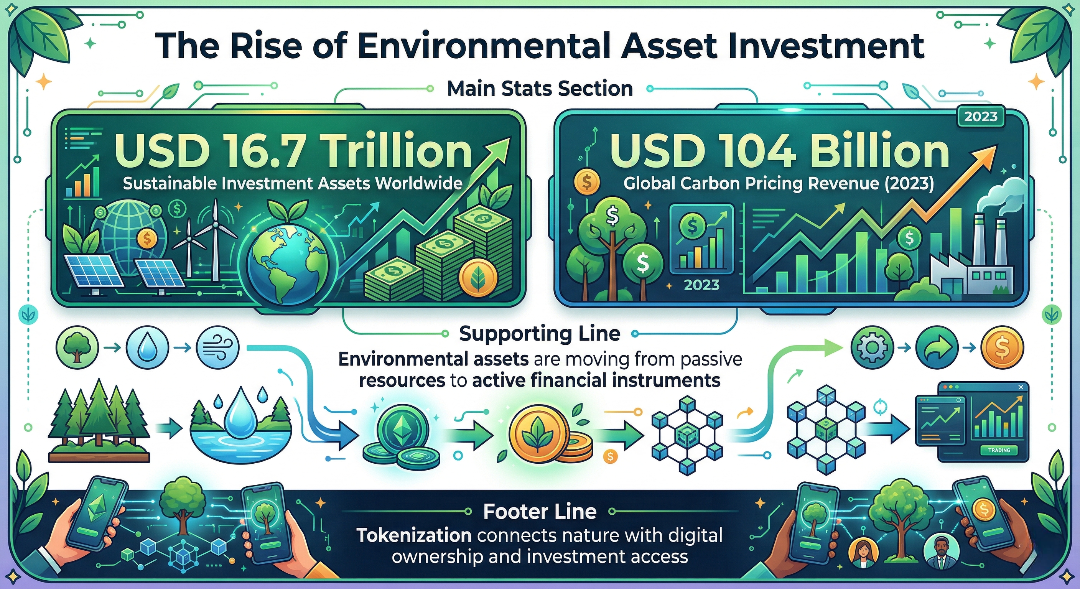
Nature has always held value, yet most of it never appeared in formal financial systems. That is starting to change. Global sustainable investment assets have reached USD 16.7 trillion, which shows that investors are actively looking for opportunities tied to long-term environmental value.
Forests, rivers, and carbon credits are no longer seen as passive resources. They are entering a financial space where ownership connects directly with environmental impact. This shift is happening alongside real financial activity. In 2023, global carbon pricing revenues crossed USD 104 billion, which shows that environmental assets already carry measurable economic weight.
This change opens new possibilities for investors and project owners. A person can now own a small share in a forest or support water conservation with a defined stake. Tokenization gives nature a structure that financial systems can recognize and trade, making participation more direct and measurable.
What Is Natural Resource Tokenization? (Simple Explanation for Beginners)
Tokenization means converting a real-world asset into digital units that people can trade online. Each unit represents a share of that asset. Think of it as dividing a large resource into smaller, affordable pieces that many people can own.
In natural resources, this includes forests, water reserves, minerals, and carbon credits. Each token links to a specific portion or right connected to that resource. Instead of needing large capital to invest in land or environmental projects, individuals can enter with smaller amounts.
Examples already exist. Carbon credit tokens are traded on digital platforms, and reforestation projects issue tokens tied to tree planting and carbon absorption. These tokens sit on blockchain systems that record ownership and transactions in a fixed and verifiable way.
Why is this gaining attention now? People want their investments to reflect their values. Digital finance meets that need by linking money with environmental impact. Tokenization gives investors a direct way to support sustainability while holding a measurable stake.
Why Tokenizing Natural Resources Is a Game-Changer
Unlocking Hidden Economic Value
Many natural assets provide benefits that rarely translate into income. A forest supports biodiversity and regulates climate, yet it often remains financially inactive unless exploited. Tokenization changes how value is assigned to these benefits.
Once converted into digital assets, these resources gain visibility in financial markets. Investors can participate without requiring physical ownership. This turns previously ignored value into something measurable and tradable.
Democratizing Access to Green Investments
Environmental investments once belonged to governments and large institutions. That barrier has lowered. Fractional ownership allows individuals to participate without large capital.
This shift brings more people into the space. Students, small investors, and local communities can now support environmental projects directly. Access becomes wider, and participation feels more practical.
Enhancing Transparency and Trust
Trust has been a concern in environmental markets, especially in carbon credits. Buyers often question whether claims match real impact. Doubt slows adoption.
Blockchain records provide a fixed transaction history. Each token links back to its source and activity. This reduces the risk of double counting and false reporting. Investors gain clearer visibility into what they are funding.
Accelerating Sustainability Goals
Financial returns and environmental outcomes can now move in the same direction. Tokenized systems allow investors to support climate projects while tracking measurable impact.
This link between profit and purpose changes how capital flows. Businesses and individuals can support environmental efforts without stepping away from financial goals. It creates a practical path where both interests align.
Types of Natural Assets That Can Be Tokenized
Natural resource tokenization covers more than one category. It works across several types of environmental assets that already carry measurable value. The logic is simple. If a resource can be verified and linked to ownership or impact, it can be represented in digital form. This makes the model useful in climate projects, farming, water systems, and energy production.
Carbon Credits and Emission Offsets
Carbon credits represent a fixed amount of reduced emissions. Each credit usually equals one metric ton of carbon dioxide avoided or removed. Once converted into tokens, these credits can move easily across digital platforms.
Traditional carbon markets often involve paperwork and long processing times. Tokenized credits reduce these delays and make transactions easier to track. Businesses that aim to meet emission targets can access these credits faster, and investors can participate without dealing with complex systems.
Forests and Biodiversity Assets
Forests support climate balance, wildlife, and local economies. Yet their financial value often stays hidden unless land is cleared or used for timber. Tokenization changes how this value is recorded and shared.
Forest tokens can represent conservation efforts or carbon storage capacity. Biodiversity credits add another layer by linking tokens to habitat protection or species recovery. This structure helps direct funding toward areas that need protection, not exploitation.
Water Rights and Resources
Water access has become a serious concern in many regions. In 2023, over two billion people faced water stress at some point during the year. Clear tracking of water usage can help manage this challenge.
Token systems can record water rights and usage in a digital format. Farmers, industries, and local authorities can view allocation and consumption data in real time. This reduces confusion and helps prevent disputes over limited resources.
Agricultural Land and Produce
Farmland attracts growing interest from investors. Buying land directly often requires high capital, which limits participation. Tokenized farmland allows people to own small shares of agricultural property.
Crop-based tokens add another option. These tokens link to expected yields such as rice, wheat, or coffee. Farmers can raise funds before harvest, and investors can track production results tied to their holdings.
Mineral and Energy Resources
Mineral extraction often raises questions about sourcing and environmental impact. Token systems can record the origin and movement of these resources. This creates a traceable record that buyers can verify.
Renewable energy projects fit well into this model. A solar plant, for example, can issue tokens linked to its power output. Investors can hold a share in energy production without owning physical equipment. This creates a direct link between clean energy generation and financial participation.
Ready to build your own Natural Resource Tokenization Platform?
Turn environmental assets into measurable digital value with a platform designed for real-world impact and investor participation.

How a Natural Resource Tokenization Platform Works
A tokenization platform follows a structured process. It connects real-world assets with digital systems through clear steps. Each stage builds trust and keeps the system aligned with actual conditions.
Asset Identification and Verification
The process starts with selecting a suitable asset. This can include forests, water sources, farmland, or carbon projects. The asset must have clear ownership, measurable value, and legal approval. Verification follows next. Environmental auditors and certification bodies confirm the asset’s authenticity. This step prevents false claims and sets a reliable foundation for token creation.
Digital Representation of Assets
After verification, the asset is converted into digital tokens. Each token represents a defined share or right linked to the resource. The digital record must match the real asset closely. Tokens often carry detailed information. This includes location, ownership history, certification data, and usage rights. These details help users understand exactly what they are buying or holding.
Blockchain Integration
The platform records tokens on a blockchain network. This creates a permanent record of ownership and transactions. Each transfer is logged with a timestamp, which adds clarity to the system. Different platforms choose different blockchain types. Public networks allow open access, and private ones offer more control. The choice depends on cost, speed, and regulatory needs.
Smart Contracts for Automation
Smart contracts handle transactions automatically. When a condition is met, the system executes the action without manual input. For example, payment can transfer once ownership changes. These contracts also manage revenue sharing. If a project generates income, the system distributes it among token holders based on their share. This reduces delays and avoids disputes.
Marketplace and Trading Ecosystem
Tokens need a place where users can trade them. The platform provides a marketplace where buyers and sellers interact. Users can purchase tokens, hold them, or sell them later. Secondary trading adds flexibility. Investors are not locked into long-term positions. They can exit when needed, which makes participation more appealing.
Key Features of a High-Performance Tokenization Platform
A reliable platform must go beyond token creation. It needs tools that make the system easy to use and safe for users. If the platform feels complex, users will step away.
Real-time tracking is one of the most useful features. Investors want to see how an asset performs. For example, a forest project can show carbon absorption data updated monthly or quarterly.
Secure storage is equally important. Digital wallets protect user holdings. Multi-step login methods and identity checks add an extra layer of safety.
User dashboards should present data in a simple format. Ownership details, transaction history, and asset performance must be easy to read. A clear interface helps users stay engaged.
Integration with external data sources adds more depth. Sensors, satellite images, and monitoring systems feed real-world data into the platform. This keeps digital records aligned with actual conditions and builds confidence among users.
Technology Stack Behind Tokenization Platforms
Natural resource tokenization platforms rely on a combination of technologies that connect real-world assets with digital systems. Each layer has a specific role, from recording ownership to tracking environmental data. The goal is to keep digital records aligned with physical conditions so users can trust what they see on the platform.
Blockchain Protocols
Blockchain acts as the base layer where all transactions and ownership records are stored. Platforms can use public networks for open access, private ones for controlled participation, or hybrid models that combine both. The choice depends on how much control and visibility the platform needs. Speed and cost also matter. A system that processes transactions quickly helps users trade without delays and keeps the platform responsive.
Smart Contract Frameworks
Smart contracts handle transactions automatically based on predefined rules. When a condition is met, such as a token transfer, the system completes the action without manual steps. This reduces delays and removes the need for intermediaries. It also keeps operations consistent, since the same rules apply to every transaction.
IoT and Remote Sensing
Real-world assets need constant monitoring to maintain accuracy. IoT devices and satellite tools provide this data. Sensors can measure water usage, soil conditions, or energy output. Satellite images can track forest cover or land changes over time. This continuous data flow confirms that the asset linked to a token is active and performing as expected.
AI and Data Analytics
Large datasets require proper analysis to be useful. AI tools process this information and identify patterns that may not be visible at first glance. They can estimate future crop yields, carbon absorption, or resource availability. This helps investors and project owners understand potential risks and expected outcomes with greater clarity.
Cloud Infrastructure
Cloud systems store and manage all platform data. They support large volumes of transactions, user activity, and environmental records. As more users join, cloud infrastructure allows the platform to expand without performance issues. This keeps the system stable even during high usage.
Step-by-Step Development Process
Building a natural resource tokenization platform involves several stages, each with a clear purpose. From planning to launch, every step contributes to creating a reliable and usable system.
Defining Business Goals and Use Cases
The process starts with defining the platform’s purpose. Teams decide which assets to focus on, such as carbon credits, water resources, or farmland. They also identify the target users. Clear goals help guide development and prevent unnecessary complexity later.
Regulatory and Legal Planning
Natural resources fall under strict environmental and financial regulations. Each region has its own rules for ownership and trading. Planning for compliance at an early stage helps avoid legal issues and builds trust among users.
Platform Architecture Design
This stage focuses on structuring the system. Backend components handle data processing and transactions. Frontend interfaces allow users to interact with the platform. Security must be part of the design from the beginning to protect user data and digital assets.
Token Model Design
Tokens can represent ownership, access, or financial rights. The platform must define their purpose clearly. Token distribution and incentives also play a role. A well-structured model keeps users engaged and supports regular activity within the platform.
Development and Integration
Developers build the platform by writing code and connecting different systems. Blockchain networks, payment services, and environmental data sources must work together. APIs help these systems communicate and keep data flowing smoothly.
Testing and Security Audits
Before launch, the platform undergoes testing to identify technical issues. This includes checking system performance under heavy usage. Smart contracts require detailed audits to confirm that financial logic works correctly. Fixing issues at this stage reduces future risks.
Launch and Scaling
After testing, the platform is introduced to users. Early adoption helps build activity and feedback. Growth continues after launch as updates and improvements are added. The platform must adapt to user needs and market changes over time.
How Much Does It Cost to Build a Natural Resource Tokenization Platform?
The cost of building a natural resource tokenization platform depends on features, complexity, and compliance needs. A basic platform may start around $40,000, while a full-scale system with advanced integrations and security can go beyond $300,000. Development time also varies. Simple platforms may take 3 to 6 months, while advanced platforms can take 9 months or more.
| Feature | Description | Development Duration | Estimated Cost (USD) |
|---|---|---|---|
| Business Planning & Research | Defines platform goals, asset types, and compliance scope | 2 – 4 weeks | $5,000 – $15,000 |
| UI/UX Design | Designs dashboards, investor panels, and asset views | 3 – 6 weeks | $4,000 – $20,000 |
| Blockchain Setup | Network selection, node setup, and configuration | 3 – 6 weeks | $5,000 – $25,000 ([Hyperlink InfoSystem][1]) |
| Smart Contract Development | Creates token logic, ownership rules, and automation | 4 – 8 weeks | $10,000 – $60,000 ([Hyperlink InfoSystem][1]) |
| Backend Development | Handles APIs, databases, and business logic | 6 – 10 weeks | $10,000 – $40,000 ([Hyperlink InfoSystem][1]) |
| Frontend Development | Builds user interface for web or mobile apps | 4 – 8 weeks | $10,000 – $30,000 ([Hyperlink InfoSystem][1]) |
| Wallet Integration | Enables storage, transfer, and access to tokens | 2 – 4 weeks | $5,000 – $20,000 |
| IoT / Data Integration | Connects sensors or satellite data to assets | 4 – 8 weeks | $10,000 – $50,000 |
| AI & Analytics Module | Adds predictive analysis for asset performance | 4 – 8 weeks | $15,000 – $60,000 |
| Compliance & KYC Modules | Identity checks and regulatory compliance tools | 3 – 6 weeks | $10,000 – $40,000 ([Alchemy][2]) |
| Testing & Security Audits | Performance testing and smart contract audits | 3 – 6 weeks | $5,000 – $100,000 ([Hyperlink InfoSystem][1]) |
| Marketplace Development | Enables buying, selling, and trading of tokens | 6 – 10 weeks | $20,000 – $80,000 |
| Deployment & Launch | Final setup, hosting, and production release | 2 – 4 weeks | $3,000 – $10,000 ([Hyperlink InfoSystem][1]) |
Real-World Use Cases and Industry Applications
Natural resource tokenization already supports several industries. These applications show how digital systems can connect with environmental assets in practical ways.
Carbon credit marketplaces allow businesses to purchase tokenized credits to offset emissions. This creates a more active market and helps project developers reach more buyers.
Forestry projects use tokens to support conservation. Investors fund forest protection and receive updates on carbon storage and land conditions. This links funding directly with measurable outcomes.
Water management systems use tokenized records to track ownership and usage. This helps allocate water more effectively across farms and industries, especially in regions facing shortages.
Renewable energy platforms issue tokens linked to solar or wind energy production. Investors can participate in clean energy projects without owning physical infrastructure.
Conservation tourism offers another application. Investors support protected areas and benefit from tourism revenue linked to those locations. This connects environmental protection with economic activity in a practical way.
Conclusion
Natural resource tokenization is changing how people view and invest in environmental assets. Forests, water, energy, and carbon credits now carry measurable financial value that can be shared across digital platforms. This model connects real-world impact with direct ownership, making participation easier for individuals and institutions. It also brings better tracking, clearer records, and more efficient markets for assets that were once difficult to manage. As interest in sustainable investment continues to grow, platforms that combine environmental data with digital systems will play a larger role in shaping this space. Blockchain App Factory provides Natural Resource Tokenization Platform Development Services, helping businesses create secure and reliable platforms that connect nature with digital ownership.