Key Insights
- It helps token projects grow through education, community proof, and steady brand visibility across owned channels.
- It helps projects push launches, listings, staking campaigns, and other short-window events with faster reach.
- Organic builds credibility and retention, and paid media expands reach and supports conversion-focused campaigns.
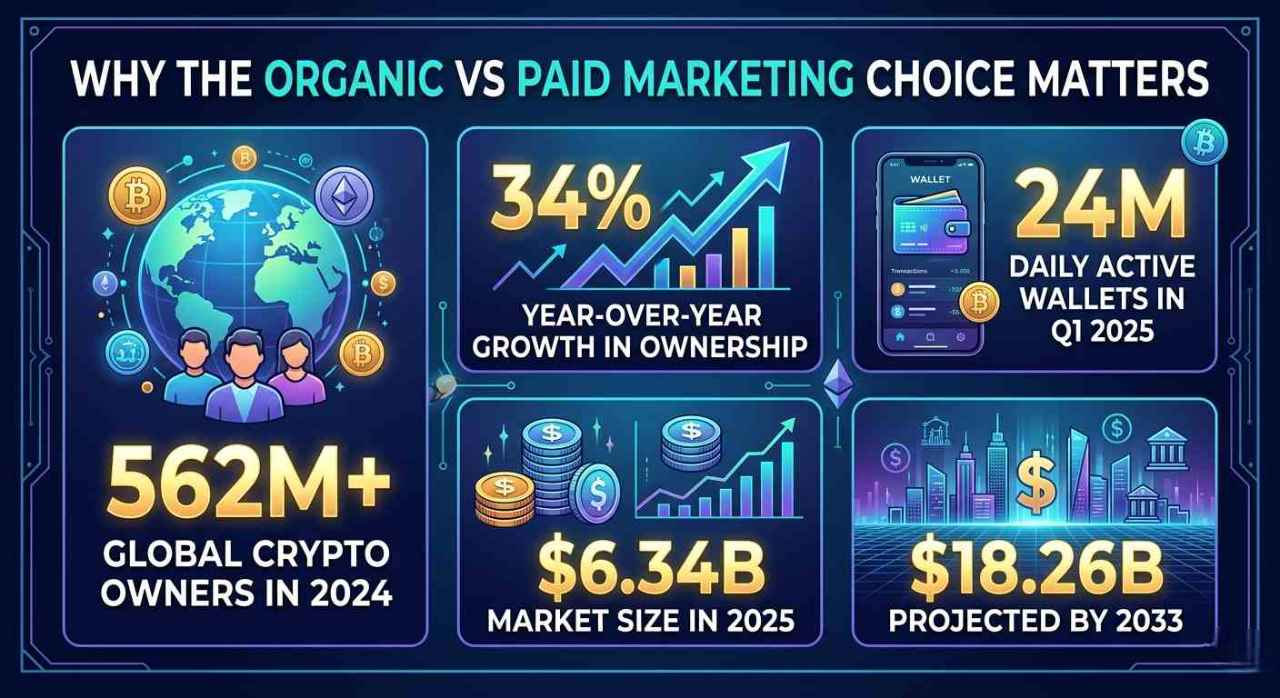
Every token project faces the same hard question early on: should growth come from organic marketing, paid promotion, or a mix of both? That choice affects far more than website traffic. It shapes launch momentum, community trust, user acquisition costs, treasury use, and long-term brand value. The decision matters even more because crypto is now a much larger market. Around 562 million people worldwide owned crypto in 2024, up 34 percent from 420 million in 2023. At the same time, the global cryptocurrency market was estimated at $6.34 billion in 2025 and is projected to reach $18.26 billion by 2033. That scale creates opportunity, but it also raises the cost of poor marketing choices.
A token launch can gain attention quickly and lose it just as fast. Paid campaigns can boost reach and impressions, but reach alone does not build trust. Organic marketing often creates deeper credibility in crypto, where users watch closely for real activity, clear communication, and steady delivery. The right mix can reduce wasted spend, keep users engaged longer, and attract real holders instead of short-term clicks. It can also support compliance goals, since paid crypto promotion often faces stricter platform checks. DappRadar also reported about 24 million daily unique active wallets in Q1 2025, showing both strong market activity and intense competition for attention. That is why organic visibility often carries more weight for early-stage token projects, even when paid channels remain useful for speed and scale.
What Crypto Marketing Means for Token Projects
Crypto marketing is not the same as marketing a SaaS product, an online store, or a mobile app. A token project asks people to believe in more than a service. It asks them to believe in an ecosystem, a future use case, and often a shared economic model. That makes every message and campaign more important.
A token project is rarely selling one simple benefit. It must explain the protocol, token utility, roadmap, community, and long-term narrative. The audience is different too. In SaaS, buyers often care about price, support, and features. In crypto, users also look at tokenomics, liquidity, governance, partnerships, founder presence, and community strength. They want proof, not slogans.
Speculation adds more pressure. Some users care more about price movement than product value, so teams need to balance excitement with credibility. Regulation adds another layer. Token promotion faces closer review from platforms, exchanges, and users. A careless message can create legal, reputational, or platform risks. That is why crypto marketing needs discipline from the start.
How Token Marketing Differs from SaaS or eCommerce
Traditional digital marketing often points to one clear action, such as buying a product or booking a demo. Token marketing is less direct. A user may see a post on X, join Telegram, read the whitepaper, follow wallet activity, and wait for the right market moment before acting. Trust, timing, and sentiment shape the journey.
Token projects also market several things at once: the protocol, the community, the token’s utility, the roadmap, and the broader narrative. That makes messaging more sensitive than in SaaS or eCommerce. One weak message can quickly damage trust across X, Telegram, Discord, Reddit, and other crypto communities.
Core Goals of Crypto Marketing
The first goal is awareness. People need to hear about the project before they can explore it. The second is community growth. Token projects need active users, not passive followers. The third is wallet activation, because attention means little if users never connect, claim, or use the product.
The next goal is token adoption. Users need clear reasons to hold, stake, vote, or use the token. Then comes liquidity support, which helps attract healthy market participation. Governance participation also matters in Web3, where users may be voters, builders, and advocates. The final goal is ecosystem expansion through developers, creators, partners, validators, and community leaders.
Why Channel Strategy Matters More in Web3
In Web3, reputation moves fast. One strong community discussion can improve visibility, while one weak campaign can create doubt. That is why channel strategy matters so much.
Paid channels are strong for speed. They can drive reach, clicks, and fast awareness. But they do not always build trust. Organic channels are stronger for belief. They give projects space to explain ideas, answer criticism, show progress, and earn attention over time.
This is the key difference. Paid media can introduce the project. Organic media can turn interest into community and community into adoption. Early-stage token projects usually need education, founder visibility, and trust first. More mature projects can use paid campaigns to support listings, launches, ecosystem programs, or user acquisition. The right mix depends on timing, budget, credibility, and what the market needs to believe next.
What Is Organic Crypto Marketing?
Definition and Channel Scope
Organic crypto marketing is how a token project earns attention without paying for every click, view, or placement. It grows through consistent publishing, real community activity, and public trust. The goal is to help people find the project, understand it, and stay connected over time.
This covers many channels. SEO helps projects appear in search results for topics tied to token utility, staking, governance, and market education. Content marketing turns whitepapers, explainers, case studies, and launch updates into long-term traffic assets. Founder-led thought leadership gives the team a public voice and helps the market judge the project through real ideas, not ad copy.
Social media and community building matter just as much. X, LinkedIn, Reddit, and Farcaster help projects share updates, answer questions, and shape public sentiment. Discord and Telegram go deeper by giving token holders and early users a place to test the team in real time. Newsletters, PR, earned media, ecosystem partnerships, and ambassador programs add more reach and credibility.
Key Strengths of Organic Crypto Marketing
Organic crypto marketing builds trust over time. That is its biggest strength. People in crypto rarely commit after one touchpoint. They watch a project, read updates, join chats, and study token utility before they act. Organic content supports that longer path.It also works well for education-heavy projects. Many token teams need to explain staking rules, governance design, treasury logic, or ecosystem mechanics. Organic channels give them space to teach clearly and reduce confusion.
Another strength is brand authority. A project that ranks in search, appears in earned media, posts useful updates, and runs active communities looks more credible. Over time, this work compounds. A strong guide can keep bringing traffic for months, and an active community can become proof of trust for new users.
Organic growth also offers more control. It does not depend on ad approvals in the same way paid campaigns do. Platform changes can still affect reach, but they do not shut down a blog, newsletter, Discord server, or partnership program overnight.
Key Limitations of Organic Crypto Marketing
Organic growth takes time. A new token project can publish strong content for weeks and still see slow traction at first. Search rankings take time to build, communities need steady care, and media attention usually follows momentum.
It also demands consistency. Teams need writers, social managers, moderators, founder visibility, and a clear content plan. Organic marketing may look low-cost, but it still requires time, skill, and daily effort.
It is also harder to scale quickly during short launch windows. A token listing, staking event, or exchange campaign may need attention in days, not months. Organic channels can support that push, but they rarely create instant reach on their own.
What Is Paid Crypto Marketing?
Definition and Channel Scope
Paid crypto marketing uses media spend to place a token project in front of a chosen audience. The team pays for placements, clicks, impressions, sponsored coverage, or other actions. The main advantage is speed. Paid campaigns can create visibility quickly and direct traffic to landing pages, products, events, or exchange activity.
The channel mix is broad. Search ads capture users with intent. Display ads expand reach across websites and apps. Paid social can support visibility in approved regions and categories. Crypto-native ad networks place campaigns on Web3-focused sites, apps, and communities.
Sponsored newsletters, influencer sponsorships, exchange promotions, and media buys add more reach. Retargeting helps bring back users who already know the brand. KOL campaigns can also work for launches, community pushes, and event-driven promotions when the audience fit is strong and the message stays credible.
Key Strengths of Paid Crypto Marketing
Paid crypto marketing delivers speed. A project can reach targeted users much faster than it can build search rankings or earn media coverage. That matters during launches, exchange listings, staking programs, governance votes, and short campaign windows.It also offers stronger targeting. Teams can test audience groups, geographies, interests, wallet-linked behaviors on crypto-native platforms, and retargeting pools. This makes it easier to align creative with user intent.
Paid channels are useful for testing too. Teams can compare headlines, visuals, landing pages, and offer angles in a short time. That feedback can improve both paid and organic marketing.
Key Limitations of Paid Crypto Marketing
Paid crypto marketing can burn budget quickly. Weak landing pages, poor targeting, or generic creative often turn spend into low-value traffic. Creative fatigue is another common issue. The same offer or visual can lose performance fast, especially in crypto where audiences see repeated promotions often.
Policy and compliance friction also make the channel harder to run. Some products, geographies, and campaign types face strict review. Some ads never get approved, and others run with limits that reduce scale. Paid campaigns can also lose trust if the message feels too promotional.
Why Paid Crypto Marketing Is Not a Standard Performance Play
Paid crypto marketing may look like standard performance marketing, but it works differently. In SaaS or eCommerce, teams often have broader platform access, simpler approvals, and clearer conversion paths. Crypto campaigns face stricter filters from the start.
Platform reviews slow down launch
Many crypto ads go through added review tied to financial services rules, licensing, and product category checks. That slows down campaign setup and limits flexibility.
Eligibility changes by product and country
Paid reach in crypto is rarely the same across markets. A campaign allowed in one region may face restrictions in another because of local laws and platform policies.
Campaign design must fit policy limits
These rules affect creative, targeting, and landing pages. Teams often need clearer disclosures, tighter product language, and narrower targeting. That changes both speed and scale.
Google, Meta, and X need separate plans
Token teams should not assume one campaign setup will work everywhere. Each platform has its own crypto rules, approval systems, and geography checks. Paid crypto marketing needs a platform-by-platform plan, not one standard playbook.
Paid media buys attention, not belief
This is the biggest difference. A click does not mean trust. A view does not mean conviction. In token markets, users still look for social proof, founder presence, community quality, and product clarity before they act. Paid media can start the conversation, but it rarely finishes it alone.
Organic vs Paid Crypto Marketing: A Direct Comparison
| Comparison Area | Organic Crypto Marketing | Paid Crypto Marketing |
|---|---|---|
| Speed to Market | Slower to build because it depends on content traction, search visibility, and community growth | Fast to activate through ads, sponsored posts, exchange promotions, and paid placements |
| Traffic Longevity | Content, SEO pages, and community discussions can keep generating traffic over time | Traffic usually falls once the campaign or spend ends |
| Trust and Credibility | Builds stronger trust through education, transparency, founder voice, and public engagement | Creates awareness quickly, but does not build belief on its own |
| Community Strength | Encourages deeper relationships through Discord, Telegram, AMAs, and ongoing updates | Can attract new users, but not always high-intent community members |
| Cost Efficiency Over Time | Becomes more efficient as content libraries and community assets grow | Often expensive to maintain as a primary growth engine |
| Short-Term Results | Limited in the early phase because results take time to compound | Strong for quick boosts in traffic, clicks, and awareness |
| Scalability | Scales authority, retention, brand search, and loyalty | Scales reach, impressions, and audience acquisition quickly |
| Retention Support | Strong because community and educational content keep users engaged | Weak unless backed by product value and strong follow-up flows |
| Control Over Channels | High control through owned assets like website, newsletter, blog, Discord, and Telegram | Lower control because campaigns depend on platform rules and ad approvals |
| Compliance Risk | Lower exposure to ad review systems, though content still needs to stay compliant | Higher risk due to crypto ad restrictions, policy reviews, and regional rules |
| Brand Building | Builds a durable brand through consistency, education, and public proof | Supports visibility but rarely creates brand loyalty by itself |
| Performance Window | Delivers value over months, often compounding with time | Performs best in short, focused windows tied to a campaign goal |
| Pre-Launch Fit | Ideal for building trust, narrative clarity, waitlist interest, and community | Useful only for selective amplification of key messages |
| Launch Fit | Helps answer questions, support trust, and reinforce token utility | Drives rapid awareness, traffic, and event visibility |
| Post-Launch Growth Fit | Important for SEO, education, ecosystem updates, and support content | Useful for targeted acquisition and campaign boosts |
| Mature Ecosystem Fit | Creates a defensible organic moat through authority and loyal users | Best used for expansion, retargeting, and tested offers |
When Organic Marketing Works Best for Token Projects
Early-Stage Projects Building Credibility
Organic marketing works best for early-stage token projects that still need trust. New ideas often require clear explanation before people are ready to act. A paid ad can create awareness, but it cannot do the full teaching job. That is why early teams often see better results from steady content, founder visibility, and open community discussion.
This matters even more for education-heavy projects. If a token introduces a new protocol model, staking logic, governance layer, or utility system, users need time to understand it. Organic channels give the team room to explain the idea, answer questions, and build belief before launch. They also help nurture real communities, which paid traffic alone cannot create.
Projects With Long Sales or Adoption Cycles
Some token projects need months of education and validation before users commit. Organic marketing works best in these cases because it supports repeated touchpoints over time.
Infrastructure tokens are a good example. They often target developers, validators, ecosystem builders, or enterprise partners. Their value is technical, not instant. These projects need explainers, case studies, deep articles, and long-form founder communication. Paid ads may support visibility, but organic content does most of the work.
Governance-heavy ecosystems fit this model too. If users need to understand voting rights, treasury use, or protocol changes, organic channels work better. The same is true for B2B or institutional token models, where audiences look for clarity, proof, and useful information.
Teams Focused on Sustainable Brand Equity
Organic marketing is also a strong fit for teams that care about long-term brand value. A token brand grows stronger when people link it with clear thinking, honest communication, and useful education. That image is built through repetition and public proof, not short bursts of promotion.
Thought leadership plays a major role here. Founder posts on X and LinkedIn can show how the team thinks. Technical explainers help the brand look serious and informed. Tokenomics education reduces confusion, while ecosystem storytelling shows where the project fits and why it matters.
These assets do more than drive traffic. They shape how the market sees and talks about the project. That is why teams focused on lasting brand strength often lean more into organic work.
High-Value Organic Tactics for Token Brands
SEO content hubs
A content hub helps the project rank for key topics through guides, glossaries, use case pages, and ecosystem updates. It builds search visibility and helps users learn at their own pace.
Educational landing pages
Landing pages should not only attract traffic. They should also explain the token, product, use case, and next step in clear language.
Tokenomics explainers
A plain-language tokenomics page can explain supply, utility, emissions, lockups, and governance rights. This is one of the most useful trust-building assets a token project can publish.
Founder content on X and LinkedIn
Founder-led content gives the project a human voice and helps users see how the team thinks and responds in public.
Community AMAs
AMAs give users direct access to the team. They help answer questions, collect feedback, and show that the team is active and accountable.
Ecosystem case studies
Case studies show the token in action through partner use, user outcomes, or ecosystem growth. They turn claims into visible proof.
Exchange readiness content
This content explains listing milestones, token access details, security reminders, and next steps. It reduces confusion and supports trust during high-attention periods.
Ready to build a crypto marketing plan that fits your token project?
Get a focused mix of organic growth, paid reach, and community strategy built around your launch stage, budget, and market goals.

When Paid Marketing Works Best for Token Projects
Time-Sensitive Campaigns
Paid marketing works best when a project needs attention quickly. Token generation events are a strong example. The team may have only a short window to drive traffic, explain access steps, and move qualified users to a landing page or exchange partner. Paid media helps speed that up.
Exchange listing promotions work the same way. Listings create short bursts of public interest, and teams often need fast visibility across search, media, social, and crypto-native channels. Staking campaigns, reward programs, waitlist pushes, and event registrations also fit this model. When speed matters, paid channels often work better.
Projects With Strong Conversion Infrastructure
Paid traffic performs best when the project is ready for it. A clear landing page is the first requirement. If users click an ad and land on a vague page, the campaign wastes money. The page should explain the token, the action, and the next step in plain language.
Compliant messaging matters just as much. Crypto campaigns need careful wording, clear claims, and visible trust signals. A smooth wallet onboarding flow also matters. If users get confused at sign-up or wallet connection, conversions drop fast.
Attribution tracking helps teams measure results. They need to know where traffic came from, what content performed best, and where users dropped off. Remarketing audiences help too. A project with site visitors, newsletter readers, or community members can use paid media more effectively than a team starting from zero.
Paid Campaigns That Can Work in Crypto
Branded search defense
Branded search campaigns protect the project’s name in search results. This matters during launches, listings, and other high-attention moments. It helps control the first click and reduce confusion from third-party pages.
Retargeting warm audiences
Retargeting often works better than cold acquisition in crypto. People who already visited the site, joined a waitlist, or engaged with content already know the brand. They usually need a reminder, not a full introduction.
Crypto-native media placements
Ads and sponsored placements on crypto-focused sites can perform well when the audience fit is strong. These channels often reach users who already follow token news, DeFi products, governance activity, and exchange updates.
Sponsored newsletter distribution
Newsletters can place the project in front of readers who already follow crypto research, launches, and market themes. This works best when the message is educational and tied to a real event or offer.
Ecosystem co-marketing
Co-marketing with exchanges, partner protocols, wallets, or launch platforms can improve paid reach. It adds borrowed trust and makes the campaign feel more credible.
Geography-specific awareness campaigns
Some projects need to focus on one region at a time. Paid media can support market-specific pushes where regulations, exchange support, language, and user demand align.
Where Paid Often Underperforms
Paid marketing often fails when cold traffic is sent to weak landing pages. If the project has no clear story, strong headline, or defined next step, clicks will not convert. Budget disappears quickly in this setup.
It also struggles when token utility is unclear. Users will not act if they do not understand why the token matters. Compliance-sensitive claims create another risk. Aggressive promises, vague financial language, or weak disclosures can reduce trust and trigger platform review issues.
Projects without social proof often see weaker paid results as well. If users click through and find a quiet community, little founder presence, and no visible support, the ad loses impact. Paid media can bring attention, but it cannot hide weak fundamentals.
The Best Strategy Is Usually Hybrid, Not Either-Or
Why a Blended Model Outperforms a One-Channel Approach
The strongest token projects rarely choose one path and ignore the other. They use organic marketing to build authority, trust, and staying power. Then they use paid marketing to speed up reach, test messages, and support high-priority campaigns.
This mix works better for a simple reason. Organic media helps people believe in the project. Paid media helps more people see it. A token brand needs both. One builds depth. The other builds speed.
A blended model often improves acquisition quality too. Organic content warms the audience before the click. Paid media then pushes that warm interest toward a focused landing page or event page. That sequence tends to produce better traffic and stronger conversion behavior than either channel alone.
A Practical Funnel for Token Projects
Top of funnel
At the top of the funnel, the goal is awareness and early trust. PR helps the project appear in public conversations. SEO content captures people searching for token education, product use cases, or market themes. Educational articles and founder-led social content help new users understand the story. This stage should answer basic questions and create first interest.
Middle of funnel
In the middle of the funnel, the project needs deeper engagement. Webinars, AMAs, and community content work well here. Sponsored content and retargeting can keep the project in front of people who already showed interest. This is where users compare claims, read details, and decide whether the project feels credible.
Bottom of funnel
At the bottom of the funnel, the focus shifts to action. Branded search helps capture users who already know the project name. Conversion-focused landing pages guide people toward sign-up, wallet connection, waitlist entry, or staking participation. Email nurture keeps warm users informed. Ecosystem offers, partner campaigns, and launch-specific pages can help turn interest into action.
How Organic and Paid Support Each Other
Paid campaigns work better when they amplify content that already performs well on organic channels. If a founder thread, a guide, or a product explainer gets strong engagement on its own, that is a useful sign. Paid media can extend its reach to similar audiences.
Organic content strengthens paid landing pages too. A landing page backed by helpful articles, tokenomics explainers, FAQs, and public team content feels more credible. Users often click through more confidently when they can validate the story.
Community signals matter here as well. An active Telegram group, visible user discussion, strong AMA turnout, and healthy social replies can improve conversion confidence. People want proof that others care. Paid media can attract the visit. Organic proof helps close the gap between curiosity and action.
Want to make your token launch marketing more effective?
Framework for Choosing Organic, Paid, or Hybrid
A token project should not choose channels based on trends or preference. It should choose them based on stage, budget, market readiness, compliance risk, and team capacity. The right mix can change over time, so the goal is to match the channel plan to the project’s current position.
Decision Factor 1: Project Stage
Idea stage
Organic marketing is usually the better fit. The project still needs a clear story, early feedback, and signs of interest. Paid promotion at this stage often drives traffic to a weak message. Founder posts, early community discussion, and educational content work better.
Pre-launch
Pre-launch projects still lean toward organic. They need trust, waitlist interest, and audience education. Selective paid support can amplify strong content, event sign-ups, or lead capture pages, but the base should still come from content, PR, founder visibility, and community building.
Post-launch
Post-launch projects usually need a mixed model. The market expects proof, activity, and clear next steps. Paid media can support acquisition and retargeting, while organic work keeps users informed and helps maintain credibility.
Growth
Growth-stage projects often benefit most from a hybrid model. They have enough proof to support paid spend and enough community and content depth to convert traffic better.
Mature ecosystem
A mature ecosystem should build from a strong organic base and use paid media carefully. Paid campaigns should support tested offers, ecosystem expansion, and major events, not carry growth alone.
Decision Factor 2: Budget and Treasury Constraints
Budget changes the answer fast. Projects with limited treasury should usually build an organic foundation first. Content, search visibility, founder communication, and community management take time, but they often create longer-term value than short paid bursts.
A larger budget gives the team room to test paid channels and expand reach. But it should support focused experiments, strong landing pages, and clear tracking, not broad spending without structure.
Treasury discipline matters. Token projects do not just spend money. They spend runway. A weak paid campaign can burn that runway quickly, while organic work often protects it better in early stages.
Decision Factor 3: Market Readiness
Before spending on paid traffic, a project should ask three questions: Is the narrative clear? Is the token utility easy to understand? Does the project have proof points people can trust?
If the story is confusing, paid media spreads confusion faster. If utility feels vague, users will click and leave. If there are no proof points, such as partnerships, product activity, or active community support, the market stays cautious.
Organic marketing is often the better choice until these basics are in place. Paid marketing works far better when the project can answer skepticism with clear evidence.
Decision Factor 4: Compliance and Jurisdiction
Compliance should shape the channel plan from the start. Platform rules vary by country, product type, and campaign format. A token campaign that works in one market may face limits in another.
Some paid campaigns also require certification, advertiser checks, or extra review. That means teams should expect delays before launch windows arrive. Organic channels offer more flexibility because blogs, newsletters, founder posts, and AMAs can still move the story forward when ad campaigns stall.
Decision Factor 5: Internal Team Capability
Channel choice should match the team’s actual skill set. A strong content team can build an organic engine through search pages, explainers, landing pages, and founder content. A skilled community team can turn Telegram, Discord, and social channels into trust assets.
Paid marketing needs different support. It needs a performance marketer for targeting, testing, spend control, and creative feedback. It also needs analytics and attribution so the team can track what happens after the click.
Many token projects make the mistake of running paid campaigns without the internal structure to support them. The result is traffic without learning. A better approach is to choose the mix the team can execute well now, then expand as capability grows.
Conclusion
Organic and paid crypto marketing both have a place in token growth, but the best results usually come from using each one at the right time and for the right job. Organic marketing builds trust, community strength, search visibility, and long-term brand value. Paid marketing brings speed, sharper testing, and faster reach during key campaign windows. Token projects that balance both can attract better users, use treasury more carefully, and turn attention into real adoption. For teams that want a clear growth plan backed by market knowledge and execution support, Blockchain App Factory provides crypto marketing services tailored to token launches, community growth, user acquisition, and long-term ecosystem expansion.