
Key Insights
-
- Points-to-token models help crypto projects grow users and engagement before launching a live token.
- They give teams better control over rewards, allocation rules, and user quality during the pre-TGE stage.
- Strong reward design can improve launch readiness, while weak design often leads to short-term activity only.
Introduction
Crypto launches have changed. A few years ago, many teams rushed from idea to token. That path now looks risky and expensive. A liquid token brings price pressure, listing pressure, legal questions, and constant community expectations from day one. So many projects now start with a points system instead. They reward early activity, track user behavior, and build a real participation base before the Token Generation Event. Galaxy describes crypto points as a gamified reward system that records user actions before a project moves into token distribution, and that framing fits what the market is doing right now.
This shift matters for one reason. Teams want growth before launch, but they want control too. A points program lets them reward trading, staking, referrals, liquidity, or governance without putting a tradable asset into the market too early. That gives the project time to study user quality, adjust incentives, and prepare a stronger token release. The user’s requested direction for these sections also fits that exact angle: keep the content simple, structured, and data-backed rather than bloated.
Why This Model Is Getting Attention Now
Points-to-token models are getting attention since they sit in the middle of growth and control. A direct token launch can attract users fast, but it can also attract short-term farming, fast exits, and price distortion. A points model slows that cycle down. It lets teams test which actions matter, rank users by value, and reward sustained participation instead of one-time clicks. Galaxy’s research notes that more blockchain applications are using points to guide user activity before token distribution, which shows this is no niche tactic anymore.
There is another reason this model stands out. Teams now know that distribution design matters almost as much as token utility. Binance’s 2025 research on airdrop design says projects should define point-to-token ratios early, communicate thresholds clearly, and avoid last-minute allocation changes. That advice only makes sense in a market where points programs have become common enough to need real operating discipline.
What Is a Points-to-Token Model in Crypto?
A points-to-token model is a pre-launch reward structure. Users earn points first. Those points come from actions the project wants to encourage, such as trading volume, liquidity provision, staking, referrals, governance participation, or routine product usage. Later, the project can use those points to decide token allocation, airdrop eligibility, reward tiers, or claim amounts. The points themselves are not the token. They are a way to measure contribution before the token enters the market. Galaxy defines crypto points in much the same way, as a system that rewards early user activity before full token distribution.
This model appeals to founders since it creates a bridge between product usage and token ownership. Instead of handing out tokens too early, the project builds a record of who showed up, who stayed active, and who added value. That record can then shape distribution in a more deliberate way. It is one reason points systems have become closely tied to pre-TGE growth planning.
Points vs Tokens
The difference between points and tokens is simple, but important.
- Points are usually non-transferable. The project controls them inside its own reward system.
- Tokens are transferable assets. Once live, they bring market pricing, exchange activity, and outside speculation.
- Points give a project room to test behavior first. The team can study usage patterns before liquidity and public trading start.
That difference changes the launch process. A points program acts like a controlled pre-launch environment. A token launch opens the door to public market behavior. Binance’s research stresses that once a project moves toward token distribution, clarity around ratios, thresholds, and allocation rules becomes critical. That makes the points stage valuable since teams still have time to shape those decisions carefully.
How the Conversion Usually Happens
There is no single conversion formula, but most projects follow a few familiar models.
- Direct ratio model: a fixed number of points converts into a fixed token amount.
- Weighted allocation model: some users receive higher token shares based on contribution quality, duration, or activity type.
- Seasonal snapshot model: points are tracked across a set period, then a snapshot decides eligibility.
- Tier-based model: users fall into reward bands based on total points earned.
- Post-TGE distribution model: points unlock claim rights after the token goes live.
Hyperliquid is a strong example of time-based reward design. Its points program began on November 1, 2023, distributed 1,000,000 points each week, and ran for six months through May 1, 2024. That structure shows how points can be used as a measured pre-launch system rather than an open-ended reward promise.
Blast is another useful example. In Phase 2, 5 billion BLAST were allocated to points-related rewards, with points linked to user balances and participation. That shows a second route: points do not always reward discrete tasks alone. They can also reflect capital commitment or on-chain presence over time.
Why More Crypto Projects Are Using Points Before Token Launches
More crypto projects are using points before launch since the model supports a more measured form of growth. Teams want active users, returning wallets, deeper liquidity, and stronger community participation, not just short-term attention. A points system helps them track those actions before the token goes live.
It also helps reduce early launch mistakes. DappRadar reported in September 2025 that 88% of airdropped tokens lost value within three months, and user activity often dropped soon after. That does not mean reward models do not work. It shows that weak reward design rarely holds value for long.
Better Control Over User Incentives
Points let a project reward the actions it actually wants, such as repeat usage, governance activity, deposits, or long-term participation. This gives the team more control over reward timing and scoring before a liquid token enters the market.
Cleaner Pre-TGE Growth
Points programs help teams build traction in a more structured way. Users join, stay active, and generate useful behavior data over time. Hyperliquid’s weekly rewards model is a strong example of how projects can encourage steady participation instead of relying on a short burst of hype.
More Flexibility in Token Distribution
Points also give teams more room to shape token allocation before launch. They can set thresholds, weight some actions more heavily, and filter out low-quality or abusive activity. Binance Research has stressed the need for clear point-to-token ratios, thresholds, and task weightings, which shows how central distribution planning has become.
A More Measurable Way to Build Launch Momentum
Many teams talk about community growth, but points make that growth easier to measure. They show who participated, how often users returned, and which actions created the most value. That gives founders stronger data for tokenomics, launch planning, and investor communication.
How a Points-to-Token System Works Technically
A points-to-token system looks simple on the surface. Users complete actions, earn points, and wait for a later token event. Underneath that, the project needs a rules engine, a data layer, and a conversion method that users can understand. That is why the technical side matters so much. The user’s brief for this section asks for practical, short, data-backed writing, and that fits this topic well.
For founders and product teams, the main job is to decide three things early. First, which actions deserve rewards. Second, where the points data will live. Third, how those points will convert into token access or allocation later. Projects that define these rules early usually run cleaner campaigns and face fewer complaints at launch. Binance has said point systems need clear ratios, thresholds, and allocation rules, which shows that reward design is now a serious launch issue rather than a side task.
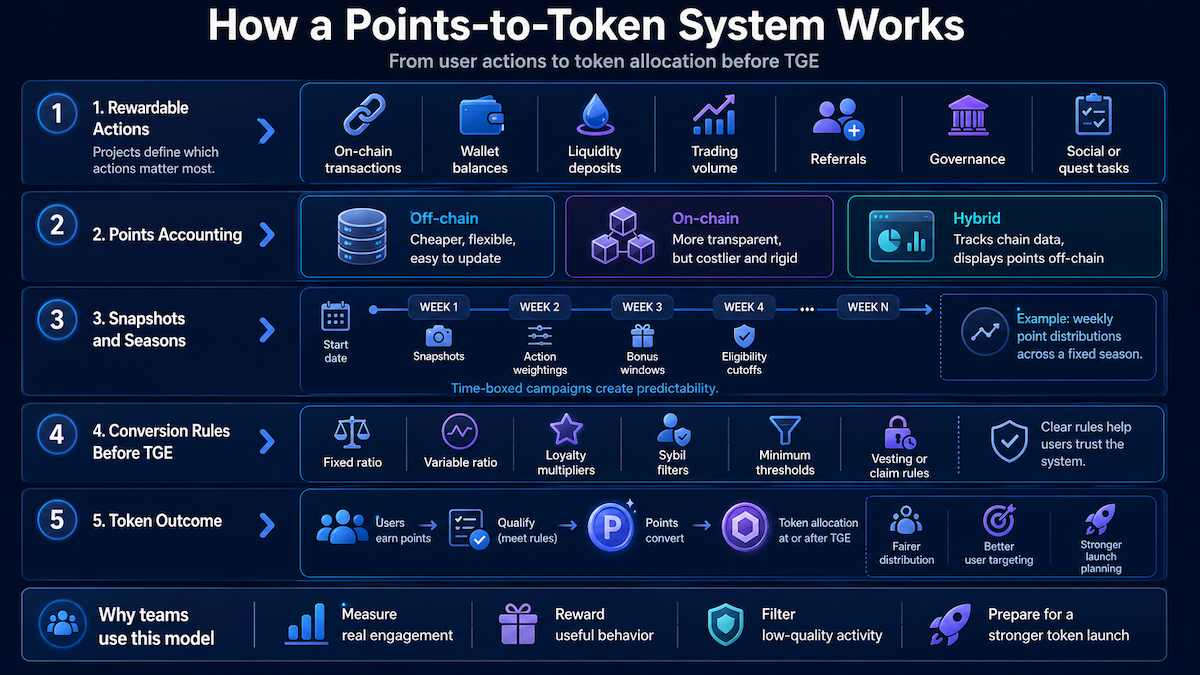
Event Tracking and Action Design
The first layer is event tracking. A project needs to decide what counts as useful activity. That sounds basic, but it shapes the whole campaign. Rewarding the wrong actions can fill the system with low-value users. Rewarding the right ones can build strong pre-TGE traction.
Most projects track a mix of these actions:
- on-chain transactions
- wallet balances
- liquidity deposits
- trading volume
- referrals
- governance activity
- social actions or quest tasks
Each action serves a different goal. Trading volume can help a trading platform. Liquidity deposits can help a DeFi protocol. Governance participation can help a network that wants active voting before launch. Social and quest-based tasks can help early awareness, but they usually need lower weight than product usage. If social tasks carry too much value, the campaign can attract users who want rewards but have no interest in the product.
Projects also need to define event quality, not just event count. A single large deposit is not always more valuable than regular usage across several weeks. A high trading number can be real demand, or wash activity. Good points systems score actions in a way that reflects business value, not just surface activity. That is one reason points programs now look more like product systems than marketing campaigns.
Off-Chain vs On-Chain Point Accounting
Once the project knows what to track, it needs a place to record the points. Most teams choose between off-chain accounting and on-chain accounting.
Off-chain accounting is easier to run. It costs less. The team can update formulas faster, fix mistakes, and include actions that happen outside the blockchain, such as referrals, social quests, or app sessions. This model works well for teams that want flexibility during the pre-launch stage.
On-chain accounting is more transparent. Users can verify balances and rules on-chain if the system is designed that way. The trade-off is rigidity. Updates take more work, transactions can cost money, and the whole setup becomes more complex.
A lot of teams use a hybrid model. They track core blockchain activity on-chain or from chain data, then calculate and display points off-chain in a dashboard. That setup gives the team room to adjust the campaign without rebuilding contract logic every time a rule changes. For an early-stage project, that balance often makes more sense than pushing every reward detail fully on-chain from day one.
Snapshot Logic, Weighting, and Season Design
Most strong points campaigns are not open-ended. They run in seasons, milestones, or fixed windows. That structure helps the team manage expectations and gives users a clear timeline.
A season can include:
- a start date and end date
- weekly or monthly snapshots
- action weightings
- bonus windows
- eligibility cutoffs
Hyperliquid is one of the clearest examples. Its points program began on November 1, 2023. It distributed 1,000,000 points every week for six months, ending on May 1, 2024. That made the program time-boxed and predictable. Users knew points were earned inside a defined window, not through an endless reward cycle.
Weighting matters just as much as timing. A project can give one weight to liquidity, another to trading, and another to governance activity. It can add multipliers for long-term retention or repeated usage. This helps the team push users toward actions that match the product’s real goals. Without weighting, a points system often turns into a race for the easiest task, not the most useful one.
Conversion Mechanics Before TGE
The last technical layer is conversion. This is where the project decides how points connect to future token distribution. That rule set needs to be simple enough for users to trust and detailed enough to resist abuse.
Most systems use a few common mechanics:
- Fixed ratio: a set number of points equals a set token amount
- Variable ratio: the final token amount depends on total users, total points, or later campaign outcomes
- Loyalty multipliers: users who stay active across several snapshots receive extra weight
- Sybil filters: wallets that look fake, linked, or abusive are removed or downgraded
- Minimum thresholds: users need to cross a floor before they qualify
- Vesting or claim rules: users receive tokens over time or claim them through a structured process
This stage often decides whether a campaign feels fair or messy. Binance’s commentary on airdrop and allocation design stresses that projects should communicate ratios, thresholds, and reward logic early. That reduces confusion and cuts down on backlash close to TGE.
Need a Smarter Token Launch Plan?
Build early traction, reward real users, and prepare for TGE with a structured points-to-token strategy.

The Business Value of Points-to-Token Models for Crypto Projects
Points-to-token models give crypto projects time to grow before facing the pressure of a live token market. That is useful for startups, DeFi apps, exchanges, and infrastructure products that need real usage data before price discovery. A direct token launch can attract attention fast, but it can also pull in users who care more about price than product. Points programs give teams room to build demand first, then connect that demand to token distribution later.
Pre-Launch User Acquisition Without Immediate Token Pressure
Projects need users early, but they do not always need a liquid token right away. A points campaign can attract wallets, deposits, repeat activity, and community attention without creating instant sell pressure. This gives the team time to improve the product and study user behavior before market price becomes the main focus.
Product-Market Testing Before Token Issuance
Points show what users actually do inside the product. Teams can see which actions repeat, which features get ignored, and which user paths lead to better retention. That helps founders adjust reward logic, app flow, and token utility planning with real behavior data.
Better Segmentation of Early Users
A points model helps teams separate casual users from high-value participants. It can highlight power users, genuine contributors, active traders, and long-term community members. That makes later token allocation and retention planning far more precise.
A More Structured Path to Token Launch Services
A points campaign also creates a more structured launch process. It connects tokenomics planning, reward design, smart contract preparation, anti-sybil checks, TGE rollout, and post-launch retention. For businesses, this turns points-to-token strategy into a practical launch function rather than just a growth tactic.
Real Market Examples That Pushed the Model Forward
The model became more visible after a few projects showed how strongly incentives can shape user behavior. These examples matter since they show both the upside and the trade-offs.
Hyperliquid and the Season-Based Participation Model
Hyperliquid ran one of the clearest season-style points programs in crypto. Its docs state that the program began on November 1, 2023, distributed 1,000,000 points weekly, and ran for six months until May 1, 2024. The points were meant to reward users who contributed to the protocol’s success. That is a strong example of a time-boxed system with clear cadence and purpose.
The value of this model is structure. Users had a defined earning period. The protocol had time to watch behavior over months, not days. That gives both the project and its users a cleaner frame for participation.
Blast and Balance-Based Points Accumulation
Blast pushed the model in a different direction. In Phase 2, 50% of the rewards pool, or 5 billion BLAST, was allocated to Blast Points. Users earned points based on balances such as ETH, WETH, USDB, and BLAST. That means the reward system was tied not just to actions, but to capital parked inside the ecosystem.
This is an important variation. It shows that points can measure economic commitment, not just task completion. For founders, that opens another design route. A project can reward depth of capital, duration of participation, or both.
Blur and the Competitive Liquidity Play
Blur showed how reward design can shift market behavior very fast. DappRadar reported that Blur captured more than 70% of NFT trading volume overnight during its airdrop-driven growth wave. That shows the power of points and incentive systems in a competitive market. They can pull activity, liquidity, and attention away from incumbents at high speed.
There is a downside too. The same reward logic can attract farmers and short-term users who leave once the token is distributed. That is why points systems need good filters, strong weighting, and realistic conversion rules. Blur is a useful case for both reasons. It proves the model can work at scale, and it shows why the design has to be disciplined.
Points Programs vs Traditional Airdrops
Points programs and traditional airdrops both reward users, but they do not work the same way. The difference matters for founders. One model rewards past activity after it happens. The other builds a public reward path before token launch. Binance Research separates airdrops into retroactive and engagement models, which makes this comparison useful for teams planning a pre-TGE campaign.
Retroactive Airdrops
A retroactive airdrop rewards users after they have already used a product or held an asset. In many cases, users do not know the reward is coming. This model can create surprise and goodwill. It can reward genuine early users who joined before any public incentive existed. Binance’s own HODLer Airdrops use historical balance snapshots, which is a clear example of a retroactive reward structure.
This model has one clear strength. It can reduce task farming at the start since users did not act with a public reward checklist in mind. The weakness is predictability. A retroactive airdrop is harder to use as a growth program since the reward logic often becomes visible only after the activity has happened. For early-stage businesses that want planned user acquisition, that can limit its value.
Engagement Airdrops
An engagement airdrop is public from the start. The project tells users which actions may qualify them for future rewards. That can include deposits, trading, referrals, quests, governance, or app usage. Binance Research describes engagement airdrops as a way to attract new users and build exposure through disclosed task incentives.
This model is stronger for growth campaigns. It gives teams a direct way to push target actions and measure results during the pre-launch stage. The trade-off is that public reward rules attract farming faster. Users may complete tasks for reward value alone, with no real interest in the product. That means the design needs strong filters and clear task weighting.
Where Points Programs Fit
Points-to-token models sit closest to engagement airdrops, but they add more structure. Instead of a one-time reward list, points programs create an ongoing scoring system. Users earn points across seasons, milestones, or repeated actions. That gives the team more room to rank participation quality, adjust weightings, and connect rewards to product behavior over time. Binance Research’s separation between retroactive and engagement airdrops supports this framing, since points programs are a more organized version of the engagement side.
That extra structure is the main difference. A normal engagement airdrop can feel campaign-based. A points program feels like a pre-launch operating layer. It tracks activity across a wider window and gives the project more data before token allocation is finalized.
Which Model Works Better for Businesses Launching in 2026
For most businesses launching in 2026, points programs are the better fit when the goal is controlled growth, targeted behavior, and a staged path to TGE. They work well for teams that need to build active wallets, deepen product usage, and study early user quality before the token goes live. Retroactive airdrops still make sense for projects that want to reward genuine early supporters without creating a public farming cycle.
So the better model depends on the job. Retroactive airdrops reward the past. Points programs help shape the future. For founders who want a measurable pre-launch system, points usually offer more control.
Risks and Failure Points in Points-to-Token Strategies
Points programs can work well, but they fail fast when the rules are weak. This section matters since it shows why a points system is not a shortcut. It is a reward system, a data system, and a launch system at the same time. If one layer breaks, the launch can lose trust quickly.
Sybil Farming and Fake Activity
The first risk is fake participation. Users can split activity across many wallets, repeat low-value tasks, or create artificial volume just to collect points. This is one of the biggest weaknesses in public reward campaigns. Binance Research says projects should use on-chain monitoring and proof-of-humanity style checks to reduce gaming and low-quality participation.
This risk changes the way teams should score activity. Raw task counts are not enough. A project needs to track action quality, wallet patterns, and repeat behavior over time. Without those filters, the campaign may look busy but still fail to build a real user base.
Confusing Rules and Poor Transparency
The next failure point is unclear communication. Users get frustrated when a project changes weightings late, keeps formulas vague, or hides important thresholds until the last minute. Binance Research says clear allocation rules and standards reduce dissatisfaction and misunderstanding. It also warns teams not to shift public rules carelessly once users are already participating.
A points campaign works best when users understand three things:
- what actions earn points
- how different actions are weighted
- what those points may lead to later
If those answers stay fuzzy, the campaign invites backlash even if the underlying product is strong.
Claim Friction and Bad User Experience
A good reward system can still lose users at the claim stage. Bad claim pages, broken eligibility checks, wallet issues, and confusing deadlines damage retention. Binance Research highlights claim experience as a weak point in token distribution design, which shows that launch UX matters almost as much as allocation logic.
This part often gets less attention than tokenomics, but it should not. A user who struggles to claim a reward loses trust fast. A clean claim path supports post-launch retention. A bad one pushes people out right when the token goes live.
Short-Term Token Dumping After Launch
A points system does not guarantee healthy token performance. DappRadar reported that 88% of airdropped tokens lost value within three months, and many projects saw user activity fall back near pre-airdrop levels within weeks. That makes one thing clear: reward programs can attract attention fast, but weak post-launch design still leads to fast exits.
So teams should not treat points as a magic fix. They still need token utility, clear distribution logic, and a post-launch plan that gives users a reason to stay.
A Framework Businesses Can Use Before Adopting a Points-to-Token Model
A points-to-token model works best when the business goal comes first. The reward structure should support product growth, not replace it. For decision-makers, a simple planning sequence makes the process easier to manage.
Step 1: Define the Business Goal
Start with the real goal. That may be:
- bootstrap liquidity
- grow active wallets
- prepare governance participation
- attract developers
- deepen product usage
Each goal needs a different reward design. A DeFi protocol may care about liquidity depth. A wallet may care about daily usage. An L2 ecosystem may care about transaction activity and app retention. The points system should match that target from day one.
Step 2: Identify the Right Behaviors to Reward
Next, connect each reward to a measurable product outcome. Do not reward activity just since it looks busy. Reward actions that push the product forward. That can include repeated trading, governance votes, retained balances, developer tasks, or high-value referrals.
This step decides campaign quality. Good reward design drives useful behavior. Bad reward design fills the system with empty activity.
Step 3: Choose the Accounting and Tracking Model
Then choose the data model. The project can use:
- off-chain accounting
- on-chain accounting
- a hybrid setup
Off-chain models are cheaper and easier to update. On-chain models offer more public visibility. Hybrid models often work best for early-stage products that need flexibility plus verifiable chain-based activity.
Step 4: Build Compliance and Launch Readiness Into the System
The reward model needs launch discipline from the start. That includes legal review, token classification risk, market timing, and internal rules around distribution governance. A points campaign can shape token allocation, so the team should treat it as part of launch planning, not a side marketing program.
This step helps teams avoid late-stage problems. It gives the project a stronger base for TGE communication, eligibility rules, and token release timing.
Step 5: Plan the Conversion Event
The final step is the conversion plan. That covers:
- snapshot timing
- allocation logic
- TGE coordination
- claim timing
- post-launch communication
Users need a clean path from points to rewards. The team needs a clear internal timeline. That is where many campaigns either gain trust or lose it.
Want to Launch with Better User Growth? Use a Points-to-token Model
When a Points-to-Token Model Makes Sense and When It Does Not
Not every crypto project needs this model. It works well in some settings and fails in others. This section helps founders judge fit before they commit time and budget.
Best Fit Scenarios
A points-to-token model is a strong fit for:
- DeFi protocols
- exchanges
- L2 ecosystems
- wallets
- NFT trading platforms
- apps that need measurable early user behavior
These products benefit from tracked activity. They can reward usage, liquidity, volume, or repeat engagement in ways that tie directly to product growth.
Poor Fit Scenarios
The model is a weak fit for:
- projects with weak product utility
- teams using points only for hype
- products without analytics discipline
- launches with no credible token purpose
In these cases, points often create noise instead of growth. Users join for rewards, then leave once the reward window closes. That pattern hurts trust and weakens the token launch later.
Conclusion
Points-to-token models have become a serious pre-launch tool in crypto since they give projects a way to build activity, study users, and shape token distribution before public trading begins. They work best when the product already has a real use case, the reward rules are clear, and the conversion plan is tied to long-term token logic rather than short-term excitement. For businesses that want to plan this properly, Blockchain App Factory provides Points-to-Token development services that cover reward model design, tokenomics planning, technical setup, and launch support in one structured path.

Vimal J is the Head of Sales at Blockchain App Factory, with 10+ years of experience in sales, client strategy, and Web3 business growth. He helps startups, enterprises, and project founders choose the right blockchain solutions for their goals, bringing a practical market perspective to topics like token development, crypto launches, and Web3 adoption.