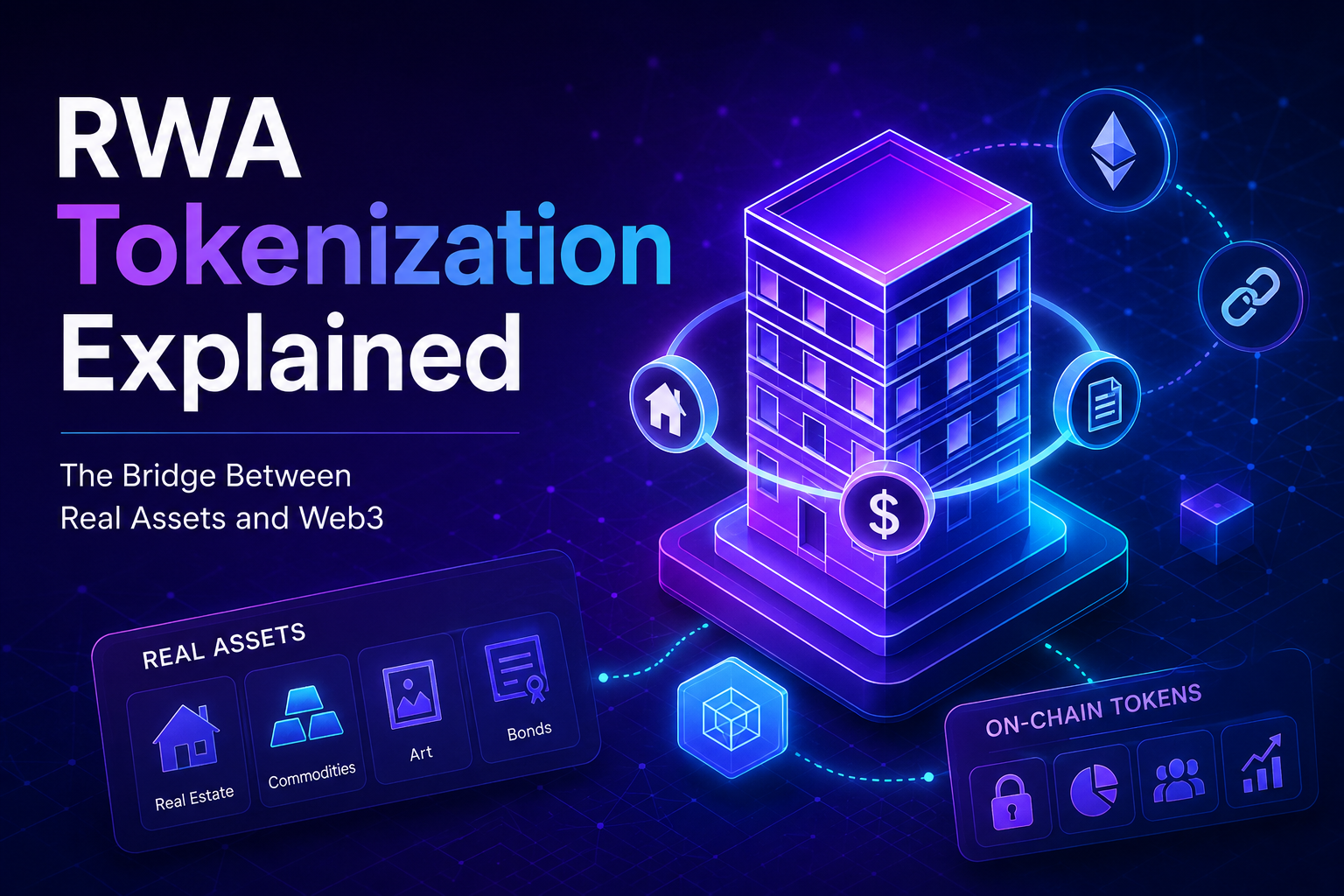

Real World Assets (RWAs) have become one of the fastest-growing sectors in blockchain. While most crypto narratives revolve around speculative tokens and digital assets, RWAs focus on bringing tangible value on-chain through tokenized representations of real financial and physical assets.
However, the conversation around RWAs is often too broad. Many discussions stop at “tokenized real estate” or “on-chain treasury bills” without explaining the deeper infrastructure behind these systems. The real transformation is not simply about putting assets on-chain. It is about changing how ownership, liquidity, yield distribution, and financial accessibility work through programmable blockchain infrastructure.
This is where fractional ownership, automated settlement, and tokenized yield systems are beginning to reshape modern finance.
What Are RWAs?
Real World Assets are physical or traditional financial assets represented digitally on blockchain networks. These assets can include:
- Real estate
- Treasury bills
- Corporate bonds
- Commodities
- Private credit
- Invoice financing
- Fine art
- Infrastructure assets
The blockchain token acts as a digital representation of ownership, exposure, or revenue participation linked to the underlying asset.
Unlike traditional systems that rely heavily on intermediaries and delayed settlement processes, blockchain enables:
- Faster transfers
- Transparent ownership tracking
- Global accessibility
- Fractional participation
- Automated yield distribution
This is why RWAs are increasingly viewed as one of the strongest bridges between traditional finance and decentralized infrastructure.
Why RWAs Are Growing Rapidly
Traditional financial systems still face several limitations:
- Long settlement timelines
- Limited market accessibility
- High entry barriers
- Illiquid ownership structures
- Geographic restrictions
For example, investing in commercial real estate often requires large amounts of capital and complex legal processes. Access to treasury products or private credit markets is also typically restricted to institutions or high-net-worth investors.
Blockchain infrastructure introduces a more efficient model by allowing ownership and value transfer to become programmable. The result is:
- 24/7 market accessibility
- Lower participation barriers
- Faster settlement
- Smaller investment sizes
- Improved transparency
This shift is driving increased institutional and retail interest toward tokenized financial systems.
The Main Types of RWAs
Different categories of RWAs require different infrastructure models and legal frameworks.
1. Tokenized Real Estate
Real estate remains one of the most widely recognized RWA categories. In this model, ownership of a property is digitally represented through blockchain tokens. These tokens may represent:
- Equity ownership
- Revenue participation
- Rental yield rights
There are generally two approaches used in tokenized real estate systems.
Full Ownership Tokenization
A single investor or institution owns the entire tokenized representation of the property. This model is often used for operational efficiency and institutional asset management.
Fractional Real Estate Ownership
The property is divided into smaller token units. For example:
- A $10 million property may be split into 10 million tokens.
- Each token represents partial ownership.
This dramatically lowers participation barriers and allows smaller investors to gain exposure to assets that were previously inaccessible.
2. Treasury Bill RWAs
Treasury-backed RWAs have become one of the fastest-growing sectors in on-chain finance. These systems tokenize exposure to:
- US Treasury Bills
- Government bonds
- Money market instruments
The reason for this growth is simple. Treasury products provide relatively stable yield compared to volatile crypto-native assets. Many DeFi systems previously relied on inflationary token emissions to generate returns. Treasury RWAs introduced a more sustainable alternative through real-world yield generation.
How Treasury Tokenization Works
A regulated entity acquires treasury exposure through traditional financial systems. Blockchain tokens are then issued to represent:
- Ownership exposure
- Yield accrual
- Redemption rights
These tokenized treasury assets can integrate directly into DeFi ecosystems and support yield-bearing stablecoins, institutional treasury management, and on-chain collateral systems. This creates a direct connection between traditional fixed-income markets and decentralized financial infrastructure.
3. Private Credit RWAs
Private credit tokenization is another rapidly growing category. This includes:
- Business loans
- Invoice financing
- Trade financing
- Revenue-backed debt structures
Traditionally, these markets were restricted to institutions and private lenders. Blockchain infrastructure introduces the ability to distribute debt exposure across a broader set of participants.
For example, a large financing agreement can be divided into smaller ownership shares. Investors purchase fractional exposure to the debt, and interest repayments are distributed proportionally. This creates programmable credit markets with improved transparency and broader accessibility.
4. Commodity-Based RWAs
Physical commodities are also increasingly being tokenized. Examples include:
- Gold
- Silver
- Oil reserves
- Agricultural commodities
Gold-backed tokens are among the most common commodity RWAs because they combine physical reserve backing, digital liquidity, and easier transferability. Instead of moving physical bullion, ownership changes occur digitally while reserves remain secured through custodial systems.
Why Fractional Ownership Matters
Fractional ownership is one of the most important innovations within the RWA ecosystem. Traditional real estate is highly illiquid because transactions take time, ownership transfers are complex, and capital requirements are high.
Fractional tokenization changes this structure by enabling:
- Smaller ticket sizes
- Easier transfers
- Secondary market trading
- Greater investor participation
Instead of requiring large amounts of capital, users can participate with significantly smaller allocations while still maintaining exposure to the asset. This creates a more liquid and accessible ownership model compared to traditional systems.
Automated Yield Distribution
Modern RWA systems can also automate revenue distribution. For tokenized real estate, rental income can be distributed through stablecoin payouts, smart contract-based revenue systems, and automated treasury mechanisms.
Rather than waiting for manual quarterly payouts, investors can receive yield programmatically through blockchain infrastructure. This introduces operational efficiency while reducing administrative overhead.
Deep Dive: The Architecture of Tokenized Real Estate
To truly understand how RWAs function, it is helpful to look at a specific asset class in detail. Real estate is the perfect example because it involves physical property, legal compliance, and ongoing revenue generation.
Tokenizing a commercial building is not as simple as minting a token. It requires a carefully structured bridge between off-chain legal systems and on-chain smart contracts. This is typically achieved through the following architectural flow:
- 1. The Legal SPV Formation: A Special Purpose Vehicle (typically an LLC) is created in the real world. This company holds the sole legal deed to the physical property.
- 2. Tokenizing the Equity: Instead of selling shares via a traditional broker, the equity of the LLC is represented by security tokens on a blockchain (like Ethereum or Polygon). Owning a token legally equates to owning a share of the LLC.
- 3. Fractionalizing the Asset: A $5 million property can be split into 50,000 tokens priced at $100 each. This allows retail investors to buy fractions of the building seamlessly.
- 4. Automated Yield via Smart Contracts: Tenants pay their monthly rent in fiat currency to a property manager. This fiat is converted to stablecoins (like USDC) and sent to a Yield Distribution Smart Contract. The contract instantly airdrops the stablecoin yield pro-rata to all wallets holding the property tokens.
Here is a visual representation of how this hybrid infrastructure connects traditional finance to the blockchain ecosystem:
Real
Estate Tokenization Architecture
Layer 1: Off-Chain (Traditional Finance)
Physical Property
Legal SPV (LLC)
Property Manager
Layer 2: The Infrastructure Bridge
Engine
Minting Security Tokens
Data Feed
Verifying Property Valuation
Layer 3: On-Chain Ecosystem
Ownership Ledger
Yield Smart Contract
Fractional Investors
This clear separation of responsibilities guarantees that the physical property is managed professionally off-chain, while the financial ownership and dividend distribution occur with absolute efficiency on-chain.
The Infrastructure Behind RWAs
RWA infrastructure is significantly more complex than standard token issuance. A functional RWA ecosystem usually includes several interconnected layers.
Asset Custody Layer
Responsible for managing or securing the underlying asset.
Legal Framework Layer
Defines ownership rights, compliance obligations, and investor protections.
Tokenization Layer
Creates blockchain representations of the asset.
Smart Contract Layer
Handles transfers, yield distribution, redemption logic, and ownership tracking.
Liquidity Layer
Supports secondary trading and price discovery.
This hybrid architecture combining off-chain legal systems with on-chain execution is becoming the dominant model in RWA infrastructure.
Compliance and Regulatory Infrastructure
Unlike purely crypto-native assets, RWAs interact directly with regulated financial systems. As a result, compliance becomes one of the most important components of the ecosystem. Most RWA platforms include:
- KYC verification
- AML checks
- Jurisdiction restrictions
- Accredited investor controls
The challenge is balancing regulatory compliance, blockchain accessibility, and operational efficiency. Projects that successfully combine all three are likely to lead long-term RWA adoption.
The Rise of Yield-Bearing RWAs
One of the biggest trends in 2025 and 2026 is the emergence of yield-bearing RWA systems. These are not static ownership tokens. Instead, they continuously accrue value through treasury yield, rental revenue, interest repayments, and asset-generated cash flow.
This transforms RWAs into productive on-chain capital rather than passive digital representations. Examples include yield-bearing treasury tokens, revenue-generating real estate assets, and interest-accruing private credit products.
This shift is particularly important because decentralized finance is increasingly moving away from unsustainable token incentives toward real external revenue sources.
RWAs and DeFi Are Beginning to Merge
The future of RWAs is not isolated tokenization. It is composability. RWA assets are increasingly being integrated into:
- Lending protocols
- Stablecoin systems
- Automated yield vaults
- Collateralized borrowing markets
This creates hybrid financial infrastructure where traditional assets interact directly with decentralized execution systems. Over time, tokenized assets may become foundational building blocks for institutional DeFi, global settlement systems, on-chain credit markets, and programmable capital coordination.
The Liquidity Challenge
Despite rapid growth, RWAs still face liquidity limitations. Major challenges include:
- Limited secondary markets
- Regulatory fragmentation
- Custodial dependencies
- Pricing inefficiencies
- Jurisdictional complexity
Liquidity remains one of the biggest obstacles preventing broader RWA adoption. This is why infrastructure providers focusing on settlement systems, compliant tokenization, custody frameworks, and liquidity routing are becoming increasingly important within the ecosystem.
The Future of Programmable Ownership
The long-term impact of RWAs goes beyond digitizing assets. The broader transformation is programmable ownership. Blockchain infrastructure enables real-time settlement, fractional global investing, automated revenue distribution, transparent ownership tracking, and continuous market accessibility.
In the future, ownership of assets may become more liquid, more accessible, more automated, and more globally connected. Rather than relying on fragmented intermediaries and delayed settlement systems, blockchain allows financial coordination to happen programmatically.
Final Thoughts
RWAs are evolving into one of the most important sectors connecting traditional finance with blockchain infrastructure. The real innovation is not simply putting assets on-chain. It is creating programmable financial systems around those assets through:
- Fractional ownership
- Automated yield distribution
- Global accessibility
- Faster settlement
- Composable liquidity systems
As the infrastructure matures, RWAs are likely to become a foundational layer in the next generation of financial markets. Companies such as Blockchain App Factory are among the organizations working on the technical frameworks required for this transition, including tokenization systems, smart contract infrastructure, and blockchain-based asset models designed for scalable real-world adoption.
Build Your RWA Ecosystem Today
Unlock the future of finance with industry-leading tokenization and smart contract infrastructure. Speak to our RWA specialists and start building.