Key Insights
- Crypto growth depends on active participation, not passive followers. Projects with engaged Telegram groups, structured Discord servers, and active X presence see higher token adoption and user retention.
- X builds visibility and attracts new users, Telegram enables fast communication and updates, and Discord strengthens long-term engagement through structured interactions and community roles.
- Short-term tactics like airdrops can drive spikes, but consistent content, real interaction, and strong moderation build trust and long-term community value.
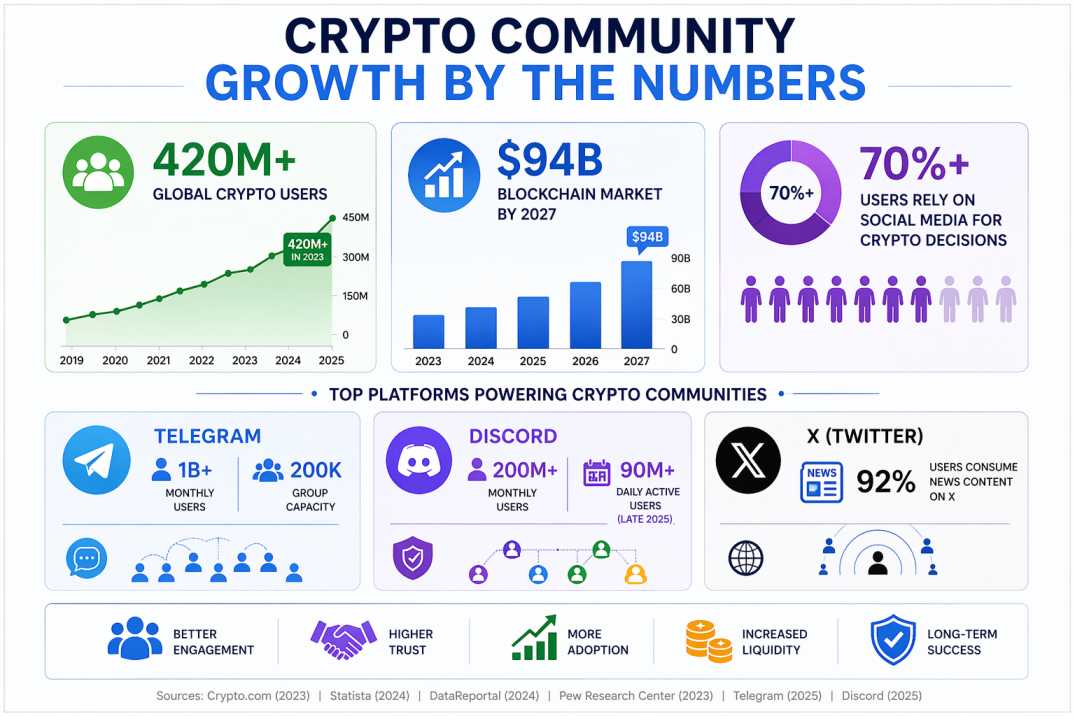
Crypto projects live or die on attention, trust, and repeat participation. A token can launch in hours. A real community takes longer. That gap explains why founders now treat community growth as core go to market work, not a side task for social media managers. The scale of the opportunity is clear. Global crypto users crossed 420 million in recent years, and the blockchain market is projected to reach nearly 94 billion dollars by 2027. At the same time, more than 70 percent of crypto users rely on social platforms to guide decisions. This makes community channels a direct driver of adoption, not just a marketing layer. Telegram, Discord, and X each play a different role in that system. Telegram gives teams direct access to large groups and broadcast channels. Discord gives them structure, gated spaces, and role based moderation. X gives them reach, real time discovery, and public conversation.
Telegram says it passed 1 billion monthly active users in 2025, and its groups can support up to 200,000 members. Discord says it had more than 200 million monthly active users in 2025 and more than 90 million daily active users in late 2025. X remains a strong news and conversation platform, with Pew finding that 92 percent of X users see at least one type of news content there. For crypto brands, those numbers matter less than intent. People open Telegram to follow channels and talk in fast moving groups. They open Discord to join niche servers, earn roles, and stay close to a project over time. They open X to track narratives, founders, token news, and market reaction in public. A business that understands those habits can build a cleaner growth path from first impression to loyal members. That path often starts on X, moves into Telegram for speed, and matures inside Discord for deeper retention.
Crypto Community Stat
Understanding Crypto Community Growth Fundamentals
What Is a Crypto Community?
A crypto community is more than a follower count. It is a network of holders, traders, builders, creators, and curious observers who share attention around a protocol, token, exchange, NFT brand, or infrastructure product. In practical terms, the community becomes a live distribution layer. It spreads launch news, explains product updates, answers peer questions, reports bugs, and shapes public trust. This matters more in crypto than in many other sectors. Most products carry technical risk, price volatility, and a high level of public scrutiny. Users often trust people inside the community before they trust the brand itself.
Why Community-Led Growth Matters in Crypto
Community led growth matters in crypto for another reason. Markets move fast, and the best projects shorten the time between announcement and response. Telegram channels help teams push updates at scale. Discord servers help them segment users into holders, contributors, moderators, and VIP tiers through roles and permissions. X helps them test messaging in public and watch what gains traction. That mix turns the community into a feedback engine and a sales engine at the same time. A DeFi protocol can announce a feature on X, answer short form questions on Telegram, then host deeper product education inside Discord. Each platform handles a different stage of trust building.
Key Metrics for Measuring Success
The strongest teams track a few core metrics instead of chasing raw member counts. Growth in members or followers still matters, but engagement matters more. On Telegram, teams should track active discussion, post views, reply volume, and admin response time. Telegram’s ad platform says public broadcast channels generate 1 trillion views per month, which shows how much passive attention flows through the app. On Discord, teams should watch active users by channel, event participation, retention by role, and moderation workload. On X, they should track impressions, reposts, replies, profile visits, Spaces attendance, and traffic into owned channels. A small community that asks good questions and joins product calls often creates more business value than a huge group filled with bots and bounty hunters.
Want to grow a powerful crypto community across platforms?
Build, engage, and scale your crypto community across Telegram, Discord, and X effectively.

Platform Overview – Telegram vs Discord vs X
Telegram for Crypto Communities
Telegram works best for speed and scale. Crypto teams use it for launch alerts, market commentary, AMA reminders, and direct group chat. Public channel posts carry shareable links, and Telegram groups can hold up to 200,000 members. Bots add another layer. Telegram says bots can handle commands, buttons, custom keyboards, and many other interface actions. That makes Telegram useful for onboarding, moderation, support routing, and campaign mechanics such as quizzes or gated announcements. The tradeoff is noise. Large Telegram groups move fast, and low quality discussion can bury real questions within minutes.
Discord for Structured Engagement
Discord suits projects that need order. A good server can separate announcements, support, governance chat, regional groups, partner rooms, and token gated sections. Roles and permissions let teams decide who can post, who can moderate, and which groups can access private channels. Discord’s own support material shows how deeply admins can control server and channel access. That structure helps projects keep serious members close and reduce chaos as the user base grows. It fits NFT brands, gaming communities, and developer ecosystems that need long term engagement, not just fast chat.
X for Visibility and Viral Growth
X serves a different purpose. It is the public square for crypto. Narratives form there first, then spread. Communities on X give brands a dedicated place for topic based discussion, and Spaces add live audio for launches, debates, and founder Q and As. Pew’s research shows that X users encounter breaking news, opinion, and current event content at very high rates. That makes X a powerful channel for discovery and credibility, but a weak home base for retention on its own. Smart teams use X to earn attention, then move people into Telegram and Discord, where the relationship becomes closer and more durable.
Step-by-Step Framework to Build a Crypto Community from Scratch
A crypto community rarely grows from one viral post. It grows from a clear promise, a clean channel setup, and steady contact with users. Teams that start with hype often attract short term traffic and little trust. Teams that start with a sharp market position build better retention. Telegram, Discord, and X each support that process in different ways. Telegram groups support up to 200,000 members, and Telegram bots can handle commands, buttons, and automated flows. Discord gives teams deep role and permission controls. That makes it useful for support, gated access, and long term member management.
Step 1: Define Your Target Audience & Value Proposition
The first step is audience definition. A meme coin group, a DeFi protocol, and a crypto wallet do not need the same members. Founders should name the first user set in plain terms. That could be active traders, yield farmers, gaming users, or developers. Then they should write a simple value statement. It should answer one question: why should this person join and stay? Good answers sound concrete. “Live token updates and fast support” works. “A strong community for Web3 growth” says little. Clear positioning shapes channel tone, post style, partner choices, and moderation rules.
Step 2: Set Up and Optimize Your Channels
Channel setup comes next. On Telegram, teams should separate broadcast and chat. A read only channel keeps product news clean. A linked group gives members a place to react and ask questions. Bots can welcome users, share FAQs, filter spam, and route support. On Discord, structure matters from day one. Projects should create a few clear channels, set role permissions, and gate private rooms for contributors, holders, or partners. Discord’s own guidance shows how role hierarchy and admin rights control posting power and moderation reach. On X, the profile should state the project category, core value, official links, and posting rhythm in plain language. That page is often the first trust check for new users.
Step 3: Content Strategy for Community Growth
Content drives the next stage. Many crypto teams post only launches, charts, and price talk. That draws speculators, then they leave. Better communities mix education, proof, and interaction. Education explains the product in plain words. Proof shows shipping progress, usage numbers, audits, or partner wins. Interaction invites replies, polls, and live questions. A wallet team can post short security threads on X, pin setup guides in Telegram, and host weekly office hours on Discord. That mix builds trust and cuts support load at the same time. Content should repeat core messages often. Most members miss the first post.
Step 4: Growth Hacking Tactics
Growth tactics work best after that base is in place. Referral drives, trading contests, ambassador programs, and quest campaigns can bring fast traffic. But poor targeting fills channels with bounty hunters and fake accounts. The best teams tie rewards to actions that show real interest. Good examples include wallet connection, event attendance, feedback forms, or testnet tasks. KOL and influencer campaigns can add reach, especially on X, where crypto narratives move fast. Yet paid endorsements need clear disclosure. The US Federal Trade Commission states that material ties between brands and endorsers must be clear and easy to notice. That rule matters for token launches, airdrop promotions, and paid review threads.
Step 5: Community Engagement & Retention
Retention decides whether growth lasts. Users stay when the team replies, ships product updates, and gives members a real role in the group. Discord works well for layered retention. Teams can assign roles for early adopters, top contributors, beta testers, and local moderators. Telegram works well for fast pulse checks, quick AMA sessions, and urgent updates. X keeps the wider market loop alive through threads, replies, and Spaces. A simple weekly system often works best: one product update, one live session, one user spotlight, and one post that asks for feedback.
Advanced Growth Strategies for Scaling Crypto Communities
Leveraging Bots and Automation
Automation becomes more useful as volume rises. Telegram bots can greet users, answer common questions, filter links, and push event reminders. Discord bots can assign roles, track engagement, and manage tickets. Automation saves time, but it should not replace human presence. Members spot canned replies fast. Good automation handles repeat tasks. Human moderators handle trust.
Influencer & KOL Marketing in Crypto
KOL marketing still drives crypto attention, especially on X. The strong campaigns pair reach with fit. A creator with 20,000 active followers in DeFi often beats a larger account with weak comment quality. Teams should check reply depth, past sponsor work, and audience overlap before signing deals. Real traction shows up in profile visits, group joins, and post save rates, not just views.
Paid Advertising & Performance Marketing
Paid media can support launches and retarget warm users. Search ads work for branded terms, wallets, exchanges, and educational pages. But crypto ad rules are strict. Google updated its cryptocurrency products policy in February 2026 and tied some ad access to certification and local rules. Teams should review country limits before they set budgets.
SEO & Content Marketing for Web3 Projects
Search content helps crypto brands reach users who are still learning. Articles, glossaries, product pages, and comparison posts bring high intent traffic that social posts often miss. This channel works well for exchanges, wallets, analytics tools, and B2B blockchain firms. A clear article can rank for months and keep sending leads into owned channels.
Community Operations and Management
Strong crypto communities need clear operations. Growth creates pressure fast. A Telegram group can hold up to 200,000 members, so one busy token launch can turn chat into noise within minutes. Telegram supports replies, mentions, hashtags, and admin tools to help large groups stay organized. That scale makes planning a business need, not a nice extra.
Moderator Roles and Responsibilities
Moderators protect the quality of the group. They remove spam, answer common questions, guide new users, and watch for scams. In crypto, this work carries extra weight. Fake links, impersonation, and phishing attempts can damage trust in one day.
A good moderation team should cover four core roles:
- Chat moderators for spam control and rule checks
- Support moderators for product questions
- Security moderators for scam alerts and fake links
- Community leads for events, feedback, and reporting
Each role needs clear limits. Not every moderator should access admin rights. Discord warns that Administrator permission grants all permissions and bypasses channel restrictions. Crypto teams should give that access only to trusted senior staff.
Community Guidelines and Response Standards
Rules work best when they are short and visible. Members should know what counts as spam, price manipulation, hate speech, fake support, and phishing. The rules should sit in pinned Telegram posts, Discord welcome channels, and X community descriptions.
Response standards matter just as much. A crypto community often becomes the first support desk for new users. A slow reply can look like neglect. A rushed answer can create confusion. Teams should create reply templates for wallet setup, token claims, roadmap questions, partnership claims, and scam warnings. These templates should sound human, not robotic.
One practical rule helps: answer public questions in public, then move private account cases to a ticket or verified support channel. This gives other members useful answers and reduces repeat questions.
Weekly Activity Planning
A healthy crypto community needs a steady rhythm. Random posting creates random engagement. Weekly planning gives members a reason to return.
A basic weekly plan can include:
- Monday: product update or roadmap note
- Tuesday: educational post or short guide
- Wednesday: Telegram AMA or Discord office hour
- Thursday: poll, quiz, or feedback request
- Friday: recap, user spotlight, or partner update
This rhythm keeps the group active without flooding members. It also helps internal teams plan content, moderation shifts, and campaign pushes. For example, a DeFi protocol can use Monday for liquidity updates, Wednesday for risk education, and Friday for governance discussion.
Reporting and Performance Tracking
Community teams need numbers. Member count alone gives a weak picture. A group with 50,000 members and 30 active speakers has less value than a group with 5,000 members and 500 real daily users.
Teams should track active users, message volume, response time, event attendance, link clicks, support cases, and conversion from X to Telegram or Discord. Reports should connect activity to business goals. Did a product AMA increase wallet signups? Did a Discord event bring testnet users? Did a Telegram post reduce support tickets?
Clear reporting helps founders judge budget, staffing, and campaign quality. It turns community work into a measurable growth channel.
Best Tools for Crypto Community Management
Tools do not replace human judgment. They remove repeat work, flag risks, and help teams act faster. Telegram, Discord, analytics platforms, and CRM systems each serve a different role.
Telegram Bots for Moderation and Automation
Telegram bots help large groups stay readable. The official Bot API supports commands, messages, buttons, and interactive flows. Teams can use bots to welcome users, share FAQs, block banned words, filter links, and collect support requests.
Crypto teams often use Telegram bots for token launch alerts, KYC reminders, wallet safety tips, and campaign registration. The best setup keeps automation simple. A welcome bot should guide users to official links, rules, and support channels. A moderation bot should remove spam before members see it.
Discord Bots for Roles and Engagement
Discord works well for structured communities. Roles and permissions let teams create rooms for holders, developers, ambassadors, partners, and moderators. Discord’s role system gives admins control over who can post, manage channels, mention groups, or access private spaces.
AutoMod adds another layer. Discord describes AutoMod as a set of content filters that can block harmful words, spam, and unsafe links before messages appear. This helps crypto servers reduce raids and scam links during busy launches.
Analytics Tools for Community Data
Analytics tools show what members do after they join. Telegram analytics can track post views, growth, and engagement. Discord analytics can show active channels, event turnout, and role activity. X analytics can show impressions, replies, reposts, profile visits, and link clicks.
The best reports compare channels. X often creates discovery. Telegram handles fast updates. Discord supports deeper retention. A clean dashboard should show how people move across that path.
CRM and Campaign Tracking Tools
A crypto community becomes more valuable when teams connect it to sales, partnerships, and investor interest. CRM tools help track leads from AMAs, demo requests, ambassador forms, and enterprise conversations. Campaign tracking links social content to real actions, such as signups, wallet connections, or waitlist entries.
This gives decision-makers a clearer view of spend and return. Community management then moves from daily chat work to structured growth operations. That shift separates serious crypto brands from short-term hype projects.
Ready to scale your Telegram, Discord, and X presence?
Conclusion
Crypto community growth has become a commercial function with direct impact on adoption, liquidity, retention, and brand trust. Teams that treat Telegram, Discord, and X as connected parts of one system will outperform teams that chase reach alone. The next phase will bring more AI support, stronger identity checks, and rising interest in decentralized social platforms. The brands that win will build clear communication habits now, then turn community into a durable business asset.
For businesses that want to accelerate this process, working with experienced partners can reduce trial and error. Blockchain App Factory supports crypto projects with community growth strategies, platform management, and campaign execution across Telegram, Discord, and X. With the right mix of strategy, execution, and ongoing engagement, companies can build communities that drive real and measurable business results.

Vimal J is the Head of Sales at Blockchain App Factory, with 10+ years of experience in sales, client strategy, and Web3 business growth. He helps startups, enterprises, and project founders choose the right blockchain solutions for their goals, bringing a practical market perspective to topics like token development, crypto launches, and Web3 adoption.