Key Insights
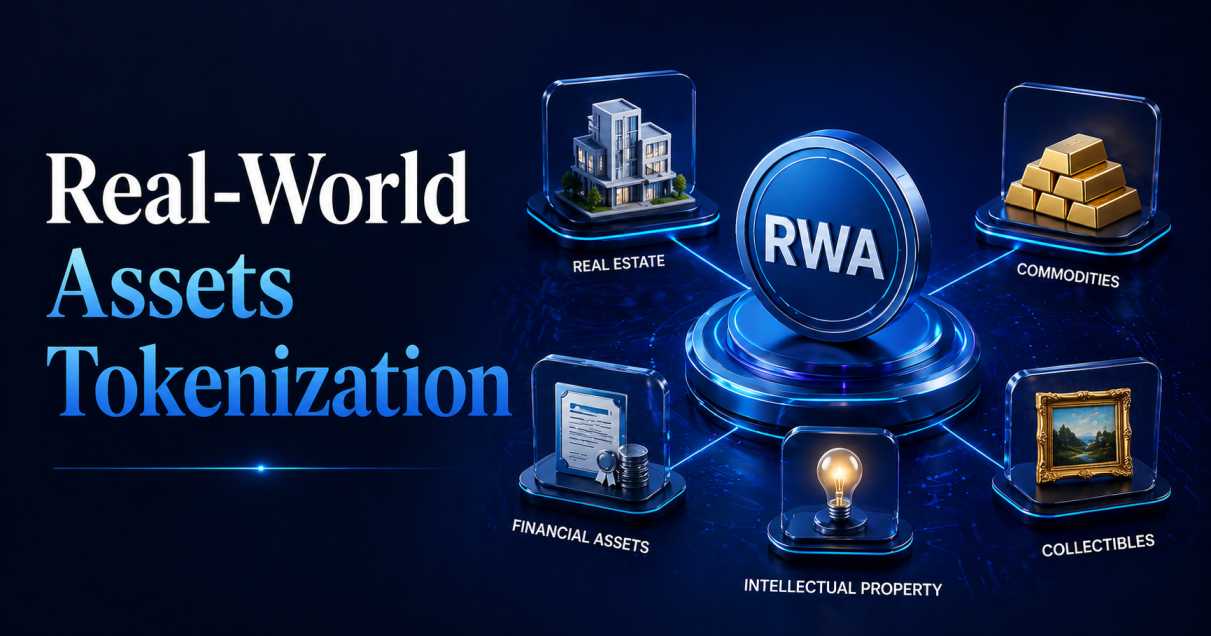
- Physical and traditional assets like real estate, art, commodities, carbon credits, and IP rights can now be converted into blockchain-based tokens, making them divisible, programmable, and globally accessible.
- Tokenization helps unlock value from illiquid assets, reduce intermediaries and transaction fees, enable faster settlement, and attract investors from global markets.
- Effective RWA tokenization requires secure smart contracts, reliable custody, regulatory compliance, investor protection, and careful asset structuring.
The traditional boundaries of asset ownership are dissolving. A $2.8 million Basquiat painting sold as fractional NFTs. Commercial real estate properties divided into thousands of tradeable tokens. Even carbon credits and intellectual property rights transformed into digital assets that trade around the clock across global markets.
This isn’t speculation about the future it’s happening now. Real-world asset (RWA) tokenization has emerged as one of blockchain’s most practical applications, with the market projected to reach $16.1 trillion by 2030. Unlike speculative crypto projects, RWA tokenization tackles real inefficiencies in how we buy, sell, and own valuable assets.
The shift goes beyond technological innovation. It’s a complete reimagining of ownership itself, where physical and digital assets become programmable, divisible, and globally accessible. For businesses, this unlocks liquidity, cuts costs, and opens new markets. But it also requires careful navigation of complex technical, legal, and regulatory landscapes.
What Is Real-World Asset Tokenization?
Real-world asset tokenization transforms physical or traditional financial assets into digital tokens on a blockchain. Each token represents a verifiable claim to a portion of the underlying asset whether that’s a share of commercial real estate, a fraction of fine art, or rights to future cash flows from commodities.
The process works through smart contracts that establish the legal and technical framework connecting the physical asset to its digital representation. When someone purchases tokens, they acquire legally recognized rights to the underlying asset proportional to their token holdings.
The Technical Foundation
Modern RWA tokenization relies on several key blockchain technologies working together:
Smart contracts automate the complex legal and financial relationships between token holders and assets. Dividend distributions and voting rights happen automatically through code no human intervention needed. Oracles bridge the gap between blockchain networks and the real world, delivering verified asset prices, performance data, and market events that affect token values. Custody solutions handle the physical side while blockchain tracks digital ownership. Think of it as a partnership: professional custodians store and maintain the actual assets while smart contracts handle who owns what shares. Compliance protocols work behind the scenes in smart contracts, automatically checking investor credentials, enforcing transfer rules, and handling regulatory reporting without manual oversight.
The Current Landscape: Where RWA Tokenization Is Making Impact
Real Estate: Democratizing Property Investment
Real estate tokenization has gained the most traction, addressing the sector’s notorious illiquidity and high barriers to entry. Traditional real estate investments often require substantial capital and lengthy transaction processes. Tokenization changes this entirely.
Take a $50 million commercial office building in Manhattan. Through tokenization, this property can be divided into 50 million tokens, each representing $1 of ownership. Investors can purchase tokens starting at $100, gaining exposure to premium real estate that was previously accessible only to institutional investors.
The benefits extend beyond accessibility. Property tokens can trade on secondary markets, providing liquidity that traditional real estate lacks. Rental income distributes automatically to token holders through smart contracts. Property management becomes more transparent, with all transactions and decisions recorded on the blockchain.
Several platforms have demonstrated real-world success. RealT has tokenized over $75 million in U.S. rental properties, allowing global investors to earn rental yields from Detroit and Cleveland properties. In Europe, platforms like Fundament Group have tokenized luxury real estate across multiple countries.
Art and Collectibles: Fractional Ownership of Cultural Assets
The art market, traditionally dominated by wealthy collectors and institutions, is opening to broader participation through tokenization. High-value artworks, rare collectibles, and cultural artifacts can now be owned collectively by thousands of investors.
Masterworks pioneered this approach by purchasing blue-chip artworks and offering shares to investors. The platform has demonstrated that fractional art ownership can generate substantial returns while making cultural assets accessible to everyday investors.
The model extends beyond investment returns. Token holders often receive additional benefits like museum loan fees, exhibition revenues, and voting rights on major decisions about the artwork’s future.
Commodities and Natural Resources
Tokenization is reshaping commodity trading and investment. Gold, silver, oil, and agricultural products become digital assets that trade more efficiently than their physical counterparts.
Consider gold tokenization. Rather than buying physical gold and wrestling with storage, insurance, and verification headaches, investors buy tokens backed by gold reserves in secure vaults. Each token represents a specific amount of gold, redeemable for physical delivery when needed.
This eliminates traditional commodity trading friction. Transactions settle instantly instead of taking days. Fractional ownership opens doors for smaller investments. Global accessibility removes geographical barriers.
Financial Instruments and Securities
Traditional financial instruments are getting a blockchain makeover. Corporate bonds, business loans, insurance policies, and future cash flows transform into tradeable digital assets.
Consider invoice tokenization businesses sell their accounts receivable as tokens, getting immediate cash instead of waiting months for customer payments. Supply chain financing improves when backed by tokenized assets that offer transparent, real-time value tracking.
Private equity and venture capital firms are testing tokenization to give limited partners more liquidity. Instead of waiting years for exit events, investors might trade their positions in secondary markets.
The Business Case: Why Companies Are Embracing RWA Tokenization
Unlocking Trapped Liquidity
Many valuable assets sit locked up for years before owners can access their value. Real estate deals drag on for months, private equity investments stay frozen until exit events, and fine art pieces gather dust in storage. Tokenization changes this by creating active secondary markets where fractional ownership can trade freely.
When assets become more liquid, their values often increase. Studies show tokenized real estate can sell for 10-20% more than traditional ownership structures investors will pay extra for the ability to exit when they want.
Reducing Transaction Costs
Traditional asset sales involve armies of middlemen: brokers who find buyers, lawyers who draft contracts, banks that handle financing, clearinghouses that settle trades, and regulators who oversee everything. Smart contracts can automate much of this work while maintaining security and compliance. Transactions that once took weeks now complete in minutes. Real estate deals that typically cost 3-6% in fees and commissions can finish for under 1% through tokenization a massive difference for large transactions.
Global Market Access
Geography once created investment barriers. That prime Tokyo office building stayed out of reach for most American investors due to complex international legal structures and currency complications. Tokenization breaks down these walls. The same Tokyo property now attracts capital from New York, London, and São Paulo just as easily as local investors. Asset owners access global demand while investors build diversified portfolios across continents.
Enhanced Transparency and Compliance
Blockchain creates permanent records of every transaction, ownership change, and asset update. This audit trail makes fraud extremely difficult while simplifying regulatory reporting. Smart contracts enforce compliance automatically ensuring only qualified investors buy certain tokens and all required disclosures happen on schedule. Companies spend less on compliance while providing better investor protection.
Learn how real-world assets are becoming digitally tradable
Understand how blockchain enables seamless trading of real-world assets globally.

Technical Implementation: Building RWA Tokenization Solutions
Choosing the Right Blockchain Platform
Different blockchain networks offer distinct advantages for RWA tokenization:
Ethereum delivers the most developed ecosystem with extensive DeFi integration possibilities. Yet high gas fees can make smaller transactions uneconomical.
Polygon offers Ethereum compatibility but with much cheaper transactions and faster processing speeds perfect for platforms handling frequent trades or smaller investment amounts. Avalanche handles heavy transaction loads while letting you create specialized subnets designed for particular asset types or regulatory requirements. Hyperledger Fabric works best for enterprises that need private networks with granular privacy controls. The right choice depends on how many transactions you expect, what regulations you need to follow, how you’ll integrate with existing systems, and your budget.
Smart Contract Architecture
Effective RWA tokenization requires sophisticated smart contract design that addresses multiple requirements:
Asset representation contracts define the relationship between tokens and underlying assets, including ownership rights, revenue distribution mechanisms, and governance structures.
Compliance contracts enforce regulatory requirements automatically, including investor accreditation, transfer restrictions, and reporting obligations.
Oracle integration contracts connect blockchain networks to real-world data sources, enabling automatic responses to external events affecting the tokenized assets.
Governance contracts enable token holders to participate in decisions about the underlying assets while maintaining appropriate legal structures.
Legal and Regulatory Framework
Successful RWA tokenization requires careful legal structuring to ensure tokens represent legally enforceable rights to underlying assets. This typically involves:
Special purpose vehicles (SPVs) that hold the physical assets while issuing tokens that represent beneficial ownership interests.
Custody agreements that ensure professional management and security of underlying assets.
Regulatory compliance with securities laws, anti-money laundering requirements, and other applicable regulations in relevant jurisdictions.
Investor protection measures including appropriate disclosures, accreditation requirements, and dispute resolution mechanisms.
Overcoming Implementation Challenges
Regulatory Complexity
RWA tokenization sits where traditional finance meets securities law and cutting-edge technology regulation. Each country handles digital assets differently, which creates headaches for projects that want to operate globally.
The most successful projects partner with legal teams who really understand both traditional asset classes and blockchain tech. Many start in crypto-friendly jurisdictions before tackling more complicated markets.
The regulatory picture is getting clearer though. The EU’s Markets in Crypto-Assets (MiCA) regulation gives much better guidance for asset tokenization. Singapore, Switzerland, and other forward-thinking jurisdictions have built comprehensive frameworks for digital assets.
Technical Integration
Connecting blockchain networks to traditional financial and legal systems requires sophisticated technical integration. Legacy systems often lack APIs or data formats compatible with blockchain networks.
Most successful projects take a hybrid approach they keep existing legal structures but layer blockchain-based ownership tracking and transfers on top. This lets them migrate gradually without breaking what already works.
Market Adoption and Liquidity
Building liquid secondary markets for tokenized assets creates a classic catch-22. You need trading volume to attract market makers, but market makers create trading volume. New projects often struggle with thin markets that undermine tokenization’s main benefits.
Smart platforms focus on network effects they attract premium assets that generate strong investor interest, then use that success to bring in more asset owners. In the early days, quality beats quantity every time.
Valuation and Price Discovery
Pricing unique assets like real estate or artwork is tricky even in traditional markets. With tokenization, you also need to account for liquidity premiums and other tokenization benefits that standard appraisals might miss.
Leading platforms blend traditional valuation approaches with real-time market data from token trading. They use multiple valuation sources and update prices regularly based on market activity and asset performance.
Industry Applications and Use Cases
Healthcare and Biotechnology
Pharmaceutical companies are exploring tokenization of drug development programs, allowing investors to purchase tokens representing rights to future revenues from specific medications. This provides alternative funding for expensive research and development while giving investors exposure to biotech innovation.
Expensive medical equipment like MRI machines and surgical robots can now be owned fractionally through tokenization. Healthcare providers get access to cutting-edge technology without massive upfront investments.
Energy and Utilities
Renewable energy projects are turning to tokenization for both funding and operations. Solar farms, wind installations, and other clean energy infrastructure can be collectively owned and invested in through tokens.
These energy tokens often represent rights to future power production, creating fresh approaches to energy trading and investment. Local communities can invest in nearby renewable projects and earn energy credits or revenue shares based on actual power generation.
Intellectual Property
Patents, trademarks, copyrights, and other IP assets are becoming investment opportunities through tokenization. Tech companies can raise capital by tokenizing patent portfolios while maintaining operational control. In entertainment, tokenization opens up music royalties, film revenue rights, and creative assets to wider investment. Artists get funding upfront while fans can invest directly in projects they believe in.
Supply Chain and Trade Finance
Tokenization is transforming supply chain financing by creating digital representations of goods in transit, warehouse receipts, and other trade-related assets. This improves transparency and reduces financing costs for international trade.
Commodity traders use tokenization to create more efficient markets for agricultural products, metals, and other raw materials. Tokens representing specific commodity lots enable better price discovery and risk management.
The Future of Asset Ownership
Integration with DeFi Ecosystems
RWA tokens are increasingly integrated with decentralized finance (DeFi) protocols, enabling new financial products and services. Token holders can use their assets as collateral for loans, participate in yield farming, or access other DeFi services.
This integration creates powerful network effects where tokenized assets become more valuable due to their utility within broader DeFi ecosystems. Real estate tokens might generate rental income while simultaneously earning yields through DeFi protocols.
Cross-Chain Interoperability
Future RWA tokenization platforms will likely operate across multiple blockchain networks, allowing tokens to move freely between different ecosystems. This interoperability will increase liquidity and expand market access.
Layer 2 solutions and blockchain bridges are already enabling cross-chain RWA trading, reducing costs while maintaining security and decentralization benefits.
Artificial Intelligence and Automation
AI will enhance RWA tokenization through automated valuation, risk assessment, and portfolio management. Machine learning algorithms can crunch market data, track asset performance, and analyze external factors to improve token pricing and investment strategies. Smart contracts are getting smarter too they’ll automatically adjust terms when market conditions change or asset performance shifts.
Regulatory Evolution
As RWA tokenization expands, regulatory frameworks are becoming more standardized and business-friendly. Clearer rules will reduce compliance costs while boosting investor protection and market confidence.
International coordination between regulators will enable more seamless cross-border tokenization projects, expanding market opportunities for both asset owners and investors.
Getting Started with RWA Tokenization
Assessment and Planning
Companies considering RWA tokenization should begin with thorough assessment of their assets, objectives, and constraints. Key considerations include:
Asset suitability: Not all assets benefit equally from tokenization. High-value, illiquid assets with stable cash flows often make the best candidates.
Regulatory environment: Understanding applicable regulations in target markets is crucial for successful implementation.
Technical requirements: Assessing existing systems and integration needs helps determine the appropriate technical approach.
Market demand: Evaluating potential investor interest and market size helps validate the business case.
Building the Right Team
Successful RWA tokenization requires expertise across multiple domains:
Blockchain developers with experience in smart contract development and security best practices.
Legal experts familiar with securities law, asset tokenization, and regulatory compliance in relevant jurisdictions.
Financial professionals who understand asset valuation, market making, and investment management.
Compliance specialists who can ensure ongoing regulatory adherence and investor protection.
Implementation Strategy
Most successful projects follow a phased approach:
Pilot phase with a single, high-quality asset to prove the concept and refine processes.
Limited expansion to additional similar assets while building market presence and investor base.
Platform scaling to handle multiple asset classes and larger transaction volumes.
Ecosystem development including secondary market integration and additional services.
Conclusion
Real-world asset tokenization marks a fundamental shift in how we approach ownership, investment, and value transfer. By merging blockchain’s efficiency and transparency with the stability and familiarity of traditional assets, RWA tokenization opens new doors for both asset owners and investors.
The technology has progressed from experimental concepts to real-world implementations that generate measurable value. From fractional real estate ownership to tokenized commodities and intellectual property, applications continue expanding as technical capabilities advance and regulatory frameworks mature.
Success in RWA tokenization requires careful attention to legal structures, regulatory compliance, and technical implementation. Companies that approach these challenges systematically while focusing on genuine value creation are positioning themselves at the forefront of a transformation that will reshape global asset markets.
The opportunity is significant, but so is the complexity. Organizations considering RWA tokenization benefit from working with experienced partners who understand both the technical possibilities and practical requirements of bringing traditional assets onto blockchain networks. Ready to explore how blockchain technology can transform your asset portfolio? Learn more about comprehensive tokenization solutions at www.blockchainappfactory.com.

Vimal J is the Head of Sales at Blockchain App Factory, with 10+ years of experience in sales, client strategy, and Web3 business growth. He helps startups, enterprises, and project founders choose the right blockchain solutions for their goals, bringing a practical market perspective to topics like token development, crypto launches, and Web3 adoption.