Key Insights
- Global crypto rules in 2026 demand stronger KYC and AML checks.
- Compliance systems help Web3 projects gain investor and user trust.
- AI tools and blockchain monitoring now drive faster risk detection.
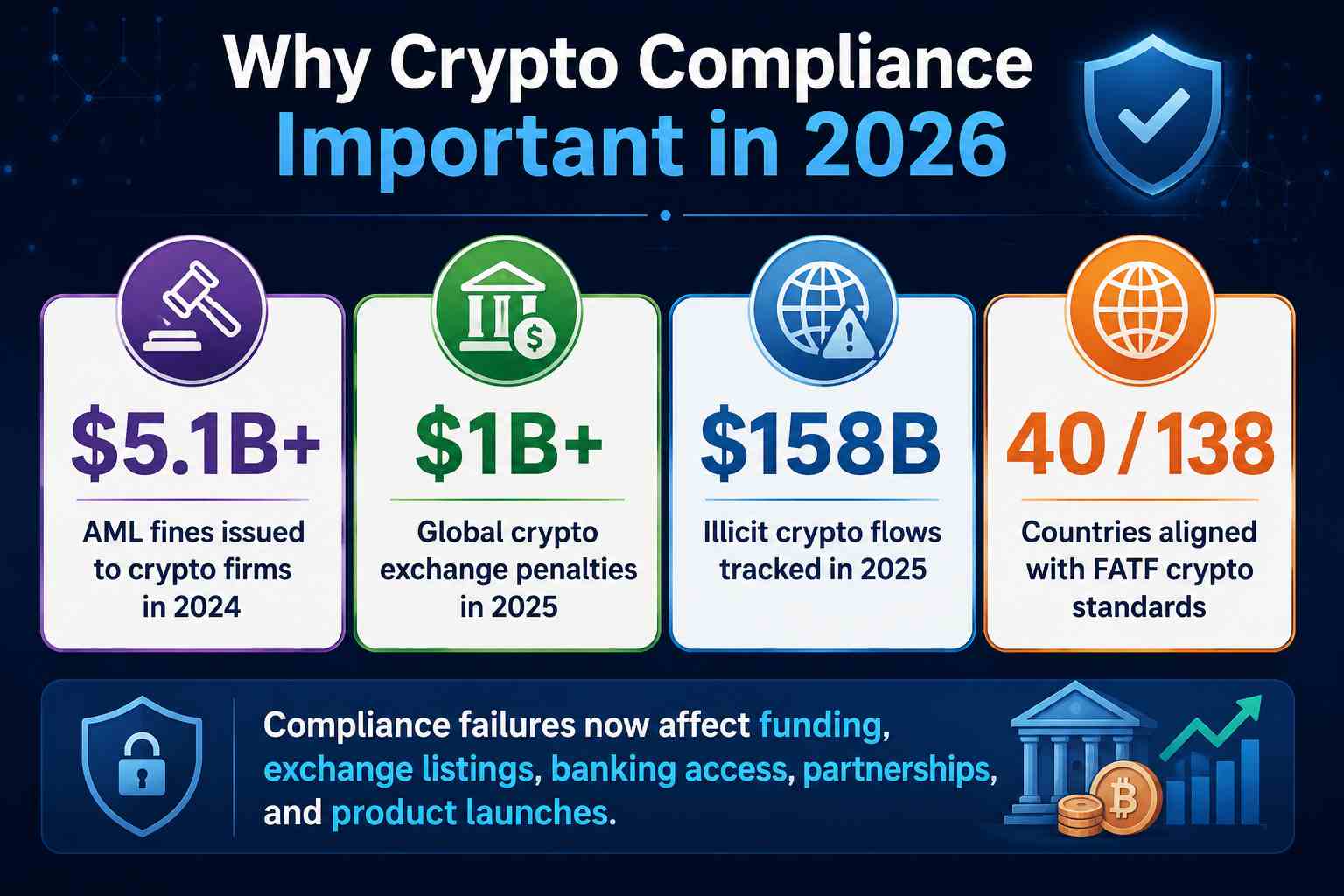
Crypto compliance is no longer optional. In 2024 alone, crypto firms faced more than $5.1 billion in AML fines for weak compliance controls. Global exchange penalties crossed $1 billion in 2025, and regulators across the US, EU, and Asia-Pacific continue to tighten enforcement.
In 2026, blockchain compliance is a launch requirement, not an afterthought. Founders who ignore KYC, AML, and reporting rules are not just facing legal pressure. They are risking investor confidence, banking access, exchange listings, and long-term growth.
If you are building a DeFi platform, launching a token, or tokenizing real-world assets, you need a clear regulatory structure before your first smart contract goes live. This guide breaks down the jurisdictions that matter, the compliance rules by sector, and the steps needed to protect your project without slowing development.
The Major Regulatory Jurisdictions You Need to Know
Web3 is global by default. That means your project may fall under the rules of multiple jurisdictions simultaneously, even if your team is in one country. Here is where the most consequential regulatory activity is happening in 2026.
United States
The US regulatory picture is more defined than it was two years ago. The SEC continues to treat most tokens as securities unless they clearly meet the criteria for commodity classification. The CFTC has expanded oversight of crypto derivatives and spot markets. Key frameworks to understand:
- Securities classification: If your token offers profit expectations tied to the efforts of others, it likely qualifies as a security under the Howey Test. This triggers registration or exemption requirements.
- Money transmission laws: Platforms that move funds between parties may need state-level money transmitter licenses, plus FinCEN registration at the federal level.
- Bank Secrecy Act (BSA): Crypto businesses operating as money services businesses (MSBs) must implement AML programs, file suspicious activity reports (SARs), and maintain transaction records.
The practical takeaway: if you are launching to US participants, get a securities law opinion before your token goes public. This is not optional.
European Union
The EU’s Markets in Crypto-Assets (MiCA) regulation is now fully in force across member states in 2026. MiCA creates a unified licensing regime for crypto-asset service providers (CASPs) and issuers of asset-referenced tokens and e-money tokens. What this means for your project:
- CASP licensing: Exchanges, custodians, and portfolio managers serving EU residents need authorization from a national competent authority.
- Whitepaper requirements: Token issuers must publish a compliant whitepaper with specific disclosures before any public offering.
- Stablecoin rules: Asset-referenced tokens face reserve requirements, redemption rights, and transaction volume caps.
MiCA also introduces liability for misleading marketing something that affects how you structure your community campaigns and token launch communications.
UAE and Singapore
Both jurisdictions have positioned themselves as crypto-friendly, but that does not mean unregulated.
UAE: The Virtual Assets Regulatory Authority (VARA) in Dubai and the Financial Services Regulatory Authority (FSRA) in Abu Dhabi’s ADGM both require licensing for virtual asset service providers. VARA’s framework covers exchange, broker-dealer, lending, and management activities.
Singapore: The Monetary Authority of Singapore (MAS) regulates digital payment token services under the Payment Services Act. Businesses need a Major Payment Institution (MPI) license to provide exchange or custodial services at scale. MAS has also issued guidance on DeFi that signals closer scrutiny of protocol governance.
If you are targeting these markets, licensing timelines can run six to twelve months. Plan accordingly.
KYC and AML Requirements for Web3 Projects
Know Your Customer (KYC) and Anti-Money Laundering (AML) requirements apply to most Web3 businesses that handle customer funds or facilitate value transfer. The specific obligations depend on your jurisdiction and business model, but the baseline is consistent across major markets.
What a compliant KYC/AML program includes:
- Customer identification: Collect and verify identity documents for all clients above transaction thresholds. For higher-risk clients, enhanced due diligence (EDD) applies.
- Transaction monitoring: Automated systems that flag unusual patterns large transfers, rapid cycling, transactions linked to sanctioned addresses.
- Sanctions screening: Check all clients and counterparties against OFAC, EU, and UN sanctions lists before onboarding.
- Suspicious activity reporting: File SARs or equivalent reports with the relevant financial intelligence unit when you identify potential money laundering.
- Record keeping: Maintain transaction and identity records for a minimum of five years in most jurisdictions.
For DeFi protocols, the picture is more complex. Fully decentralized protocols with no controlling entity have argued they fall outside traditional AML frameworks. Regulators in the US and EU are increasingly skeptical of that argument, particularly when a team controls protocol upgrades or fee collection.
The safe approach: design your protocol with compliance optionality. Build KYC gating into your front-end interface, even if the underlying smart contracts are permissionless. This gives you a defensible position if regulators come calling.
Compliance by Blockchain Vertical
Different product types carry different regulatory profiles. Here is a practical breakdown.
DeFi Platforms
DeFi is the most actively scrutinized vertical in 2026. Regulators are focusing on:
- Lending and borrowing protocols that resemble banking activity
- DEXs that facilitate trading of securities-adjacent tokens
- Yield products that may qualify as investment contracts
Your compliance priorities: legal opinion on token and protocol classification, front-end KYC for regulated markets, smart contract audit documentation, and a governance structure that demonstrates decentralization where you are claiming it.
Token Launches
Token launches face the most immediate legal exposure. Before you launch:
- Get a securities law opinion from counsel in each target jurisdiction
- Prepare a MiCA-compliant whitepaper if you are targeting EU participants
- Implement KYC for token sale participants
- Restrict access from jurisdictions where you have not obtained clearance (commonly the US, if you are not registered)
- Document your tokenomics and utility clearly vague utility claims do not protect you from securities classification
Airdrop and staking programs also carry compliance implications. Airdrops to US persons may trigger securities law issues depending on how they are structured.
NFT Marketplaces
NFTs occupy a gray area, but that area is narrowing. Regulators have signaled that NFTs with financial characteristics royalties, fractional ownership, revenue sharing may qualify as securities. Marketplaces that facilitate high-volume trading may also face money transmission requirements.
Practical steps: define clearly what your NFTs represent, avoid embedding financial return mechanics without legal review, and implement transaction monitoring if your platform handles significant volume.
Real-World Asset Tokenization
RWA tokenization is one of the fastest-growing verticals and one of the most heavily regulated. Tokenizing real estate, commodities, or financial instruments typically means you are issuing securities. That requires:
- Securities registration or a valid exemption (Reg D, Reg S, or equivalent)
- Accredited investor verification for private placements
- Transfer restrictions encoded at the smart contract level
- Ongoing disclosure obligations for asset-backed tokens
This vertical rewards founders who build compliance into the architecture from day one, not those who retrofit it after launch.
Need a compliance-ready launch plan for your Web3 project?
Get clear guidance on AML, KYC, token regulations, and launch compliance for your crypto platform.

Building a Compliance Framework Into Your Product
A compliance framework is not a document you file once. It is a set of systems, policies, and technical controls that run alongside your product. Here is how to structure one.
Step 1 Jurisdiction mapping. Identify every market where your product will be accessible. Map the regulatory requirements for each. Decide which markets you will serve, which you will geo-restrict, and which require licensing before launch.
Step 2 Legal classification. Obtain written legal opinions on your token, protocol, and business model. This is the document that protects you in an enforcement conversation.
Step 3 Technical controls. Build compliance into your product architecture. This includes KYC/AML integrations, sanctions screening APIs, geo-blocking for restricted jurisdictions, and on-chain transfer restrictions where required.
Step 4 Policy documentation. Write and maintain a Privacy Policy, Terms of Service, AML Policy, and Risk Disclosure. These need to reflect your actual product behavior, not boilerplate.
Step 5 Ongoing monitoring. Regulations change. Assign responsibility for tracking regulatory developments in your key markets. Review your compliance posture at least quarterly.
If you are working with a development partner, compliance architecture should be part of the technical specification, not a conversation you have after the product ships.
At Blockchain App Factory, the team builds compliance considerations into the product design phase. With 90+ certified blockchain experts and 800+ projects delivered across DeFi, token launches, RWA platforms, and exchanges, they have seen what happens when compliance is treated as optional. It is not. Schedule a free consultation to discuss how compliance fits into your build.
Smart Contract Audits as a Compliance Tool
Smart contract audits serve two purposes: they catch technical vulnerabilities before launch, and they provide documented evidence that your code has been reviewed by an independent party. In 2026, investors, exchanges, and regulators increasingly expect audit reports as a condition of engagement.
What a thorough audit covers:
- Logic errors: Code that behaves differently from its specification
- Reentrancy vulnerabilities: Attack vectors that allow repeated withdrawals
- Access control flaws: Functions callable by unauthorized addresses
- Economic exploits: Tokenomics that can be gamed through flash loans or price manipulation
- Regulatory red flags: Hardcoded admin keys, upgrade mechanisms without governance controls, or fee structures that create securities-like characteristics
An audit report from a credible firm is not just a technical document. It is a signal to your community, your investors, and regulators that you take security and accountability seriously.
Common Compliance Mistakes Web3 Teams Make
Even experienced founders make these errors. Avoid them.
- Launching to all geographies by default. If you have not cleared a jurisdiction, geo-restrict it. The burden of proof falls on you.
- Treating utility token claims as a legal shield. Calling something a utility token does not make it one. The underlying economics determine classification.
- Skipping KYC for airdrops. Distributing tokens to unverified recipients in regulated markets creates exposure.
- Using boilerplate Terms of Service. Generic legal documents that do not match your product behavior offer little protection.
- Waiting until post-launch to engage legal counsel. By then, your architecture may be difficult or expensive to change.
- Ignoring AML for smart contract interactions. If your protocol handles significant value, transaction monitoring is not optional in most major markets.
- Assuming decentralization equals exemption. Regulators are looking at control, not labels. If your team controls the upgrade keys, you are not fully decentralized in their eyes.
Final Thoughts
Blockchain compliance in 2026 is not a barrier to building it is the foundation that makes your build defensible. The founders who treat compliance as part of their architecture, not a box to check before listing, are the ones who attract institutional investors, get listed on major exchanges, and avoid enforcement headlines.
If you are planning a token launch, DeFi protocol, or RWA platform and need a development partner who builds with compliance in mind from the start, learn more at www.blockchainappfactory.com. With 12+ years of experience and 800+ projects delivered, the team at Blockchain App Factory has the technical depth and regulatory awareness to help you build it right the first time.
FAQs
What is blockchain compliance in 2026?
Blockchain compliance in 2026 refers to the set of legal, regulatory, and technical requirements that Web3 projects must meet to operate lawfully across major jurisdictions. This includes securities law compliance, KYC/AML programs, licensing for crypto-asset service providers, and smart contract audit standards.
Do DeFi protocols need to comply with KYC and AML rules?
It depends on the protocol’s structure and the jurisdictions it operates in. Fully autonomous protocols with no controlling party have argued for exemption, but regulators in the US and EU are increasingly applying AML requirements to front-end operators and governance token holders who exercise meaningful control. Building KYC optionality into your front-end is the defensible approach.
What does MiCA mean for my token launch?
If you are offering tokens to participants in EU member states, MiCA requires you to publish a compliant whitepaper with specific disclosures before the offering. Asset-referenced tokens and e-money tokens face additional reserve and redemption requirements. Crypto-asset service providers need authorization from a national regulator.
How do I know if my token is a security?
In the US, the Howey Test is the primary framework: if your token involves an investment of money in a common enterprise with an expectation of profit from the efforts of others, it is likely a security. Other jurisdictions use similar economic substance tests. A written legal opinion from qualified counsel in your target markets is the only reliable answer.
What should a smart contract audit include for compliance purposes?
A compliance-relevant audit should cover logic errors, access control vulnerabilities, economic exploits, upgrade mechanism risks, and any hardcoded admin functions that could indicate centralized control. The audit report should be from an independent firm and publicly available to signal accountability to investors and regulators.
How long does it take to get a crypto license in the UAE or Singapore?
Licensing timelines vary. In Dubai under VARA, the process typically runs six to twelve months depending on the license category and application quality. MAS in Singapore has similar timelines for Major Payment Institution licenses. Both jurisdictions require detailed business plans, AML policies, and technical documentation.
Can I launch a token without a legal opinion?
You can, but it is a significant risk. Without a legal opinion, you have no documented basis for your securities classification position. If a regulator challenges your token’s status, you are defending a decision with no paper trail. For any token launch targeting multiple jurisdictions, a legal opinion is a baseline requirement, not an optional expense.

Vimal J is the Head of Sales at Blockchain App Factory, with 10+ years of experience in sales, client strategy, and Web3 business growth. He helps startups, enterprises, and project founders choose the right blockchain solutions for their goals, bringing a practical market perspective to topics like token development, crypto launches, and Web3 adoption.