Key Insights
- Email gives Web3 brands direct access to users without relying on platforms like Discord or X, which can limit reach or change rules at any time.
- Targeted email campaigns based on user behavior and interests can generate much higher engagement and revenue compared to generic messaging.
- With rising crypto scams, verified email communication helps build credibility, educate users, and guide them toward secure, informed actions.
Crypto brands live inside rented spaces. A project can build a large following on Discord, Telegram, or X, then lose reach overnight after an algorithm change, an account freeze, or a wave of scam replies. Email changes that power balance. It gives Web3 teams a direct line to people who asked to hear from them, and it does not depend on a third-party feed to deliver each message.
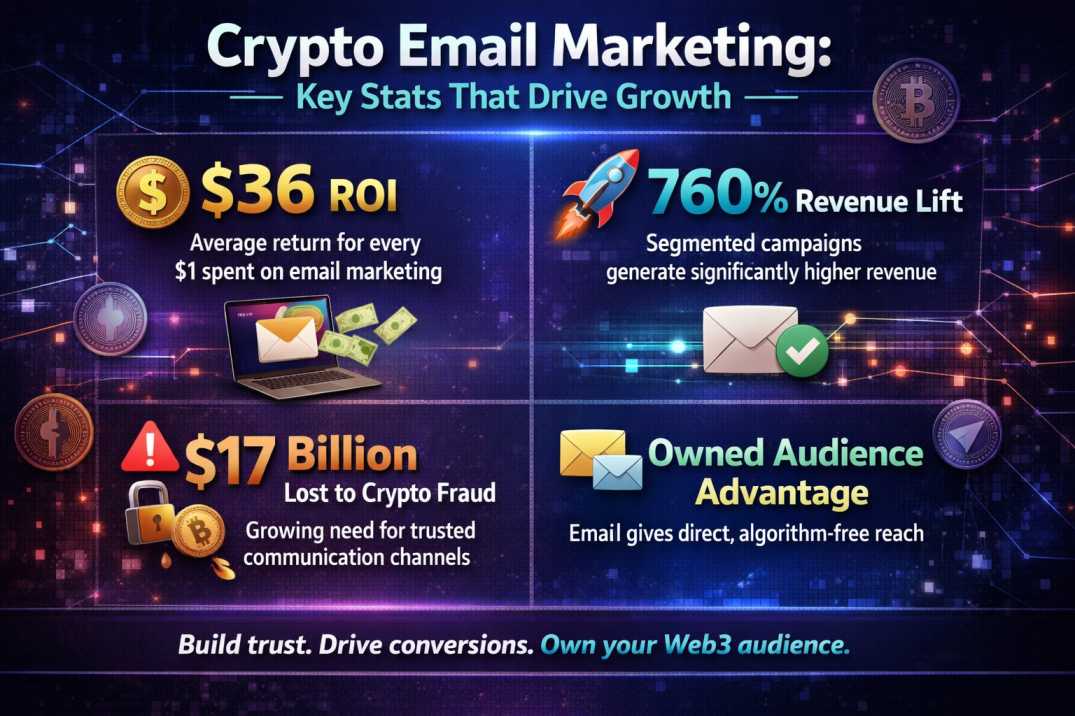
That matters for token launches, product updates, governance votes, and education campaigns that need trust, timing, and a record of consent. Email still performs at a high level for marketers. Industry reports show that email marketing generates an average return of $36 for every $1 spent. Campaign Monitor data also shows that segmented email campaigns can drive up to 760 percent more revenue than non-segmented campaigns. These numbers explain why email remains a core channel for acquisition and retention.
In crypto, that value rises since trust is fragile and noise is constant. Reports from Chainalysis estimate that crypto-related fraud reached over $17 billion in recent years, which has increased user caution and demand for verified communication channels. A verified email program helps a project speak from an authenticated domain, set a repeatable cadence, and move users from hype to informed action. For business leaders, that means better control over acquisition costs, clearer attribution, and a channel that keeps working long after a social post fades.
What Is Crypto Email Marketing?
Definition and Key Differences from Traditional Email Marketing
Crypto email marketing is the use of permission-based email to attract, educate, convert, and retain people inside a blockchain or token-based business. The mechanics look familiar. A brand collects consent, segments its list, sends newsletters or campaigns, and tracks results. The difference lies in the audience and the message.
Traditional email programs often push discounts, product news, and sales reminders. Web3 email needs to do more teaching and more trust building. A wallet user wants plain answers on token utility, roadmap progress, security steps, exchange listings, staking rules, or governance changes. A founder or growth lead needs email that can explain risk, answer objections, and guide readers toward a wallet connect, app signup, or community action without sounding like a pump campaign.
This makes content quality far more important. A weak retail email can annoy subscribers. A weak crypto email can damage trust, trigger spam complaints, or create confusion around financial risk. That is why successful Web3 campaigns rely on plain language, clear disclosures, and audience segmentation. A trader, DAO voter, NFT holder, and developer all need different messages. Crypto email marketing works best when it treats those groups as separate audiences with separate needs.
Role of Email in the Web3 Marketing Stack
Email plays a clear role in the Web3 marketing stack. Social channels create attention. Community platforms create conversation. On-chain activity shows intent. Email ties those signals together and gives the brand a stable place to nurture them.
A team can welcome a new subscriber, send a three-part education series, invite that reader to a product demo, and follow with a governance update or token utility explainer. It can do that on a schedule it controls. That control matters in Web3, where platform volatility, impersonation scams, and fragmented communities often weaken communication.
Email also adds structure. Discord is great for live interaction, but it can bury key information. Telegram moves fast, but posts disappear under volume. X can create reach, but it rarely supports deep education. Email fills that gap. It gives projects a place for onboarding, product education, investor updates, security reminders, and conversion-focused campaigns. For serious Web3 brands, email is not a side channel. It is core infrastructure.
Looking to improve conversions from your crypto emails?
Boost crypto email conversions with targeted, high-impact Web3 campaigns

Why Email Marketing Works for Web3 Audience Growth
Own Your Audience (vs. Platform Dependency)
The strongest reason email works is ownership. A Discord server can drive buzz, but the platform owns discovery and moderation rules. X can amplify a launch, but reach can drop with no warning. Email gives the brand first-party audience data and direct access to the inbox.
That creates a durable asset that survives platform swings. It gives leadership teams a cleaner view of cost per lead, conversion path, and lifetime value. It gives compliance teams a record of consent and unsubscribe behavior. It gives operators a way to react fast during a product incident or a governance vote without relying on a crowded public channel.
This matters more in crypto than in many other sectors. Web3 communities often gather across several apps at once. A user may follow on X, join Discord, hold a token, and read governance posts, but still miss the one message that matters. Email reduces that fragmentation. It lets the brand bring scattered attention into one owned channel that it can measure and improve over time.
High-Intent Audience Engagement
Email also works for Web3 growth since it captures stronger intent. People who hand over an email address show more commitment than someone who taps follow on social media. That higher intent makes email a better place for serious education and stronger calls to action.
A DeFi brand can send a wallet safety guide, a protocol explainer, and a product update in sequence. An NFT project can warm up a list before a mint and segment collectors by activity level. A crypto exchange can turn a newsletter reader into a funded account through onboarding flows and market education.
This is where email beats broadcast channels. Instead of shouting one message to everyone, a project can send tailored messages to smaller groups. New users need basic education. Power users need deeper product detail. Inactive users need a reason to return. That level of relevance improves open rates, click rates, and conversion rates.
Community Building and Retention
Community growth is not only about acquiring attention. It is about keeping attention. Many Web3 teams spend heavily to attract users, then fail to build a consistent relationship after the first interaction. Email helps fix that problem.
A strong email program keeps users informed between launches and market cycles. It can share roadmap progress, governance proposals, product releases, security alerts, and community wins. That steady contact builds familiarity and reduces the drop-off that often follows an initial burst of hype.
Email also supports a deeper kind of community participation. A holder who receives useful weekly updates is more likely to stay active than one who only sees occasional social posts. A DAO member who gets timely governance summaries is more likely to vote. A user who receives product education at the right moment is more likely to try a new feature. Retention often comes from repeated, low-friction contact, and email is built for exactly that.
Revenue & Conversion Opportunities
Email produces commercial value since it can move users toward action in a direct and measurable way. Web3 brands need more than awareness. They need wallet connections, app signups, deposits, purchases, votes, and repeat participation.
A well-run email program can support those goals at every stage. Early campaigns can attract subscribers with market education, waitlists, or token utility explainers. Mid-funnel emails can build trust through case studies, product walkthroughs, and community proof. Late-stage campaigns can push conversion with launch alerts, whitelist announcements, staking reminders, or time-sensitive offers.
The best part is measurement. Teams can track who opened, who clicked, who signed up, and who returned. That data helps marketers refine subject lines, calls to action, content themes, and timing. In a market full of noise, email gives crypto brands a channel that is direct, measurable, and built for conversion. For Web3 companies that want stable growth, email is not old media. It is the owned channel that turns attention into trust, and trust into revenue.
How to Build a High-Quality Web3 Email List
Step-by-Step Framework for List Building
A strong Web3 email list starts with a clear value exchange. People do not hand over an email address for vague promises. They join for research, market briefings, product access, event invites, whitelist alerts, governance news, or security updates. The offer must match the audience. A DeFi protocol can offer a short guide on yield risks and product use. An NFT brand can offer early drop access and collector updates. A wallet app can offer a security checklist and release notes. Mailchimp says list growth works best with clear signup forms, landing pages, and a useful reason to subscribe. It reports that pop-up forms can raise list growth rates by an average of 50.8 percent.
The next step is placement. Signup forms need to appear where intent is already high. That means the homepage, blog posts, product pages, community hubs, event pages, and waitlists. Web3 teams often hide email capture inside Discord or Telegram. That misses high-intent traffic from search and direct visits. A better setup uses one message across every touchpoint. The website promise, form copy, welcome email, and first nurture sequence should all describe the same benefit. That consistency builds trust fast, and trust matters more in crypto than in most sectors.
The welcome sequence deserves close attention. Many projects collect addresses, then send nothing for weeks. That wastes the moment of highest interest. The first email should confirm the promise, explain what the subscriber will receive, and set cadence. The next two or three emails should teach, not sell. They can explain product basics, token utility, wallet safety, and core use cases. This early sequence filters casual curiosity from real intent and gives the team a base for later segmentation.
Web3-Specific List Growth Strategies
Web3 list growth works best with community-driven offers, not broad lead magnets copied from SaaS playbooks. Token-gated reports, beta access, early feature announcements, and event recaps often beat generic newsletters. A project that serves builders can collect emails through hackathon registrations and workshop signups. A consumer wallet can grow its list with security education and product update alerts. A protocol can use governance briefings and ecosystem research. Each offer should reflect a real job the reader wants done.
Partnerships work well in this market. Many crypto brands share audiences with media outlets, analytics firms, wallets, and infrastructure providers. Joint webinars, co-branded reports, and newsletter swaps can attract qualified subscribers at a lower cost than paid social. The list stays cleaner too, since the person opted in for a topic with direct relevance.
List quality matters more than raw volume. Bought lists damage sender reputation and trust. Mailchimp warns against purchased lists and notes that spam traps can hurt future deliverability. For Web3 brands, that risk is even sharper. Scam-heavy markets already face user skepticism. A brand that sends cold promotional mail looks careless at best and unsafe at worst.
Compliance & Ethical Data Collection
Compliance is not a legal footnote. It shapes deliverability, trust, and brand reputation. The European Commission states that direct marketing by email must follow GDPR rules and the ePrivacy Directive, and marketers must respect objections to direct marketing. Consent under GDPR must be freely given, specific, informed, and unambiguous.
That means Web3 teams need plain consent language, visible unsubscribe links, and accurate records of signup source and date. They should not bundle email consent into wallet connection or account creation. Double opt-in is a smart standard, even where law does not require it, since it confirms address quality and cuts fake signups. Deliverability rules matter too. Google says all senders to Gmail must meet baseline sender requirements, and bulk senders near or above 5,000 messages a day face extra rules.
Segmentation & Personalization for Web3 Audiences
Behavioral Segmentation Models
Segmentation turns a crypto email list from a media channel into a revenue channel. The most useful model starts with behavior, not identity. What did the user do? Did they subscribe from a research page, a token page, a wallet guide, or an event form? Did they open the welcome sequence, click product links, fund an account, mint, stake, or vote? These actions reveal intent far better than broad labels such as “community member.”
A practical Web3 model often uses five groups: new subscribers, educated prospects, active users, inactive users, and advocates. Each group needs different messages. New subscribers need context and trust. Educated prospects need proof and product detail. Active users need updates and expansion paths. Inactive users need a clear reason to return. Advocates need referral, governance, or ambassador content.
Personalization Strategies
Personalization should reflect real user signals, not gimmicks. McKinsey reports that personalization can cut acquisition costs by as much as 50 percent, lift revenue by 5 to 15 percent, and raise marketing ROI by 10 to 30 percent. Faster-growing companies derive 40 percent more of their revenue from personalization than slower-growing peers. In Web3, those gains come from relevance. A trader should not get the same email as a DAO contributor. A user who abandoned onboarding should not get a token-holder update.
The strongest personalization uses content blocks, timing, and lifecycle triggers. A welcome email can change its middle section based on signup source. A product email can show security content to new wallet users and feature updates to active users. A reactivation email can pull in the last viewed product or community area. These small adjustments improve clicks and reduce fatigue.
Email Marketing Funnel for Crypto Projects
Awareness Stage
At the top of the funnel, the goal is trust and clarity. Educational emails work best here. They explain the market problem, the product category, and the project’s role in plain language. Security content performs well too, since it meets a real user need and signals credibility.
Consideration Stage
At this stage, readers compare options and test claims. Emails should provide product walkthroughs, case studies, ecosystem metrics, founder notes, and FAQ content. The tone should stay factual. Hype weakens confidence at this point.
Conversion Stage
Conversion emails need one clear action. That action may be wallet connect, account signup, deposit, mint, or governance registration. Strong conversion emails reduce friction. They explain the next step, link to the right page, and answer the top risk question before the reader asks it.
Retention & Advocacy Stage
The funnel does not stop at first conversion. Retention drives long-term value in crypto, where user churn can spike after market swings. Product updates, governance reminders, milestone recaps, and referral offers keep users active. Done well, email turns subscribers into repeat users and loyal community members.
Automation & Technical Setup for Crypto Email Marketing
Essential Tools & Infrastructure
Crypto email marketing needs more than a newsletter tool and a contact list. It needs a sending platform, a customer data layer, domain authentication, event tracking, and clear links between product activity and email behavior. The sending platform handles campaign creation, templates, segmentation, and reporting. The data layer connects website events, signup source, wallet actions, and product milestones to subscriber records. Without that foundation, teams send the same message to everyone and lose commercial value fast. Mailchimp describes automation as a way to build customer journeys, trigger messages from user actions, and track what happens after each send.
For Web3 teams, infrastructure choices shape growth. A wallet app needs event tracking for signup, wallet creation, backup completion, and first transaction. A DeFi product needs triggers for first deposit, inactive balances, or abandoned onboarding. An NFT brand needs campaign logic tied to waitlists, mint alerts, and post-mint retention. The core stack should connect forms, CRM records, analytics, and email flows in one place. That link turns email from a broadcast channel into a revenue channel. Litmus reports that segmentation remains one of the strongest personalization tactics in email, which makes clean data and shared identifiers far more than a technical detail.
Automation Workflows
Automation works best once it mirrors the real user journey. The first workflow is the welcome series. Mailchimp notes that an automated welcome series is a strong way to greet new subscribers and introduce the brand. In crypto, that series should explain what the project does, what the subscriber can expect by email, and what action matters next. A weak welcome flow sends a discount-style blast. A strong one builds trust with product education, security notes, and one clear next step.
The next layer is lifecycle automation. New subscribers need onboarding. Prospects need product education and social proof. Active users need feature updates and habit-building nudges. Inactive users need reactivation emails tied to a real trigger, such as unused balances, unfinished setup, or missed governance activity. Mailchimp lists welcome emails, re-engagement campaigns, and triggered journeys as core uses of automation. For a crypto company, these flows cut manual work and create steady contact at the moments that matter most.
Deliverability & Security Best Practices
Deliverability is a hard business issue, not a backend chore. Google states that all senders should set up SPF or DKIM, and bulk senders should set up SPF, DKIM, and DMARC. Google defines bulk senders as domains that send close to 5,000 messages or more to personal Gmail accounts in a 24-hour period. Yahoo states that bulk senders should authenticate mail and keep spam complaint rates below 0.3 percent. These rules shape whether messages reach the inbox or vanish into spam.
Security matters even more in crypto email. FTC guidance warns that scammers impersonate real crypto businesses, and CISA notes that phishing emails often use urgent language and requests for sensitive data. Chainalysis reports that crypto scams and fraud reached an estimated $17 billion in 2025, with impersonation scams up 1400 percent year over year. A serious email program should use a verified domain, consistent sender identity, plain security reminders, and zero links that create confusion. Teams should train users to check domains, distrust urgency, and ignore any message asking for seed phrases or private keys.
Ready to grow engagement with crypto email marketing?
Content Strategy for High-Converting Crypto Emails
Content Pillars That Work in Web3
High-converting crypto emails rest on a small set of content pillars. Education comes first. Most users still need plain language on wallet safety, token utility, product mechanics, and market risk. Product updates come next. Readers want to know what changed, what shipped, and why it matters. Community content follows close behind. Governance votes, ecosystem wins, partner news, and event recaps keep the project alive between launches. Promotional content has a place, but it should sit on top of trust, not replace it. Litmus points to segmentation and personalization as core drivers of stronger performance, and that only works once the content itself matches a real reader need.
Writing for Web3 Audiences
Writing for Web3 readers demands precision. This audience spots hype fast, and it punishes empty claims. Good crypto email copy uses short sentences, concrete nouns, and direct calls to action. It explains one idea at a time. It avoids slang-heavy insider talk that blocks new users, and it avoids inflated promises that trigger distrust. The best emails sound like a credible operator, not a promoter. That tone matters for businesses trying to attract serious users, investors, and partners, not short-term clicks.
High-Converting Email Elements
Conversion often comes down to structure. Subject lines need one clear promise. Preview text should add context, not repeat the subject. The body should lead with the main point in the first lines, then move to proof, then a single action. A crypto exchange email may push account funding. A wallet email may push backup completion. A DAO email may push voting participation. One email should serve one business goal. Litmus notes that A/B testing helps teams compare email elements and learn audience preferences. That discipline matters in crypto, where confusion kills clicks and trust.
Conclusion
Crypto email marketing works best once the technical base and the content strategy support each other. Clean data powers segmentation. Automation sends the right message at the right time. Authentication and security practices protect trust. Then content turns that trust into action. For Web3 brands that want durable growth, email is not a side task. It is the owned channel that carries education, conversion, and retention in one system.
Businesses that invest in crypto email marketing, Web3 email marketing strategies, and blockchain audience growth gain a clear advantage. They build direct relationships, improve conversion rates, and reduce reliance on volatile platforms. This approach creates steady engagement across product launches, token campaigns, and community initiatives.
Blockchain App Factory helps businesses design and execute high-performing email marketing systems tailored for Web3 ecosystems. With the right mix of automation, segmentation, and content strategy, companies can turn subscribers into active users, token holders, and long-term community advocates.

Vimal J is the Head of Sales at Blockchain App Factory, with 10+ years of experience in sales, client strategy, and Web3 business growth. He helps startups, enterprises, and project founders choose the right blockchain solutions for their goals, bringing a practical market perspective to topics like token development, crypto launches, and Web3 adoption.