Key Insights
- Traffic, followers, and reach look good on reports, but they do not prove business growth. Real progress comes from wallet activation, repeat usage, retention, and revenue.
- SEO, community, paid media, partnerships, and lifecycle messaging each serve a different role. The best results come from combining them based on product type, user intent, and growth stage.
- A strong KPI structure shows which channels bring active users and which ones waste budget. That helps teams improve onboarding, retention, and campaign performance over time.
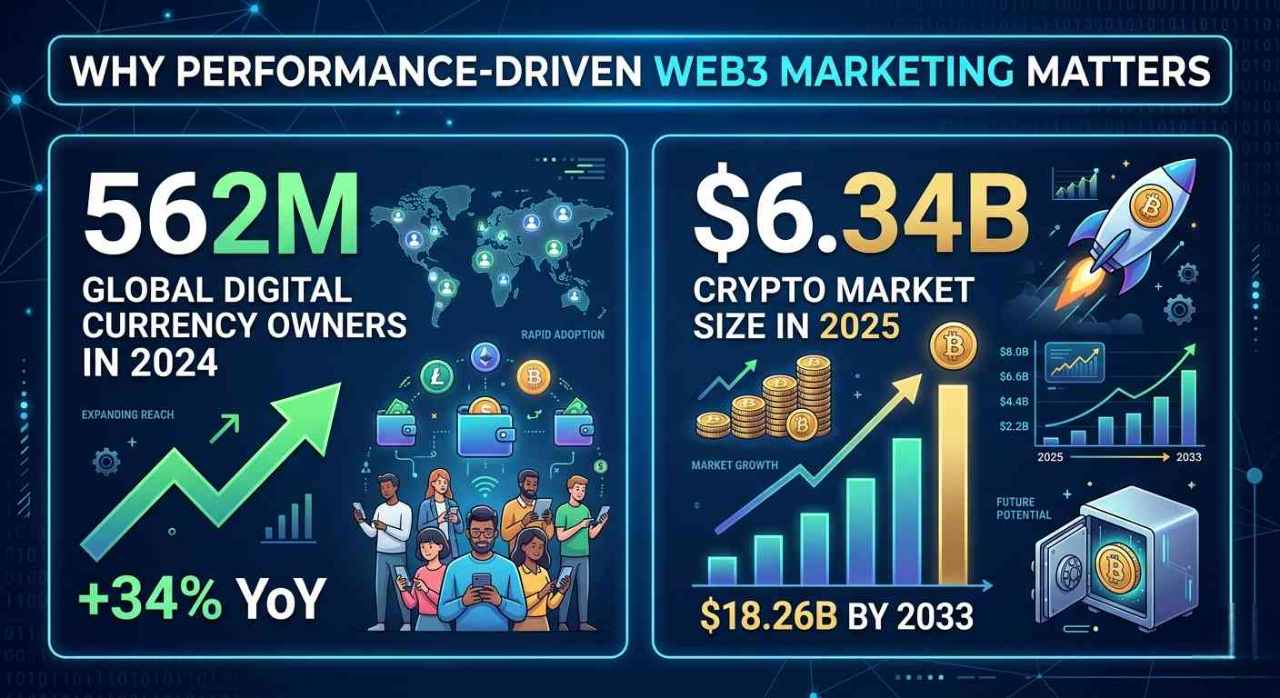
Web3 marketing has changed fast. Early crypto promotion often focused on follower counts, post reach, trending hashtags, and short traffic spikes. That model no longer works for serious businesses. Attention alone does not build active wallets, repeat users, fee revenue, or loyal communities. This shift matters even more because the market is much larger now. Around 562 million people worldwide owned digital currencies in 2024, up 34 percent from 420 million in 2023. At the same time, the global cryptocurrency market was estimated at $6.34 billion in 2025 and is projected to reach $18.26 billion by 2033. In a market of that size, weak marketing wastes budget, lowers user quality, and slows revenue growth.
A stronger Web3 growth model focuses on performance. It tracks what people do, not just what they see. Web3 users move across Discord, X, Telegram, YouTube, docs, wallets, and dApps before they act. They may discover a project today and transact much later. The journey is fragmented and filled with friction, from wallet connection to bridging and gas fees. That is why Web3 growth marketing needs a sharper system. It helps teams reduce wasted spend, improve attribution, lift retention, and focus on real user activity instead of short-term hype.
What Is Web3 Growth Marketing?
Web3 growth marketing is a growth system built for blockchain products, token ecosystems, NFT platforms, wallets, DeFi apps, games, and infrastructure businesses. It brings together brand, community, product, analytics, and on-chain conversion into one model.
Unlike basic crypto promotion, it does more than create visibility. It moves users through clear stages, from discovery to wallet connection, then into active participation such as staking, trading, minting, voting, or advocacy.
Why It Is Different from Traditional Marketing
Web3 growth marketing is not just a marketing function. It depends on several teams working together. Product teams improve onboarding. Community teams build trust. Content teams educate users. Data teams track wallet behavior and retention. Growth teams connect all of this to cost, activation, and revenue.
This differs from traditional digital marketing, which often relies on forms, emails, app installs, and checkout flows. In Web3, the first strong signal of intent may be a wallet connection, token swap, mint, or governance action instead of an email signup.
Why Web3 Needs a Different Strategy
Web3 user journeys are harder to track and manage. Many users operate through wallet addresses, not personal profiles, so standard CRM methods are less useful. Trust is also built differently. Users often evaluate founder activity, token design, audits, roadmap progress, and community quality before they act.
The path to conversion is also spread across many channels. A user may discover a project through content, return later through social media or Discord, then finally take action on-chain. That makes attribution and channel planning more complex.
Key Conversion Signals in Web3
In Web3, pageviews are only a starting point. More meaningful signals often include wallet connections, first swaps, staking activity, NFT mints, liquidity deposits, governance votes, and repeat transactions. These actions show stronger intent and product fit.
Community also plays a central role. Users often discover products through creators, ecosystem partners, chat groups, and crypto communities. Adoption is shaped by trust, incentives, and shared narratives, not just paid promotion.
Core Goals of a Web3 Growth Program
A strong Web3 growth program focuses on business outcomes instead of surface-level attention. Its main goals include attracting qualified users, activating wallets, growing community, increasing protocol usage, improving revenue, and strengthening retention.
It also supports ecosystem expansion through partners, creators, protocols, wallets, and marketplaces. This helps teams move beyond short-term visibility and build sustainable growth over time.
Why Web3 Growth Marketing Matters for Businesses
Web3 growth marketing connects marketing spend to user action, product usage, and revenue. Many teams still focus on reach and surface engagement, but that does not always create wallet activation or long-term users. A better system tracks what happens after discovery.
Why It Matters for Web3 Businesses
This is important for protocols, dApps, exchanges, NFT brands, and Web3 SaaS companies. These businesses need more than traffic. They need the right users and repeat activity, whether that means deposits, swaps, trading volume, mint participation, product adoption, or renewals.
Better Capital Efficiency
Web3 acquisition can become expensive through KOL deals, paid campaigns, exchange promotions, incentives, and events. A structured growth program helps teams see which channels bring active users and which only bring empty clicks. That reduces waste.
Faster Learning and Optimization
Growth marketing helps teams test landing pages, wallet onboarding, messaging, and content formats in short cycles. This makes it easier to spot friction, improve conversion, and understand what users respond to.
Stronger Retention and Less Hype Dependence
It also improves segmentation, retention, and monetization. Teams can build clearer messages for different user groups and focus on repeat actions, not one-time wallet connections. It also reduces dependence on hype cycles by building growth through product value, trust, education, and long-term engagement.
Market Signals Supporting Long-Term Investment
The market still offers strong reasons to invest in Web3 growth. Crypto adoption remains active across both retail and institutional segments, with strong demand in regions such as Asia, Latin America, the Middle East, and Africa. This shows that growth is not limited to one market or one type of user.
Demand is also becoming more utility-driven. Stablecoins are expanding in payments and cross-border transfers. DeFi continues to attract users for lending, trading, and yield. Blockchain gaming and tokenized assets are also opening new growth paths. This shift rewards products that solve real problems, not just projects that create visibility.
That is why long-term investment in Web3 growth marketing makes sense. The market has moved beyond a stage where attention alone is enough. Businesses now need clear messaging, strong onboarding, better analytics, and retention programs that support ongoing use.
Want to make your Web3 brand easier to find and trust?
Use search content, community building, and clear messaging to raise visibility and credibility.

The Web3 Growth Funnel Explained
A Web3 growth funnel shows how a user moves from first discovery to repeat value. The stages may look similar to a SaaS funnel, but the actions are different because Web3 journeys often begin in public communities and end in wallet-based actions.
Stage 1: Awareness
This is where users first discover the project through SEO, founder posts, media coverage, ecosystem partners, and platforms like X, Discord, Telegram, Farcaster, and Reddit. At this stage, credibility matters as much as reach. The goal is not just visibility, but qualified attention.
Stage 2: Consideration
In this stage, users evaluate the project more seriously. They want to know what the product does, who it serves, and whether it is trustworthy. Blogs, explainers, landing pages, FAQs, community discussions, audits, and transparent communication all help move users from curiosity to intent.
Stage 3: Activation
Activation happens when a user takes the first real action, such as connecting a wallet, making a swap, staking, minting, or setting up an account. This stage is critical because it turns interest into measurable behavior. Clear onboarding, simple calls to action, and low-friction flows are essential here.
Stage 4: Retention
Retention begins after the first action. Teams need to bring users back through lifecycle messaging, product education, feature campaigns, loyalty systems, and governance participation. This stage helps turn one-time users into active, repeat participants.
Stage 5: Revenue and Advocacy
The final stage turns user activity into business value and community growth. Revenue comes from actions like trades, fees, subscriptions, and secondary sales. Advocacy grows when satisfied users share the product, refer others, and help expand the ecosystem. This creates a loop that strengthens growth over time.
Top Web3 Growth Marketing Channels
Web3 brands need channel discipline because not every channel brings the same kind of user. Some channels drive discovery, some build trust, some push first action, and others improve retention. Strong growth programs choose channels based on product fit, user behavior, and revenue goals.
SEO and Content Marketing for Web3 Brands
SEO is one of the strongest long-term growth channels in Web3 because it captures users who are already searching for answers, products, and comparisons. Content such as blogs, comparison pages, glossaries, use-case pages, protocol explainers, and developer docs can attract qualified traffic and keep generating value over time.
Community-Led Growth
Community is a core growth channel in Web3 because trust often forms in public. Platforms like Discord, Telegram, X, Reddit, and Farcaster help brands build conversation, credibility, and retention. Structured activities such as AMAs, governance education, and contributor programs make communities more valuable than random posting.
Paid Media and Performance Campaigns
Paid media can support Web3 growth, but it works best when focused on measurable actions rather than raw reach. Search ads, sponsored placements, retargeting, and ecosystem ad networks can help test messages, support launches, and re-engage warm audiences. The focus should stay on wallet actions, retained users, and revenue, not clicks alone.
Influencer, KOL, and Creator Partnerships
Creator partnerships help brands reach trusted communities faster. A relevant creator with a strong audience fit often performs better than a large account with weak trust. The best programs measure outcomes such as landing page visits, wallet connects, community joins, and repeat activity.
Ecosystem and Partnership Marketing
Partnerships are often one of the strongest Web3 growth levers. Wallets, ecosystems, launchpads, aggregators, marketplaces, and developer platforms can expand reach and bring built-in trust. These partnerships often drive better activation and retention than cold paid traffic.
Airdrops, Referrals, and Incentive Campaigns
Incentives can grow awareness and product usage quickly, but poor design attracts low-quality users. Strong programs reward meaningful actions such as repeat usage, liquidity duration, governance activity, or high-quality referrals. This improves retention and reduces wasted spend.
Email, Push, and Lifecycle Messaging
Lifecycle messaging is a powerful but underused channel in Web3. Email, push notifications, and in-app messages help recover drop-offs, guide onboarding, promote features, and bring users back. This channel is especially valuable for improving retention and feature adoption.
Need a growth partner for your Web3 business?
Web3 Growth Marketing Framework for Businesses
A growth program works best with structure. Random channel activity creates random results. A clear framework helps teams align the business model, key user action, channel mix, metrics, and testing process.
Step 1: Define the Business Model
Start by identifying how the business creates value. A protocol may focus on staking, liquidity, governance, or fees. An exchange may focus on funded accounts and trading volume. A wallet, NFT platform, gaming product, or infrastructure company will each have different growth goals. Without this step, teams often track the wrong outcomes.
Step 2: Identify the Primary Growth Event
Next, define the main action that signals real user value. This could be a first deposit, trade, mint, vote, app session, subscription, or integration. Every growth program needs one primary event that guides campaigns, onboarding, and reporting.
Step 3: Choose the Right Channel Mix
Then choose the channels that fit the product and growth stage. SEO supports long-term intent capture. Community builds trust and advocacy. Paid campaigns help with testing and amplification. Partnerships add distribution, and lifecycle messaging improves retention. The right mix should match the product, not market trends.
Step 4: Build the KPI Tree
A KPI tree links channel activity to product use and revenue. It can include channel metrics like traffic and clicks, funnel metrics like wallet connects and activation rate, product metrics like active users and feature adoption, revenue metrics like fees or volume, and retention metrics like repeat usage. This helps teams find where growth is breaking.
Step 5: Launch an Iterative Testing Program
Growth also needs a steady testing rhythm. Weekly reviews, cohort reporting, landing page tests, onboarding experiments, and incentive audits help teams improve performance over time. Small changes in messaging, flow design, or audience targeting can create meaningful gains across the funnel.
Conclusion
Web3 growth works best with clear channel choices, strong tracking, and steady testing. Brands that focus on user quality, wallet activation, retention, and revenue build stronger results than brands that chase short bursts of attention. A smart plan connects SEO, community, paid campaigns, partnerships, incentives, and lifecycle messaging into one system that supports real business growth. For companies that want that kind of structured execution, Blockchain App Factory provides Web3 marketing with a focus on measurable growth, user acquisition, and long-term brand value.