Key Insights
- They focus on faster settlement, lower fees, stablecoin-native gas models, and simpler payment flows compared to general-purpose blockchains.
- They support cross-border payments, merchant checkout, supplier settlement, payroll, remittances, and treasury transfers with better speed and transparency.
- Companies must plan for compliance, liquidity, wallet security, fiat on/off ramps, enterprise APIs, and user-friendly payment experiences.
Payments are one of the clearest business uses for blockchain. Companies send money across borders, pay suppliers, settle marketplace transactions, and manage global cash flows every day. Traditional rails work, but they often move slowly across borders. They can add bank fees, FX costs, cut-off times, and manual checks. For fast-moving businesses, those delays create real cost.
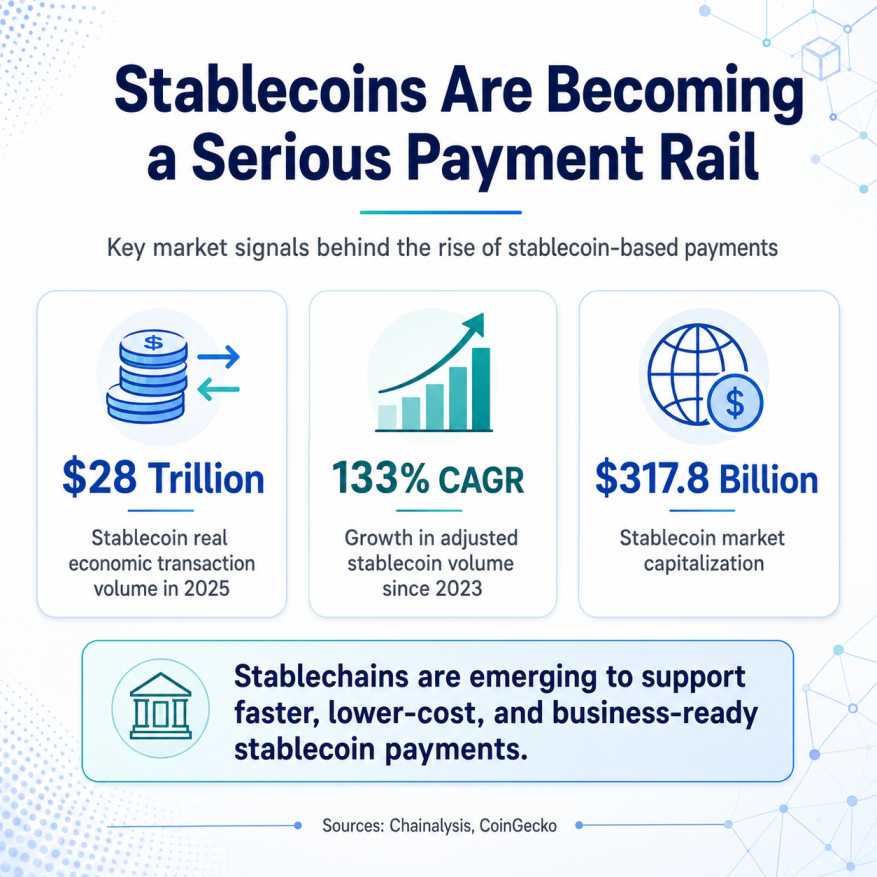
Stablecoins changed this conversation. They let users send a digital asset tied to fiat value, often the U.S. dollar, across blockchain networks. The market has already reached a serious scale. Chainalysis reported that stablecoin adjusted transaction volume grew at a 133% compound annual growth rate since 2023 and reached $28 trillion in real economic activity in 2025. CoinGecko also lists the stablecoin category at about $317.8 billion in market value.
Stablechains take this idea one step further. They focus the blockchain itself on stablecoin payments. Instead of asking businesses to use broad public chains built for many use cases, stablechains aim to give payment teams faster settlement, lower fees, simpler user flows, and cleaner infrastructure for digital money movement.
What Are Stablechains?
Stablechains are blockchain networks designed mainly for stablecoin-based payments. They are also called stablecoin chains or stablecoin-centric blockchains. Their main purpose is to move fiat-pegged digital assets in a fast, low-cost, and reliable way.
A stablechain is not the same as a stablecoin. A stablecoin is the digital asset, such as USDC or USDT. A stablechain is the network that supports payment activity using those assets. The chain can handle transaction validation, wallet activity, smart contracts, fees, compliance tools, and settlement records.
CoinGecko describes stablecoin-centric blockchains as Layer 1 networks built for stablecoin payments, with examples such as Plasma, Arc, and Tempo. Its overview frames these chains as payment-first infrastructure rather than general-purpose smart contract networks.
For a business reader, the value is simple. A stablechain can act like a blockchain-native payment rail. It can support merchant checkout, cross-border supplier payments, remittances, payroll, treasury movement, and B2B settlement. The goal is not speculation. The goal is predictable money movement.
How Stablechains Differ from Traditional Blockchains
Traditional blockchains support many activities. Ethereum, Solana, Tron, and Base process stablecoin payments, but they also support trading, DeFi, gaming, NFTs, token launches, and many smart contract apps. This broad design creates network effects, but it can also create congestion, fee swings, and complex user flows.
Stablechains start with a narrower question: how can a blockchain move stable value better?
That design choice changes the product. A payment-focused chain can use stablecoin-native fees, fast confirmation times, payment APIs, wallet tools, risk controls, and business dashboards. Some projects also target high transaction throughput. CoinGecko reports that Plasma, Arc, and Tempo each use payment-focused design claims, including high throughput targets and fast finality.
For businesses, this matters most at volume. A retailer processing thousands of daily transactions needs fee predictability. A remittance company needs low transfer costs. A global marketplace needs clear records for payouts. A bank or fintech needs compliance controls and audit trails. A traditional blockchain can support these tasks, but a stablechain puts them at the center.
Ready to explore the next evolution of digital payments?
Discover how stablechains reshape payments with faster, global stablecoin-based transactions.

Why Stablecoin-Based Payments Need Dedicated Blockchain Infrastructure
Stablecoin payments have grown beyond crypto trading. They now touch treasury, global payouts, remittances, merchant settlement, and institutional cash movement. Chainalysis reported that stablecoins processed $28 trillion in real economic volume in 2025, which shows how large this category has become.
This scale creates new technical and commercial needs. Payment systems need uptime, clear fees, fast settlement, fraud controls, liquidity, reporting, and support teams. A blockchain built only for broad developer use will not always meet those needs cleanly. Dedicated infrastructure gives payment companies more control over cost, speed, and customer experience.
The Limitations of Existing Payment Rails
Cross-border payments still rely on many parties. A payment can pass through banks, correspondent networks, payment processors, FX providers, and local clearing systems. Each party can add cost, time, and operational risk.
Businesses feel this in several ways:
- Supplier payments can take days to settle.
- FX fees can reduce margins.
- Cut-off times can delay urgent transfers.
- Payment status can remain unclear.
- Reconciliation can take manual work.
- Small-value international payments can become too costly.
The European Central Bank has called for cheaper, faster, and more transparent cross-border payments, which shows that legacy payment friction remains a global policy concern.
Stablecoins address part of this problem by moving value on digital rails. Yet the chain beneath the stablecoin still affects cost, speed, and usability. That is where stablechains enter the picture.
The Role of Stablecoins in Modern Payments
Stablecoins serve as digital representations of fiat value. They reduce the price volatility that makes Bitcoin or Ether hard to use for everyday business payments. A dollar-backed stablecoin lets a company price invoices, receive payments, and hold short-term balances in a familiar unit.
USDT and USDC dominate stablecoin market share. CoinGecko’s stablecoin market data lists USDT and USDC among the largest stablecoins by market value and trading volume.
For enterprises, the main appeal is practical. Stablecoins can support near-instant transfer, 24/7 availability, programmable payment rules, and lower reliance on intermediaries. Circle’s reports also show stablecoin use in global payments and cash management, including payout partnerships for emerging markets.
How Stablechains Solve Payment Infrastructure Challenges
Stablechains aim to make stablecoin payments easier to deploy at business scale. They can reduce the friction that appears when payment teams adapt general-purpose blockchains for high-volume money movement.
A well-designed stablechain can support:
- Stablecoin-denominated transaction fees.
- Fast payment confirmation.
- Lower cost for frequent transfers.
- APIs for wallets, merchants, and payment apps.
- Compliance screening and transaction monitoring.
- Clear settlement records for finance teams.
- Links to exchanges, banks, and fiat on-ramps.
This matters for commercial adoption. A fintech app does not want users to manage volatile gas tokens. A merchant does not want unclear settlement timing. A treasury team does not want fragmented reports across several chains. Stablechains can bring these functions into one payment-first environment.
They are not a full replacement for banks or payment processors. They are a new layer that can connect digital dollars, wallets, businesses, and financial institutions. For decision-makers, the question is no longer whether stablecoins can move value. The sharper question is which infrastructure can support stablecoin payments safely, cheaply, and at business scale.
How Do Stablechains Work?
Stablechains work as blockchain networks built around stablecoin movement. A user sends a stablecoin through a wallet, payment app, merchant checkout, or API. The network checks the transaction, records it on-chain, and settles value between the sender and receiver. This flow looks simple to the user, but the chain handles validation, fee payment, smart contract rules, and transaction history in the background.
The main difference sits in the design goal. A general blockchain supports many use cases. A stablechain gives priority to payments. It can use stablecoins for gas fees, reduce user friction, and support business tools such as reporting, compliance checks, payment links, and treasury dashboards. Stripe said its Tempo blockchain is “purpose-built for payments” and includes dedicated payment lanes, sub-second finality, opt-in privacy, and links to compliance and accounting systems.
A basic stablechain payment flow has five parts:
- The payer starts a transaction.
- The wallet signs the payment request.
- Validators confirm the transfer.
- The recipient receives stablecoins.
- The business system records the payment for accounting, settlement, or payout.
Smart contracts can add rules for subscriptions, escrow, payroll, vendor payments, or marketplace payouts.
This structure matters as stablecoin use grows. Chainalysis reported that stablecoins processed $28 trillion in real economic volume in 2025. That growth places pressure on networks to handle payments with lower cost, better records, and stronger controls.
Key Features of Payment-Focused Stablechains
Payment-focused stablechains are designed to make stablecoin transactions practical for businesses, fintech platforms, merchants, and payment providers. Their value comes from speed, predictable costs, simple user flows, and stronger operational controls.
Fast and Predictable Settlement
Fast settlement is one of the strongest reasons businesses study stablechains. Traditional cross-border payments can take one to five business days. A stablechain can settle payments in seconds or minutes.
That speed helps remittance firms, suppliers, marketplaces, and treasury teams. It reduces waiting time and gives finance teams clearer cash visibility. A marketplace can pay sellers faster. A payroll platform can support global contractors. A supplier can receive funds without waiting for banking cut-off times.
Low Transaction Fees for High-Volume Payments
Payment companies operate on thin margins. A fee change of a few cents can affect profit at high volume. Stablechains target low-cost transfers, mainly for frequent payments and small-value transactions.
This fits use cases such as:
- Remittances
- Creator payouts
- Gaming rewards
- Marketplace settlements
- Merchant checkout
- B2B invoice payments
Lower fees also help businesses enter regions where card costs or bank transfer charges reduce adoption.
Stablecoin-Native Gas and Fee Models
Many blockchains require users to hold a separate token to pay gas. That creates confusion for new users. A customer sending USDC may still need ETH, SOL, or another network token to complete the payment.
A stablechain can solve this by allowing fees in the same stablecoin used for payment. This feels closer to card payments or bank transfers. The user sees a payment amount and a fee, not a second crypto asset.
For businesses, this makes onboarding easier. It also reduces support issues linked to failed transactions, missing gas tokens, and network confusion.
Enterprise-Grade Scalability
Business payment systems need high uptime, fast finality, and the capacity to process many transactions at once. A stablechain built for enterprise payments must support large transaction loads without slowing down during peak use.
Scalability matters for payment gateways, exchanges, remittance apps, neobanks, and merchant platforms. These companies cannot rely on unstable network performance. They need payment rails that can support daily use, seasonal spikes, and global transaction traffic.
Interoperability with Wallets, Exchanges, and Banking Systems
Stablechains gain commercial value only when they connect with the wider financial stack. A payment chain must work with wallets, exchanges, banks, merchant tools, fiat ramps, and accounting software.
Interoperability helps businesses move from blockchain experiments to live payment operations. It supports fiat conversion, customer onboarding, treasury reporting, merchant settlement, and compliance checks. A stablechain without strong integrations remains isolated.
Compliance-Ready Infrastructure
Compliance is central to business adoption. Banks, fintech firms, payment processors, and enterprises need wallet screening, sanctions checks, transaction monitoring, risk scoring, and audit records.
Stablechains built for payments must support these controls from the start. A business cannot launch a stablecoin payment product without risk management. Compliance-ready infrastructure helps companies meet legal duties and build trust with partners, banks, and customers.
Stablechains vs Traditional Blockchains
| Comparison Factor | Stablechains | Traditional Blockchains |
|---|---|---|
| Purpose and Design Philosophy | Built mainly for stablecoin payments, settlement, and digital money movement. | Built for many use cases, including DeFi, NFTs, gaming, token launches, and smart contracts. |
| Transaction Cost and Fee Predictability | Designed to offer lower and more predictable fees for payment use cases. | Fees can change based on network demand, trading activity, and congestion. |
| User Experience and Merchant Adoption | Can simplify payments by supporting stablecoin-native fees, payment APIs, and easier checkout flows. | Often requires users to manage wallets, gas tokens, network selection, and transaction confirmations. |
| Compliance and Institutional Readiness | Can include payment-focused compliance tools, wallet screening, risk checks, and audit records. | Compliance usually depends on external tools and third-party monitoring services. |
| Stablechains vs Layer 2 Payment Networks | Built from the ground up for stablecoin payments and business settlement. | Layer 2 networks scale existing blockchains and inherit part of the base chain’s structure. |
| Stablechains vs Traditional Payment Processors | Settle stablecoin payments on-chain and support programmable payment flows. | Connect merchants to cards, banks, and local payment rails for authorization and settlement. |
| Best Fit | Stablecoin payment gateways, remittances, merchant settlement, treasury transfers, and global payouts. | Broad Web3 applications, DeFi protocols, NFT platforms, token ecosystems, and general smart contract use. |
Top Stablecoin Chains Powering the Future of Digital Payments
Stablecoin chains are becoming a new payment rail for companies that need fast settlement, lower transfer costs, and programmable money movement. The strongest projects in this category focus on stablecoins as the main payment asset, not as one token among many. This design matters for banks, fintech firms, merchants, exchanges, and global enterprises.
Arc by Circle
Arc is Circle’s stablecoin-focused blockchain for payments and institutional finance. Circle is the issuer of USDC, one of the largest dollar-backed stablecoins. Reuters reported that USDC circulation reached $77 billion, up 28% year over year, during Circle’s first quarter of 2026. Circle also reported $694 million in quarterly revenue and reserve income.
Arc is important for businesses that already use USDC for payments, treasury, or settlement. The network uses USDC for transaction settlement, which gives companies a familiar dollar-based unit for value transfer. The Wall Street Journal reported that Circle raised $222 million through a presale linked to Arc, with investors including Andreessen Horowitz and BlackRock.
Tempo by Stripe and Paradigm
Tempo is a payments-first blockchain backed by Stripe and Paradigm. Stripe said it unveiled Tempo in September 2025 as a blockchain built for payments. It lists dedicated payment lanes, sub-second finality, opt-in privacy, and links to compliance and accounting systems as core design points.
Tempo deserves attention from businesses for one clear reason. Stripe already works with merchants, platforms, and online businesses at global scale. A Stripe-linked stablecoin chain can bring blockchain payments closer to existing checkout, payout, and treasury systems. Paradigm said Tempo was built with design input from firms such as Visa, Shopify, Deutsche Bank, Nubank, Standard Chartered, Revolut, DoorDash, and OpenAI.
Plasma
Plasma is a Bitcoin-secured Layer 1 built for stablecoin payments. Eco’s 2026 overview says Plasma launched its mainnet in September 2025 with zero-fee USDT transfers and EVM support. This makes it relevant for payment firms that use USDT for remittances, merchant settlement, or high-volume transfers.
Plasma targets one of the largest stablecoin markets. Polygon’s USDT payment data says USDT processed about $703 billion per month between June 2024 and June 2025, with $1.01 trillion in June 2025. That liquidity gives Plasma a strong commercial base.
Stable by Tether
Stable, also known as StableChain, focuses on USDT-native payments. Its official site describes it as a USD₮ native Layer 1 built for global commerce and payments, with low fees and predictable payments. CoinGecko reported that Stable’s mainnet went live in December 2025 after a pre-deposit campaign that attracted more than $2 billion from 24,000 wallets.
Stable fits companies that already serve markets where USDT has deep liquidity. This includes exchanges, remittance apps, over-the-counter desks, and payment firms in regions with strong dollar demand.
Stablechain Development: What Businesses Need to Build
A stablechain payment product needs more than a blockchain connection. It needs business logic, wallet design, compliance controls, liquidity access, and reporting tools. A weak product can fail even on a strong chain.
Stablechain Consulting and Feasibility Analysis
The first stage defines the payment use case. A business must study transaction size, target markets, user type, settlement currency, risk level, and regulatory duties. A remittance app has different needs from a B2B treasury platform. A merchant checkout product needs strong user experience and refund logic.
Stablecoin Payment Gateway Development
A stablecoin payment gateway connects customers, wallets, merchants, and settlement accounts. It should support payment links, invoices, QR codes, API calls, merchant dashboards, and settlement reports. It should also support refunds, failed payments, transaction status, and fiat conversion.
Wallet and Custody Infrastructure
Wallet design affects adoption. Retail users need simple wallets. Enterprises need role-based controls, transaction limits, approval flows, and secure key management. Custody choices matter too. Some companies prefer self-custody. Banks and large enterprises often choose regulated custody or MPC wallet systems.
Smart Contract Development
Smart contracts add business rules to stablecoin payments. They can handle escrow, recurring billing, vendor payouts, marketplace splits, and payroll flows. Smart contracts need audits, access controls, and clear upgrade plans.
Liquidity and On/Off-Ramp Integration
Stablecoin payments need easy movement between fiat and digital dollars. Companies must connect banks, exchanges, liquidity providers, and local payment rails. Without this layer, users can receive stablecoins but struggle to convert or spend them.
Compliance and Risk Management Tools
Stablecoin payment systems need wallet screening, sanctions checks, AML monitoring, transaction scoring, and audit records. Chainalysis says banks need visibility into on-chain activity, risk exposure, and transaction flows for stablecoin programs.
Enterprise API and Dashboard Development
Business users need clear dashboards. They need transaction history, settlement status, customer records, reconciliation files, fee reports, and role controls. APIs should connect with ERP, accounting, CRM, and payment systems.
Stablechain Adoption Framework for Businesses
Identify the Payment Use Case
Start with one clear use case: cross-border payments, vendor payouts, remittances, merchant checkout, treasury transfers, or payroll. A narrow launch reduces risk.
Choose the Right Stablecoin Model
The stablecoin choice shapes trust and liquidity. USDC fits firms that prefer regulated U.S. dollar exposure. USDT fits markets with deep global liquidity. Other stablecoins fit selected use cases and regions.
Select the Blockchain or Stablechain Infrastructure
The chain choice should reflect speed, fees, liquidity, security, compliance support, and developer tools. Businesses should compare Arc, Tempo, Plasma, Stable, and large public networks before launch.
Design Compliance and Risk Controls
Compliance design must come before live payments. This includes KYC, AML checks, wallet screening, sanctions controls, record retention, and reporting rules.
Build Wallet, Payment, and Settlement Workflows
The product should guide users from payment start to settlement confirmation. Good design reduces failed payments and support tickets.
Test Security, Scalability, and User Experience
Teams should test smart contracts, APIs, wallets, payment status, transaction loads, and edge cases. Security audits reduce risk before funds move at scale.
Launch, Monitor, and Improve
After launch, teams should track settlement time, fees, failed payments, liquidity depth, compliance alerts, and user behavior. Better data turns stablechain payments into a reliable business rail.
Ready to understand the future of stablecoin payments?
Challenges of Stablechains
Stablechains offer faster and cheaper payment rails, but businesses must handle several risks before adoption. These networks move digital money, so weak planning can create legal, financial, and security issues.
Regulation is the biggest challenge. Stablecoins sit between banking, payments, and crypto. Rules differ across markets, and payment firms need KYC, AML checks, sanctions screening, tax records, and transaction reporting. A stablechain used for remittances, merchant payments, or treasury transfers must meet local compliance rules before launch.
Reserve risk is another concern. Stablechains depend on stablecoins, so users must trust the issuer, reserve assets, redemption process, and audit reports. If a stablecoin loses its peg, businesses can face settlement losses and customer trust issues.
Security also matters. Stablechain payment systems include wallets, smart contracts, APIs, validators, bridges, and custody tools. Each layer needs protection. Smart contract audits, access controls, transaction limits, and live monitoring help reduce risk.
Liquidity can also slow adoption. Stablecoins operate across many chains, but liquidity is not equal everywhere. A business may receive stablecoins on one network and need conversion through another. This can add cost and delay. Strong exchange support, fiat on/off ramps, and banking links are key.
User experience remains a barrier too. Many users still find wallets, gas fees, and chain selection confusing. Stablechains can reduce this issue with stablecoin-native fees and simple payment flows, but businesses must still build user-friendly apps and dashboards.
Conclusion
Stablechains mark a strong step forward for stablecoin-based payments. They focus on fast settlement, low fees, programmable payments, and business-ready infrastructure. For companies, they can support cross-border payments, merchant checkout, supplier settlement, payroll, remittances, and treasury transfers. The best stablechains will not win through speed alone. They must combine performance with compliance, liquidity, security, reserve trust, and enterprise integrations.
Businesses should begin with one clear payment use case, then choose the right stablecoin, select the right chain, build risk controls, and connect the system with wallets, payment gateways, accounting tools, and banking partners. Blockchain App Factory, a leading stablechain development company, helps businesses design and launch secure stablecoin payment solutions, including stablecoin payment gateway development, wallet integration, smart contract development, liquidity support, and enterprise API development.

Vimal J is the Head of Sales at Blockchain App Factory, with 10+ years of experience in sales, client strategy, and Web3 business growth. He helps startups, enterprises, and project founders choose the right blockchain solutions for their goals, bringing a practical market perspective to topics like token development, crypto launches, and Web3 adoption.