Key Insights
- Rising stablecoin volume and on-chain settlement show that decentralized exchanges now support real payment, treasury, and trading activity.
For businesses, this shifts DEXs from a crypto niche into a practical tool for faster market access and asset movement. - A DEX lets firms keep custody of assets, tap on-chain liquidity, and launch token markets without relying only on centralized venues.
That gives treasury teams, fintech apps, and token issuers more control over execution, pricing, and product timing. - A workable DEX needs clear business goals, legal review, secure smart contracts, deep liquidity, and a measured rollout plan.
Firms that treat security, governance, and market design as core priorities are more likely to build a DEX that users trust and use.
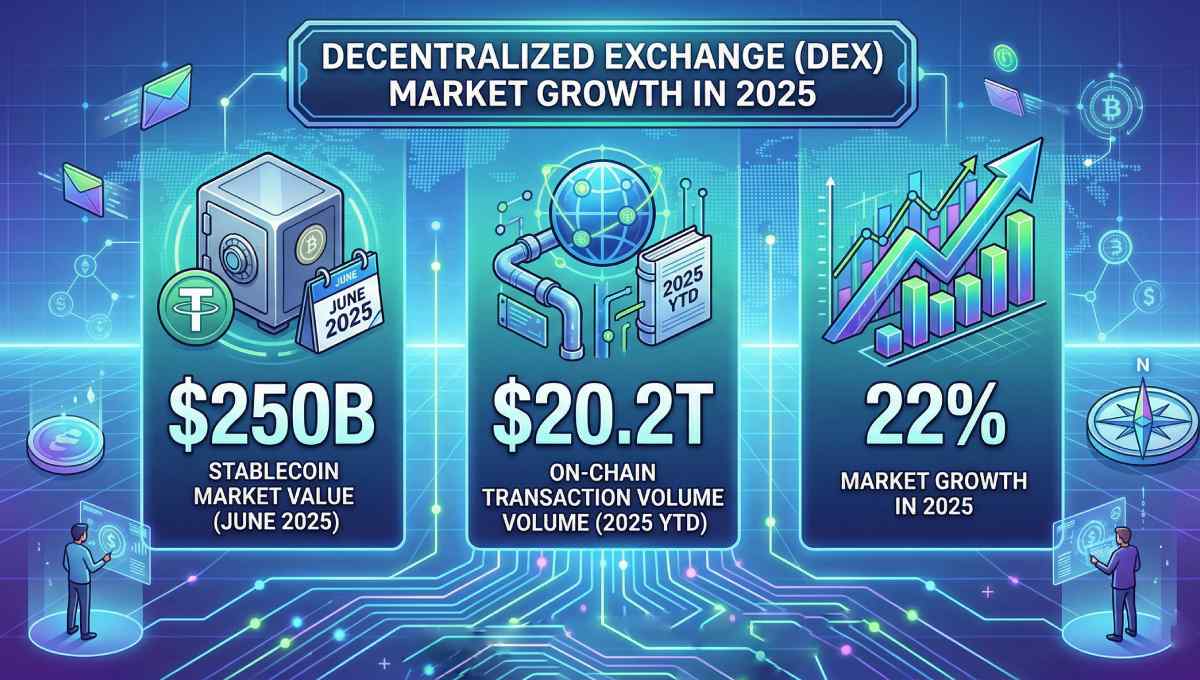
Decentralized exchanges are no longer a niche part of crypto. They now sit inside a market that is growing fast and drawing clear business interest. Coinbase Institutional reported that stablecoins reached about $250 billion in market value by June 5, 2025, up 22 percent year to date. Over the same stretch, on-chain stablecoin transaction volume hit $20.2 trillion, far above the $13.8 trillion recorded across the first five months of 2024. These figures show that blockchain-based value transfer is expanding at a pace that business leaders cannot ignore.
For businesses, that growth has direct meaning. A decentralized exchange, or DEX, gives firms access to on-chain liquidity, token markets, and near real-time settlement without relying only on centralized trading venues. That creates new paths for treasury management, token launches, cross-border payments, and digital asset products built for global users. As more capital moves through blockchain networks, DEX infrastructure is becoming a practical business tool rather than a crypto side topic.
What Is a Decentralized Exchange (DEX)?
A decentralized exchange is a peer-to-peer marketplace for digital assets. Users swap tokens through smart contracts on a blockchain instead of sending funds to a central exchange account. In plain terms, the platform does not take custody of user funds in the same way a traditional exchange does. Users keep control of their assets in their own wallets and approve each trade from there. Uniswap, one of the best-known DEX protocols, describes its system as a peer-to-peer protocol on Ethereum built from persistent smart contracts that prioritize self-custody, censorship resistance, and security.
That structure marks a clear break from a traditional exchange. A centralized exchange usually holds customer assets, runs its own internal ledger, and processes many actions off-chain. A DEX handles trades on-chain through code. Pricing and liquidity often come from algorithmic pools instead of a classic order book. Settlement becomes easier to inspect since the blockchain records it in public. For finance teams, auditors, and product leaders, that level of visibility can be a real business advantage.
This matters for modern businesses for one core reason. It cuts the number of gatekeepers between the firm and the market. A fintech app can plug into on-chain liquidity. A token issuer can support trading without waiting for a centralized listing. A treasury team can access decentralized markets through rules set in code. That does not make a DEX simple. It does make it relevant. As digital finance grows, firms that understand how decentralized exchanges work will be in a better position to judge where they fit, where they do not, and how to use them with care.
How Does a Decentralized Exchange Work?
Smart contracts as the execution layer
A decentralized exchange runs on smart contracts. These are programs stored on a blockchain that follow fixed rules every time a user sends a trade request. In a DEX, the contract checks the tokens in the trade, applies the pricing formula, moves assets between parties, and sends fees to the pool or protocol. That cuts out the exchange operator that would normally match orders and settle trades behind the scenes. Ethereum’s developer docs describe smart contracts as code that enforces rules automatically, and Uniswap describes its protocol as a set of persistent smart contracts built for peer-to-peer token exchange.
This design removes a lot of manual work, but it shifts trust into code. A weak contract can fail in public, and every transaction hits the same rules. Ethereum’s security docs state that public functions can be called by anyone after deployment, so contracts need built-in safeguards. For a business reader, that is the core trade-off. Staff do less manual processing, yet code review, testing, and verification move to the center of risk control.
Liquidity pools and token pairs
Instead of a central order book, most DEXs use liquidity pools. A pool is a smart contract that holds two tokens and lets traders swap between them. Uniswap’s docs define each pool as a trading venue for a pair of ERC-20 tokens. In simple business terms, think of the pool as shared inventory for a market. Traders draw from that inventory, and the contract updates the price after each trade.
Who supplies that inventory? Users, funds, token issuers, and market makers deposit both assets into the pool. In return, they earn a share of trading fees. Uniswap documents multiple fee tiers, including 0.01%, 0.05%, 0.30%, and 1% pools, which shows how fee design can match different asset types and risk profiles. That matters for firms that want to support stablecoin trading, volatile token pairs, or deeper liquidity for a branded asset.
Automated market makers, concentrated liquidity, and the user journey
The engine behind many DEXs is the automated market maker, or AMM. An AMM replaces a traditional matching engine with a formula and pooled assets. Uniswap states that its protocol uses an AMM instead of a central limit order book. This model helped DEXs grow fast, so new markets did not need a large base of active buyers and sellers posting orders all day. That made on-chain trading easier for niche assets, newer token projects, and markets with lower volume.
More advanced DEXs now use concentrated liquidity. Uniswap explains that concentrated liquidity lets providers place capital inside a custom price range instead of spreading it across every possible price. Its docs give a clear stablecoin example: the v2 DAI/USDC pair used about 0.50% of total capital for trading between $0.99 and $1.01. That is a strong business lesson. Capital placed in the active trading range works harder, so the same funds can support tighter pricing and better fee generation. Executives already know this idea from treasury management and inventory control.
For the end user, the journey is direct. The user connects a wallet, picks the token pair, checks price impact, slippage, and fees, signs the transaction, and then waits for on-chain confirmation. Uniswap’s developer docs show the same flow in practical form through quoting, routing, executing trades, and providing liquidity. The process is simple on the surface. Underneath, every step depends on contract logic, chain speed, and fee conditions at that moment.
Core Components of DEX Infrastructure
Wallet connectivity and self-custody
Wallet connectivity sits at the front of the stack. DEXs do not hold user funds in the same way a centralized exchange does. Uniswap states that self-custody is a core design goal, which gives users direct control over assets. For enterprise products, that changes the customer experience. The app must support wallet connection, signing flows, and key management standards that feel safe and clear. The same model creates extra security duties for the user or the business running the interface, so custody design becomes a board-level issue, not just a product feature.
Smart contract logic and protocol structure
Behind the interface sits the protocol itself. Smart contract logic handles routing, fee collection, pool behavior, and in some protocols, custom hooks or governance rules. Uniswap v4 docs note that hooks can run before or after pool creation, swaps, liquidity changes, and donations. That opens the door to custom fee logic, automated liquidity management, and order types built on top of the core exchange contract. Teams then need to decide which parts stay fixed and which parts stay upgradeable.
Liquidity design and market support
Liquidity design shapes the market’s health. Pools need suppliers, market makers, fee incentives, and in many cases early-stage rewards that attract capital into a new market.
Blockchain networks and scalability
Network choice matters just as much. Ethereum remains the base for many DEXs, yet Layer 2 networks cut costs and raise throughput. Ethereum.org states that congestion on mainnet pushes fees up, and Layer 2 chains handle transactions at lower cost. It notes that some L2s offer 10 to 100 times cheaper fees than mainnet. For any business launch, gas cost, settlement speed, and finality have a direct effect on user retention and trade volume.
Analytics, monitoring, and compliance tooling
The final layer is monitoring and reporting. On-chain logs support analytics, and Ethereum’s docs note that contract events help teams track contract use and build off-chain scripts. Compliance teams then add transaction monitoring, wallet screening, risk dashboards, and treasury reporting. Chainalysis states that its transaction monitoring tools assess risk on incoming and outgoing crypto transactions and alert teams to risky activity. For businesses, that turns raw blockchain data into an operating system for control, reporting, and audit readiness.
Why DEXs Matter in the Broader Financial Ecosystem
Transparent, programmable market infrastructure
A DEX records trades on a public blockchain. Each swap leaves a time-stamped transaction record that any authorized team can review with the right tools. That matters for finance teams that need clean reconciliation, for auditors that need traceable records, and for regulated firms that need stronger control over asset movement. Ethereum’s developer docs describe smart contracts as public programs that anyone can inspect, and that public design makes transaction logic easier to verify than the closed systems used by many private platforms.
Programmable execution gives firms a fixed ruleset for pricing, fees, and settlement. The contract does not improvise. It follows the same logic every time a user interacts with the pool. That gives internal teams a more predictable record of how funds moved and why fees were charged. It is one reason blockchain analytics firms now serve banks, payment providers, regulators, and crypto businesses, not just retail traders. Chainalysis says its platform helps financial institutions manage AML, sanctions, fraud, and stablecoin risk with full visibility into crypto exposure.
New access to liquidity and global markets
DeFi markets do not close at the end of a trading day. Ethereum’s DeFi overview says these services are open to anyone with an internet connection and that the markets stay open at all times. For businesses, that means round-the-clock access to liquidity, faster response to market moves, and fewer delays tied to banking hours or regional cutoffs. A treasury team in Singapore and a partner in London can interact with the same pool on the same schedule.
Tokenized assets can test demand faster
A DEX gives new token projects a faster path to price discovery. A company can create a token pair, seed liquidity, and watch real trading behavior from day one. That lowers the delay between launch and market feedback. It is useful for ecosystem incentives, community rewards, and tokenized products that need early liquidity before large exchange listings appear. Uniswap’s docs center this model on pools, and its protocol design lets any ERC-20 token interact with a common market structure.
Reduced intermediary dependence
A DEX removes several middle layers found in centralized trading. Users hold assets in their own wallets, smart contracts settle trades, and pool rules handle price formation. That can cut custody exposure, reduce settlement friction, and give a business more direct control over market access. Uniswap states that its protocol is built to function without trusted intermediaries who can restrict access. For firms that want direct market rails, that is a clear structural shift.
This model changes the cost structure too. Instead of paying only for listing, custody, and off-platform settlement, firms can put capital into liquidity pools and earn fees from market activity. They can set token incentives, choose target chains, and shape user access through their own interface layer. The result is tighter control over distribution, liquidity, and product timing.
Composability and integration with DeFi services
A DEX is not an isolated product. It is one part of a larger financial stack. Ethereum’s documentation on smart contract composability says contracts act like public APIs, so developers can integrate them into other applications. The ERC-20 standard supports this model by giving tokens a common interface that wallets, exchanges, and other apps can reuse. That shared design lets a swap engine plug into lending tools, treasury apps, payment flows, and token issuance systems with far less custom work.
This is where DEXs become more than a trading venue. A treasury desk can swap reserves on-chain. A lending app can route collateral through a liquidity pool. A payments product can use tokens that already trade in open markets. Uniswap’s newer hook model goes even further by letting developers attach custom logic to pool activity before and after swaps or liquidity changes. That opens room for policy checks, treasury rules, and specialized payment flows inside the same market structure.
DEX vs CEX: Which Model Makes Sense for Business?
For most businesses, the choice between a decentralized exchange and a centralized exchange starts with control. A DEX lets users trade from their own wallets through smart contracts. A CEX holds customer assets in hosted wallets and runs trading through its own platform. Uniswap describes its protocol as a peer-to-peer system built for self-custody and smart contract execution. Coinbase states that Coinbase.com is a centralized exchange that stores customer assets in hosted wallets for their benefit.
That difference shapes risk, speed, compliance, and product design. A DEX fits firms that want direct on-chain access, self-custody, and programmable liquidity. A CEX fits firms that want easier onboarding, deeper order books, and managed custody. Binance Academy notes that large CEXs often have deeper liquidity than DEXs, which can reduce price impact for large trades. The SEC has flagged centralized custody models as carrying counterparty and insolvency risk.
| Business Factor | Decentralized Exchange (DEX) | Centralized Exchange (CEX) |
|---|---|---|
| Asset custody | Users keep control of assets in their own wallets until settlement. | The exchange holds and manages customer assets. |
| Trading model | Trades run through smart contracts and liquidity pools. | Trades run through an order book managed by the exchange. |
| Liquidity depth | Liquidity may vary across pools. Large trades can face higher price impact. | Large exchanges offer deeper liquidity and smoother execution. |
| Transparency | Transactions and liquidity are visible on-chain. | Internal processes are not fully visible to users. |
| Counterparty risk | Lower reliance on a central operator. Smart contract risk remains. | Exposure to exchange risk, including custody and operations. |
| Compliance | Businesses must handle wallet controls, policies, and transaction checks. | Exchanges manage most onboarding and compliance steps. |
| User experience | Requires wallet use, transaction signing, and gas fees. | Easier onboarding with login-based access and managed accounts. |
| Product flexibility | Supports token launches, embedded swaps, and on-chain features. | Supports fiat access, institutional trading, and custody services. |
| Revenue model | Fees from swaps, liquidity pools, and protocol activity. | Fees from trading, listings, spreads, and custody services. |
Benefits of Decentralized Exchanges for Businesses
Greater control over digital assets
One of the biggest business benefits of a DEX is control. A firm does not need to hand all assets to a centralized venue just to access liquidity. The business, its clients, or its treasury team can hold funds in their own wallets and interact with smart contracts directly. Uniswap lists self-custody as a core design goal, and that matters for any company that wants fewer counterparty points of failure.
Access to programmable liquidity
Programmable liquidity gives firms more than a place to trade. It gives them a market tool they can shape. A token issuer can seed a pool for a new asset. A platform can reward liquidity providers to deepen trading. A treasury team can place idle assets into a pair that matches its risk profile and fee targets. Uniswap’s fee tiers and pool structure show how liquidity can be tailored for stable pairs, volatile assets, and specialized markets.
Faster market entry for token-based products
Centralized listings take time, review, and negotiation. A DEX gives token teams a faster route to public trading. That speed matters for startups, ecosystem builders, and platforms that need early liquidity to support product use. The market can begin with a wallet, a token contract, and funded liquidity. That is a much shorter path from issuance to trading.
Potential operational efficiencies
Smart contracts handle swaps, pricing, and fee allocation with no manual booking desk in the middle. For some use cases, that trims back-office work and shortens settlement flow. The gain is clearest in crypto-native products that already run on-chain. Finance teams still need strong controls, yet the operating model is more direct than the layered process common in legacy venues.
Product differentiation and new service lines
Businesses can build on DEX infrastructure instead of treating it as a market they merely use. Wallet providers can add in-app swaps. Fintech firms can offer token trading and liquidity access. Marketplaces can support tokenized assets with built-in exchange functions. Payment firms can settle through token pools that stay open at all hours. This turns a DEX from a venue into a core product rail.
Global reach and 24/7 availability
A DEX does not stop for weekends, bank holidays, or regional office hours. That constant access matters for global businesses with users, partners, and treasury activity spread across many markets. Ethereum’s DeFi overview notes that these markets are always open, and that feature alone changes how digital asset products reach customers. A business can serve users in many regions through one on-chain market rather than piecing together local trading windows.
Want to launch your own decentralized exchange?
Build a secure and scalable decentralized exchange with expert support. Plan, develop, and launch a DEX aligned with your business goals, from smart contracts to liquidity setup.

Key Business Use Cases for DEXs
Treasury Diversification and Digital Asset Management
A decentralized exchange gives firms direct access to on-chain markets. That matters for treasury teams first. A company that holds stablecoins, ETH, or tokenized assets needs places to swap, rebalance, and raise liquidity without parking all funds on a central venue. Uniswap’s protocol model shows why this appeals to business users. Trades run through smart contracts, and users keep custody of assets in their own wallets until settlement. For a finance team, that means tighter control over asset movement and a clearer audit trail on public chains.
Token Launches and Ecosystem Growth
Token launches are another major use case. A project that issues a utility token, governance token, or reward token needs an active market soon after launch. A DEX gives that project a way to seed liquidity, set up trading pairs, and let users trade without waiting for a centralized listing. This matters for ecosystem growth. Liquidity supports price discovery, partner onboarding, and community activity. Each pool starts with an initial deposit and an opening price, then grows into a trading venue for that pair. That structure has made DEXs a practical route for early token markets.
Cross-Border Payments and Settlement Innovation
Cross-border payments deserve close attention from business leaders. Stablecoins already move value across borders at internet speed, and DEX rails give payment firms a way to swap between assets inside that flow. A fintech app may receive one stablecoin, swap into another asset on-chain, then settle in a target market. This cuts reliance on a single exchange partner and opens more routing options. Coinbase Institutional reported in early 2025 that stablecoin market capitalization was growing by more than $2 billion each week. That points to rising on-chain liquidity and stronger payment utility.
Embedded Trading in Fintech and Web3 Products
DEX infrastructure now sits inside consumer products as well. Wallets, investment apps, gaming platforms, and marketplaces use embedded swaps to keep users inside one product instead of sending them to a separate exchange. That shift turns a DEX from a destination into backend infrastructure. Coinbase Ventures said it is watching next-gen DeFi and specialized exchanges closely into 2026. That signal matters. Venture capital usually tracks areas where product demand and business models are getting sharper.
Market Making and Liquidity Strategy
Market making is another strong fit. Brands, DAOs, and token issuers use structured liquidity programs to support tighter spreads and steadier trading. A DEX gives them a direct way to manage token pairs, test incentive models, and support healthier market activity. This is useful for new projects that need steady participation from both retail users and strategic partners.
Tokenized Real-World Assets and New Market Models
Then there is the next wave: tokenized real-world assets. Stocks, funds, credit products, and other claims are moving on-chain in limited pilots and early commercial models. DEX infrastructure gives these assets a venue for trading and price discovery. This use case is still early, but the direction is clear. Coinbase Ventures put asset tokenization and specialized exchanges near the top of the themes it expects to matter in 2026.
How to launch a Own Your Decentralized Exchange
Step 1: Define the Business Objective
A business should start with one plain question: what job will this DEX do? Some firms want better liquidity access. Some want product distinction inside a wallet or fintech app. Some want a token launch venue. Others want customer growth tied to trading, staking, or rewards. The answer shapes every later choice, from chain selection to fee design. A treasury desk needs deep stablecoin pairs. A consumer app needs low-friction swaps. A token issuer needs market depth and partner access on day one.
Step 2: Assess Regulatory and Compliance Exposure
The next step is legal and compliance review. A firm needs a jurisdiction map, sanctions screening rules, AML controls, disclosure standards, and internal approval paths. This is where many projects gain or lose momentum. A strong enterprise DeFi strategy sets these controls early and writes them into product design.
Step 3: Choose the Right Technical Model
Then comes the technical model. A company may build its own DEX from scratch, license white-label infrastructure, integrate a third-party protocol, or run a hybrid model with centralized interfaces and decentralized settlement. Public protocol documentation gives developers a clear view of swaps, pools, and liquidity mechanics. That helps teams compare build and integration paths with more confidence.
Step 4: Evaluate Security and Governance
Security and governance come next. Smart contract audits, key management rules, admin controls, and incident response plans are not side tasks. They sit at the center of launch readiness. Governance rules matter too. Teams need to decide who can change fees, pause contracts, or approve upgrades.
Step 5: Model Liquidity and Economics
After that, the business needs an economic model. Fees, rewards, projected volume, and market-maker participation shape whether the venue attracts real flow or sits idle. A DEX with weak liquidity will struggle even if the code works well. This step needs hard numbers, not broad assumptions.
Step 6: Plan Rollout and Ongoing Improvement
A launch plan should follow with a pilot market, clear KPIs, user education, and fixed review dates for risk and performance. This is the stage where DEX consulting services and blockchain integration services add real value. They shorten design cycles, reduce rework, and connect product goals to live market structure.
Conclusion
A decentralized exchange gives businesses more control over digital assets, faster access to on-chain liquidity, and a direct path into token-based products and markets. That value is now clear for treasury teams, fintech firms, payment providers, and brands building digital ecosystems. The firms that act early can build stronger market access, sharper product features, and new revenue paths around trading and liquidity. Blockchain App Factory provides Decentralized Exchange Development for businesses that want to launch secure, scalable, and market-ready DEX platforms with the right mix of strategy, smart contract architecture, and integration support.