Key Insights
- It allows investors to buy small portions of assets like property or bonds. This lowers entry cost and opens markets to a wider audience.
- Blockchain records ownership in a shared digital ledger. This reduces delays and cuts down manual steps in asset transfers.
- The market has already reached billions in value with steady growth. Forecasts show it could reach trillions in the coming years.
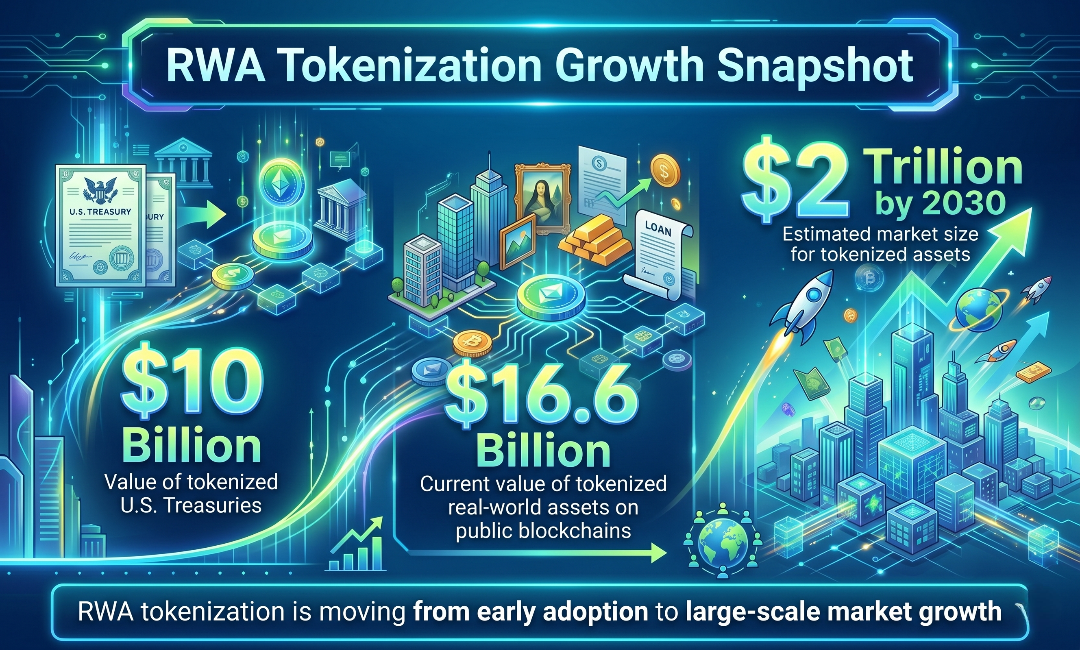
If you follow finance or crypto, you have likely seen the term RWA tokenization more often in recent years. That interest is backed by real numbers. Public blockchain data shows about $16.6 billion in tokenized real-world assets, and tokenized U.S. Treasuries alone account for nearly $10 billion. Market forecasts also point to rapid growth. Estimates suggest tokenized assets could reach around $2 trillion by 2030, excluding cryptocurrencies and stablecoins. These numbers show that RWA tokenization is not a passing trend. It reflects a shift in how people think about ownership and investing. For years, traditional finance relied on paperwork, middlemen, and limited access. Now, digital systems are opening access to a wider group of investors.
Traditional finance has clear limits. Buying property or bonds often needs large capital and long processes. Blockchain-backed ownership changes this setup. Ownership records sit on digital ledgers, and transfers need fewer steps. Transactions that once took days can now happen much faster.
Tokenization breaks large assets into smaller parts. Each part becomes easier to buy and sell. This allows people from different regions to invest in assets without large funds. A person can now own a share of property or other assets without buying the whole asset. This brings investment access closer to everyday users.
By 2026, the focus has shifted from learning to applying. Many regions now have clearer rules. Financial firms are entering this space with real use cases. Platforms are becoming easier to use. These changes are pushing RWA tokenization into wider use.
This topic matters to more than crypto users. Investors gain access to new asset types. Institutions can rethink how they manage and distribute assets. Everyday users can start with smaller amounts. Anyone interested in ownership or investing can benefit from understanding this shift.
Understanding the Basics of RWA Tokenization
A clear base helps before moving into details. RWA tokenization combines real-world value with digital systems. Once you understand the basics, the process becomes easier to follow.
What Are Real-World Assets (RWAs)?
Definition and scope of RWAs
Real-world assets are items that exist outside digital systems. These include physical goods and financial instruments. They carry measurable value and often produce income or hold ownership rights.
Categories: real estate, commodities, bonds, art, and more
RWAs cover many asset types. Real estate includes homes and commercial buildings. Commodities include gold, oil, and crops. Financial instruments include bonds and treasury bills. Art and collectibles also fall under this group when they hold value.
How RWAs differ from digital-native crypto assets
Crypto assets such as Bitcoin or Ethereum exist only in digital form. RWAs link to physical or legally recognized assets. This link adds value but also requires legal backing and verification.
What Does Tokenization Mean?
Breaking down physical ownership into digital tokens
Tokenization converts ownership into digital units. Each token represents a portion of an asset. Instead of buying an entire building, an investor can own a small share.
How blockchain enables fractional ownership
Blockchain stores ownership records in a shared system. This allows assets to be divided into smaller units. Investors can buy fractions instead of full assets. This reduces the amount needed to enter the market.
Key components: smart contracts, ledgers, and digital wallets
Smart contracts define rules for ownership and transfers. The ledger records every transaction. Digital wallets store tokens and allow users to manage them. These parts work together to support digital ownership.
RWA Tokenization in Simple Terms
A beginner-friendly analogy
Consider a large hotel valued at millions. Instead of one owner, it is split into thousands of shares. Each share is a token. Owning a token means owning part of that hotel. Investors can trade these shares as needed.
From physical asset to digital representation to tradable token
The process begins with a real asset. That asset is converted into a digital form on a blockchain. Tokens are then created and offered to investors. This turns a physical asset into something that can be traded online with ease.
How RWA Tokenization Works Step by Step
RWA tokenization follows a clear and structured process. Each step connects a physical asset to its digital version. The process starts with selecting the right asset and ends with ongoing management after tokens are issued.
Step 1: Asset Selection and Legal Structuring
The process begins with choosing an asset that has clear value and proper documentation. Assets like real estate, bonds, and commodities are often selected since they are easier to evaluate. Legal structure is then defined. Ownership must be clearly established before any token is created. Rules differ across regions, so compliance plays a major role. Without proper legal backing, the tokens will not represent real ownership.
Step 2: Digitization of Ownership Rights
Once the legal setup is complete, the asset is divided into smaller units. Each unit is converted into a digital token. This allows multiple investors to own a share of the same asset. Smart contracts define ownership and set rules for transfers. They also manage income distribution, such as rent or interest, based on how many tokens each investor holds.
Step 3: Token Issuance on Blockchain
Tokens are then issued on a blockchain network. This network records ownership and transaction history. Public blockchains allow open participation, while private ones limit access to selected users. Token standards like ERC-20 or ERC-721 define how these tokens function. These standards help maintain consistency and make tokens easier to use across platforms.
Step 4: Distribution and Trading
After issuance, tokens are sold to investors. This initial sale is known as primary issuance. Once distributed, tokens can be traded in secondary markets. Investors can buy or sell their shares without waiting for the entire asset to be sold. Digital platforms make this process simple, allowing users to manage their holdings in one place.
Step 5: Ongoing Management and Compliance
After tokens are in circulation, management continues. If the asset generates income, such as rent or interest, token holders receive their share. Smart contracts can automate these payments. At the same time, regular reporting and monitoring are required to meet legal standards. This keeps the connection between the digital tokens and the real asset valid over time.
Types of Real-World Assets Being Tokenized in 2026
By 2026, RWA tokenization covers many asset types. Any asset with value and legal ownership can be represented in digital form. This has expanded the market beyond early use cases and attracted a wide range of investors.
Real Estate Tokenization
Real estate remains one of the most active areas. Property has always attracted investors, but it requires large capital and long timelines. Tokenization divides ownership into smaller shares, which makes entry easier. Residential properties such as homes and apartments appeal to those seeking rental income or long-term growth. Commercial properties such as offices and retail spaces may offer different income patterns. Fractional ownership allows investors to buy a portion of a property instead of the whole asset, which reduces cost and spreads risk.
Financial Instruments
Financial instruments fit well into tokenization since they already follow structured systems. Bonds and treasury bills have fixed returns and timelines, which makes them easier to convert into tokens. Investors can buy smaller portions instead of committing large amounts. Private credit also becomes more accessible through token division. Tokenized securities, including stocks and fund shares, are gaining attention as more institutions enter this space and expand distribution.
Commodities and Natural Resources
Commodities such as gold, oil, and agricultural products hold recognized market value. Tokenization allows these assets to be represented digitally. Gold-backed tokens often represent a fixed quantity of metal, which removes the need for physical storage. Oil and agricultural goods can follow similar models. One advantage is faster pricing updates, which helps investors react quickly to market changes.
Art, Collectibles, and Intellectual Property
Art and collectibles depend on rarity and demand rather than steady income. Tokenization allows these assets to be divided into shares, which opens access to more investors. NFTs represent digital items, while RWA tokens link to physical or legally recognized assets. Creators can also use tokenization to share ownership of their work, which creates new income options and allows investors to participate in high-value assets.
Emerging Asset Classes
New categories are entering the tokenization space as the market grows. Carbon credits are one example, where tokens represent emission rights or reductions. These assets are easier to track and trade in digital form. Infrastructure assets such as transport systems and energy networks are also being considered. Private equity, which often requires large capital and long holding periods, can be divided into smaller shares through tokenization. This expands access to asset classes that were once limited to large investors.
Ready to turn your real-world assets into digital investments?
Bring your assets to the blockchain with a secure and compliant tokenization process. Reach global investors, improve liquidity, and manage ownership with ease.

Key Benefits of RWA Tokenization
The growing interest in RWA tokenization is not based on hype alone. There are practical reasons why investors, businesses, and financial firms are paying attention. Traditional asset markets often come with high costs, limited access, and slow processes. Tokenization offers a different route by making ownership easier to divide, move, and manage in digital form.
Increased Liquidity for Traditionally Illiquid Assets
Many real-world assets are valuable, but they are not easy to sell quickly. Property, private funds, and certain debt instruments often require long negotiations, large buyers, and significant paperwork. Tokenization can help by breaking these assets into smaller parts that are easier to trade.
Unlocking value from real estate and private investments
Real estate and private investments often tie up money for years. That can be fine for long-term holders, but it limits flexibility. Tokenization creates a way for owners to sell part of an asset rather than the whole thing. It also gives buyers a chance to enter positions that were once too large or too slow-moving. In simple terms, it turns a heavy asset into something that feels lighter to move.
Fractional Ownership for Broader Access
This is one of the easiest benefits to understand. Instead of needing a large amount of money to buy an entire asset, investors can buy a portion of it through tokens. That changes who gets to participate.
Lower barriers to entry for retail investors
For many people, traditional asset markets feel like private clubs with high entry fees. Tokenization lowers that barrier by allowing smaller investment amounts. A person may not be able to buy a building, a bond portfolio, or a fine art piece in full, but they may be able to buy a fraction. This wider access brings more people into markets that were once reserved for institutions, funds, or wealthy individuals.
Transparency and Trust Through Blockchain
When ownership and transaction records are written to a blockchain, there is a permanent history of what happened and when it happened. That creates a record that participants can refer to when checking transfers, holdings, or payment history.
Immutable records and auditability
An immutable record means the transaction history cannot be casually edited after the fact. That matters in asset markets where trust and recordkeeping are serious concerns. For auditors, issuers, and investors, this can make tracking ownership more straightforward. It does not remove the need for legal verification in the real world, but it does create a consistent digital trail that can be reviewed more easily.
Faster Settlement and Reduced Costs
Traditional asset transfers can be slow and expensive. They often involve brokers, custodians, lawyers, clearing firms, and multiple checks across different systems. Tokenization can reduce some of that friction by placing ownership activity in one digital environment.
Eliminating intermediaries
Not every middle party disappears, but fewer handoffs can mean fewer delays and lower costs. In older systems, every extra participant adds time and fees. With tokenized assets, certain steps can be managed through code and shared digital records. That can simplify the process for both issuers and investors.
Near-instant transactions
In some tokenized systems, transactions can happen much faster than in traditional markets. Instead of waiting several business days for ownership to be updated and funds to settle, transfers may happen in a much shorter time frame. For investors, that means more flexibility. For businesses, it can mean less administrative drag and more efficient cash flow handling.
Global Market Accessibility
One of the most appealing parts of tokenization is that it is not tied to a single geography in the same way traditional finance often is. Digital platforms can reach users across borders, subject to local laws and restrictions.
Borderless investing opportunities
A tokenized asset can potentially be offered to eligible investors in different countries without relying on the old model of local-only distribution. That creates wider reach for issuers and more choices for investors. Someone in one region may gain access to an asset located on the other side of the world. It is similar to how online shopping expanded product access, except here the product is ownership itself.
The Role of Blockchain in RWA Tokenization
Blockchain is the system that makes RWA tokenization workable in practice. Without it, digital ownership would still depend on scattered databases, manual updates, and separate records held by different parties. Blockchain gives tokenized assets a shared digital environment where issuance, transfers, and recordkeeping can happen in one place.
Why Blockchain Is Essential
Blockchain matters because it gives participants a common record that can be checked by everyone with the right access. Instead of one institution holding the only version of ownership records, multiple parties can rely on the same ledger. This reduces confusion and lowers the chance of mismatched data.
Decentralization and trustless systems
Decentralization means the system does not rely on a single controlling party to maintain the record. A trustless system does not mean trust disappears completely. It means users do not have to depend only on a central administrator to confirm every transaction. The network rules and recorded data do much of that work. In RWA tokenization, this helps create a more consistent structure for asset issuance and transfers.
Public vs Private Chains for RWAs
Not all blockchains work the same way, and that matters for tokenized assets. Some are open to the public, while others are limited to approved participants. The choice depends on regulation, privacy needs, and the type of asset involved.
Trade-offs in transparency and control
Public chains are open and often easier to verify because activity can be viewed broadly. This can be useful when market visibility matters. Private chains offer more control and restricted access, which may be more suitable for regulated financial products or institutional use. Public chains may appeal to wider participation, while private chains may fit businesses that need tighter oversight. It is a trade-off between openness and control, and many projects choose based on their legal and operational needs.
Smart Contracts as the Backbone
Smart contracts are one of the main reasons tokenized assets can function with less manual effort. These are self-executing pieces of code that carry out actions when certain conditions are met. In RWA tokenization, they help define how assets behave once they are issued.
Automating compliance and transactions
Smart contracts can handle tasks such as ownership transfers, payment distribution, and investor restrictions. For example, a token may only be transferred to approved wallets, or income may be distributed automatically based on the number of tokens held. This reduces repetitive manual work and can make operations more consistent. It is a bit like having a digital rulebook that not only explains the rules but also applies them.
Interoperability and Cross-Chain Solutions
As tokenization grows, assets and platforms will not all live on the same blockchain. That creates a new challenge. Systems need ways to interact with one another if tokenized markets are going to function smoothly across different networks.
Connecting multiple ecosystems
Interoperability refers to the ability of different blockchains and platforms to work together. Cross-chain solutions help move data, value, or asset access between these systems. This matters because investors may use one platform while an asset is issued on another. If those systems cannot communicate, the market becomes fragmented. Better connections between networks can make tokenized assets easier to manage, trade, and integrate into broader financial activity.
RWA Tokenization vs Traditional Investment Models
RWA tokenization and traditional investing both deal with ownership, value, and returns. The real difference lies in how people enter the market, how assets are recorded, and how quickly they can be traded. Traditional models are familiar and widely accepted, but they often involve slow paperwork, more middle parties, and higher entry costs. Tokenized models use digital records and smaller ownership units, so the process feels more flexible for modern investors.
Comparing Ownership Structures
Traditional ownership usually sits in contracts, registries, custody records, or fund documents. The investor owns the asset through legal paperwork and institutional systems. In tokenized markets, ownership is represented by digital tokens on a blockchain. The legal claim still matters, but the investor interacts with a digital share of the asset. This changes how ownership is held and transferred. A person no longer needs to buy the full asset in many cases. They can buy a smaller portion and still gain exposure to its value.
Liquidity Differences
Liquidity is one of the most noticeable differences. Traditional assets such as property, private equity, or private funds can take a long time to sell. Buyers are fewer, paperwork takes time, and settlement often moves slowly. Tokenized assets try to reduce that delay by making ownership easier to transfer. In some cases, trading can happen far more often than in older systems. That does not mean every token will sell instantly, but it does create a market structure that feels more active and flexible.
Cost Structures
Traditional investing often comes with a long list of fees. Investors may pay brokers, custodians, legal teams, administrators, and fund managers. These charges can reduce returns over time. Tokenized systems can cut some of these layers by using shared digital records and coded rules for transfers and payments. There are still costs, such as platform charges, network fees, and compliance expenses. Even so, the structure is often simpler and easier to follow than older financial systems.
Accessibility and Inclusion
Traditional markets often favor large investors, institutions, and people with access to private networks. High minimum investments and long onboarding steps can keep regular investors out. Tokenization changes that by dividing assets into smaller units. A person who cannot buy a full property or a large bond position may still be able to buy a fraction. This matters since wider access gives more people a chance to take part in asset ownership and long-term wealth creation.
Real-World Use Cases and Success Stories
RWA tokenization is no longer just a concept discussed in crypto circles. It is being used in real markets across property, finance, government projects, and retail investing. These use cases show that tokenization can serve practical goals, not just speculative ones. As more examples appear, the market looks less experimental and more connected to everyday finance.
Tokenized Real Estate Platforms
Real estate remains one of the easiest use cases to understand. Property has long been attractive, but it usually requires large capital and a long holding period. Tokenized real estate platforms divide a property into digital shares that many investors can buy. This allows people to access residential or commercial assets without buying the whole property. Returns can come from rent, price growth, or both. The appeal is simple. Investors get exposure to property without taking on the full burden of ownership.
Institutional Adoption
Large financial institutions have started testing tokenized products in more serious ways. Banks, asset managers, and funds are looking at tokenized bonds, money market products, private credit, and fund shares. Their interest comes from practical reasons. Digital records can reduce manual work, and smaller investment units can widen distribution. Institutional participation gives the market more credibility and pushes it closer to formal standards and tighter compliance.
Government and Public Sector Initiatives
Public sector activity gives tokenization another level of relevance. Governments and public bodies have begun testing digital bonds and funding structures tied to public projects. Tokenized bonds can make issuance and distribution more direct. Infrastructure projects can use similar models when long-term capital is needed. These examples show that tokenization is not limited to private investment products. It can play a role in public finance and large-scale development.
Retail Investment Platforms
Retail platforms are bringing tokenized assets closer to everyday users. Through mobile apps and web platforms, people can review offerings, complete identity checks, and invest in smaller amounts through a single interface. This removes much of the friction found in older systems. For younger investors in particular, tokenized investing feels closer to the digital products they already use for payments, savings, and trading. As these platforms become easier to use, wider public interest is likely to grow.
How to Get Started with RWA Tokenization
Getting started in RWA tokenization requires care, even if the process looks simple on the surface. Investors, asset owners, and businesses all enter this market from different angles. Each group needs to understand its goals, risks, and responsibilities before taking action. The opportunity is real, but so is the need for proper legal structure, reliable platforms, and careful research.
For Investors
Investors are often drawn to tokenized assets by lower entry amounts and wider access. Still, buying a token is not the same as buying certainty. The first step is understanding what the token represents, what rights come with it, and how the underlying asset is managed. A good platform should explain ownership terms, reporting standards, and trading rules in plain language. Investors should look at asset quality, liquidity, issuer reputation, and platform compliance before putting money in. Spreading funds across different assets can reduce risk and prevent overexposure to one deal.
For Asset Owners
Asset owners can use tokenization to raise capital, divide ownership, or widen their investor base. This works best for assets with clear ownership records, strong documentation, and real investor appeal. The asset usually needs to sit inside a legal structure that supports token issuance. Then the digital side is added through smart contracts and platform tools. The legal side matters just as much as the technical side. If the ownership link is weak or unclear, the token loses value in practice. Asset owners need to think carefully about tax, reporting, investor rights, and long-term management.
For Businesses and Startups
For businesses and startups, RWA tokenization can be a business line in itself. Some firms want to issue tokens for asset owners. Others want to build trading platforms, custody tools, compliance systems, or reporting services. The first step is defining the exact problem the business wants to solve. A broad idea is not enough. The company needs the right legal structure, secure smart contracts, identity checks, payment systems, wallet support, and custody arrangements. Good infrastructure matters more than polished marketing. A platform will only last if it works well, follows the rules, and makes the process easy for users.
Conclusion
RWA tokenization is changing how people view ownership, access, and investment across global markets. It brings real-world assets into digital systems, reduces entry barriers, and creates new ways to trade and manage value. From property and bonds to emerging assets, the shift is clear and steady. Investors gain more choice, asset owners gain new funding paths, and businesses gain new opportunities to build in this space. As the market grows, proper legal structure, reliable platforms, and informed decisions will remain critical for long-term success. Blockchain App Factory provides RWA Tokenization Services that help businesses and asset owners convert real assets into secure digital tokens with full technical and compliance support.
Vimal J is the Head of Sales at Blockchain App Factory, with 10+ years of experience in sales, client strategy, and Web3 business growth. He helps startups, enterprises, and project founders choose the right blockchain solutions for their goals, bringing a practical market perspective to topics like token development, crypto launches, and Web3 adoption.