Key Insights
- AI models now generate direct income through APIs, subscriptions, and enterprise use.This shift is turning them into assets that can be owned, priced, and shared.
- Tokenization divides model value into smaller units that people can buy or trade.
It allows wider participation instead of limiting access to large investors. - Businesses can earn from models while still using them internally. They can also raise funds by offering tokens tied to future model performance.
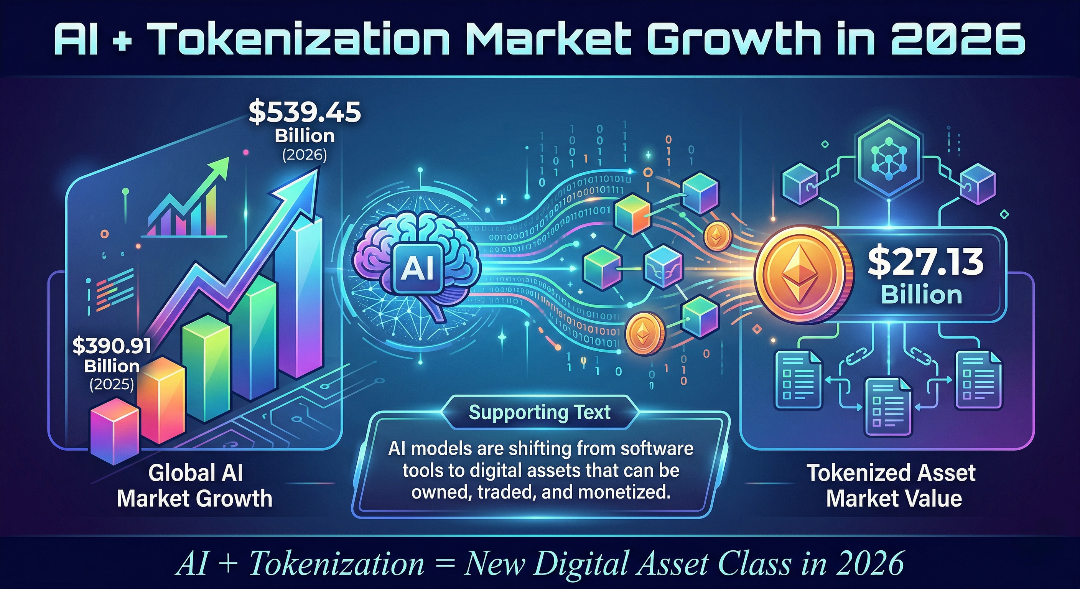
AI started as a tool. In 2026, many people see it as property. That shift matters. The global AI market was estimated at $390.91 billion in 2025 and is projected to reach $539.45 billion in 2026. At the same time, tokenized assets account for about $27.13 billion in distributed value across markets. These numbers show how fast digital assets are gaining real financial weight.
A useful model can write product copy, flag fraud, sort legal files, read scans, or answer support tickets. These tasks save time and generate income. Once a model reaches that level of output, people stop treating it as simple software.
Ownership becomes the next question. A company can own a model like it owns a patent or a revenue source. The model is no longer just a service with a monthly fee. It becomes something that can be priced, licensed, shared, or sold. This opens new paths for founders, investors, creators, and niche communities.
Older software followed a simple pattern. A business built a product, sold access, and kept the value inside the company. AI changes that. The model itself can earn through subscriptions, API calls, contracts, or custom deployments. The model becomes the asset, not just the interface around it.
Tokenization gives this asset a market structure. It divides ownership or revenue rights into digital tokens recorded on a blockchain. The model stays intact, but the value linked to it can be split into smaller parts. This makes buying, selling, and sharing much easier than traditional contracts.
Understanding AI Model Tokenization in Simple Terms
What Is AI Model Tokenization?
AI model tokenization means turning rights tied to an AI model into digital tokens on a blockchain. Those rights can cover revenue, access, governance, licensing, or partial ownership. A token is not magic. It is a digital record linked to a real claim.
Think about a model that earns money through API usage or business contracts. The income from that model can be tied to tokens. People who hold those tokens may receive a share of revenue, voting rights, or access to the model. The exact structure changes from project to project, but the basic idea stays the same. A model with value gets divided into digital units that people can hold or trade.
This does not always mean the model file becomes public. In many cases, the token represents legal and commercial rights, not a direct download link. That detail matters. In AI, ownership is rarely one simple thing. It often includes code, model weights, contracts, usage rules, and revenue claims.
Breaking Down Complex Models into Tradable Digital Units
Large AI models cost real money to develop. Teams spend on data, training, testing, storage, compute, and updates. That creates a high entry barrier. One buyer may not want to pay for the full asset. Tokenization solves that problem by dividing the value into smaller units.
This works much like company shares. The business stays one business, yet ownership is split into many parts. A tokenized AI model follows the same logic. The model keeps working as one system, but the rights linked to it can be split into pieces and sold to many people. That makes access wider and gives model owners a new way to raise funds.
It helps smaller investors too. They do not need to buy the whole model. They can buy a fraction tied to future revenue or usage. That shift matters in 2026, when more people want exposure to AI growth without backing a full startup round.
Tokenization vs Traditional Licensing Models
Traditional licensing follows a straight line. A company owns the model. A customer pays to use it. The contract sets the rules, and the company keeps control over the asset and most of the upside. That method still works, and many firms will keep using it.
Tokenization changes the structure. Instead of selling access alone, the project can split economic rights into tokens. Those tokens can represent a revenue share, a stake in governance, access to premium features, or a mix of all three. That opens the door to wider participation.
The difference is simple. Licensing rents out use. Tokenization divides value. One model can still serve customers through paid access, yet part of the income or ownership can sit in the hands of token holders. That creates a broader market around the model itself.
Why Tokenization Matters in 2026
The timing is not random. AI now produces direct commercial value across software, healthcare, media, finance, logistics, and law. At the same time, digital ownership systems have matured. People are far more comfortable buying and trading tokenized assets than they were a few years ago.
There is another reason this matters now. Many builders want more control over the models they create. Many buyers want exposure to AI value without buying stock in a private company. Tokenization meets both needs. It gives creators a funding path and gives investors a new asset type tied to actual model usage.
It opens the market to smaller participants too. That does not remove legal risk or price swings. It does make the field more open than older ownership models. For many people, that is the real appeal. They do not just want to use AI. They want a stake in it.
The Components Behind Tokenized AI Models
AI Models as Digital Assets
Before a model can be tokenized, it must be treated as an asset with clear value. Not every model fits this category. A basic chatbot with low usage has little market interest. A model that saves time, reduces cost, or brings new revenue stands in a different position.
Several types of models fit this idea. Language models handle writing, coding, and research tasks. Vision models work with images and video, often used in healthcare or retail. Speech models support voice assistants, transcription, and translation. Then there are niche models trained for specific industries such as finance, law, or logistics. These focused models often carry high value since they solve expensive problems.
Value comes from usage. If companies or users rely on the model daily, it starts to behave like a revenue-producing asset. That is the point where tokenization makes sense.
Ownership Rights: Weights, Datasets, and Architecture
Ownership in AI is layered. It is not just about one file. The model weights hold the learned patterns. The dataset used for training carries its own rights. The architecture defines how the model works. Each part can have different ownership rules.
A tokenized setup must define these rights clearly. One token may give a share of revenue without giving access to the model weights. Another may allow voting on updates but not commercial use. Some projects may offer full ownership rights, though that is less common.
Clarity matters here. If rights are unclear, the token loses meaning. Buyers need to know exactly what they are getting. A token linked to vague claims will not hold long-term value.
Blockchain Infrastructure
Blockchain records ownership and transactions. It acts as a public or private ledger that shows who holds which tokens and how they move between users. This record helps build trust since activity can be checked at any time.
Smart contracts handle the logic. These are small programs that run on the blockchain. They can send payments, record transfers, or apply rules without manual input. For example, if a model earns money through API usage, the contract can split that income and send it to token holders automatically.
Projects can choose between public and private blockchains. Public chains allow open access and easy trading. Private chains limit access and suit companies that need more control. The choice depends on the audience and how open the system needs to be.
Token Standards and Structures
The structure of tokens depends on what is being offered. Fungible tokens are identical units. Each one holds the same value and rights. This works well for shared ownership where many people hold small portions of a model.
Non-fungible tokens are unique. Each token can represent a specific model, a custom license, or exclusive rights. This fits cases where ownership is not meant to be divided evenly.
Some projects combine both. A token may provide access to the model, and another may handle governance or revenue rights. This split keeps things simple for users. Not everyone wants the same level of control or involvement. Some only want access, while others want a say in how the model evolves.
Step-by-Step Guide to Tokenizing an AI Model
Define the Model’s Value Proposition
Start with a simple question. Why does this model matter? If the answer is unclear, tokenization will not help. A model must solve a real problem. It can reduce costs, speed up tasks, improve accuracy, or create new revenue. Then check demand. Are people or businesses already paying for similar tools? If yes, what makes your model better? It could be faster, cheaper, or trained on better data. Numbers help here. If a model cuts support costs by 30 percent or reduces processing time by half, that is easy to explain and sell. A clear value makes everything else easier. Investors understand it faster. Users trust it more. Without that clarity, even a good model can struggle to gain traction.
Establish Ownership and Rights
Ownership must be clear from the start. Who owns the training data? Who owns the model weights? Who owns the outputs? If several people contributed, their shares must be written down. You also need to decide what the token represents. Does it give full ownership of the model, or only access and revenue rights? Licensing-based tokens give usage benefits without ownership. Full ownership tokens give wider control but bring more legal responsibility. Clear rules prevent problems later. If rights are unclear, disputes can arise, and trust drops fast. Buyers want to know exactly what they hold. A token must point to something real and well defined.
Choose the Right Blockchain Platform
The blockchain you choose affects cost and user experience. Some networks charge low fees and process transactions quickly. Others have higher costs but larger user bases. You need to balance both. Ask a few direct questions. Can users afford the transaction fees? Can the system handle high usage without delays? Can tokens move across different platforms? Public blockchains offer open access and active trading. Private networks offer more control and privacy. The choice depends on your audience. A public project often benefits from visibility. A company-focused model may prefer a closed system.
Design the Tokenomics
Tokenomics defines how value flows. You decide the total supply, pricing, and distribution. How many tokens will exist? Who gets them? Founders, developers, early backers, and users all need a share. Revenue distribution is just as important. If the model earns money, how do token holders benefit? Some projects pay out earnings directly. Others rely on token demand to increase value. Keep it simple and fair. If users cannot understand how rewards work, they will lose interest. Clear rules keep people engaged over time.
Deploy Smart Contracts
Smart contracts handle the system logic. They record ownership, process transactions, and distribute income. Once deployed, they run automatically. For example, when a user pays to access a model, the contract can split that payment and send shares to token holders. This removes manual work and reduces delays. Testing is critical. A small error can lead to financial loss. Contracts must be checked before launch. A reliable contract builds trust since users know the system works as expected.
Launch and Distribute Tokens
After setup, tokens need to reach users and investors. This usually happens through an initial sale. Early buyers take more risk, so they often get lower prices or added benefits. Community matters at this stage. A strong early group can push adoption faster. People trust projects that show active participation and clear communication. This step is not just about selling tokens. It is about building confidence. If people believe in the model, they are more likely to use it and support its growth.
Monetization Strategies for Tokenized AI Models
Pay-Per-Use Model Access
Pay-per-use is simple and direct. Users pay each time they use the model. This often happens through API calls. Businesses prefer this method when they want flexibility without long-term commitments.
Some projects use tokens as credits. Users buy tokens and spend them for access. This creates a direct link between usage and token demand. If the model becomes popular, demand for tokens rises as well.
Revenue Sharing for Token Holders
Many tokenized models share income with token holders. If the model earns from usage or contracts, a portion goes back to those holding tokens. This creates passive income. Early supporters benefit the most since they hold tokens at lower entry points. As usage grows, payouts can increase. It aligns incentives. Developers want the model to succeed. Token holders want higher usage. Both sides work toward the same goal.
Licensing and Enterprise Deals
Large companies often prefer structured agreements. Tokenized models can still support this. Businesses can pay for dedicated access or custom features. Revenue from these deals can flow back to token holders. This creates two income streams. One from general users and another from enterprise clients. This setup works well for specialized models. A financial or medical model may attract fewer users but generate higher-value contracts.
Secondary Market Trading
Tokens can be traded after launch. Prices change based on demand and model performance. If a model gains traction, token value may rise. If interest drops, prices can fall. Liquidity matters here. Some platforms offer pools where users can buy and sell tokens easily. Exchanges can list tokens for wider access. This adds another layer of activity. Some participants focus on long-term income. Others trade based on market trends. Both play a role in shaping token value over time.
Ready to turn your AI model into a tradable digital asset?
Build, tokenize, and launch your AI model with the right structure, ownership setup, and revenue strategy. From concept to deployment, get expert support at every step.

Key Benefits of AI Model Tokenization
Unlocking Liquidity
AI models often sit inside companies and generate value quietly. They are hard to sell or divide in a practical way. Tokenization changes that by breaking the value into smaller units that people can buy and trade. This creates liquidity. Owners can sell a portion of the model instead of giving up full control. They can raise funds, bring in partners, or exit partially without shutting down the project. It works like dividing a large property into smaller plots. Each part becomes easier to sell, and more people can take part.
Democratizing AI Investment
AI investment used to sit with venture funds and large firms. Entry costs were high, and access was limited. Tokenization lowers that barrier. Smaller investors can take part without needing large capital. This shift spreads opportunity. A successful model no longer benefits only the founders and early backers. A wider group can share the upside. That does not remove risk, but it changes who can participate. More participants also bring more attention to projects. When people have a stake, they pay closer attention to performance and growth.
Incentivizing Innovation
Developers work differently when they have a financial stake in what they build. Tokenization connects effort with reward. Contributors, researchers, and even data providers can earn based on the value of the model. This creates a direct link between improvement and income. If the model performs well, everyone involved benefits. That pushes teams to refine, test, and update more often. It also attracts talent. Skilled developers prefer systems where their work can generate long-term returns instead of one-time payments.
Transparency and Trust
Blockchain records track ownership, transactions, and revenue flows. Anyone can check how tokens move and how income is shared. This reduces reliance on private reports or closed systems. Clear records build trust. Investors can see where money flows. Users can verify activity without depending on a company’s internal data. This level of visibility helps reduce disputes. When rules and transactions are recorded openly, it becomes harder to manipulate or misreport outcomes.
Real-World Use Cases of Tokenized AI Models
AI-as-a-Service Marketplaces
AI platforms are shifting toward marketplace models. Instead of one company offering a single tool, multiple models are listed in one place. Users can pick a model, pay for usage, and switch when needed. Tokenization adds a financial layer to this setup. Each model can have its own token linked to usage or revenue. Developers can earn directly when their model is used. For users, the experience is simple. They choose a model, pay, and get results. For developers, it removes the need to depend on large platforms for distribution.
Industry-Specific Models
Some models focus on narrow industries. Healthcare, finance, and legal services often need high accuracy and reliable data. These models can carry high value even with fewer users. Tokenization supports funding and ownership for these projects. A medical model trained on rare datasets can generate income from hospitals or research labs. Tokens can link investors and contributors to that income. This creates a direct connection between expertise and financial return. The more useful the model, the higher its value.
Community-Owned AI Models
Open-source AI relies on shared effort. Many contributors build and improve models together. The challenge has always been reward distribution. Tokenization changes that. Contributors can receive tokens tied to their work. These tokens can represent ownership, revenue share, or voting rights. This keeps contributors engaged. People stay involved when they see long-term value. Decisions can also become more collective, with token holders voting on updates and changes.
Creator Economy Integration
Creators are starting to treat AI tools as personal assets. A writer, designer, or educator can train a model based on their work. That model can then be shared with an audience. Tokens allow fans to access the model or share in its income. For example, a creator can offer a writing model trained on their style. Users pay to use it, and token holders benefit from that usage. This creates a new income stream. Instead of selling only content or courses, creators can earn from tools linked to their expertise.
How Businesses Can Leverage Tokenized AI
Creating New Revenue Streams
Many businesses already use AI internally. These models often solve real problems and save costs. With tokenization, those same models can generate external revenue. A company can offer access to its model without selling it بالكامل. Tokens can represent usage rights or revenue share. This allows the business to earn while keeping control of the asset. For example, a logistics firm with a demand prediction model can offer access to other companies. Each use generates income tied to the model.
Reducing Development Costs
AI development requires data, compute power, and ongoing updates. Costs can grow quickly. Tokenization offers a way to raise funds during development. Companies can issue tokens linked to future performance. Early supporters provide capital in return for potential income. This spreads financial risk across a wider group. It works like crowdfunding, but with a clearer link between contribution and reward. If the model succeeds, early backers benefit directly.
Building Ecosystem Loyalty
When users hold tokens, their role changes. They are no longer just customers. They have a stake in the product’s success. This leads to stronger engagement. Token holders often promote the model, give feedback, and support its growth. Their interests align with the business. Communities form around these models. These groups help expand usage and improve the product over time. For businesses, this reduces reliance on traditional marketing and builds long-term loyalty.
Conclusion
AI model tokenization is turning models into assets that people can own, trade, and earn from. It changes how value is shared across developers, investors, businesses, and users. Clear ownership, simple token design, and real demand decide whether a project succeeds. The space is still growing, so risks exist, but the shift toward shared ownership is hard to ignore. For teams that want to enter this space with the right structure and execution, Blockchain App Factory provides AI model tokenization services that help bring these ideas into real, working systems.

Vimal J is the Head of Sales at Blockchain App Factory, with 10+ years of experience in sales, client strategy, and Web3 business growth. He helps startups, enterprises, and project founders choose the right blockchain solutions for their goals, bringing a practical market perspective to topics like token development, crypto launches, and Web3 adoption.