Key Insights
- Tokenization and DeFi turn traditional financial products into programmable, on-chain assets with faster settlement, richer data, and stronger operational control.
- On-chain investment products can reduce manual work, widen investor access, improve distribution, and open new revenue models through digital-first product design.
- Firms need clear use cases, strong legal and technical foundations, and expert execution to launch secure and scalable on-chain products.
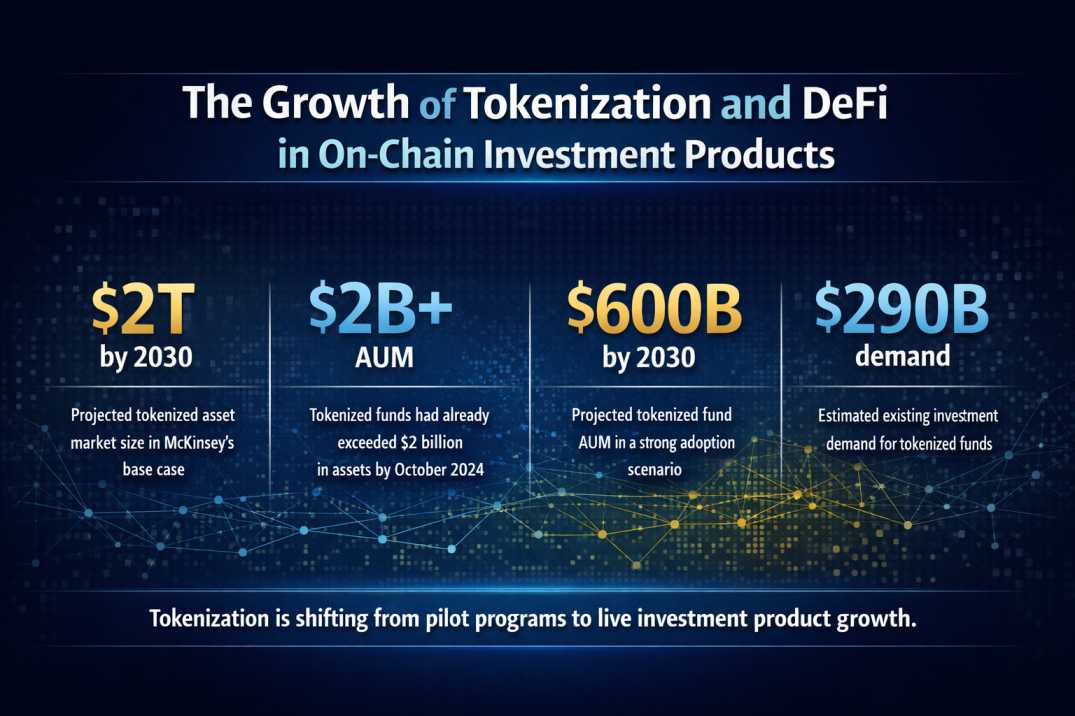
Tokenization and DeFi now sit at the center of a new phase in capital markets. Tokenization turns an asset into a blockchain-based unit of ownership or claim. DeFi adds software rules for transfer, settlement, pricing, and cash flow distribution. Together, they create investment products that can move faster, carry richer data, and serve investors through digital channels that never close. The market case is getting harder to ignore. McKinsey estimates that tokenized financial assets could reach about $2 trillion by 2030 in its base case, and BCG reported that tokenized funds had already passed $2 billion in assets under management by October 2024, with a path to more than $600 billion by 2030. These figures show that tokenized finance is moving out of the pilot stage and into product development, distribution, and revenue planning.
This shift matters to business leaders for a simple reason. Traditional product infrastructure still relies on fragmented ledgers, manual reconciliations, and limited operating hours. On-chain rails reduce those frictions. Industry research has shown that tokenized platforms can support real-time or near real-time settlement, reduce reconciliation work, and create new forms of contracting through smart contracts. That makes tokenization more than a branding exercise. It turns product design into a software problem with direct impact on cost, speed, and distribution. BIS has also described tokenized money market funds as a rapidly growing segment of DeFi, which signals that real capital is already flowing into on-chain financial products
Why Tokenization and DeFi Are Converging Now
The shift from pilot projects to scalable digital asset infrastructure
The market has moved past the stage where tokenization meant isolated proofs of concept. Institutions now have live products tied to government bonds, money market funds, and private market assets. Recent industry research has noted that tokenized money market funds have become a rapidly growing part of DeFi. Market forecasts also suggest that tokenized funds could see strong demand in the near term as asset managers adopt on-chain rails. These numbers show a commercial pattern, not just technical curiosity.
What businesses gain from combining tokenization with DeFi
Businesses gain three things from this convergence. First, they gain tighter operations. Issuance, transfer restrictions, distributions, and reporting can sit inside the product logic itself. Second, they gain new distribution paths. Fractional ownership and wallet-based access let firms reach investor segments that older fund rails often exclude. Third, they gain products with stronger utility. A tokenized fund share can serve as an investment, a source of collateral, or a building block inside a treasury workflow. Recent market analysis points to these features as major reasons institutions are testing tokenized assets and tokenized cash at the same time.
Why this matters for asset managers, fintechs, exchanges, and banks
This trend carries special weight for asset managers, fintechs, exchanges, and banks. Asset managers can package funds in forms that settle faster and report more cleanly. Fintechs can build investment products into apps that already own the customer relationship. Exchanges can create secondary venues for approved participants. Banks can issue, custody, and settle tokenized instruments on infrastructure that supports programmable cash. The firms that learn these rails early will shape product standards for the next cycle of digital finance.
What Are On-Chain Investment Products?
On-chain investment products are financial instruments issued and managed through smart contracts. The token records ownership or entitlement. The code handles product actions such as minting, transfer checks, fee collection, income payouts, and redemptions. In plain terms, the product is not just represented on a blockchain. Part of its operating logic lives there too. This definition fits both traditional assets such as bonds and newer structures such as tokenized fund shares.
Examples of on-chain investment products
Examples already exist across several categories. Tokenized money market funds are among the clearest proof points. Industry reports have documented their growth and their role inside DeFi activity. Private credit, real estate interests, treasury products, and fund shares have all entered tokenized form in live market settings. The appeal is clear. Investors get faster access and more transparent records. Issuers get tighter control over eligibility rules and servicing events.
How they differ from traditional digital investment products
These products differ from traditional digital investment products in one key way. Older systems digitized records. On-chain systems digitize the asset and its operating rules in the same environment. That allows atomic settlement, direct audit trails, and machine-driven compliance checks. It does not remove legal, custody, or risk work. It changes where that work happens and how quickly firms can execute it. For decision-makers, that is the real promise of tokenization meeting DeFi: investment products that act more like software, yet remain tied to real assets, real controls, and real revenue models.
The Business Case for On-Chain Investment Product Development
Operational efficiency and cost reduction
On-chain investment products solve an old problem in finance. Too many systems still sit in separate silos. Issuers, custodians, fund administrators, transfer agents, and distributors often keep their own records. Staff then match those records by hand or through batch files. This process takes time, adds cost, and raises the risk of errors.
Tokenization changes that model. A shared ledger records ownership, transfers, subscriptions, redemptions, and payout events in one place. Smart contracts can process key actions through preset rules. A fund token can block an ineligible wallet, calculate fees, and release a distribution without a chain of manual approvals. Firms still need oversight and controls, but the daily operating load drops. That reduction matters most in products with many investors, frequent transactions, or strict transfer limits.
Liquidity, distribution, and market access
Traditional investment products often suffer from narrow distribution. High minimums keep many buyers out. Limited trading windows slow activity. Cross-border access adds another layer of friction. On-chain rails open a wider market. A tokenized product can support smaller ticket sizes, near real-time transfer records, and direct access through digital wallets or regulated platforms.
Liquidity does not appear on its own. It needs market makers, approved venues, and buyer demand. Yet tokenization gives issuers a stronger base for liquidity than static paper records or closed databases. It creates a format that other financial systems can read and process. That format can support trading, collateral use, and treasury operations. For firms that want broader investor reach, this matters more than the technology label itself.
Product innovation and new monetization models
The strongest business case sits in product design. Tokenization lets firms build investment products that do more than hold value. A tokenized fund interest can distribute income on a fixed schedule. A private credit token can carry loan data, servicing status, and eligibility controls. A treasury product can plug into cash management workflows and serve as collateral in approved settings.
This opens new revenue paths. Firms can charge issuance fees, servicing fees, platform fees, and distribution fees on digital rails that run all day. They can offer white-label products to banks, brokers, or fintech apps. They can build niche products for accredited investors, treasuries, or family offices. The result is not just a faster version of the old product. It is a product with more utility and more ways to earn.
Strategic risks of waiting too long
Delay carries a price. Competitors that start early learn how to handle legal structuring, custody, smart contract controls, and investor onboarding. That knowledge compounds. Early entrants build partner networks and shape buyer expectations. Late entrants then face a market with fewer degrees of freedom.
There is another risk. Firms that wait often end up buying systems built around someone else’s product model. That weakens control over fees, data, and customer relationships. On-chain finance still sits in an early stage, but the design choices made now will define market structure for years.
Ready to build on-chain investment products?
Turn tokenization and DeFi into a secure, market-ready investment product

Tokenization + DeFi Architecture: The Core Building Blocks
Asset layer
The asset layer answers the first commercial question: what value sits behind the token? It can be a fund share, bond, private loan, real estate interest, treasury bill, or revenue stream. The legal claim must be clear. The cash flows must be clear. The rights of token holders must be clear. A weak asset layer breaks the whole product, no matter how polished the code looks.
Token layer
The token layer converts those rights into programmable units. This layer defines supply, divisibility, transfer rules, minting, burning, and redemption. It sets the product’s mechanical behavior. For investment products, this layer often needs permission controls. Not every wallet should hold every token. That is why many issuers use token standards or custom contracts that support restrictions tied to identity and jurisdiction.
Compliance and identity layer
Compliance sits near the center of every serious on-chain investment product. KYC, AML, accreditation checks, sanctions screening, and investor categorization must connect to the token logic. This turns compliance from a separate checklist into a working part of the product. A transfer can fail at the smart contract level if the receiving wallet lacks approval. That lowers legal risk and reduces dependence on post-trade cleanup.
Settlement and cash layer
A tokenized asset still needs a cash leg. Subscriptions, redemptions, coupon payments, and income distributions must settle in money that the market accepts. Stablecoins, tokenized deposits, and linked bank rails all play a role here. The choice affects speed, geography, counterparty risk, and user experience. A product aimed at institutions often needs bank-grade settlement paths and strong fiat connectivity.
Data, oracle, and valuation layer
Many investment products depend on outside data. Private credit needs servicing data. Bond products need price and rate feeds. Fund products need NAV data. That information reaches the chain through oracles or trusted reporting systems. Poor data design creates valuation errors, broken redemptions, and legal disputes. Good data design builds trust in the product and supports auditability.
Custody, governance, and access layer
Custody and governance define who controls the product and how users reach it. Some issuers rely on qualified custodians. Others give investors wallet-based access through controlled platforms. Governance rules cover upgrades, emergency actions, fee changes, and operational roles. This layer matters just as much as the smart contract. Investors and regulators want to know who can change the rules and under what conditions.
A Practical Framework for Developing On-Chain Investment Products
Step 1: Define the commercial use case
Every strong product starts with a market need. A firm may want to distribute a fund to new investor groups. It may want to package short-term yield for corporate treasuries. It may want to digitize private market interests with clearer servicing and reporting. The use case must tie directly to revenue, distribution, or cost reduction.
Step 2: Select the legal and regulatory model
The legal model defines the product’s shape. Is the token a fund interest, security, note, or contractual claim? Which investors can buy it? Which jurisdictions can access it? These questions must be settled early. Legal ambiguity spreads into every later stage.
Step 3: Choose the blockchain and protocol design
The next step is platform choice. Public chains offer reach and composability. Permissioned systems offer tighter control. Hybrid models sit between those poles. The choice should reflect product goals, privacy needs, cost, and market access.
Step 4: Design token economics and lifecycle events
This stage sets the rules for issuance, transfer, fee accrual, payouts, redemption, and retirement. The mechanics must match the legal structure and business model. Clean lifecycle design prevents confusion in live operations.
Step 5: Build compliance directly into workflows
Compliance should not sit outside the product. It should sit inside transfer logic, onboarding, monitoring, and reporting. That makes the product safer and easier to run at scale.
Step 6: Integrate custody, payments, and reporting
A live product needs more than a token contract. It needs custody, cash movement, investor reporting, accounting support, and service channels. Firms that ignore this step end up with a token that no institution wants to touch.
Step 7: Launch with phased market adoption
The best launches start small. A pilot with one asset class, one investor segment, and a controlled distribution plan gives the issuer room to test operations. Then the firm can expand into new channels, new products, and broader liquidity paths with real market data in hand.
Tokenization vs Traditional Product Infrastructure
Issuance and administration
Traditional product infrastructure grew through layers of custodians, fund administrators, transfer agents, and internal record systems. Each layer serves a purpose, but the full chain creates delay and duplication. Subscription records, ownership updates, fee calculations, and investor notices often pass through separate teams and separate databases. That model works, but it carries labor cost and reconciliation risk.
Tokenized product infrastructure changes the operating model. The product can issue digital units on a shared ledger, record ownership in near real time, and apply transfer rules through code. McKinsey has described this shift as a move from pilot work toward scale, with firms seeking programmability, transparency, and lower friction across asset servicing. For issuers, that means fewer handoffs and cleaner product data. For investors, that means faster confirmation and a record that is easier to verify.
Settlement and servicing
Settlement is where the gap between old and new infrastructure becomes clear. Traditional systems still rely on delayed settlement cycles, cash movement across banking rails, and post-trade reconciliation. A tokenized product can pair asset transfer with digital cash or a linked payment rail. That creates a tighter servicing loop. Coupon payments, income distributions, redemptions, and corporate actions can follow preset rules and recorded events.
The benefit is not magic. The benefit is simpler process design. McKinsey has noted that tokenization reaches its full value when cash settlement improves too, and BIS has argued that tokenized platforms can support new market structures with more direct settlement logic. This matters most in products with frequent flows, strict investor eligibility checks, or cross-border activity. The more manual touchpoints a product has today, the more value on-chain servicing can create.
Distribution and investor access
Traditional product distribution often runs through a narrow set of banks, brokers, and private placement networks. Entry points stay limited, minimum tickets stay high, and trading windows follow local office hours. Tokenization does not erase legal limits, but it can widen the distribution model. A tokenized fund or note can reach approved investors through digital platforms, support smaller allocations, and move across compatible systems without rebuilding the product each time.
This shift already shows up in tokenized funds. BIS reported in 2025 that tokenized money market funds were growing fast inside DeFi and hybrid market structures. BCG said in late 2024 that tokenized funds were seeing potential demand of about $290 billion in the near term. Those figures point to investor appetite for products that combine familiar asset exposure with faster digital access.
Where traditional systems still have an edge
Traditional systems still hold advantages in several areas. Legal precedent is deeper. Service providers are more mature. Large institutions know how these systems behave under stress. That matters for complex products, large fund ranges, and heavily regulated investor groups. A transfer agent with decades of operating history still carries weight in boardrooms and compliance teams.
There is a second advantage. Legacy rails connect to the full stack of fund accounting, tax reporting, registrar services, and distribution contracts. Tokenized infrastructure is improving fast, but many issuers still run in a hybrid model. BIS made this point in its review of tokenized money market funds. The product may sit on-chain, yet parts of repo, cash, and administration still sit off-chain. That is why firms should compare real operating fit, not just technology appeal.
Decision matrix for businesses
A business should ask five direct questions before it picks a model. Does the product suffer from heavy manual administration. Does it need stricter transfer control. Does it target new investor channels. Does faster settlement improve economics. Does the issuer want a product that can interact with digital cash or collateral systems.
A “yes” to most of those questions points toward tokenization. A “no” on most points suggests that a standard structure may still fit better. Hybrid design often wins in practice. The issuer keeps proven legal and servicing components, then adds tokenized issuance, investor permissions, or digital distribution where the value is highest. That is the pattern many institutional products follow today.
Want to launch secure on-chain investment products faster?
Conclusion
On-Chain Investment Product Development has become a serious business priority for firms that want faster servicing, cleaner data, stronger transfer control, and broader digital distribution. Traditional systems still serve many products well, but on-chain infrastructure gives issuers a better path for products that need programmable workflows, real-time records, and closer ties to digital cash and tokenized assets. The firms that act early can shape product standards, build stronger partner networks, and gain practical operating knowledge before the market becomes more crowded.
A clear rollout plan makes the difference. Businesses need a strong commercial use case, a legal structure that fits the product, and a technical design that supports custody, reporting, payments, and investor access. They also need a development partner that understands capital markets, compliance, and smart contract execution in equal measure. Blockchain App Factory can support that process through strategy, architecture, product design, and launch support for firms building the next generation of tokenized financial products. For companies that want to compete in digital finance, On-Chain Investment Product Development is no longer a side project. It is becoming a core part of product strategy.

Vimal J is the Head of Sales at Blockchain App Factory, with 10+ years of experience in sales, client strategy, and Web3 business growth. He helps startups, enterprises, and project founders choose the right blockchain solutions for their goals, bringing a practical market perspective to topics like token development, crypto launches, and Web3 adoption.