
Key Insights
- Stablecoins, RWAs, ZK privacy, perp DEXs, ETFs, and crypto cards reveal where users, developers, and institutions are focusing in 2026.
- Trends like stablecoin payments, RWA tokenization, DeFi trading, and crypto cards create commercial opportunities across finance, payments, asset management, and Web3.
- Companies that align products with emerging blockchain trends can enter markets faster, attract users earlier, and build stronger positions in Web3 industries.
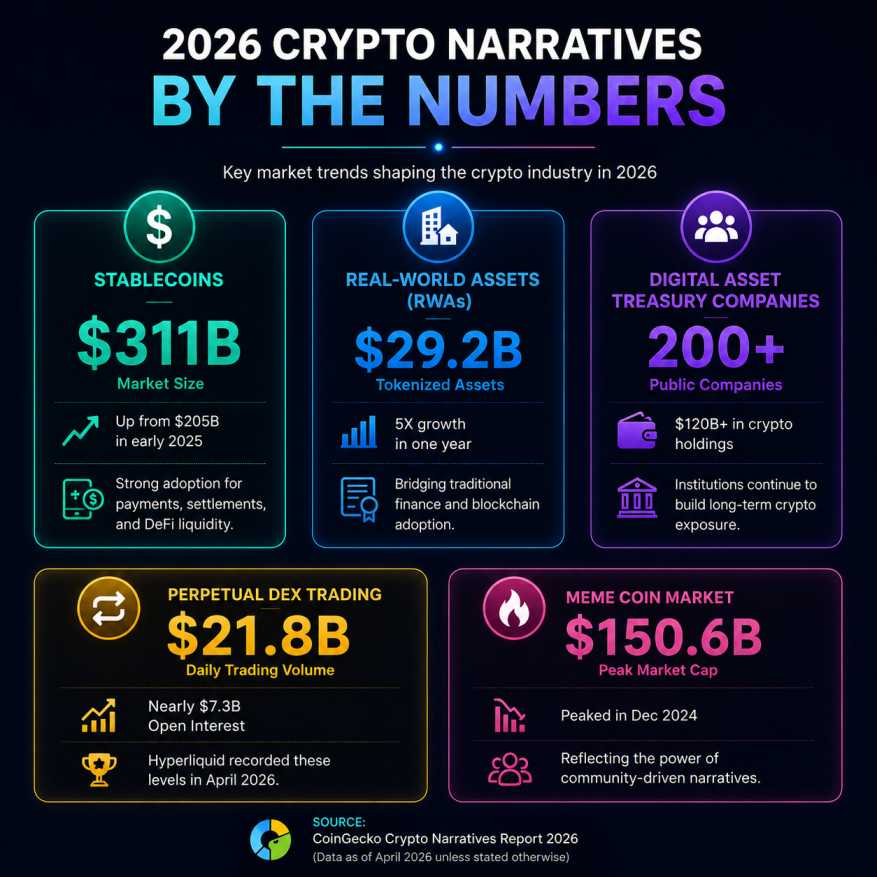
Crypto narratives are the market stories that guide attention, capital, and product demand. CoinGecko defines them as dominant themes that shape how investors value digital assets across a market cycle. The numbers behind these narratives already show massive market momentum. Stablecoin market value grew from about $205 billion in early 2025 to nearly $311 billion by April 2026. Tokenized real-world assets expanded from $5.5 billion to $29.2 billion during the same period. Digital Asset Treasury Companies now hold more than $120 billion in crypto assets across 200+ firms.
For 2026, CoinGecko highlights meme launchpads, ICO launchpads, prediction markets, privacy and ZK, perp DEXs, stablecoins, ETFs, RWAs, and crypto cards as key narratives shaping the industry. These trends matter far beyond trading. They show where users are moving, where developers are building, and where institutions are allocating capital. Companies that study these signals early can identify stronger product opportunities, enter new markets faster, and build long-term blockchain strategies with clearer commercial value.
What Are Crypto Narratives?
Crypto narratives are shared beliefs about which blockchain sectors will grow next. They turn complex technology into clear market themes. DeFi Summer in 2020 made lending, staking, and decentralized exchanges easier to understand. The NFT boom in 2021 did the same for digital ownership. AI crypto in 2024 linked machine learning with tokens, data, and compute markets. CoinGecko notes that narratives often drive price action before project fundamentals fully mature.
This does not mean every narrative has long-term value. Some narratives grow from culture, speed, and speculation. Meme coins fit this group. CoinGecko reports that the meme coin sector peaked near $150.6 billion in December 2024, then fell to about $33.7 billion by April 2026. That drop shows how fast attention-based markets can cool.
Other narratives come from clear business demand. Stablecoins are a strong example. CoinGecko states that stablecoin market value reached about $311 billion by April 2026, up from about $205 billion at the start of 2025. That growth reflects real use in payments, treasury, trading, and settlement.
Why Crypto Narratives Matter for Businesses
Businesses need crypto narratives for market timing and product design. A fintech company planning a payment product will read the stablecoin trend very differently from a trader watching short-term price charts. A real estate firm studying tokenization will care about legal structure, investor access, liquidity, and asset custody.
Narratives help leaders answer one practical question: where is demand forming now? The answer affects budget, hiring, platform design, and go-to-market plans.
Real-world asset tokenization shows this clearly. CoinGecko reports that tokenized RWAs grew from about $5.5 billion in early 2025 to $29.2 billion by April 2026. It also notes growth in tokenized private credit and real estate. For asset managers, banks, and real estate groups, this is not just a crypto trend. It points to new models for fractional ownership, faster settlement, and wider investor access.
Privacy and ZK proofs offer another business case. CoinGecko says ZK proofs now support identity checks and confidential DeFi use cases, not just scaling. Users can prove facts such as age or credit status without exposing private data. That matters for banks, exchanges, health platforms, gaming firms, and any business that needs both compliance and user privacy.
Ready to Launch a Product Around the Next Big Crypto Narrative?
Build scalable blockchain products aligned with the fastest-growing crypto trends of 2026, including stablecoins, RWAs, DeFi, crypto exchanges, and Web3 platforms.

How Crypto Narratives Influence Market Cycles
Crypto markets often move in waves. A theme gains attention, capital enters, token prices rise, builders follow, and users test new products. Then the market separates durable projects from weak ones.
This cycle can reward early movers, but it can punish poor planning. A company that launches a product only to chase hype risks wasted spend. A company that studies the underlying demand can build for longer use. Stablechains show this shift. CoinGecko describes them as blockchains built for stablecoin transfers and gas-less payments. It also cites projects from Circle, Stripe, Paradigm, and major banks that are building payment and clearing systems around stablecoins.
Perp DEXs show the same pattern in trading. CoinGecko reports that Hyperliquid alone had about $21.8 billion in 24-hour perpetual derivatives volume and nearly $7.3 billion in open interest as of April 2026. This signals demand for faster decentralized trading, deeper liquidity, and products that compete with centralized exchanges.
From Market Attention to Business Adoption
Market attention creates the first signal. Business adoption creates lasting value. The gap between both is where strategy matters.
Prediction markets offer a useful example. CoinGecko notes that these platforms expanded beyond politics into weather, corporate earnings, and on-chain metrics. A media company can use them to track sentiment. A fund can use them as a risk signal. A governance platform can use them to measure expected outcomes before votes.
The same logic applies to crypto cards. CoinGecko says crypto cards now let users spend wallet-held assets at Visa or Mastercard terminals with no manual top-ups. For fintech firms, this turns crypto from an investment product into a payment product.
Key Evaluation Framework for Decision-Makers
Business leaders should assess each crypto narrative with a clear filter:
- Market demand: Are users paying, trading, borrowing, or spending?
- Regulatory fit: Can the product work under current rules?
- Technical maturity: Is the infrastructure stable enough for real users?
- Revenue model: Can fees, subscriptions, spreads, or token models support the business?
- Security risk: Have smart contracts, custody, and data flows been tested?
- Adoption path: Can users understand the product without deep crypto knowledge?
The best crypto narratives for 2026 are not only popular. They connect capital, users, regulation, and practical use. Businesses that read these signals well can build products that meet demand early, reduce wasted effort, and create stronger positions in Web3 markets.
Top Crypto Narratives Defining 2026
Crypto narratives in 2026 show a clear shift from pure speculation to usable financial systems. CoinGecko’s updated 2026 list includes meme launchpads, ICO launchpads, prediction markets, privacy and ZK, perp DEXs, stablecoins, ETFs, RWAs, and crypto cards. These themes matter to businesses since they show where capital, users, and product demand are moving.
Meme Launchpads 2.0
Meme launchpads changed token creation in 2024 and 2025. Platforms like Pump.fun and LetsBonk.fun made it simple to launch tokens without code. CoinGecko reports that meme coin market value peaked near $150.6 billion in December 2024, then dropped to about $33.7 billion by April 2026.
The 2026 version focuses on fairer launches. Anti-sniper tools block bots from buying early supply. Bonding curves lock liquidity only after set market cap levels. Reputation systems reward real users over fake wallets. For brands, this points to new forms of community marketing. The risk remains high, but the business use case is clearer: tokenized engagement, fan communities, and viral Web3 campaigns.
ICO Launchpad Revival
The ICO model has returned in a more controlled form. CoinGecko says 2026 launchpads now use smart contract escrow and milestone-based fund release. Funds move to project teams only after agreed goals are met.
This model can help Web3 startups raise capital with more trust. It suits infrastructure projects, DeFi tools, gaming platforms, and tokenized marketplaces. Businesses planning token launches need strong tokenomics, KYC checks, legal review, and audited contracts. A modern ICO launchpad is no longer only a fundraising page. It works as a trust layer between builders and early backers.
Prediction Markets
Prediction markets gained attention during the 2024 elections. CoinGecko notes that they now cover weather, company earnings, and on-chain data. Platforms such as Polymarket use decentralized oracles like Chainlink to bring external data on-chain.
For businesses, prediction markets can become market intelligence tools. A fund can track sentiment around rate cuts or crypto approvals. A media firm can measure public expectations before major events. A DAO can use forecast markets before governance votes. The value comes from users risking money on their views, not just sharing opinions.
Privacy and Zero-Knowledge Proofs
Privacy has moved from a niche crypto feature to a business requirement. CoinGecko states that ZK proofs now support identity checks and confidential DeFi, not just blockchain scaling. A user can prove age, income band, or credit status without exposing private data.
This matters for banks, exchanges, healthcare firms, and enterprise platforms. They need compliance, but users still expect data protection. ZK tools can support private lending, secure identity, and permissioned DeFi. CoinGecko also reports renewed privacy coin interest, with Zcash up 691.3% and Monero up 143.6% in late 2025.
Perpetual Decentralized Exchanges
Perp DEXs are closing the gap with centralized exchanges. CoinGecko reports that Hyperliquid alone had about $21.8 billion in 24-hour perpetual trading volume and nearly $7.3 billion in open interest as of April 2026.
This growth shows demand for faster decentralized trading. Traders want deep liquidity, sub-second execution, cross-margin accounts, and more collateral choices. Businesses can build around liquidity tools, derivatives platforms, risk engines, and institutional DeFi trading products.
Stablecoins and Stablechains
Stablecoins are one of the strongest business narratives for 2026. CoinGecko reports that stablecoin market value reached about $311 billion by April 2026, up from about $205 billion at the start of 2025. USDT held about 59% market share, near $184 billion.
Stablechains take this further. These chains focus on stablecoin payments, gas-less transfers, and institutional settlement. CoinGecko cites Circle’s Arc, Stripe and Paradigm’s Tempo, and bank-led stablecoin projects in Europe and Japan.
For businesses, this is about payments. Stablecoins can support cross-border transfers, merchant settlement, treasury flows, and payroll. They can cut delays in markets where banking rails remain slow.
ETFs and Digital Asset Treasury Companies
Crypto ETFs bring digital assets into traditional brokerage accounts. CoinGecko says the ETF market expanded in 2025, with products tracking Bitcoin, Ethereum, Solana, XRP, Litecoin, and Hedera by late 2025. It also reports more than 126 crypto ETF applications under SEC review.
Digital Asset Treasury Companies add another layer. CoinGecko says this sector grew from 4 companies in 2020 to over 200 by late 2025, with more than $120 billion in digital assets. For businesses, the message is direct. Crypto is becoming part of public market finance, treasury planning, and investor access.
Asset Tokenization and Real-World Assets
RWA tokenization links blockchain with traditional assets. CoinGecko reports that tokenized RWAs grew from about $5.5 billion in early 2025 to $29.2 billion by April 2026. Private credit reached about $17 billion tokenized, and BlackRock’s BUIDL fund held more than $1.7 billion in assets.
This is one of the most practical narratives for enterprises. Real estate, bonds, invoices, commodities, and private credit can move on-chain. Businesses gain fractional ownership, faster settlement, and wider investor reach.
Crypto Cards
Crypto cards solve a basic adoption problem: spending digital assets. CoinGecko says 2025 and 2026 cards let users spend assets such as USDC or ETH at Visa and Mastercard terminals with no manual top-ups. The card liquidates only the needed amount at purchase.
This turns wallets into payment accounts. Fintech firms, exchanges, and Web3 brands can build card products with rewards, loyalty, and global spending access. It also brings crypto closer to daily commerce, where real adoption is measured by use, not only market price.
How Businesses Can Build Around 2026 Crypto Narratives
Businesses should treat crypto narratives as market signals, not slogans. CoinGecko’s 2026 list points to areas where users, builders, and institutions already show demand: stablecoins, RWAs, privacy, perp DEXs, ETFs, crypto cards, prediction markets, meme launchpads, and ICO launchpads. These themes shape capital flows and user behavior before full business maturity arrives.
A strong business plan starts with use case fit. A fintech company will gain more from stablecoins and crypto cards than from meme launchpads. A real estate firm should study RWA tokenization. A trading firm should assess perp DEX infrastructure. A data company should examine prediction markets.
Stablecoins offer the clearest commercial path. CoinGecko reports that stablecoin market value reached about $311 billion by April 2026, up from about $205 billion at the start of 2025. That growth supports payment products, treasury tools, merchant settlement, and cross-border transfers.
RWAs give asset-heavy businesses another route. Tokenized RWAs grew from about $5.5 billion in early 2025 to $29.2 billion by April 2026. Private credit reached about $17 billion in tokenized value. BlackRock’s BUIDL fund passed $1.7 billion in assets. These numbers show demand from institutions, not only crypto-native users.
Businesses should build with four rules:
- Match the narrative to a real customer problem.
- Test legal and compliance needs early.
- Use audited smart contracts and trusted custody.
- Design simple user flows for non-crypto users.
The strongest projects will turn narratives into products that save time, cut cost, or open new markets.
Curious about the next big crypto trends?
Challenges Businesses Should Consider
Crypto narratives move fast, but business execution moves through legal, technical, and financial checks. A trend that looks strong on social media can fail under compliance review. Meme launchpads show this risk clearly. CoinGecko reports that meme coin market value peaked near $150.6 billion in December 2024, then fell to $33.7 billion by April 2026. That fall shows how quickly attention-led sectors can lose value.
Regulation is the first challenge. Stablecoins, tokenized assets, ETFs, and crypto cards touch payments, securities, banking, and consumer protection rules. A company planning an RWA platform must define asset ownership, investor rights, transfer limits, custody, and disclosure standards. A crypto card product must address KYC, AML, chargebacks, tax reporting, and wallet security.
Security creates the second challenge. Smart contracts control funds directly. A coding flaw can freeze assets or drain liquidity. Perp DEXs add further risk through liquidation engines, oracle feeds, collateral rules, and high-leverage trading. CoinGecko notes that Hyperliquid reached about $21.8 billion in 24-hour perp volume and nearly $7.3 billion in open interest in April 2026. Scale brings revenue, but it also raises failure costs.
User trust is the third challenge. Crypto products often ask users to manage wallets, private keys, fees, and volatile assets. That creates friction for mainstream adoption. Crypto cards reduce this barrier by letting users spend wallet-held assets at Visa or Mastercard terminals. The card converts only the needed amount at purchase. This makes crypto feel closer to normal payments.
Businesses should not chase every 2026 narrative. They should rank each one by demand, regulation, build cost, revenue, and user trust. That filter prevents wasted budgets and weak launches.
Conclusion
Crypto narratives are shaping the next phase of blockchain adoption across finance, payments, tokenization, trading, and digital ownership. Stablecoins are transforming global payments. RWAs are bringing traditional assets on-chain. ZK technology is improving privacy and compliance. Perp DEXs and crypto ETFs are expanding institutional participation in digital assets.
Businesses that act early can turn these market shifts into real commercial opportunities. Companies that align their products with strong crypto narratives can attract users faster, enter emerging sectors earlier, and build long-term market value in Web3.
As a leading Blockchain App Factory, we help startups, enterprises, and crypto brands build scalable blockchain products tailored to evolving market trends. From token development and crypto exchange development to RWA tokenization, DeFi platform development, and Web3 marketing services, our team delivers end-to-end blockchain solutions built for growth in 2026 and beyond

Vimal J is the Head of Sales at Blockchain App Factory, with 10+ years of experience in sales, client strategy, and Web3 business growth. He helps startups, enterprises, and project founders choose the right blockchain solutions for their goals, bringing a practical market perspective to topics like token development, crypto launches, and Web3 adoption.