Key Insights
- They bring trading, custody, and account controls into one place, which cuts setup time and lowers operational friction.
- Large trading volumes can support better execution, tighter spreads, and easier entry for firms moving serious capital.
- Recent survey data and exchange volume growth point to rising interest from firms that want regulated market access.
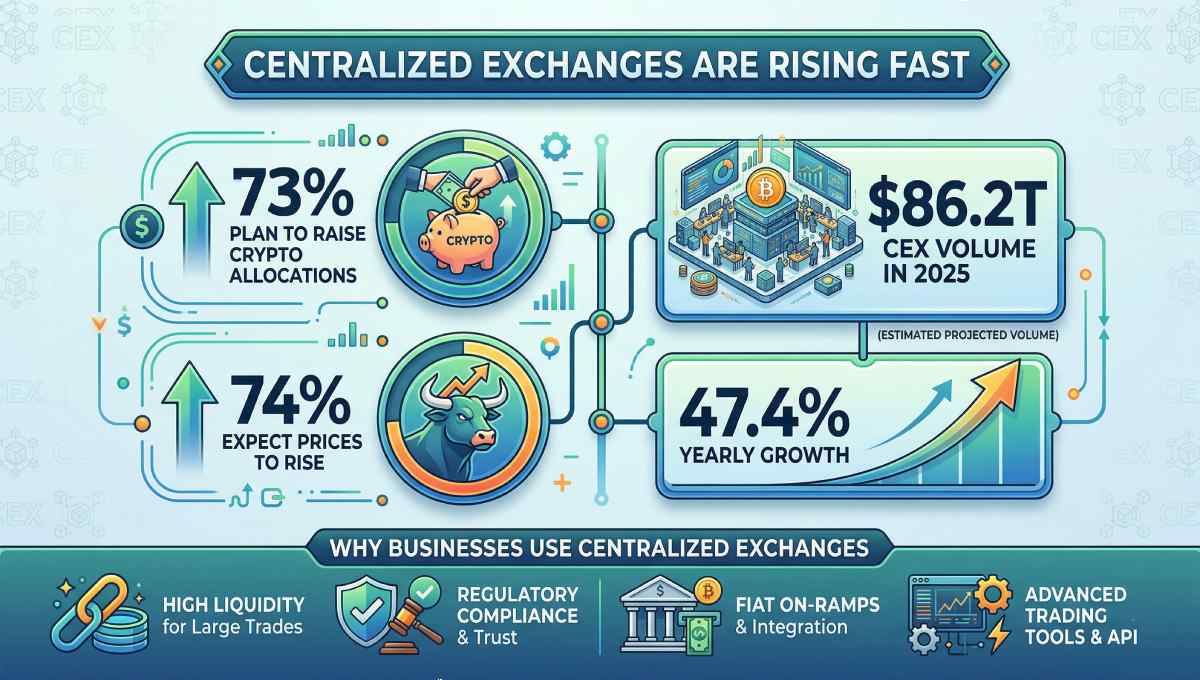
Digital assets are no longer a side topic for finance teams. They now sit inside boardroom discussions, treasury planning, and product strategy. In Coinbase and EY’s 2026 institutional survey, 73% of respondents said they plan to increase digital asset allocations in 2026, and 74% expect crypto prices to rise over the next 12 months. Those numbers show clear business demand, not casual interest. They point to a market where companies want exposure, but they also want structure, liquidity, and a safer way to enter.
Trading activity supports that shift. CoinGecko reported that centralized exchange perpetual trading volume reached $86.2 trillion in 2025, up 47.4% from 2024. That scale explains why the centralized exchange, or CEX, matters to modern businesses. A crypto exchange platform gives firms a managed route into digital asset markets, with one venue handling order matching, custody, and account controls. For fintech companies, payment firms, and institutions, that can mean faster market entry, deeper liquidity, and a more practical path to enterprise crypto trading.
What Is a Centralized Exchange (CEX)?
A centralized exchange is a digital trading platform run by one company that acts as the intermediary between buyers and sellers. That is the core CEX meaning. The platform holds custody of client assets, records balances on internal ledgers, and matches orders through its own trading engine. Coinbase explains that a CEX supports fiat-to-crypto and crypto-to-crypto trading pairs, which places it closer to a broker or securities venue than a peer-to-peer swap tool. This model gives users a familiar account-based experience and gives businesses one operating partner for trading, custody, and account controls.
Several traits define centralized exchanges. First, they usually follow a custodial model, so the platform controls wallet infrastructure and private key management. Second, they run a centralized order book that matches bids and asks in real time. Third, they often require KYC and AML checks before higher-value trading or fiat movement. Fourth, they offer managed governance, customer support, and service tiers for institutions. Kraken’s education content notes that many users pick centralized venues for a simpler and more user-friendly trading process than direct on-chain trading. That ease of use is a serious factor for companies that want clean workflows and lower operational friction.
Popular examples include Binance, Coinbase, Kraken, and KuCoin. Binance led the top 10 CEX market by volume in 2025, based on CoinGecko data. Coinbase positions its exchange around regulated access and institutional liquidity. Kraken markets API trading, OTC services, and institutional access. Together, these firms show how the modern crypto exchange platform now serves retail users, treasury teams, trading firms, and fintech builders in the same broad market.
How Does a Centralized Exchange Work? Step by Step Process
Registration and Compliance Come First
A centralized exchange runs like a managed trading venue. The company behind it controls onboarding, custody, trade matching, and settlement. That structure gives users a fast path from account setup to live trading. For businesses, this matters. Treasury teams, fintech firms, and funds need speed, records, and clear controls. A CEX offers all three in one place.
The process starts with registration and compliance. A user opens an account, shares basic details, and completes identity checks. Most platforms ask for a government ID, address proof, and risk screening. Business accounts face a stricter review. The exchange checks company registration, ownership, directors, and source of funds. Chainalysis notes that KYC and AML checks are now central to crypto compliance programs, especially for firms that move client funds or operate across borders.
Funding the Account Through Fiat or Crypto
Next comes funding. Users can deposit fiat through bank wires, ACH, or cards, then move to crypto trading from the same account. They can deposit crypto from an external wallet too. At this stage, the exchange records funds in custodial wallets that it controls. That setup removes friction for active traders, though it places asset security in the hands of the platform.
Orders Enter the Matching System
Trading begins once funds clear. A customer places a market order, limit order, or another order type. The exchange sends that order to its order book, where bids and asks sit in real time. Gemini explains that a central limit order book matches orders by price and time priority. This is one reason large exchanges can fill trades fast and keep pricing transparent.
Trades Settle on the Internal Ledger
After a match, the exchange updates balances on its internal ledger. No blockchain transfer needs to happen for every trade between users on the same platform. That design cuts delay and reduces on-chain costs. It is one reason centralized venues still dominate high-volume spot trading. For large firms, internal execution and settlement workflows can lower market impact, especially when smart routing and OTC desks are available. Coinbase Institutional says institutions often value routing and depth more than raw speed alone.
Withdrawals Complete the Cycle
The final step is withdrawal and settlement. A user can send crypto to an outside wallet or move fiat back to a bank account. That step triggers wallet checks, risk review, and network confirmation for crypto transfers. Behind the scenes, core technologies keep the system running. These include the matching engine, custody stack, liquidity aggregation tools, and APIs for institutional trading. API access matters for funds and trading desks that need automated execution, reporting, and account controls.
Core Components of a Centralized Exchange Infrastructure
The Trading Engine Drives Market Activity
The trading engine sits at the center of a CEX. It receives orders, ranks them, and matches buyers with sellers. The order book shows available prices and volumes, which helps traders judge depth before they place size. In liquid markets, this reduces price gaps and improves execution. Kraken explains slippage as the gap between the expected trade price and the final fill price, often tied to thin liquidity or fast price moves.
Custodial Wallet Systems Protect User Assets
Custody is the next core layer. Exchanges usually split assets between hot wallets and cold wallets. Hot wallets support daily deposits and withdrawals. Cold wallets stay offline and protect reserves from online attacks. Strong platforms add multi-signature controls, access limits, and manual approval steps for large transfers.
Liquidity Systems Improve Execution Quality
Liquidity systems shape trading quality. Exchanges rely on market makers, internal flow, and external routing to keep spreads tight. Deep books matter most for business users that move large orders. Kraken Pro promotes OTC execution for trades above $50,000 with deep liquidity and instant settlement services, which shows how platforms build separate workflows for larger clients.
Security Architecture Supports Trust and Control
Security architecture ties the whole stack together. Good exchanges use encryption, device monitoring, withdrawal screening, and incident response plans. They track unusual behavior, freeze suspicious activity, and review wallet movements in real time. For businesses, these controls are not just technical features. They are part of vendor due diligence, risk management, and audit readiness.
Centralized Exchange vs Decentralized Exchange (CEX vs DEX)
A centralized exchange and a decentralized exchange serve the same basic purpose. They let people trade digital assets. The trade path is very different. A CEX runs through a company that manages custody, order matching, account access, and compliance checks. A DEX runs through smart contracts and user wallets, so traders interact onchain without handing asset control to a platform operator. Coinbase defines a DEX as a peer-to-peer marketplace where trades occur directly between crypto traders. Kraken describes DEX trading as wallet-based and notes that many DEXs use automated market makers instead of a managed order book.
For most businesses, the real choice comes down to control, speed, liquidity, compliance, and operational risk. A CEX often feels closer to a traditional brokerage account. It supports fiat deposits, customer support, business verification, and familiar trading tools. A DEX gives direct wallet control and faster access to newly issued onchain assets, yet it asks users to manage keys, gas fees, wallet security, and smart contract risk on their own. Kraken notes that centralized venues are often the more efficient way to trade crypto, and Coinbase states that DEX assets can become tradable very quickly after launch.
That difference shapes business use. A treasury team or regulated fintech firm will often prefer a CEX for reporting, controlled access, and fiat settlement. A DeFi-native fund, token team, or onchain market maker may prefer a DEX for self-custody, direct blockchain access, and broader token availability. Investopedia adds that centralized exchanges are managed by single entities and often offer a more regulated entry point for general users, though counterparty risk remains part of the model.
| Feature | Centralized Exchange (CEX) | Decentralized Exchange (DEX) |
|---|---|---|
| Operating model | Run by a company or exchange operator ([Investopedia][1]) | Run through smart contracts and blockchain protocols ([Coinbase][2]) |
| Custody of funds | Platform holds user assets in custodial wallets ([Kraken Support][3]) | User keeps assets in a non-custodial wallet ([Kraken][4]) |
| Identity checks | KYC and AML checks are common, especially for fiat access and business accounts ([Investopedia][1]) | Many DEXs allow trading without KYC at the protocol level ([Kraken][4]) |
| Trading method | Central order book and matching engine are common ([Kraken Support][3]) | AMMs and liquidity pools are common, though some DEXs use order books ([Kraken][5]) |
| Fiat support | Strong fiat on-ramps and off-ramps through banks and cards ([Investopedia][1]) | Fiat support is limited and often handled by third-party tools ([Coinbase][2]) |
| Token availability | Asset listing is controlled by the exchange ([Coinbase][6]) | New onchain assets can appear for trading very quickly ([Coinbase][6]) |
| User experience | Easier for beginners and business teams that need managed access ([Investopedia][1]) | Better suited to users comfortable with wallets, gas fees, and self-custody ([Coinbase][2]) |
| Liquidity profile | Often deeper liquidity for major assets and large orders ([Kraken][7]) | Liquidity depends on pool depth and token pair activity ([Kraken][5]) |
| Speed and settlement | Fast internal execution, then withdrawal to chain if needed ([Kraken Support][3]) | Trades settle onchain and depend on network conditions ([Coinbase][2]) |
| Main risks | Custodial risk, exchange failure, compliance exposure, withdrawal restrictions ([Investopedia][1]) | Smart contract bugs, wallet loss, MEV exposure, thin liquidity in some pairs ([Investopedia][8]) |
| Best fit | Institutions, enterprises, beginners, fiat-heavy operations | DeFi traders, self-custody users, token discovery, onchain strategies |
Benefits of Centralized Exchanges for Businesses
High Liquidity and Market Depth
Centralized exchanges attract large pools of buyers and sellers, and that matters to businesses that trade size. Deep books cut slippage and keep pricing tighter during busy sessions. Coinbase says its exchange gives clients access to one of the deepest pools of liquidity among regulated crypto spot venues, with high-throughput APIs built for heavy order flow. CoinGecko’s January 2026 market share report shows how much activity still sits on major centralized venues. Binance alone held 38.3 percent of spot market share in December 2025, and top exchanges processed vast monthly volume. That scale helps a treasury desk move a large order with less price shock.
User-Friendly Interfaces and APIs
A business does not need a team of protocol engineers to start on a centralized exchange. That is one of the clearest commercial gains. Large platforms pair web dashboards with trading APIs, custody tools, reporting, and account controls. Coinbase says its Exchange API is built for high-volume trading and real-time market data. Its Prime APIs target institutions that need programmatic trading, custody actions, and automated operations. For a finance team, that means faster onboarding, cleaner internal workflows, and less manual work across wallets and reconciliations. The platform handles much of the market plumbing, so the business can focus on execution and risk.
Regulatory Compliance and Trust
Trust still shapes every business crypto decision. Centralized exchanges often build identity checks, transaction monitoring, and sanctions screening into the account opening process. FATF updated Recommendation 15 to clarify how anti-money laundering and counter-terrorist financing rules apply to virtual asset service providers. FATF’s 2025 update pressed for stronger global action in this sector, which shows how closely regulators watch exchange controls. Chainalysis notes that financial institutions entering crypto need clear compliance planning at each stage of rollout. For a board or compliance team, this structure lowers operational friction and gives a clearer audit trail than an informal over-the-counter setup.
Advanced Trading Features and Revenue Opportunities
Many centralized exchanges package services that go far past spot trading. Firms can access futures, financing, staking, and lending from one account stack. Coinbase Derivatives lists futures products across several contract types. Coinbase Prime and Coinbase Staking market custody-linked staking and financing to institutions. Kraken markets institutional staking and regulated custody with segregated assets. These tools create new revenue lines for exchanges through trading fees, custody fees, financing spreads, token listing programs, and liquidity incentives. They create new income options for business users too. A treasury team can earn protocol rewards on idle assets through staking, and a broker can route client flow through exchange APIs.
Want to build a stronger crypto trading strategy for your business?
Get guidance on exchange selection, liquidity access, and the steps needed to support enterprise crypto trading.


Vimal J is the Head of Sales at Blockchain App Factory, with 10+ years of experience in sales, client strategy, and Web3 business growth. He helps startups, enterprises, and project founders choose the right blockchain solutions for their goals, bringing a practical market perspective to topics like token development, crypto launches, and Web3 adoption.