Key Insights
- Tokenization allows individuals to invest in large energy assets with smaller capital. This opens participation beyond institutions to a wider global audience.
- Digital tokens make it easier to buy and sell energy asset shares. Investors gain faster entry and exit compared to traditional ownership models.
- Blockchain records ownership and transactions in a shared system. This improves trust by making asset data easier to verify and track.
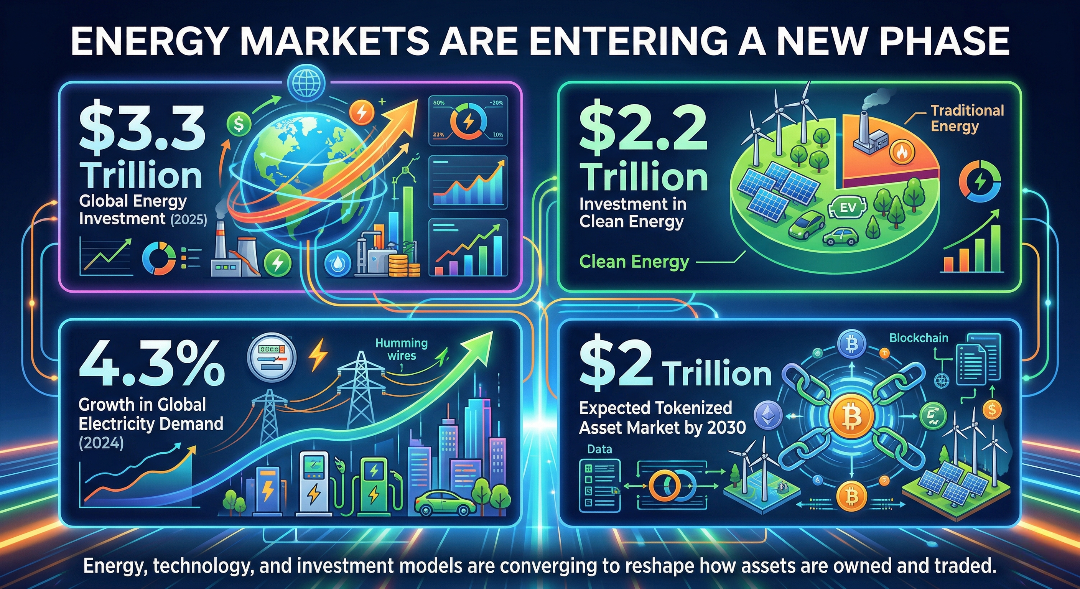
Energy markets are entering a quiet but massive shift. Global energy investment is expected to reach $3.3 trillion in 2025, with $2.2 trillion flowing into clean energy projects. This scale shows how fast the sector is evolving. Yet, access to these assets has remained limited for years. Owning oil fields, pipelines, or solar plants required large capital and insider access. That model is now changing. Ownership is no longer tied only to physical control or company shares. Digital tokens can represent portions of real energy assets. These tokens act as proof of value linked to something tangible. Instead of holding stacks of documents, investors hold digital units that reflect a share of an asset’s worth.
Why investors are moving from physical assets to digital tokens
Traditional energy investments often move slowly. Selling a stake in a project takes time, legal checks, and negotiations. This limits flexibility. Digital tokens change how ownership can be divided and traded. Investors can buy smaller portions and move them more easily. A large oil reserve can be split into thousands of units, each representing a fraction of the asset. This lowers entry barriers and improves speed. Transactions that once took weeks can now move much faster in digital form.
The convergence of blockchain, sustainability, and global energy demand
Energy demand continues to rise across regions. Global electricity demand grew by 4.3% in 2024, and further growth is expected in the coming years. At the same time, there is pressure to shift toward cleaner sources. Blockchain plays a role by recording ownership and transactions in a shared system. This allows investors from different locations to participate in renewable projects without being physically present. Clean energy, digital systems, and rising demand are now closely linked.
A quick preview of how tokenization is reshaping access, liquidity, and control
Tokenization changes how people access and trade energy assets. Entry becomes easier since investments can start at smaller amounts. Liquidity improves since tokens can be traded more freely than physical stakes. Ownership also spreads across a wider group of participants. Interest in this model is growing fast. Estimates suggest tokenized assets could reach $2 trillion by 2030, showing how digital ownership is gaining traction. This shift opens the market to more participants and changes how value moves within the energy sector.
What Is Energy Tokenization? A Simple Breakdown for Beginners
Understanding Tokenization in Plain Terms
Converting real-world assets into digital tokens
Tokenization means turning a physical asset into a digital representation. Take a solar farm as an example. Its total value is divided into many small digital units. Each unit represents a portion of the asset. These units exist on a blockchain, which records ownership. This allows multiple investors to hold shares of the same asset without owning the entire project. The idea is simple. A large asset becomes a collection of smaller parts that many people can hold.
How blockchain enables fractional ownership
Blockchain works as a shared record that stores every transaction. Each entry is visible and can be verified. This makes it easier to divide assets into smaller units without confusion. Ownership is tracked clearly, and transfers are recorded in sequence. Instead of buying a full wind turbine, an investor can hold a fraction through tokens. This opens participation to a wider group, not just large funds or corporations.
traditional shares and tokenized assets
Traditional shares represent ownership in a company. The value depends on the company’s overall performance. Tokenized assets can represent a direct link to a specific asset. This could be a solar panel, a storage unit, or a mineral reserve. Shares trade through stock exchanges and follow fixed market hours. Tokens can move through digital platforms with fewer intermediaries. The difference is simple. Shares connect you to a company. Tokens can connect you to the asset itself.
How Tokenization Applies Specifically to Energy and Natural Resources
Tokenizing oil reserves, solar farms, wind projects, and minerals
Energy and resource assets carry high value and often require large investments. Tokenization divides these assets into smaller units. Oil reserves can be linked to tokens that represent future output. Solar and wind projects can issue tokens tied to energy production. Minerals such as lithium and gold can also be represented digitally. This reduces the weight of ownership and makes access easier for more investors.
Representing production rights, revenue streams, or ownership stakes
Tokens can represent different types of value. Some reflect ownership in the asset. Others represent rights to income or production. An investor may receive a share of revenue from a wind farm or a portion of output from an oil project. This flexibility allows project owners to structure offerings based on their needs. Investors can choose between holding ownership or receiving income tied to performance.
Real-world examples of asset-backed tokens
Several projects already use token models linked to real assets. Some focus on solar energy output and pay returns based on electricity generation. Others link tokens to physical commodities with measurable quantities.
Why the Energy Sector Is Ripe for Tokenization
The Limitations of Traditional Energy Investment Models
High entry barriers and capital intensity
Energy projects require large upfront spending. Building a power plant or drilling site can cost millions. This limits participation to large firms and wealthy investors. Smaller investors rarely get access at early stages. Tokenization reduces this barrier by splitting ownership into smaller units. A project that once needed a single large investor can now involve many smaller participants. This opens the door for broader participation without changing the asset itself.
Illiquidity of energy infrastructure assets
Energy infrastructure does not move easily between buyers. Selling a stake in a pipeline or storage facility takes time and effort. Legal checks, approvals, and negotiations slow the process. This lack of movement discourages some investors. Tokenized assets allow ownership units to be traded more easily. Instead of transferring a large physical stake, smaller digital units can change hands. This improves how quickly investors can enter or exit positions.
Geographic and regulatory constraints
Energy projects are tied to specific locations and local laws. Investors must deal with different regulations, currencies, and approval processes. This adds complexity, especially for cross-border participation. Tokenization introduces a digital layer that can simplify access. Investors can participate without being physically present in the project’s location. Legal requirements still apply, but the process becomes more structured and easier to manage.
The Global Push Toward Decentralization and Sustainability
Rising demand for renewable energy participation
Interest in clean energy continues to grow. Many individuals want to support renewable projects but lack direct access. Installing personal infrastructure is not always possible. Tokenization offers another route. Investors can hold digital units linked to renewable energy output. This allows participation without owning physical equipment. It creates a connection between individuals and clean energy projects through financial involvement.
ESG investing trends driving innovation
Investment decisions now often include environmental and social factors. Investors want clarity on how their money is used. Tokenized energy assets can link investments directly to specific projects. This creates a clearer connection between capital and impact. Investors can track where funds are allocated and what type of project they support. This alignment attracts those who want both financial return and measurable impact.
Democratization of energy ownership
Ownership in the energy sector has long been concentrated among a few large entities. Tokenization spreads ownership across a wider group. More participants can hold small portions of large assets. This creates a more inclusive structure. Instead of limited access, ownership becomes more widely distributed. It shifts participation from a closed system to one that allows broader involvement across different investor groups.
Key Benefits of Tokenizing Energy Assets
Fractional Ownership: Lowering the Entry Barrier
Enabling micro-investments in large-scale projects
Tokenization splits large energy assets into small investment units. That means a person does not need huge capital to take part in a solar farm, wind project, or storage facility. A small token can represent a small share of a much larger asset. This lowers the barrier for entry and opens the market to more participants.
Opening access to retail investors worldwide
This model gives retail investors access to projects that were once limited to private funds and large institutions. Investors from different regions can look at the same opportunity through digital platforms. The process becomes more open, and participation is no longer limited to a small group with industry access.
Enhanced Liquidity in Traditionally Illiquid Markets
Secondary trading of energy tokens
Energy assets are usually hard to sell. A stake in a power plant or mineral project often takes time to transfer. Tokenization changes this by making smaller units easier to trade on secondary markets. Investors gain more flexibility, and the asset becomes easier to move between buyers.
Faster buying and selling compared to physical assets
Physical asset sales often involve long approval processes and heavy documentation. Token-based transfers reduce much of that friction. Buying and selling becomes quicker, which makes the investment more practical for people who do not want to stay locked in for long periods.
Transparency and Trust Through Blockchain
Immutable records of ownership and transactions
Blockchain keeps a permanent record of ownership and transfer history. Once data is recorded, changing it without detection becomes difficult. This helps investors and project operators track who owns what at any given time. In energy markets, that level of recordkeeping adds more order to asset ownership.
Reduced fraud and improved accountability
Clear transaction records make fraud harder to hide. Participants can verify transfers and ownership history through a shared ledger. This improves accountability and reduces disputes over who holds rights to the asset or its income.
Global Accessibility Without Intermediaries
Borderless investment opportunities
Tokenization can connect investors with projects outside their home markets. A renewable project in one country can attract capital from buyers in another, subject to legal rules. This widens the investor base and gives projects more funding options.
Reduced reliance on brokers and financial institutions
Traditional investment deals often involve brokers, custodians, and settlement agents. Tokenized systems can reduce some of these layers by recording transfers directly on a blockchain. This creates a more direct link between the investor and the asset.
Faster Capital Formation for Energy Projects
Streamlined fundraising for renewable and extractive industries
Raising money for energy projects usually takes time and involves many parties. Tokenization offers a digital fundraising route that can reach a broader investor base. This can help renewable and extractive projects gather capital in a more flexible way.
Reduced financing delays
Funding delays can affect project timelines, equipment orders, and construction schedules. Tokenized offerings can reduce some of these delays by simplifying participation and cutting administrative steps. Faster access to capital can help projects move ahead with fewer interruptions.
Ready to turn your energy assets into digital investment opportunities?
Tokenize your energy and natural resource assets with a structured approach that improves access, liquidity, and investor reach across global markets.

Types of Energy Assets That Can Be Tokenized
Renewable Energy Projects
Solar farms, wind turbines, hydroelectric plants
Renewable energy assets are a natural fit for tokenization. Solar farms, wind turbines, and hydro plants produce measurable output and often generate recurring income. Tokens can represent ownership, revenue rights, or future electricity sales. This makes large projects easier to divide into smaller investment units.
Community-based renewable initiatives
Tokenization is not limited to large utility projects. Community solar programs, shared battery systems, and local clean energy projects can use tokens to raise funds. This gives local residents a chance to participate in projects close to home and benefit from their economic value.
Fossil Fuel Resources
Oil fields and natural gas reserves
Oil and gas assets can also be tokenized. Tokens can represent a share of a reserve, a project interest, or income linked to production. This gives investors another way to access fossil fuel assets without using only traditional ownership models.
Tokenizing extraction rights and revenue streams
A token does not always need to represent direct ownership. It can represent rights to part of the extracted output or a share of future revenue. This gives project owners more flexibility in how they structure investment participation.
Mining and Natural Resource Assets
Precious metals like gold and lithium
Mining assets such as gold and lithium are well suited for tokenization. These materials already have market value and strong investor interest. Tokens linked to reserves, production, or revenue can attract a wider range of participants.
Rare earth minerals critical for clean technology
Rare earth minerals are used in batteries, electronics, and clean energy equipment. Tokenization can give investors exposure to these assets through digital ownership models. These projects still need careful legal and commercial planning, but the structure offers new funding possibilities.
Energy Infrastructure
Pipelines, grids, storage facilities
Energy infrastructure creates value over long periods. Pipelines, grid networks, and storage facilities often generate recurring cash flow. Tokens can represent ownership stakes, debt interests, or revenue rights tied to these assets.
Tokenized revenue-sharing models
Revenue-sharing is one of the most practical formats for infrastructure tokenization. Instead of selling direct ownership in the full asset, a project can issue tokens tied to a portion of transport fees, storage income, or grid charges. This makes the investment easier to understand for many buyers.
How Energy Tokenization Works: Step-by-Step Process
Asset Identification and Valuation
Assessing the real-world asset
Every tokenized project starts with the asset itself. This could be a solar plant, a gas field, or a storage unit. The asset must be reviewed in detail before any digital step begins. Investors need clear facts. What does the asset produce? What risks exist? What income can it generate over time? Without this clarity, the token has no real backing. It becomes just a digital label without substance.
Legal and financial structuring
After identifying the asset, the structure must be defined. The token can represent ownership, revenue rights, or a share in a legal entity. Each option affects taxation, investor rights, and legal treatment across regions. A well-defined structure gives the token real value. A weak structure creates confusion and risk for investors.
Token Creation and Smart Contract Deployment
Defining token economics
The issuer then decides how the token will function. This includes the number of tokens, pricing, rights, and transfer rules. These details form the terms of the investment. Investors rely on this information to understand what they are buying. Clear token terms reduce confusion and build confidence.
Automating ownership and revenue distribution
Smart contracts handle transactions based on fixed rules. They record ownership changes and distribute income to token holders. This reduces manual work and limits disputes. Payments such as royalties or profit shares can be processed according to preset conditions. The system runs based on rules rather than constant oversight.
Regulatory Compliance and Legal Framework
Navigating securities laws and jurisdictional rules
Tokenized assets often fall under securities regulations. Issuers must check legal requirements in each region involved. This includes where the asset is located and where investors are based. Rules differ across countries, and ignoring them can stop a project entirely. Compliance is a critical part of the process, not an optional step.
Ensuring investor protection
Investors need clear information before committing funds. This includes risk disclosures, ownership rights, and resale conditions. They must understand how returns are generated and what happens if the project underperforms. Proper safeguards build trust and make the structure more reliable.
Token Distribution and Market Listing
Initial token offerings (STOs or ITOs)
Once legal and technical steps are complete, tokens are offered to investors. The project owner presents details about the asset, pricing, and expected returns. This stage works much like traditional fundraising, except the investment is issued in digital form.
Listing on digital asset exchanges
After issuance, some tokens are listed on exchanges. This allows investors to buy and sell them in a secondary market. Listing improves price visibility and gives investors more flexibility. It also makes the asset more attractive for those who prefer not to hold long-term positions.
Ongoing Management and Revenue Distribution
Dividends, royalties, or profit-sharing via smart contracts
Once tokens are active, the project enters its operational phase. If the asset generates income, token holders receive their share. Payments can be handled through smart contracts based on predefined terms. This keeps distribution consistent and reduces manual errors.
Monitoring performance and maintaining investor communication
Regular updates remain important. Investors expect data on production, revenue, and operational changes. Clear communication helps maintain trust. Tokenization does not remove the need for strong management. The asset must still perform well in the real world, since digital structure alone cannot support a weak project
Real-World Use Cases and Emerging Examples
Tokenized Solar Projects Empowering Local Communities
Crowdfunding renewable energy infrastructure
Solar projects now attract funding from a wider group of contributors. Developers can raise capital through digital tokens linked to the project. This reduces reliance on a few large investors. A solar installation can gather support from many smaller participants, making funding more accessible.
Shared ownership models
Local communities can hold a stake in nearby energy projects. Instead of observing from the outside, residents can take part in the asset’s economic value. This creates a closer connection between infrastructure and the people it serves. Ownership becomes more local and more inclusive.
Oil and Gas Tokenization for Institutional Investors
Digitizing revenue rights from production
In oil and gas, tokens often represent income rights rather than direct ownership. Investors gain access to a portion of production revenue without managing the asset. This creates a structured way to participate in large-scale projects.
Improving capital efficiency
Tokenization allows capital to be divided into smaller units. This gives issuers more flexibility when raising funds. Investors can allocate capital across different projects instead of committing large sums to a single asset. This improves how funds are distributed across the sector.
Mining Tokenization and Supply Chain Transparency
Tracking resource extraction and ownership
Mining supply chains involve multiple stages. Tokenization can record each step, from extraction to final use. This creates a clear record of origin and ownership. It helps reduce confusion in complex supply chains.
Enhancing ethical sourcing verification
Many industries now require proof of ethical sourcing. Tokenized records can link materials to verified data about origin and handling. This allows companies and investors to check whether sourcing standards are met. It adds another layer of accountability to resource tracking.
The Role of Blockchain in Powering Energy Tokenization
Smart Contracts for Automated Transactions
Eliminating manual processes
Smart contracts reduce the need for constant human involvement. They follow fixed rules and execute actions once conditions are met. This replaces many manual steps such as updating ownership records or processing transfers. Fewer manual steps mean fewer errors and less time spent on repetitive tasks. The process becomes more structured and easier to manage.
Ensuring timely payments and settlements
Payment delays often occur in traditional systems. They depend on approvals, verification, and multiple parties. Smart contracts can process payments once revenue data is recorded. If a token holder is entitled to income, the system calculates and transfers it based on predefined terms. This keeps payments consistent and predictable.
Decentralized Ledgers for Transparency
Real-time tracking of ownership and asset performance
A decentralized ledger records every transaction in sequence. All approved participants can view the same data. This allows investors to track ownership changes and, in some cases, asset performance. Instead of waiting for periodic reports, they can access more current information. This improves clarity and reduces disputes over records.
Better visibility across project participants
Traditional systems often store data in separate databases. This creates gaps between operators, investors, and administrators. A shared ledger brings these records into one place. Each participant works from the same source of information. This reduces confusion and improves coordination across the project.
Integration with IoT and Energy Grids
Smart meters and real-time energy data
Energy systems now rely on devices that measure production and usage. Smart meters track how much electricity is generated and consumed. This data can be linked to tokenized systems. Accurate data helps calculate returns and monitor asset performance. It connects the digital layer with real-world output.
Tokenizing actual energy production and consumption
Tokenization can extend beyond ownership. It can represent actual units of energy. A household with solar panels can generate surplus electricity and exchange its value. Buyers can purchase units linked to verified consumption. This creates a system where production and usage are measured and exchanged in a structured way.
How Tokenization Supports the Renewable Energy Shift
Accelerating Investment in Green Projects
Easier funding for sustainable initiatives
Renewable projects require large upfront investment. Funding can take time and involve many parties. Tokenization offers a way to gather capital from a broader group of investors. Smaller contributions from many participants can support large projects. This reduces dependence on a limited number of funding sources.
More room for early-stage participation
Many investors miss early opportunities in renewable projects. Access is often limited during initial stages. Tokenization allows participation earlier in the project cycle. This gives investors a chance to take part before the asset becomes fully operational.
Enabling Peer-to-Peer Energy Trading
Consumers becoming producers
Energy systems are changing. Households now produce electricity through solar panels and storage systems. These users both consume and produce energy. Tokenization provides a way to record and exchange this value. It supports a system where individuals take part more actively in energy markets.
Local energy marketplaces
Local energy trading becomes easier with tokenized systems. A household with excess electricity can transfer value to another nearby user. Transactions are recorded and settled through digital platforms. This supports smaller, local exchanges without relying entirely on centralized systems.
Improving Energy Accessibility in Emerging Markets
Financing infrastructure in underserved regions
Many regions still face gaps in energy access. Funding for infrastructure can be slow or limited. Tokenization allows projects to gather capital from a wider pool of investors. Mini-grids, solar systems, and regional projects can benefit from this structure. It creates another path for financing energy access.
Expanding participation beyond major institutions
Tokenization allows more groups to take part in funding energy projects. Local communities, small investors, and external supporters can contribute. This broadens participation and reduces reliance on large institutions alone. It creates a more inclusive funding model for energy development
How Businesses Can Leverage Energy Tokenization Today
Identifying Tokenizable Assets
Evaluating feasibility and ROI
Businesses must first assess whether an asset suits tokenization. Assets with stable income and clear ownership structures are easier to convert into digital form. A solar plant with steady output or a storage facility with predictable usage fits better than uncertain projects. Clear valuation is important before moving forward.
Return expectations must also be reviewed. Businesses should compare costs, expected investor interest, and potential benefits. If tokenization does not improve access to capital or participation, it may not add value.
Partnering with Blockchain Platforms
Choosing the right technology stack
The choice of platform affects cost, speed, and compatibility. Businesses should select systems that match their project needs and regulatory requirements. The decision should be based on function, not popularity.
The broader system includes more than just blockchain. It involves onboarding, identity checks, payment systems, and reporting tools. All parts must work together to support the project over time.
Building Investor Trust and Compliance
Transparent governance models
Investors need clarity on how the project operates. Businesses must explain management roles, decision processes, and investor rights. Clear governance builds confidence and reduces uncertainty.
A structured model should define reporting standards, distribution rules, and dispute handling. Investors expect accountability, especially in long-term energy projects.
Scaling Tokenized Energy Projects Globally
Expanding reach through digital markets
Tokenization allows businesses to present projects to a wider audience. Investors from different regions can access opportunities through digital platforms. This increases visibility and potential funding sources.
Scaling across regions requires consistent reporting and legal planning. Businesses must handle participation from different jurisdictions carefully. A well-organized structure helps maintain credibility as the investor base grows.
Conclusion
Energy tokenization is changing how people access, fund, and participate in the energy and natural resources sector. Large assets are no longer limited to a small group of investors. Digital tokens allow broader participation, faster transactions, and clearer ownership records. From renewable projects to mining and infrastructure, the model supports new ways to connect capital with real-world assets. Businesses and investors now have more flexible options to engage with energy markets. As adoption grows, this structure can support both traditional and emerging energy systems. Blockchain App Factory provides Tokenization of Energy and Natural Resources, helping businesses convert physical assets into structured digital investments with clear ownership and accessible participation.

Vimal J is the Head of Sales at Blockchain App Factory, with 10+ years of experience in sales, client strategy, and Web3 business growth. He helps startups, enterprises, and project founders choose the right blockchain solutions for their goals, bringing a practical market perspective to topics like token development, crypto launches, and Web3 adoption.