Key Insights
- Listing on a top exchange connects your token to deep liquidity, global users, and institutional capital, which directly impacts trading volume and credibility.
- Exchanges prioritize projects with working products, clear tokenomics, compliance readiness, and proven user traction over marketing noise.
- Sustainable community growth, real user activity, and aligned PR campaigns play a critical role in securing and maintaining a Tier-1 crypto exchange listing.
For a crypto project, a Tier-1 exchange listing is often the point where market interest turns into market access. A top exchange gives traders deeper order books, better price discovery, and wider distribution. CoinMarketCap ranks spot exchanges by liquidity, volume, web traffic, and confidence scores. CoinGecko uses liquidity, scale of operations, cybersecurity, proof of assets, and past incidents in its trust score model. Those measures show why listing quality matters as much as listing quantity.
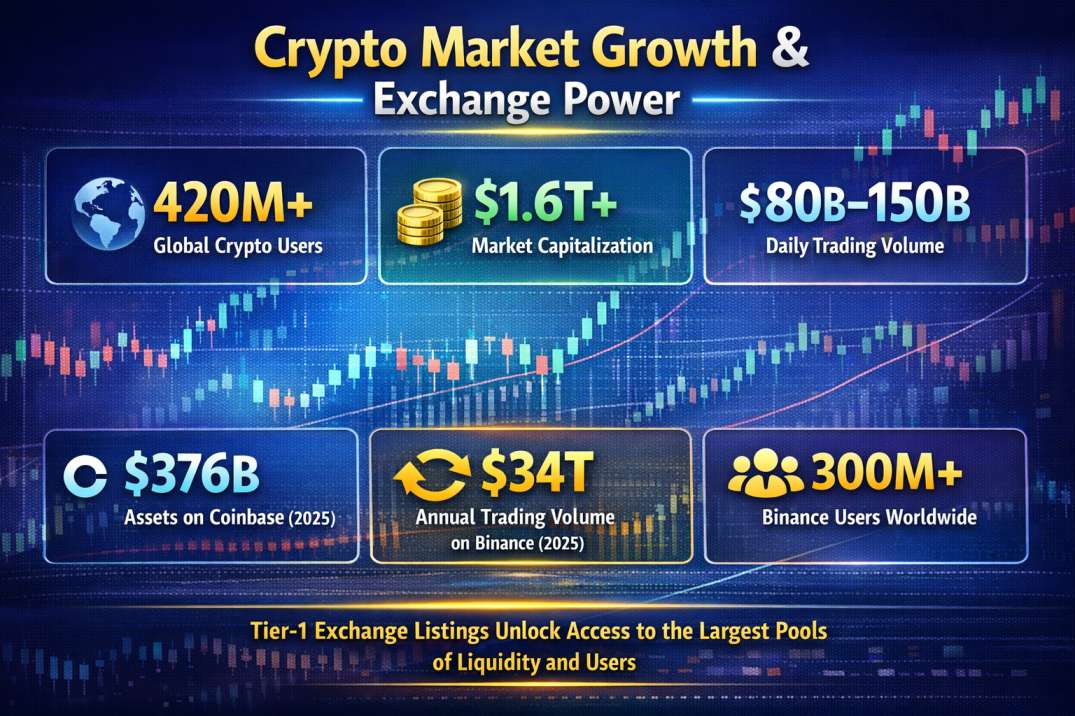
The scale of the crypto market makes this even more important. The global crypto market cap has crossed the $1.6 trillion mark, with daily trading volumes often ranging between $80 billion and $150 billion. More than 420 million users now hold or trade digital assets worldwide. This level of activity creates intense competition for visibility, liquidity, and investor attention.
The business case is simple. More credible venues can put a token in front of millions of users and large trading firms. Binance said it passed 300 million global users and recorded about $34 trillion in 2025 trading volume. Coinbase reported $1.2 trillion in annual trading volume and $376 billion in assets on platform as of December 31, 2025. That kind of reach can change liquidity, brand trust, and funding conversations for a project that is ready for public markets.
Tier-1 Crypto Exchanges and Why They Matter
Definition and Key Characteristics
There is no universal legal label for a “Tier-1” crypto exchange. The term is market shorthand. It usually refers to platforms with high liquidity, large active user bases, strong compliance controls, broad asset coverage, and a record of stable operations. Data providers support that view. CoinMarketCap ties exchange rank to liquidity and confidence. CoinGecko adds cybersecurity, API coverage, team presence, and proof of assets. Kaiko looks at market depth, spreads, and execution quality in its exchange research.
That mix matters for issuers. A token can post a large daily volume figure on a weak venue and still face poor execution. Kaiko notes that slippage rises fast in thin markets, which means traders pay more than expected for large orders. A Tier-1 venue reduces that risk. It gives a project cleaner price action and a stronger signal to funds, market makers, and partners.
Tier-1 vs Tier-2 vs Tier-3 Exchanges
The gap between tiers is not just about brand names. It is about market quality. Tier-1 exchanges tend to offer the deepest books, tighter spreads, stronger surveillance, and stricter listing review. Tier-2 exchanges often have solid regional demand or niche strength, but less depth and less global reach. Tier-3 venues may list assets quickly, yet they often carry thinner liquidity, weaker due diligence, and a higher risk of inflated volume. CoinMarketCap created its liquidity score in part to help users see that not all reported volume is equal.
For token teams, this difference has real consequences. A lower-tier listing can create a headline. A higher-tier listing can support lasting secondary market activity. Kaiko’s work on exchange liquidity shows that execution quality depends on depth and resilience, not just headline turnover. That is why serious projects often treat smaller listings as stepping stones, not end goals.
Business Benefits of Tier-1 Listings
The first gain is credibility. Coinbase’s platform scale and public market reporting give institutions a reference point for trust and governance. Kraken markets itself on transparency, security, and deep liquidity for advanced and institutional traders. Exchanges at this level act as filters. If a project passes review, the listing itself becomes a signal to the market.
The second gain is liquidity. Better order books lower slippage and support larger tickets. That helps market makers quote tighter spreads, and it helps treasury teams manage token supply with less disruption. It also supports derivative listings, structured products, and cross-exchange arbitrage, all of which can deepen price efficiency over time. Kaiko’s research links market depth directly to execution quality, which is a core part of sustainable token trading.
The third gain is commercial reach. A project listed on a top exchange has a stronger path to user acquisition, ecosystem partnerships, and treasury growth. Binance’s reported 300 million users and Coinbase’s reported $376 billion in platform assets show the scale at stake. For founders and business leaders, a Tier-1 listing is not just a marketing win. It is infrastructure for broader market access.
Planning to list your token on top-tier exchanges?
Get expert support to secure fast, reliable Tier-1 exchange listings.

Core Requirements for Tier-1 Exchange Listings
Technical & Product Readiness
Tier-1 exchanges expect projects to operate beyond the concept stage. A working product with real users carries more weight than a detailed whitepaper. Exchanges review system stability, uptime, and transaction reliability before moving forward. A project must show that its infrastructure can handle increased trading activity without failure.
Security plays a central role in this stage. Exchanges require audited smart contracts and secure backend systems. Many projects present audits from firms such as CertiK or Hacken to build credibility. A 2023 CertiK report highlighted over $1.8 billion lost in crypto exploits, which explains why exchanges place strict focus on security. Technical transparency also matters. Active GitHub repositories, frequent updates, and clear documentation show that the team continues to build and improve the product.
Legal & Compliance Requirements
Regulatory compliance now shapes listing decisions more than ever. Exchanges operate under strict oversight in multiple regions, and they expect projects to meet the same standards. Teams must provide clear company registration records, legal opinions on token classification, and internal policies for KYC and AML processes.
Global regulations such as the European Union’s MiCA framework and enforcement actions from the SEC have increased scrutiny. Exchanges avoid projects that present legal uncertainty. A clear compliance structure reduces risk for both the platform and its users. Coinbase, for example, applies a structured legal review before listing assets. Projects that pass these checks gain access to regulated markets and a wider pool of institutional investors.
Tokenomics & Financial Transparency
Token structure directly affects trading behavior and long-term stability. Exchanges examine how tokens are distributed, how supply changes over time, and how incentives align with user growth. A project with unclear token allocation or sudden unlock schedules creates risk for traders and the exchange.
Teams must present detailed information about total supply, circulating supply, and allocation across stakeholders. Vesting schedules need to be clear and predictable. Sudden token releases can lead to sharp price drops, which harm market confidence. Binance Research has noted that poor token distribution often leads to unstable trading patterns and reduced investor retention.
Financial transparency extends beyond token supply. Projects that disclose treasury management, funding sources, and operational runway build stronger trust. This level of openness signals that the team can sustain development and support market activity over time.
Market Traction & Community Strength
Exchanges look for clear signs of demand before listing a token. A strong product without users rarely qualifies for a Tier-1 platform. Teams must show active wallets, consistent transaction volume, and steady user growth. These metrics indicate that the token will attract real trading activity after listing.
Community engagement also influences decisions. Active participation on platforms such as Telegram, Discord, and Twitter reflects genuine interest. Exchanges analyze engagement quality, not just follower counts. Artificial growth patterns often fail detection checks and lead to rejection.
Projects that build strong ecosystems tend to succeed. Arbitrum serves as a clear example. Before securing major listings, it demonstrated high on-chain usage and strong developer activity. That traction made it attractive to top exchanges and supported rapid adoption after listing.
The Step-by-Step Process to Get Listed on Tier-1 Exchanges
Step 1 – Project Evaluation & Positioning
Teams must begin with an honest assessment of their project. This includes reviewing product readiness, compliance status, and user adoption. Many projects fail by applying before meeting basic requirements. A clear internal review helps avoid early rejection.
Positioning also plays a key role. Exchanges want to understand the project’s purpose and market fit. A strong value proposition explains why users will trade the token and how it stands apart from competitors. Clear positioning improves the chances of passing initial screening.
Step 2 – Exchange Selection Strategy
Each Tier-1 exchange serves a different audience and follows its own listing criteria. Projects must choose platforms that align with their goals and user base. Coinbase focuses on compliance and regulated markets, while Binance supports large-scale retail trading across regions. Kraken often attracts experienced traders and institutional participants.
A phased listing plan helps manage risk. Many projects start with one major exchange and expand over time. This approach allows teams to build liquidity gradually and adjust their strategy based on market response.
Step 3 – Documentation & Data Room Preparation
A well-prepared data room speeds up the listing process. Exchanges request detailed information, and incomplete submissions can delay decisions. Teams must organize all materials in a clear and accessible format.
This includes technical documentation, audit reports, legal opinions, tokenomics details, and team credentials. Clear and structured information shows professionalism and reduces follow-up questions. It also helps exchange reviewers assess the project more efficiently.
Step 4 – Application & Due Diligence
The application process involves detailed evaluation. Exchanges often require extensive questionnaires that cover technology, governance, and risk management. Some applications include over 50 questions.
Due diligence goes beyond written responses. Exchanges review code quality, verify legal claims, analyze market demand, and assess team backgrounds. They aim to confirm that the project can sustain trading activity and maintain market integrity. Any weakness in these areas can lead to rejection.
Step 5 – Liquidity & Market Making Setup
Liquidity determines how well a token trades after listing. Without proper liquidity, price swings become sharp, and user confidence drops. Exchanges expect projects to prepare liquidity strategies before launch.
Many teams work with professional market makers. These firms manage order books, reduce spreads, and support stable price movement. They use algorithmic trading to maintain balance between buy and sell orders. A strong liquidity setup improves trading experience and protects the token’s reputation.
Step 6 – Technical Integration & Launch
The final stage involves system integration and testing. Exchange teams connect wallets, configure trading pairs, and test deposit and withdrawal functions. These checks confirm that the token operates smoothly within the exchange environment.
Once testing is complete, the exchange schedules the listing announcement. Timing plays a critical role. Many projects align their launch with marketing campaigns, partnerships, or product updates to drive early trading activity. A well-planned launch builds momentum and attracts users. A poorly executed launch can limit growth, even if the project meets all technical and compliance standards.
Want to maximize your chances of Tier-1 listings?
Marketing Strategies to Secure Tier-1 Listings
Building Exchange-Ready Brand Credibility
Tier-1 exchanges do not list marketing stories. They list projects that look durable under scrutiny. Brand credibility starts with proof. Binance states that listed and aspiring projects should focus on genuine value, product quality, openness, and ethical practices. Coinbase says every asset goes through legal, compliance, and technical security review, then a business assessment that weighs both quantitative and qualitative signals. That means a project’s public image must match its internal facts. A polished website cannot cover weak governance, unclear token distribution, or a thin product roadmap.
A credible brand gives exchange reviewers a clean narrative. The team should present a live product, active users, public documentation, and steady shipping history. Public founder profiles matter too. So do audit reports, treasury updates, and direct answers during diligence. Binance’s listing guidance has long stressed the same point: strong builders explain their progress in concrete terms and keep communication clear. Projects that do this well reduce perceived risk before the first formal listing call.
Brand credibility has a second job. It shapes trader trust after listing. Binance’s 2025 guidance on maintaining a listing says weak product demand and weak communication can hurt a token even after it reaches a major venue. That is a useful signal for pre-listing marketing. Teams should not frame listing as a finish line. They should frame it as a public test of execution. Exchanges want assets that can hold user trust past launch week.
Community Growth & Engagement
Community size matters, but community quality matters more. Exchanges can see the difference between real demand and rented attention. Binance’s public guidance points teams toward product demand and clear communication, not vanity metrics. Coinbase’s review process includes business assessments, which gives weight to evidence of actual user interest. A project that can show repeat wallet activity, active governance participation, and strong retention tells a better story than one with inflated follower counts.
This is where on-chain data becomes marketing proof. Chainalysis reported broad grassroots adoption in its 2024 Global Crypto Adoption Index, based on both on-chain and off-chain measures, and its 2025 APAC report said monthly on-chain value received in the region rose from about $81 billion in July 2022 to a peak of $244 billion in December 2024. Those numbers show a market that rewards useful products and active networks. Teams that can tie their own wallet growth, transaction counts, and user cohorts to this larger demand picture enter listing talks with stronger evidence.
Good community work is disciplined. It means active Discord and Telegram moderation, public founder sessions, fast release notes, and tight feedback loops with users. It means less paid hype and more product education. Strong communities often produce a second asset that exchanges value: independent advocacy. Users who explain a protocol in their own words create social proof that paid campaigns cannot match. That social proof becomes even more persuasive once exchange teams cross-check it against on-chain activity.
PR, Media & Awareness Campaigns
Media coverage can strengthen a listing case, but only if it supports a real business story. PR works best when it announces measurable progress such as audits, product launches, partnerships, user milestones, or new markets. Empty headlines fade fast. CoinDesk’s advertising page says the outlet reaches more than 4 million unique visitors, with 300,000 plus monthly podcast downloads and 1.7 million monthly on-site video views. That scale shows why serious crypto PR still matters. Major outlets can place a project in front of traders, funds, and market makers at the same time.
Reach alone does not close listings. Message discipline does. A project should build one clear narrative and repeat it across media interviews, founder posts, exchange decks, and community channels. That narrative should answer four questions: what the product does, who uses it, why the token matters, and how the team manages risk. Exchange reviewers read public coverage during diligence. Consistent messaging cuts confusion and reduces doubt.
Media campaigns work best near concrete milestones. A security audit, mainnet upgrade, liquidity partnership, or regional expansion gives reporters something worth covering. This timing helps exchange business teams too. It shows the project can create demand around real events, not just speculation. Good PR is not noise. It is structured evidence that the market is paying attention.
Token Demand Generation
Exchanges care about demand that lasts. That makes token design and user incentives part of marketing, not just tokenomics. Messari describes airdrops as a way to distribute tokens widely and spur initial engagement. That goal is real, but retention is the hard part. Dune’s review of the 2020 Uniswap airdrop found that UNI reached more than 250,000 addresses, yet 93.8 percent of addresses received less than 412 UNI. Later retention analysis cited by Dune-based research found heavy early selling among recipients. The lesson is clear: broad distribution can create attention, but weak incentive design can turn that attention into short-term sell pressure.
Strong demand programs reward usage, not mere claims. Teams can connect incentives to staking, governance, liquidity provision, referrals, or product activity. Messari’s 2026 report on Stable noted that launch allocations included airdrop campaigns, liquidity provision, and exchange and partner campaigns. Its 2025 report on Rayls said ecosystem funds were used to reward early liquidity providers, validators, developers, and community participation. These examples show a pattern. The best demand programs tie token rewards to actions that deepen the network.
For Tier-1 listing goals, demand generation should produce three visible signals: stable user growth, tradable liquidity, and a reason for users to hold or use the token after launch. Exchanges are more likely to back projects that can show those signals before listing day.
Exchange-Focused Marketing Alignment
A listing strategy works better when marketing matches the target exchange. Each venue serves a different audience and evaluates risk in its own way. Coinbase emphasizes legal, compliance, and technical standards, then applies a formal prioritization process. Binance highlights quality products, long-term development, and clear communication. Kaiko’s exchange ranking adds market depth, reliability, data quality, and regulatory compliance to the picture. So a project should tailor its evidence to the venue, not send the same pitch everywhere.
This alignment affects content, partnerships, and launch planning. A project targeting an institution-friendly venue should foreground audits, governance, and market quality. A project targeting a retail-heavy venue should still present those facts, but it should add stronger user education and community activation. Kaiko’s research on liquidity concentration and exchange liquidity shows that market depth and execution quality remain central to exchange quality. That makes market making plans and post-listing communication part of marketing, not just trading operations.
Conclusion
Securing a Tier-1 crypto exchange listing requires more than technical readiness. Marketing plays a direct role in proving demand, credibility, and long-term viability. Projects that build strong brands, active communities, and consistent narratives stand out during the evaluation process. Each marketing effort must support real data, user activity, and product growth.
A successful crypto exchange listing depends on alignment across product, compliance, and market demand. Teams that treat marketing as evidence rather than promotion gain a clear advantage. For businesses aiming to accelerate this process, working with experienced partners such as Blockchain App Factory can streamline strategy, execution, and exchange outreach.

Vimal J is the Head of Sales at Blockchain App Factory, with 10+ years of experience in sales, client strategy, and Web3 business growth. He helps startups, enterprises, and project founders choose the right blockchain solutions for their goals, bringing a practical market perspective to topics like token development, crypto launches, and Web3 adoption.