
Key Insights
- The blog shows that crypto trading has moved into a large commercial market, with 179 tracked exchanges and $116 billion in 24-hour trading volume. This creates a clear opportunity for businesses that want to build a crypto exchange like Binance.
- A Binance-like exchange needs more than trading features. It must protect user funds, meet KYC and AML rules, and offer deep liquidity so traders can buy and sell without poor pricing.
- The blog explains each stage from scope planning to launch monitoring. This step-by-step process helps businesses build a stable exchange, avoid rework, and add advanced features after market demand is proven.
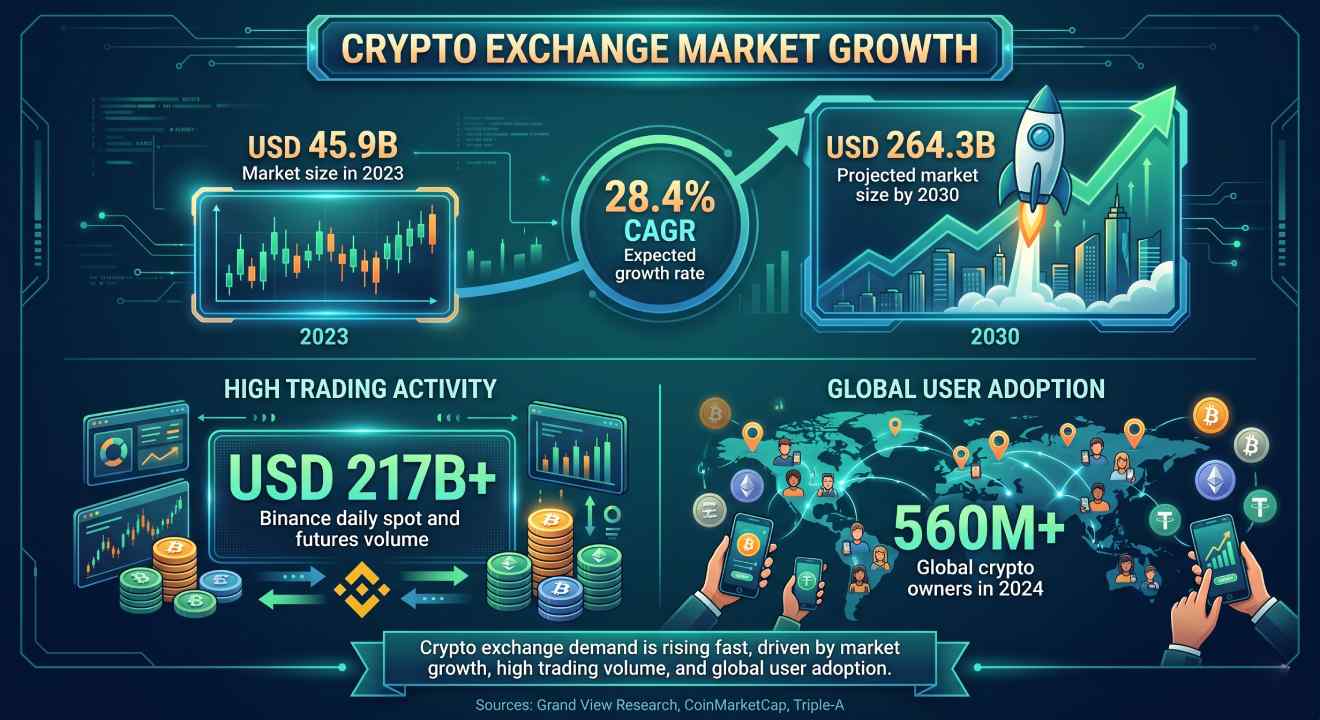
Crypto exchange development has become a serious business opportunity. The global cryptocurrency exchange platform market was valued at USD 45.9 billion in 2023 and is expected to reach USD 264.3 billion by 2030, with a CAGR of 28.4%. This growth shows strong demand for secure and scalable trading platforms. Binance gives a clear view of the market at full scale. As of June 2025, it reported more than USD 217 billion in daily spot and futures trading volume. User adoption also keeps rising. More than 560 million people owned digital currencies worldwide in 2024. For businesses, these numbers point to a clear opening. A well-built crypto exchange can generate revenue through trading fees, token listings, staking services, and premium trading features. The key is to build a platform that combines speed, security, liquidity, and compliance from the start.
What Makes Binance the Benchmark in Crypto Exchange Development?
Binance became the model for centralized exchange development through speed, liquidity, and product depth. Traders expect instant execution, live charts, low spreads, and access to many assets. A Binance-like crypto exchange must deliver the same core experience from day one.
The trading engine sits at the center. It matches buy and sell orders in real time. Wallet systems then process deposits, withdrawals, and internal transfers across chains. The platform also needs admin controls, fraud checks, liquidity routing, and customer support tools.
Revenue Streams of a Binance-Like Crypto Exchange
A strong crypto exchange business model has several income paths:
- Spot trading fees from daily buy and sell activity
- Futures and margin trading fees for advanced traders
- Listing fees from token projects
- Staking income from supported assets
- Withdrawal fees and payment gateway charges
- Institutional liquidity services
- NFT or launchpad transaction fees
White label crypto exchange products help startups enter the market faster. Custom crypto exchange development gives larger businesses more control over security, branding, trading rules, and future product lines. Both models work, but the right choice depends on budget, timeline, target market, and compliance needs.
Market Research and Strategic Planning Before Development
Start With Market Proof, Not Code
A serious exchange project starts with market research, not code. Binance crossed 250 million registered users in early 2025, which shows the size of demand for fast trading, deep liquidity, and broad asset access. Coinbase reported $202 billion in quarterly trading volume and $294 billion in assets on platform as of March 31, 2026, which shows strong demand from regulated retail and business users.
Study the Leading Exchanges Closely
A competitive study must cover Binance, Coinbase, Kraken, Bybit, and OKX. Each platform teaches a different lesson. Binance leads with liquidity and product depth. Coinbase wins trust through public-market reporting and compliance. Kraken appeals to security-focused users. Bybit attracts active derivatives traders. OKX blends trading, Web3 access, and wallet tools.
Define the Right User Segment
The next task is audience selection. Retail traders need simple onboarding, low fees, and fast deposits. Institutional investors need custody, reporting, large order handling, and API access. DeFi users expect wallet support, token swaps, and on-chain access. Regional markets need local payment rails, language support, and legal fit.
Choose the Right Regulatory Market
Regulation must shape the plan early. MiCA entered into force in June 2023 and now sets EU rules for crypto-asset service providers. Dubai’s VARA regulates virtual asset activity in and from Dubai. Singapore’s MAS issued licensing guidelines for digital token service providers in May 2025.
Build a Business Plan That Can Support Growth
A strong business plan covers budget, liquidity, security, staffing, support, and user growth. This is where crypto exchange consulting services help founders choose between custom builds, white-label platforms, and regional launches. A qualified crypto exchange development company can map costs before you launch a crypto exchange platform.
Core Features Required to Build a Crypto Exchange Like Binance
User Registration and Compliance Checks
The core crypto exchange features must support trust, speed, and control. Registration starts with KYC and AML checks. This includes identity capture, document checks, sanctions screening, and risk scoring.
High-Speed Trading Engine
The crypto trading engine is the heart of the platform. It manages order matching, market orders, limit orders, order books, and trade execution. Low latency matters, since active traders leave slow platforms.
Secure Multi-Currency Wallet System
Wallet integration for crypto exchange products needs hot wallets, cold storage, multi-signature controls, and withdrawal rules. Custodial wallets suit mainstream users. Non-custodial options suit Web3 users.
Real-Time Trading Dashboard
The dashboard must show candlestick charts, market depth, open orders, balances, and portfolio value. These tools help traders act faster and stay inside the platform longer.
Liquidity Management System
A liquidity management system connects internal order books, market makers, and third-party liquidity APIs. Strong liquidity reduces slippage, improves pricing, and makes the exchange more useful from day one.
Admin Control and Risk Monitoring
The admin panel controls users, fees, assets, risk alerts, and support cases. It gives operators a clear view of platform activity and helps teams react fast to trading, payment, or compliance issues.
Security Features for User Trust
Security must include 2FA, anti-phishing codes, DDoS defense, AES-256 encryption, and role-based access. These controls protect user funds, business data, and exchange operations.
Mobile Trading Applications
Mobile apps for iOS and Android help users track trades, receive push alerts, and manage portfolios in real time. A Binance clone script must still pass audits, testing, and compliance review before launch.
Technical Architecture of a Binance-Like Crypto Exchange
Frontend Technology Stack
A Binance-like exchange needs a fast, clear, and trader-friendly interface. React.js suits advanced trading screens with live charts, order books, and portfolio views. Angular works well for enterprise crypto exchange development that needs strict code structure. Vue.js fits lean teams that want faster UI builds.
WebSocket integration is the core of the trading experience. It sends live price feeds, order book changes, and trade updates without page reloads. A slow interface can push active traders to another platform.
Backend Development Technologies
The backend handles matching, balances, risk checks, fees, and user sessions. Node.js works well for real-time services. Python with Django or FastAPI supports admin panels, KYC flows, and analytics. Golang is a strong fit for low-latency trading engines. Java Spring Boot suits banks, brokers, and large firms that need strict security controls.
A scalable crypto exchange architecture should split core functions into separate services. Trading, wallets, authentication, alerts, and reporting should not sit in one large codebase.
Database Architecture
PostgreSQL fits user data, balances, trade history, and compliance records. MongoDB can store flexible market data and user activity logs. Redis caching helps reduce delay during heavy trading hours.
Event-driven architecture helps each service react to deposits, withdrawals, trades, and risk alerts. This design keeps custom crypto exchange software stable during sudden traffic spikes.
Blockchain Integration Layer
A serious exchange needs Bitcoin node setup, Ethereum integration, Binance Smart Chain compatibility, and multi-chain support. Binance says its Proof of Reserves shows user assets backed 1:1, which shows why wallet transparency matters for trust.
Cloud Infrastructure, DevOps, and APIs
AWS deployment, Docker, Kubernetes, and CI/CD pipelines help teams ship updates with fewer service breaks. REST APIs support admin tools and partner apps. WebSocket APIs serve traders. FIX protocol support helps brokers, funds, and institutional trading desks connect at speed.
Want to Build a Crypto Exchange Like Binance?
Launch a secure crypto trading platform with high-speed transactions, strong liquidity, advanced security, and scalable infrastructure built for long-term growth.

Security Frameworks and Compliance Requirements
Why Security Is Critical for Crypto Exchanges
Crypto exchanges hold user funds, private keys, identity data, and trading records. Chainalysis reported that stolen crypto reached $2.2 billion in 2024, with private key compromise driving the largest share of theft.
Attackers target hot wallets, weak admin access, APIs, smart contracts, and phishing flows. One breach can damage liquidity, user trust, and platform valuation.
Core Security Controls for Binance-Like Platforms
Secure crypto exchange development starts with cold wallet asset segregation. Hot wallets should hold only daily withdrawal needs. Hardware Security Modules protect private keys. Multi-signature approvals reduce insider risk.
Penetration testing should run before launch and after major updates. Smart contract audits matter for staking, launchpads, bridges, and token modules.
KYC, AML, and Data Compliance
A KYC AML crypto exchange needs identity checks, sanctions screening, transaction monitoring, and risk scoring. FATF states that virtual asset service providers should face AML and counter-terrorist financing duties, including licensing or registration.
The Travel Rule applies to virtual asset transfers and pushes exchanges to share originator and beneficiary data for covered transactions.
GDPR, PCI DSS controls, encryption, access logs, and audit reports help build a regulation-ready exchange. For businesses, this is not just legal work. It protects revenue, banking access, and long-term market entry.
Step-by-Step Crypto Exchange Development Process
Building a crypto exchange like Binance needs a planned technical process. Each stage affects security, user trust, trading speed, and launch cost. A strong process helps businesses avoid rework and build a platform that can handle real trading activity from day one.
Step 1: Define the Exchange Scope and Features
Start by defining what the exchange will offer at launch. Decide the exchange type, target users, supported regions, fiat options, coins, trading pairs, and revenue model.
The first version should focus on core features such as user registration, KYC, spot trading, wallets, deposits, withdrawals, admin controls, and support tools. Advanced features like futures trading, staking, launchpads, referral programs, and OTC trading can come later.
A clear scope helps the development team estimate cost, set timelines, and reduce technical risk.
Step 2: Design UI/UX for Traders
The trading interface must be simple, fast, and clear. Users should find charts, order books, balances, open orders, and trade history without confusion.
Retail traders need easy buy and sell options. Professional traders need limit orders, stop orders, real-time charts, and market depth. Mobile users need a clean app with secure login, KYC, deposits, withdrawals, and live trading.
Good UI/UX reduces drop-offs and builds trust during the first trading session.
Step 3: Develop the Trading Engine
The trading engine is the core of the exchange. It matches buy and sell orders, updates balances, records trades, and sends live market data to users.
It should support market orders, limit orders, stop orders, order cancellation, and high trade volume. Low latency is critical. Slow execution can cause slippage, failed trades, and user loss.
A reliable trading engine gives the exchange the speed and stability needed to compete with larger platforms.
Step 4: Integrate Wallets and Payment Systems
A crypto exchange needs secure wallets for each supported asset. Most platforms use hot wallets for daily withdrawals and cold wallets for larger reserves.
The wallet system should manage address creation, deposits, withdrawals, transaction status, gas fees, and approval workflows. For fiat support, the platform needs payment gateways, bank transfer systems, cards, UPI, or local payment rails based on the target market.
This stage must be handled with strict security controls, since it deals directly with user funds.
Step 5: Implement Liquidity Management
Liquidity allows users to buy and sell assets without large price gaps. A new exchange needs liquidity before public launch.
Businesses can connect with market makers, liquidity providers, shared liquidity pools, or external exchange APIs. Strong liquidity creates tighter spreads and smoother trade execution.
Without liquidity, traders see empty order books and poor prices. That can push them away from the platform quickly.
Step 6: Add Compliance and Security Modules
Security and compliance must be part of the build from the start. The exchange should include KYC checks, AML screening, transaction monitoring, audit logs, withdrawal limits, and admin access controls.
Key security features include two-factor authentication, anti-phishing codes, IP tracking, device management, encrypted data storage, DDoS protection, and cold wallet storage.
Compliance rules differ by region, so the platform should support reporting, user verification, and Travel Rule needs where required.
Step 7: Conduct QA Testing and Penetration Testing
Testing should cover every user and admin flow. Teams must test signup, login, KYC, deposits, withdrawals, order matching, trade history, wallet balances, payment failures, and admin approvals.
Penetration testing checks the platform for security gaps. It should cover APIs, wallet flows, login systems, admin panels, server settings, and data access.
A crypto exchange should never launch after basic testing alone. One serious bug can affect user funds and damage the brand.
Step 8: Deploy on Cloud Infrastructure
The exchange needs cloud infrastructure that can handle traffic spikes, live trading, and large data loads. AWS, Google Cloud, and Azure are common choices.
A strong setup includes load balancers, firewalls, database backups, monitoring tools, disaster recovery, and separate environments for development, testing, and production.
The architecture should separate key services such as trading, wallets, KYC, notifications, and admin tools. This reduces downtime risk and makes future growth easier.
Step 9: Launch and Monitor the Exchange
Start with a controlled launch before opening the exchange to a wider audience. Invite limited users, test live trades, review withdrawal speed, and monitor system errors.
After launch, track trading volume, order execution speed, failed transactions, wallet delays, support tickets, security alerts, and user activity.
Live monitoring helps the team fix issues early. It also shows which features users need next, such as staking, futures, mobile apps, or institutional APIs.
Cost to Build a Crypto Exchange Like Binance
The cost to build a crypto exchange like Binance depends on the feature set, trading engine, wallet setup, liquidity model, security layer, and compliance needs. A basic MVP costs less and launches faster. A full Binance-like platform costs more since it needs advanced trading, mobile apps, deep liquidity, and stronger security.
| Feature | Description | Duration | Cost |
|---|---|---|---|
| Planning and scope | Defines features, trading pairs, user roles, and revenue model. | 1 to 2 weeks | USD 1,000 to USD 4,000 |
| UI/UX design | Covers web, mobile, dashboard, wallet, and trading screens. | 2 to 3 weeks | USD 3,000 to USD 10,000 |
| User login and KYC | Adds signup, 2FA, user verification, and account security. | 2 to 4 weeks | USD 5,000 to USD 15,000 |
| Trading engine | Matches buy and sell orders and updates market data. | 5 to 8 weeks | USD 20,000 to USD 60,000 |
| Spot trading module | Supports market orders, limit orders, fees, and trade history. | 3 to 6 weeks | USD 12,000 to USD 35,000 |
| Wallet integration | Manages deposits, withdrawals, hot wallets, and cold storage. | 4 to 7 weeks | USD 15,000 to USD 50,000 |
| Liquidity setup | Connects liquidity providers, market makers, or exchange APIs. | 2 to 5 weeks | USD 8,000 to USD 30,000 |
| Admin panel | Manages users, coins, fees, withdrawals, and reports. | 3 to 5 weeks | USD 8,000 to USD 25,000 |
| Security modules | Adds encryption, DDoS protection, withdrawal limits, and access control. | 3 to 5 weeks | USD 8,000 to USD 30,000 |
| Mobile app | Supports trading, wallets, KYC, alerts, and portfolio view. | 6 to 10 weeks | USD 25,000 to USD 75,000 |
| Testing and audit | Tests trading, wallets, payments, APIs, and security gaps. | 3 to 5 weeks | USD 8,000 to USD 25,000 |
| Cloud deployment | Sets up servers, monitoring, backups, and release pipeline. | 2 to 4 weeks | USD 5,000 to USD 18,000 |
Conclusion
Building a crypto exchange like Binance takes more than a trading screen. It needs a secure trading engine, strong wallet architecture, deep liquidity, compliance controls, cloud infrastructure, and live monitoring from the first release. Businesses that plan each stage well can launch a platform that supports real users, handles high trading activity, and creates revenue through trading fees, listings, staking, and premium features. Blockchain App Factory provides crypto exchange development services for startups and enterprises that want to build secure, scalable, and market-ready trading platforms.

Vimal J is the Head of Sales at Blockchain App Factory, with 10+ years of experience in sales, client strategy, and Web3 business growth. He helps startups, enterprises, and project founders choose the right blockchain solutions for their goals, bringing a practical market perspective to topics like token development, crypto launches, and Web3 adoption.