
Key Insights
- Covers what a $10M+ ICO needs beyond token creation, including tokenomics, compliance, security, and investor-ready launch planning.
- Explains how a 30-day ICO launch can work with the right structure, tested modules, and clear execution flow.
- Highlights the technical, legal, and fundraising elements that matter most for building trust and attracting serious investors.
A $10M+ ICO needs far more than a token contract and a launch date. In 2026, serious fundraising depends on tokenomics, legal review, investor onboarding, platform build, contract security, treasury planning, and post-sale execution. Investors now study structure closely. They look at allocation, vesting, jurisdiction fit, audit status, and how cleanly the sale runs.
Speed still matters, but careless speed can damage trust fast. A strong 30-day launch needs clear ownership, tested systems, and a stack ready for live demand. For founders targeting a large raise, the goal is not just to launch quickly. It is to launch with a sale structure that looks credible and gives investors confidence.
What a $10M+ ICO Really Requires in 2026
Why high-value ICOs are different from small token launches
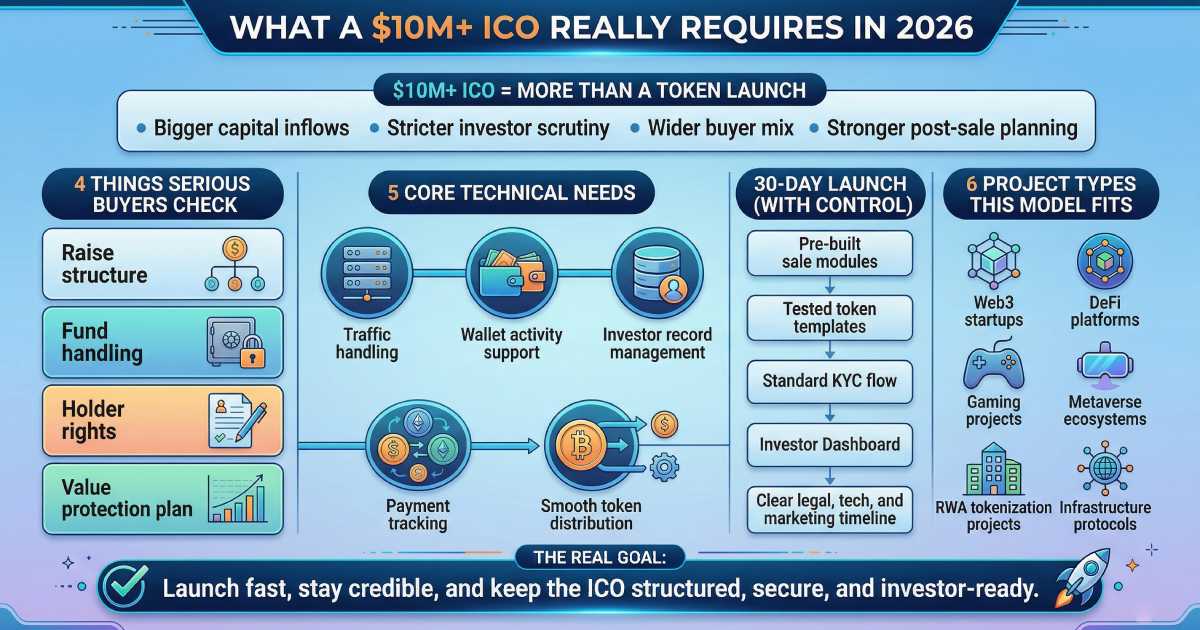
A small token launch can work with simple mechanics and a limited community. A $10M+ ICO cannot. At that level, the sale must support larger inflows, stricter scrutiny, and a wider buyer mix that may include funds, high-net-worth participants, strategic backers, and serious retail users. These buyers want to know how the raise is structured, how funds are handled, what rights holders receive, and how the team plans to protect value after the sale.
The technical side matters just as much. The platform must handle traffic, wallet activity, investor records, payment tracking, and token distribution without friction. Strong pricing, tighter vesting, cleaner communication, and a more mature post-sale plan are all expected. At this level, buyers want proof that the project can manage capital and operate under pressure.
The business case for launching fast without launching carelessly
A 30-day launch can help a project keep momentum, hit the market at the right time, and avoid long delays that weaken interest. That speed can create a real advantage, but only if the process is structured well.
The best way to move fast is to avoid rebuilding what already works. Pre-built sale modules, tested token templates, standard KYC flows, investor dashboards, and clear workstreams save time and reduce errors. Good ICO development services help teams lock the token model early, align legal, tech, and marketing tasks, and keep the launch on one clear timeline. In a high-value ICO, speed works only when it comes with control.
Who this fast-track ICO launch model is built for
This model fits teams that already know what they are building and need a disciplined path to market. Web3 startups use it to turn traction into funding. DeFi platforms use it to back liquidity, governance, and staking systems. Gaming and metaverse projects use it to support in-game economies and digital asset ecosystems.
It also suits RWA tokenization projects, infrastructure protocols, and enterprises entering tokenized markets. These teams often need faster execution, stronger trust signals, and tighter compliance control. The appeal is simple: shorten the launch timeline without turning the ICO into a risky or poorly managed sale.
How to Evaluate Whether Your Project Is Ready for a $10M+ ICO
Product-market readiness before token launch
A $10M+ ICO starts with one question: does the token need to exist? Serious buyers do not fund weak utility. They want a token that plays a real role in the product through access, staking, governance, payments, rewards, or network participation. If the platform works almost the same without the token, the sale story weakens fast.
The project must also fit a real market. Founders need to show who the users are, what problem the platform solves, and how the token supports that activity. Monetization matters too. Investors want to see how value enters the system, how revenue is created, and how token demand connects to usage. A visible product, clear utility, and a real business model make the ICO far more credible.
Founding team, governance, and investor confidence signals
A high-value ICO needs a team that looks ready for public capital. Investors review the people behind the raise as closely as the token itself. Public founder profiles, clear roles, strong technical leadership, and credible advisors all help build trust. A serious team shows that the project can execute, manage funds, and stay accountable after the raise.
Governance adds another layer of confidence. Buyers want to know who controls treasury wallets, who approves fund movement, and what the decision structure looks like after the sale. Multi-signature controls, published allocation rules, vesting schedules, and a basic governance plan all strengthen trust. In large ICOs, structure matters more than hype.
Market timing and fundraising potential
Even a strong project can struggle if it launches at the wrong time. Fundraising depends on market activity, category momentum, buyer sentiment, and community depth. In active sectors, capital moves faster. In slower markets, teams need sharper positioning and stronger proof.
Recent data shows that serious capital is active again, but investors are more selective. They now look closely at token design, legal setup, timing, community strength, and post-sale planning before they commit. That is why founders need to read the market carefully. A strong project should launch into active attention, not into a noisy or crowded window.
The 30-Day ICO Launch Framework
Week 1: Strategy, architecture, and token design
The first week sets the direction for the full launch. Founders need to lock the ICO business model early, including what the raise funds, how capital will be used, and what buyers receive beyond the token itself. Token utility, tokenomics, chain selection, compliance scope, white paper planning, and sale mechanics should all be defined in this stage. A strong Week 1 gives the team a clear structure before development begins.
Week 2: Smart contract development and platform buildout
Week 2 turns the plan into working infrastructure. The team builds the token contract, vesting contracts, and any staking or rewards logic tied to the sale. At the same time, the fundraising platform takes shape through the investor dashboard, sale portal, wallet integration, and admin controls. By the end of this stage, the project should have a working front end, core contracts, and a sale flow that the team can operate.
Week 3: Security review, audit prep, and operational testing
Week 3 focuses on security and launch readiness. This includes full contract testing, sale-flow simulation, edge-case review, and audit preparation. Teams should freeze core logic, verify dependencies, document permissions, and prepare deployment controls. The goal is simple: know what was tested, what was fixed, and how the contracts will be monitored after launch.
Week 4: Go-live execution, marketing rollout, and investor onboarding
Week 4 is the live launch phase. Contracts are deployed, sale links are verified, KYC workflows go live, and the campaign begins driving investors into the sale portal. Support teams must be ready to handle user issues, region checks, and onboarding questions. At the same time, treasury monitoring, exchange preparation, and investor communications should run in sync. A strong final week turns a fast build into a credible fundraising launch.
Ready to launch your ICO faster?
Get a clear path to token design, platform setup, compliance, and launch execution.

The Complete Technical Stack Behind a High-Value ICO
Token smart contracts
Handle ERC-20 token logic, supply controls, vesting rules, treasury access, and emergency pause rights.
ICO fundraising platform infrastructure
Manage investor registration, wallet connection, payment flow, bonus logic, and region-based sale access.
Back-end and admin stack
Support CRM sync, admin controls, KYC tracking, contribution records, cap table visibility, and treasury reporting.
Front-end investor experience
Show sale stages, token price, allocation details, supported assets, and key legal and white paper links.
Analytics, monitoring, and post-launch visibility
Track wallet activity, transaction flow, conversion data, campaign sources, token holders, and post-TGE liquidity movement.
Choosing the Right Blockchain for a 30-Day ICO Launch
Ethereum for ecosystem reach and infrastructure maturity
Ethereum suits ICOs that need mature ERC standards, broad tooling, strong wallet support, and established audit practices. Its main drawback is higher gas cost, so it fits better for larger raises than fee-sensitive retail-heavy sales.
BNB Chain for lower fees and retail accessibility
BNB Chain works well for ICOs that want EVM compatibility with lower transaction costs and easier retail participation. It is a practical fit for launches that need frequent wallet activity, cheaper user actions, and simple onboarding.
Solana for performance-driven launch models
Solana fits ICOs that want high throughput, lower user friction, and faster transaction flow. It works best for consumer-facing products, but it needs a different contract, wallet, and audit setup than EVM chains.
Multi-chain ICO launch models and when they make sense
A multi-chain launch can expand buyer access, but it adds more contracts, wallets, support needs, and operational work. It makes sense only when the project has a clear reason to target different user groups across different networks.
How to choose the right network based on fundraising goals, users, and compliance needs
Ethereum fits projects that want mature infrastructure, BNB Chain suits lower-cost retail participation, and Solana works for speed-focused products. The right choice depends on fundraising goals, target users, technical fit, and compliance needs.
Tokenomics for a $10M+ ICO
Designing token utility that supports long-term demand
The token must have a real role in the product, such as access, governance, staking, payments, rewards, or network use. Long-term demand comes from repeat utility, not short-term hype.
Supply structure, allocation, and vesting logic
A strong token model needs balanced allocation across private sale, public sale, team, treasury, rewards, liquidity, and advisors. Clear vesting rules help build trust and reduce fear of early sell pressure.
Pricing strategy for high-value fundraising rounds
Pricing should follow a fair round structure from seed to public sale, with sensible hard cap, soft cap, and valuation logic. Oversubscription rules should be defined early to avoid confusion during the raise.
Avoiding tokenomics mistakes that damage fundraising confidence
Weak utility, oversized insider allocation, poor vesting, inflated valuation, and emission-heavy rewards can quickly reduce investor trust. Good tokenomics should feel fair, clear, and usable.
Legal, Compliance, and Risk Controls for ICO Launches
White paper requirements and investor disclosures
A serious ICO needs a clear white paper that explains the project, token rights, risks, team, technology, and sale terms. Strong disclosure builds trust and supports compliance.
KYC AML integration and jurisdiction controls
KYC and AML checks should cover identity review, sanctions screening, investor eligibility, geo-blocking, and transaction monitoring. These controls must be built into the sale process from the start.
Marketing compliance for token sales
All token sale marketing should match the white paper and avoid misleading claims. Legal review is important, especially for cross-border campaigns and investor-facing promotions.
Risk management frameworks for founders
Founders need clear legal support, treasury controls, custody planning, incident response, and communication rules before launch. Strong internal control makes the ICO look more credible and better managed.
Smart Contract Security and Audit Readiness
Why audits matter in large ICO launches
Audits help identify contract flaws before live funds are exposed. In a large ICO, that matters even more, since errors in token logic, vesting, or payment flow can damage both capital and trust. A completed audit also gives investors more confidence in the launch structure.
What auditors review in ICO smart contracts
Auditors review access controls, vesting rules, purchase logic, fund handling, upgrade risks, and deployment setup. They check whether admin rights are too broad, whether token unlock rules can be bypassed, and whether sale mechanics work as planned under real conditions.
Security best practices before mainnet launch
Before launch, teams should complete internal QA, testnet runs, code freeze, dependency review, wallet security checks, and monitoring setup. They should also confirm signer roles, multisig controls, and emergency permissions so launch-day operations stay controlled.
Audit firms, timelines, and preparation tips
Audit planning should begin early in the 30-day schedule. Teams should enter review with fixed code, clear documentation, defined admin roles, deployment notes, and a clean test-ready contract base. Better preparation usually leads to faster review and fewer last-minute changes.
Building the Investor Funnel for a $10M+ ICO
Pre-launch positioning and investor narrative
A strong ICO narrative should explain the problem, market case, token role, product traction, team strength, and roadmap. Serious buyers want a clear reason to trust both the raise and the team behind it.
Lead generation infrastructure
The funnel should include landing pages, whitelist forms, CRM capture, segmented email flows, community channels, and investor outreach. This structure helps teams track interest, follow up properly, and move different buyer types through the right path.
ICO marketing strategy for faster fundraising momentum
PR, KOL outreach, content, paid ads, AMAs, and community campaigns help build visibility and investor interest. The goal is not just reach, but repeated exposure that pushes qualified buyers toward the token sale.
Converting interest into committed contributions
A clean onboarding flow, clear FAQs, strong proof points, live support, and deadline-based offers help improve conversions. Buyers are more likely to commit when the sale process feels simple, credible, and easy to follow from first visit to final contribution.
Industry Use Cases for Fast-Track ICO Launches
DeFi and on-chain financial products
DeFi projects often need both early capital and active users. An ICO can help fund audits, liquidity, market-making, and user rewards, while the token supports staking, governance, fee benefits, or protocol activity. This makes the ICO model useful for DeFi teams that need both fundraising and long-term user participation.
Gaming, metaverse, and digital asset ecosystems
Gaming and metaverse projects fit ICOs well when the token has a real in-platform use. It can power purchases, rewards, staking, access, governance, or marketplace activity. The raise helps fund development and user growth, and the token helps turn early buyers into active community members.
Infrastructure and protocol networks
Infrastructure projects often need funding before network usage grows at scale. An ICO can help support network buildout, and the token can power fees, governance, node incentives, or service access. This works well for Layer 1 projects, middleware, oracle systems, interoperability tools, storage networks, and developer-focused platforms.
Real-world asset tokenization platforms
RWA platforms usually need early funding for legal setup, compliance, custody, and platform development. An ICO can help finance that work and build a committed community around the platform. The token can support governance, access, staking, fees, or transaction activity across the ecosystem.
AI and data economy token ecosystems
AI and data projects are becoming a strong fit for token launches. Their tokens can support payments for compute, inference, storage, data access, or agent activity. An ICO helps fund the network early and build a user base that starts using the token from the beginning.
Need expert help for your ICO launch?
Why a 30-Day ICO Launch Strategy Can Work
The role of pre-built modules and proven frameworks
A 30-day launch works best when teams use tested modules for token contracts, vesting, dashboards, KYC flows, wallet integration, and admin controls. This saves time and reduces errors during the build.
Why decision-makers benefit from compressed execution timelines
A shorter launch timeline helps founders keep momentum, reduce delays, and move toward the raise with stronger focus. It gives teams a fixed goal and helps keep product, legal, tokenomics, and marketing work aligned.
The limits of speed and where businesses should slow down
Speed works only when legal review, tokenomics, security testing, and compliance checks are handled with care. Teams should move fast on execution, but slow down on decisions that affect trust, safety, and launch quality.
Conclusion
Launching a $10M+ ICO in 30 days is possible, but only for teams that treat fundraising as a full business operation and not just a token release. Real success comes from clear token utility, disciplined tokenomics, strong legal review, secure smart contract architecture, audit readiness, investor-focused platform design, and a marketing funnel that turns interest into committed participation. Each part of the launch must support the next, so the project enters the market with credibility, control, and a structure that can hold up after the sale ends. For businesses that want all of that under one roof, Blockchain App Factory provides compliant ICO development services that cover strategy, token creation, platform development, security preparation, and launch execution for serious token fundraising goals.

Vimal J is the Head of Sales at Blockchain App Factory, with 10+ years of experience in sales, client strategy, and Web3 business growth. He helps startups, enterprises, and project founders choose the right blockchain solutions for their goals, bringing a practical market perspective to topics like token development, crypto launches, and Web3 adoption.