
Key Insights
- Clear content and active communities attract better users.Trust leads to stronger DeFi adoption.
- Traffic matters less than wallet connections and deposits.Real success shows up in usage and retention.
- SEO brings intent, and social builds credibility.Email helps keep users active over time.
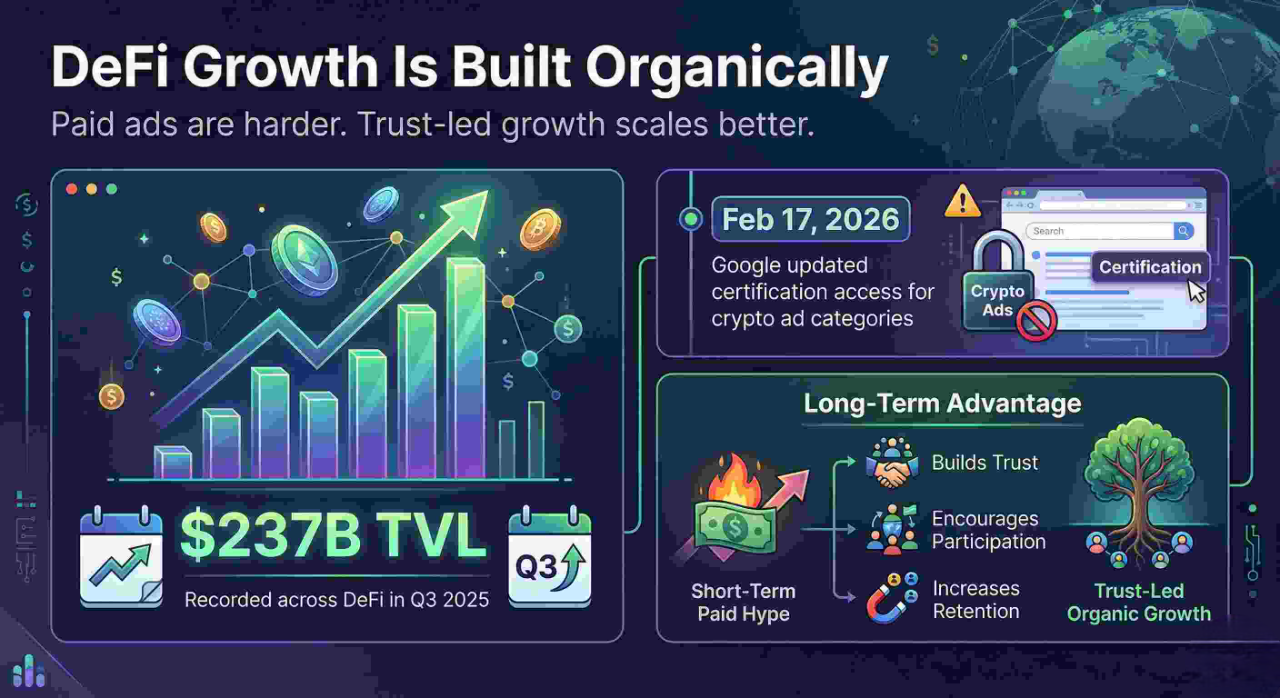
Promoting a DeFi protocol without paid ads is no longer a backup option. For many teams, it is the more effective strategy. Crypto advertising rules have become stricter across major platforms, which has made paid user acquisition harder, slower, and more uncertain. Google stated on February 17, 2026, that some advertisers must apply for certifications for categories including cryptocurrency exchanges and software wallets, adding another layer of compliance to crypto promotion. At the same time, the DeFi market has grown to a scale where trust matters more than short bursts of paid visibility. DappRadar reported that DeFi reached a record $237 billion in total value locked in Q3 2025, showing how much user confidence now drives real on-chain value.
Organic growth fits DeFi especially well because trust is built through education and community, not just visibility. Users rarely trust a protocol after seeing a single ad. They trust it after reading useful content, joining discussions, testing the platform, and hearing about it from credible voices. In this market, success is not measured by traffic alone but by meaningful actions such as wallet connections, deposits, liquidity participation, governance activity, and repeat usage. That is why strong content, active communities, and earned credibility often deliver better long-term results than paid ads, helping protocols build traction that compounds over time. The scale of DeFi today makes that approach even more important, since large amounts of locked value depend on sustained trust rather than one-time clicks.
How DeFi Marketing Works Without Paid Advertising
What Organic DeFi Marketing Really Means
Organic DeFi marketing means attracting users through education, trust, and community activity instead of buying reach. That includes search traffic, social posts, ecosystem mentions, community referrals, governance discussions, founder visibility, and product-led word of mouth. It is less about pushing offers and more about helping people understand why the protocol matters.
This matters even more in decentralized finance, where users often face real risk. They want to know how the protocol works, what the yield source is, what risks exist, and who built it. A team that answers those questions in public earns more trust than a team that only promotes rewards and APYs.
Organic marketing in DeFi must connect to protocol usage. That means your growth work should support measurable actions such as total value locked, daily transactions, wallet retention, governance activity, and repeat deposits. If a campaign brings page views but no wallet activity, it did not do its job. Good DeFi marketing closes the gap between attention and action.
Organic vs Paid Growth in Web3
Paid growth gives fast visibility. It can push a campaign in front of people in a short time. Yet that reach often fades as soon as spend stops. It can bring cold traffic, weak trust, and poor conversion if the audience does not already know the protocol. In crypto, it brings another problem too. Ad compliance takes time, and platform rules change often.
Organic growth works in a different way. It starts slower, but it stacks value over time. A blog post can rank for months. A tutorial can keep earning shares. A community discussion can turn one user into ten referrals. A founder thread on X can build authority that no ad can buy. This kind of growth creates durable visibility.
There is another key difference. Paid ads interrupt. Organic content attracts. That changes user intent. Someone who finds your article on lending strategies or joins your Discord after reading a governance thread is already more engaged than someone who clicked a generic ad. In DeFi, that intent often leads to stronger retention and better wallet conversion.
Why Organic Strategies Win in DeFi
Organic strategies win in DeFi since they match how users make decisions. Most users do not deposit funds into a protocol after seeing one promotional message. They research. They compare. They ask questions. They watch what the community says. Organic marketing supports that exact process.
It lowers customer acquisition cost over time. A useful article, SEO page, partner mention, or community resource keeps working after publication. The cost of that asset spreads across every new visitor it brings. Paid ads stop the moment budget runs out. Organic assets keep producing value.
It builds credibility in a trust-sensitive market. That credibility matters more in DeFi than in many other sectors. Users look for open communication, visible founders, active communities, and proof that the protocol has real traction. Organic marketing helps create that proof in public.
It encourages ownership too. DeFi users do not want to feel like passive customers. They want to contribute, vote, discuss, create, and share. Organic growth gives them ways to do that. And once users feel ownership, they stop acting like traffic and start acting like advocates.
Core Pillars of Organic DeFi Promotion
Content-Led Growth: SEO and Education
Content is the base layer of organic DeFi promotion. It turns confusing concepts into clear answers, and it helps protocols show up when users search for real problems. A strong content strategy targets high-intent topics such as how to earn yield safely, how lending protocols work, stablecoin farming risks, or best collateral strategies. These are not casual searches. They come from people who want to act.
The best DeFi content does three jobs at once. It educates new users, builds trust with cautious users, and captures search demand from active users. That is why DeFi content marketing works so well. It meets people at different stages without sounding forced.
Useful content formats include blog posts, explainers, tutorials, protocol comparisons, case studies, technical docs, FAQ pages, and whitepapers. Each one serves a different purpose. Tutorials help activation. Comparison pages help decision-making. Docs support retention. Case studies give proof that the protocol works in real conditions.
A smart crypto SEO strategy focuses on problem-aware search terms, not just brand terms. Many users do not search for your protocol name first. They search for the problem they want to solve. Your content should meet them there. That is how search becomes a real acquisition channel instead of a traffic vanity project. For teams that want lasting reach, this is a core part of DeFi growth marketing.
Community-Led Growth: The Web3 Native Engine
Community is not just a support channel in DeFi. It is a growth engine. Protocols grow faster when users feel heard, involved, and rewarded for participating. That is why community-led growth holds such a central place in Web3.
The most active channels still include Telegram, Discord, Reddit, and X. Yet the platform matters less than the behavior inside it. A dead server with many members creates no value. A smaller group with active discussion, fast responses, governance debate, and product feedback can drive real adoption.
Strong communities run on participation loops. A user joins to ask a question. They get a fast answer. They test the protocol. Then they return to share feedback or help another user. That cycle builds trust and keeps the group active. AMAs, governance calls, community office hours, and feature discussions all support this loop.
A serious DeFi community building plan treats members like contributors, not spectators. That is where DAO marketing strategy becomes useful. Community members can help with education, moderation, onboarding, bug reports, translations, memes, and product discussion. Each action increases visibility and strengthens protocol loyalty.
Incentivized Participation Models
Many DeFi users want more than passive membership. They want a role. Incentivized participation gives them one. This does not mean shallow reward farming. It means creating structured ways for users to contribute and get recognized for useful work.
Bounty programs are a strong starting point. Teams can reward users for finding bugs, writing content, translating materials, creating dashboards, recording tutorials, or producing memes that spread brand awareness. These programs turn community energy into output that helps growth.
Token rewards can support this system if they are used with care. A reward tied to a real contribution feels fair and motivating. A reward with no standards often attracts low-quality activity. So the structure matters. Clear tasks, public criteria, and simple review rules keep the program credible.
The strongest part of this model is advocacy. Users who contribute content or feedback often become long-term supporters. They know the product better. They talk about it with more confidence. And they bring in other users through trust, not hype.
Influencer and Thought Leadership Through Value
Not every influencer strategy needs a payment. In DeFi, value-based collaboration often works better than sponsored promotion. Users can spot empty hype quickly. They respond better to credible voices who explain products with depth and honesty.
Protocols can work with analysts, researchers, newsletter writers, community educators, and crypto creators who like technical content. The best collaborations focus on educational threads, deep-dive reviews, walkthroughs, podcast discussions, and honest protocol analysis. That format builds authority instead of noise.
Founder visibility matters here too. If core team members share useful views on risk models, token design, governance, or protocol direction, they become thought leaders in their niche. Trust grows faster when the people behind the protocol speak clearly in public.
The goal is not mass exposure. The goal is relevant trust. One respected thread from a trusted voice can outperform a large paid campaign if it reaches the right audience at the right moment.
Ecosystem and Partnership Growth
DeFi does not grow in isolation. Protocols gain reach faster when they connect with the rest of the ecosystem. Integrations with wallets, dashboards, aggregators, analytics tools, bridges, and other DeFi protocols can create steady organic traffic and new user flows.
Partnership growth works since it brings borrowed trust. If a protocol gets listed in a wallet interface, included in an aggregator, or featured in a joint campaign with another respected project, users see social proof. That reduces friction and helps with discovery.
Co-marketing is a useful part of this pillar. Joint AMAs, shared educational content, cross-community events, research reports, and product guides help both sides. Each partner brings its own audience, and the overlap often produces high-quality users.
This type of growth works best when the partnership has a clear product fit. A lending protocol and a yield dashboard make sense together. A stablecoin protocol and a payment app make sense together. Relevance beats reach every time in DeFi promotion.
A Step-by-Step Organic Growth Framework for DeFi Protocols
A DeFi protocol needs more than good code and a token. It needs a clear growth system. Organic growth works best when the team follows a repeatable process. That process starts with audience clarity, then builds traffic, community, activation, and measurement. Each stage should push users one step closer to real protocol use.
Step 1: Define Ideal User Personas
Start with the people you want to attract. Not every DeFi user wants the same thing. A yield farmer looks for returns, risk data, and speed. A trader wants liquidity, low fees, and market access. An institution looks for security, compliance signals, and reporting. A developer wants documentation, APIs, and room to build.
Once you know these groups, map their intent. A new user may search for simple guides and explainers. A serious user may look for protocol comparisons, APR details, and smart contract audits. A developer may skip the blog and go straight to GitHub or docs. This is why persona work matters. It tells you what to publish, where to share it, and what action to ask for next.
Step 2: Build a Content and SEO Engine
The next step is search visibility. A DeFi team needs content that covers both early questions and buying intent. Informational terms bring people into the funnel. Searches like “What is DeFi lending” or “how yield farming works” attract users who want clarity. Transactional terms bring people closer to action. Searches like “best DeFi lending platforms” or “top yield farming protocols” come from users who are ready to compare and choose.
A strong SEO engine uses keyword clusters, not random articles. Build one main pillar page for each core topic, then support it with related content. A DeFi lending protocol, for example, can create a main page on DeFi lending, then add articles on collateral models, liquidation risk, interest rates, and protocol comparisons. This structure helps search engines understand the site, and it helps users move from question to decision.
Step 3: Launch Community Infrastructure
Traffic alone does not build a DeFi brand. Community does. Set up Discord and Telegram with a clear structure from day one. Create channels for announcements, support, governance, education, and feedback. Add bots for moderation, spam control, role assignment, and simple onboarding. New users should know where to go in the first minute.
A community needs rhythm. Weekly engagement cycles keep it active. That can include product updates, live AMAs, governance discussions, meme contests, user spotlights, and educational threads. The goal is simple. Give people a reason to return. A quiet server makes the protocol look inactive. An active one makes the protocol feel alive and trusted.
Step 4: Activate Users Through Value
Organic growth does not stop at awareness. It must lead to action. That is where user activation comes in. A clear onboarding path works best. Start with tutorials. Show users how the protocol works, what they need, and what risks they should know. Then move them toward the first meaningful step, such as wallet connection, token deposit, or liquidity entry.
Value drives action better than hype. A user who understands the protocol is more likely to try it. Incentives can help at this stage. Airdrops, point systems, referral rewards, and first-use bonuses can push hesitant users to act. The reward should support the product, not distract from it. A weak product cannot hide behind incentives for long.
Step 5: Measure On-Chain Conversion
Organic growth needs hard numbers. DeFi teams should track more than clicks and page views. Those numbers matter, but they do not show protocol success on their own. The better metrics sit on-chain or close to it.
Track wallet connections, first transactions, TVL growth, repeat usage, retention rate, and governance participation. These numbers show whether marketing leads to real use. A blog post that brings 10,000 visitors means little if nobody connects a wallet. A Discord campaign that adds 500 active users and 100 new deposits tells a stronger story. Good DeFi marketing always links content and community work to protocol usage.
Want to grow your DeFi protocol without paid ads?
Build trust, drive user action, and grow with a DeFi platform strategy built for long-term traction.

Advanced Organic Growth Strategies
Once the basic engine works, a protocol can push growth further with advanced tactics. These methods help teams scale content, deepen community loyalty, and build stronger trust with users and developers.
Programmatic SEO for DeFi
Programmatic SEO helps DeFi teams build many useful pages at scale. This works well for pages built around yield comparisons, token analytics, protocol metrics, chain-specific opportunities, or asset pair data. Each page targets a narrow search term, and together they capture long-tail traffic that broad pages often miss.
For example, a protocol can publish pages for “best USDC yield on Arbitrum,” “ETH lending rates by protocol,” or “staking rewards for top DeFi assets.” These pages attract users with clear intent. They are already deep in research mode. That makes them more valuable than broad traffic with weak interest.
The key is quality. Programmatic pages must still be useful, accurate, and easy to read. Thin pages will not rank well for long. Strong pages combine live data, plain language, and a clear next step.
Community Flywheel Model
A healthy DeFi community can grow itself. This works through a flywheel. A user joins and learns. Then that user contributes. Then that contributor becomes an advocate. Then that advocate brings in more users. Each stage creates momentum for the next one.
This model needs visible reward loops. A contributor should get recognition, role access, small token rewards, or public credit. An advocate should feel that their effort matters. This is how community shifts from chat activity to real growth. People stay active when they feel seen and useful.
The best protocols build systems for this. They turn users into helpers, helpers into educators, and educators into ambassadors. That process creates trust at scale without paid reach.
Guerrilla Marketing in Web3
Web3 rewards creative attention. Guerrilla marketing works well in this space since crypto users notice bold, smart, and timely ideas. A sharp meme campaign, a viral founder thread, a public challenge, or a playful community event can create reach far beyond the protocol’s own audience.
This style works best when it feels native to crypto culture. It should still fit the brand and the product. Empty jokes fade fast. Smart ideas tied to product value stick longer. A thread that explains a market pain point in plain language can spread fast. A campaign built around user behavior or market timing can pull strong attention with no media spend.
The goal is not random noise. The goal is memorable attention from the right crowd. In Web3, one strong idea can travel across X, Telegram groups, Discord servers, and newsletters in a single day.
Open-Source and Developer Growth
Developer trust matters in DeFi. Open-source activity gives people a visible signal that the protocol is active, serious, and transparent. Public repositories, commit history, issue tracking, and technical discussions all help build that trust. Developers pay attention to this. So do power users.
GitHub is more than a code host. It is part of the protocol’s public brand. An active repo tells a story of progress. Good documentation, public roadmaps, and issue responses make that story stronger. Teams can extend this growth channel through grants, hackathons, SDK support, and developer bounties.
Developer growth often leads to ecosystem growth. New tools, dashboards, bots, and integrations expand the protocol’s reach without paid promotion. Each builder adds utility. Each new use case gives the community more reasons to stay engaged. That is how open work turns into organic reach.
Ready to build trust and traction without paid ads?
Channels That Drive Organic DeFi Growth
A DeFi protocol needs the right channels, not just more channels. Organic growth works best when each channel has a clear job. Some channels bring discovery. Some build trust. Some bring users back. The strongest teams know how to use each one with purpose.
Search (SEO)
Search is one of the best organic channels for DeFi growth. It brings people who are already looking for answers, tools, or protocols. That intent matters. A user who searches for “best DeFi lending platforms” or “how to earn yield on stablecoins” is much closer to action than someone who scrolls past a random post.
SEO works well for both educational and transactional content. Educational pages attract early interest. These users want to learn how a protocol works, what risks they face, and what returns they can expect. Transactional pages help users compare choices and move toward a decision. A protocol needs both. Education builds trust. Comparison pages help conversion.
Search traffic compounds over time. A strong article, landing page, or glossary page can keep bringing visitors for months. That makes SEO one of the few channels that gets stronger with steady work. For DeFi teams, that steady flow can turn into wallet connections, sign-ups, deposits, and deeper product use.
Social Platforms: X, Reddit, Discord
Social platforms give DeFi projects a public voice. They help teams speak in real time, answer doubts, and show that the protocol is active. This matters a lot in crypto. Users want to see discussion, not silence. They want proof that the team listens and responds.
X works well for short updates, educational threads, market commentary, and founder visibility. Reddit works well for deeper discussion and topic-based discovery. Discord helps with ongoing community activity, support, and governance talk. Each platform serves a different need, and together they create a strong public presence.
Trust grows faster on social platforms when the team speaks clearly and often. Product updates, audit mentions, governance proposals, and user education posts all help. So do honest answers to hard questions. A protocol that handles public discussion well earns more trust than one that only posts promotion.
Crypto Media and PR
Earned media still matters in DeFi. A feature in a respected crypto publication can bring new traffic, brand credibility, and stronger search visibility. More than that, it gives the protocol outside validation. That matters in a market where trust is hard won.
PR works best when the story is real. A product launch, a new integration, a governance shift, a research report, or a data-backed trend piece gives media outlets a reason to pay attention. Empty announcements rarely last. Useful stories travel farther.
Thought leadership articles play a strong role here. Founders and core team members can publish articles on risk design, market structure, token utility, or protocol mechanics. These pieces help shape public opinion and place the team in serious conversations. Good media coverage is not just publicity. It is reputation built in public.
Email and Owned Channels
Owned channels give a DeFi protocol direct access to its users. That makes them valuable. Social reach can drop. Search rankings can change. Email lists and in-app channels stay under the team’s control. That control matters for long-term growth.
Email works best for retention. It keeps users informed about product updates, governance votes, market changes, new tutorials, and reward programs. A useful newsletter can bring inactive users back and keep active users engaged. It does not need flashy design. It needs clear value.
Owned channels can include newsletters, blogs, app notifications, forum posts, and community update pages. These channels help teams build a direct line to users without relying on third-party platforms. In DeFi, retention is just as important as acquisition. Email and owned channels help protect that retention with regular, trust-based communication.
| Channel | Strength | Limitation | Best Use Case |
|---|---|---|---|
| SEO | Long-term ROI | Slow start | Education + acquisition |
| Community | High trust | Requires active management | Retention + advocacy |
| Influencers | Fast reach | Credibility risk | Awareness + validation |
| Partnerships | Scalable growth | Dependency | Expansion |
| PR | Authority building | Limited control | Brand credibility |
Conclusion
Organic promotion gives DeFi protocols a more durable path to growth. It helps teams build trust, attract users with real intent, and turn education into wallet activity, deposits, and long-term retention. Strong SEO, active communities, useful content, and smart ecosystem partnerships can create steady traction without relying on ad budgets. This matters even more in DeFi, where credibility often drives adoption more than visibility alone. For businesses that want to strengthen reach, user engagement, and protocol awareness, Blockchain App Factory provides Defi Marketing services built to support real and lasting growth.

Vimal J is the Head of Sales at Blockchain App Factory, with 10+ years of experience in sales, client strategy, and Web3 business growth. He helps startups, enterprises, and project founders choose the right blockchain solutions for their goals, bringing a practical market perspective to topics like token development, crypto launches, and Web3 adoption.