


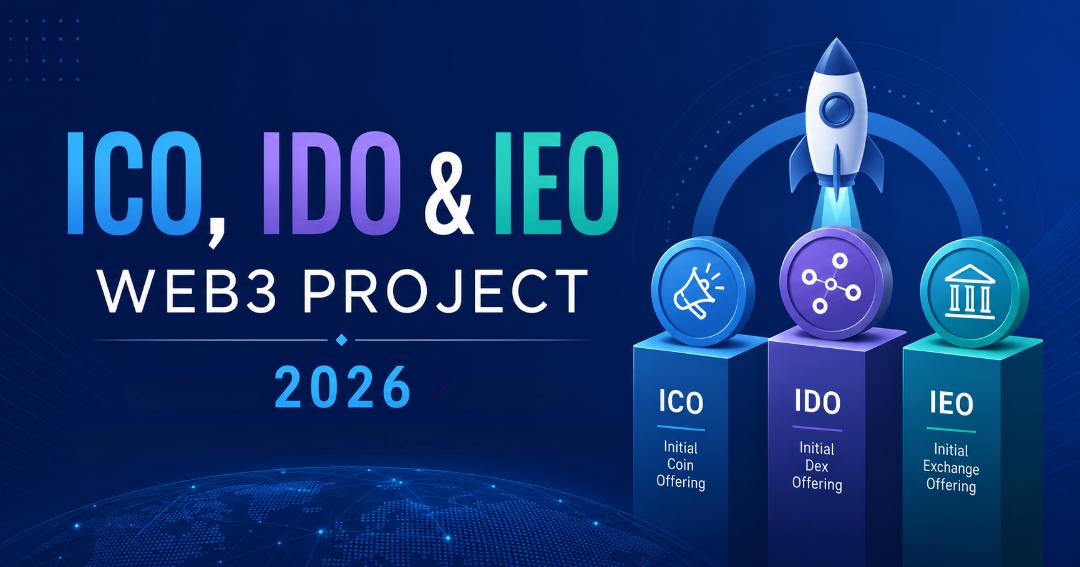
Key Insights
- IDOs are expected to dominate the market with $14.3 billion in projected funding and 45% market share. Fast liquidity and strong DeFi communities make them the top choice for decentralized projects.
- Exchange-backed fundraising still attracts strong retail participation. IEOs are projected to raise $11.8 billion in 2026, driven by built-in exchange audiences, KYC support, and higher credibility.
- ICOs remain relevant for projects that already have an active audience. They offer full fundraising control and lower launch costs, with more than 1,150 projects expected to launch through ICOs in 2026.
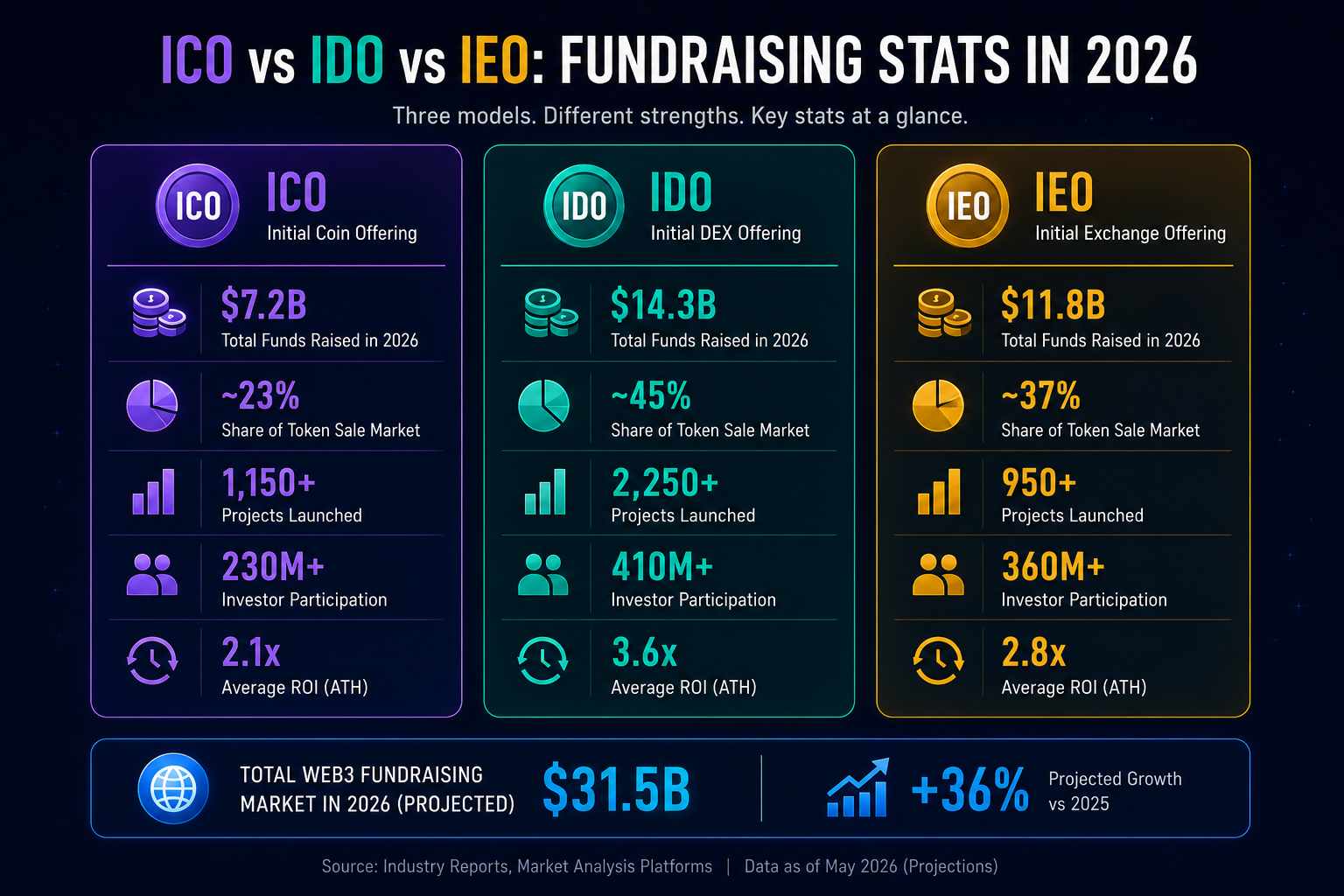
Web3 fundraising in 2026 is expected to become more competitive, data-driven, and model-specific than ever before. The total Web3 fundraising market is projected to reach $31.5 billion, reflecting 36% growth compared to 2025. Within this market, IDOs are expected to lead with $14.3 billion in total funds raised and around 45% market share, followed by IEOs with $11.8 billion and nearly 37% market share, while ICOs are projected to generate $7.2 billion, accounting for about 23% of the token sale market.
These numbers show that each fundraising model has a different role in the 2026 Web3 landscape. IDOs are projected to dominate activity with 2,250+ projects launched, 410M+ investor participation, and an average ROI of 3.6x, making them strong for community-driven launches. IEOs are expected to attract 360M+ investors, support 950+ projects, and deliver an average ROI of 2.8x through exchange-backed credibility. ICOs, meanwhile, remain relevant for flexible fundraising, with 1,150+ projects launched, 230M+ investor participation, and an average ROI of 2.1x. For founders, choosing between ICO, IDO, and IEO in 2026 depends on whether the priority is decentralization, liquidity, investor trust, or launch control.
What These Three Models Actually Are
Before comparing them, it’s worth being precise about what each model actually does.
ICO (Initial Coin Offering): You sell tokens directly to the public usually through your own website or smart contract without involving a third-party exchange or launchpad. You set the price, the terms, and the timeline. No gatekeeper, no listing fee.
IDO (Initial DEX Offering): You launch your token through a decentralized exchange (DEX) or a decentralized launchpad like Polkastarter, DAO Maker, or Fjord Foundry. Liquidity is available immediately at launch, and anyone with a compatible wallet can participate.
IEO (Initial Exchange Offering): A centralized exchange (CEX) Binance Launchpad, KuCoin Spotlight, OKX Jumpstart hosts your token sale. The exchange vets your project, handles KYC/AML for participants, and lists your token once the sale closes.
Each model has been used to raise meaningful capital. The question is which one fits your specific situation.
ICO: Maximum Control, Maximum Risk
ICOs dominated crypto fundraising from 2016 through 2018. They still exist, but the regulatory environment has shifted considerably since then.
What works in your favor
- You control the entire process: pricing, vesting schedules, whitelist criteria, and smart contract logic.
- No platform takes a cut of your raise or demands equity.
- You can reach a global audience without needing approval from a centralized intermediary.
- Structuring is flexible run a private round, a public round, or both.
What works against you
- There’s no built-in audience. You’re responsible for generating all awareness, trust, and participation from scratch.
- Regulatory scrutiny is significant. In the US, UK, EU, and Singapore, token sales can trigger securities law obligations depending on how the token is structured and marketed.
- Scam association is a real problem. After the fraud that defined the 2017–2018 cycle, many retail investors approach unsolicited ICOs with skepticism.
- Smart contract vulnerabilities are entirely your problem. A bug in your sale contract can drain funds and end your project before it starts.
When an ICO makes sense in 2026
ICOs work best when you already have a strong, established community that trusts your team and legal counsel confirming your token qualifies as a utility token in your target jurisdictions. You also need the technical capability to build and audit your own sale infrastructure.
Starting from zero name recognition? An ICO puts you in a difficult position.
IDO: Speed and Decentralization
IDOs became the preferred alternative to ICOs as DeFi matured. The model trades some control for speed and immediate liquidity.
What works in your favor
- Tokens list and become tradeable almost immediately after the sale no waiting on a CEX to schedule your listing.
- Decentralized launchpads bring some built-in audience. Projects accepted by platforms like DAO Maker or Polkastarter get exposure to that platform’s existing community.
- Participation is permissionless in many cases, which broadens your potential investor base.
- Lower listing costs compared to major CEXs.
What works against you
- Front-running and bot activity are structural problems on many DEX-based launches. Without proper design, bots can sweep large allocations in the first block and immediately dump on retail participants.
- Launchpad selection matters enormously. A low-quality launchpad delivers minimal credibility and a thin audience.
- Regulatory clarity around IDOs is still developing in several jurisdictions. The permissionless nature that makes them attractive also makes compliance harder to demonstrate.
- Early liquidity can be shallow, which creates price volatility that damages sentiment fast.
When an IDO makes sense in 2026
IDOs suit DeFi-native projects with technically sophisticated audiences who understand how DEX participation works. They also work well for teams that have already built community through Discord, X, and Telegram before the launch date and want fast price discovery.
Planning a Token Launch but Confused Between ICO, IDO, and IEO?
Choose the right fundraising path for your Web3 project with expert support for ICO, IDO, token launch, and exchange strategy.

IEO: Exchange-Backed Credibility
An IEO shifts the gatekeeping function to a centralized exchange. The exchange becomes your distribution partner in exchange for a fee, equity, or a token allocation.
What works in your favor
- The exchange’s reputation transfers to your project. Being listed on a Tier 1 or Tier 2 CEX signals that your project passed a vetting process, which reduces perceived risk for retail participants.
- KYC and AML are handled by the exchange, which significantly reduces your compliance burden.
- Built-in distribution. The exchange markets the IEO to its existing user base potentially millions of people on major platforms.
- Immediate listing on a liquid market after the sale closes.
What works against you
- Getting accepted by a top-tier exchange is competitive and expensive. Listing fees, token allocations, and sometimes equity stakes are part of the deal.
- You give up control over timing, pricing structure, and participant eligibility.
- Smaller exchanges offer less credibility and smaller audiences, so the tradeoff weakens quickly as you move down the tier list.
- If the exchange faces compliance issues or gets hacked, your token’s reputation can take collateral damage through no fault of your own.
When an IEO makes sense in 2026
IEOs are best suited for projects with traction, a working product or strong MVP, and the budget to meet exchange requirements. They work particularly well when your target investors are retail participants who prefer the familiarity and security of a centralized platform.
Side-by-Side Comparison
| Factor | ICO | IDO | IEO |
|---|---|---|---|
| Control over process | High | Medium | Low |
| Regulatory burden | High | Medium | Lower (exchange handles KYC) |
| Built-in audience | None | Launchpad community | Exchange user base |
| Time to liquidity | Variable | Fast (immediate) | Post-sale listing |
| Cost to launch | Low | Low to medium | Medium to high |
| Credibility signal | Weak (without brand) | Medium | High (Tier 1 exchange) |
| Smart contract risk | Entirely on you | Shared with launchpad | Managed by exchange |
| Regulatory compliance | You manage it | Partially you | Exchange manages KYC |
| Best for | Established communities | DeFi-native projects | Projects with traction |
How to Choose the Right Model for Your Project
No single model is objectively superior. The right choice comes down to four factors.
- Your community size before launch
If you already have 20,000 engaged members across Discord and Telegram, an ICO or IDO can work. Starting cold? An IEO gives you borrowed distribution.
- Your compliance posture
Projects operating in regulated markets or those planning to attract institutional participants should prioritize models where KYC and AML are handled formally. IEOs have the clearest compliance path. ICOs require the most legal groundwork upfront.
- Your token’s technical structure
If your token provides governance or utility within a DeFi protocol, an IDO on a relevant launchpad reinforces that positioning. If it’s more broadly accessible and targets mainstream retail, a CEX-hosted IEO reaches that audience more effectively.
- Your budget and timeline
ICOs and IDOs have lower upfront costs. IEOs require significant capital to secure a quality exchange. If your raise needs to happen quickly and cost-efficiently, IDOs often offer the fastest path from preparation to liquidity.
What Most Founders Get Wrong
The same mistakes show up repeatedly across all three models.
Underestimating the marketing requirement. Even an IEO on a major exchange doesn’t guarantee participation. You still need community momentum, influencer coverage, and a clear narrative before the sale opens. Projects that assume the exchange will carry the marketing consistently underperform.
Skipping the smart contract audit. Whether you’re running an ICO, IDO, or IEO, your token contract and sale contract need a thorough audit before any funds are at risk. A single exploitable vulnerability can wipe out your raise and your reputation at the same time.
Misaligning tokenomics with the fundraising model. An IDO with aggressive vesting cliffs and large team allocations will face immediate sell pressure from informed participants. Your tokenomics need to match the expectations of the community you’re targeting through your chosen model.
Choosing a launchpad or exchange based on price alone. The cheapest launchpad is rarely the right one. Audience quality, platform reputation, and post-launch support matter more than the fee structure.
Launching without a post-sale growth plan. The sale is not the finish line. Token price performance after launch depends on product delivery, community engagement, and ongoing marketing. Projects that treat the fundraise as the goal rather than the start of a longer growth cycle tend to lose momentum within weeks.
Final Thoughts
ICO, IDO, and IEO are not interchangeable. Each carries a different risk profile, cost structure, compliance burden, and audience reach. The right choice depends on where your project stands today not which model sounds the most credible in the abstract.
Start with your community size, your legal posture, and your budget. Then match the model to those realities rather than forcing your project into a format that doesn’t fit.
If you want experienced guidance on structuring your token launch tokenomics design, smart contract auditing, launchpad selection, and post-launch marketing visit Blockchain App Factory to schedule a free consultation with a team that has delivered 800+ blockchain projects across every major fundraising format.
FAQs
What is the main difference between an ICO, IDO, and IEO?
An ICO is a direct public token sale run by the project team. An IDO uses a decentralized exchange or launchpad as the distribution mechanism. An IEO is hosted by a centralized exchange that vets the project and handles compliance. The core difference is who controls the process and who provides the audience.
Which model is the most regulated in 2026?
IEOs have the most structured compliance path because centralized exchanges handle KYC and AML for participants. ICOs place the full regulatory burden on the project team. IDOs sit somewhere in between, with compliance requirements varying by jurisdiction and launchpad.
Can a project run more than one type of fundraising round?
Yes. Many projects run a private round first, followed by a public IDO or IEO. Some combine a whitelist ICO for early community members with an IDO for broader participation. The right combination depends on your fundraising targets and community structure.
How important is a smart contract audit before any token sale?
Non-negotiable. A vulnerability in your sale contract can result in lost funds, legal exposure, and permanent reputational damage. Audits should be completed and published before any sale opens, regardless of which model you use.
What does a launchpad actually provide in an IDO?
A launchpad brings an existing community of investors who participate in token sales, a vetting process that signals credibility, and technical infrastructure for the sale itself. Quality launchpads also offer marketing support and post-launch exposure to their community.
Is an IEO worth the cost for an early-stage project?
For most early-stage projects, the cost of a Tier 1 IEO is prohibitive. Mid-tier exchanges offer a more accessible entry point, but the credibility benefit is smaller. Early-stage projects often get better results building community first and using an IDO, then pursuing a CEX listing after the token has demonstrated traction.
How long does it take to prepare for each type of token sale?
An ICO can be prepared in four to eight weeks if the legal and technical groundwork is already in place. An IDO typically requires two to four weeks of launchpad application and review time, plus community preparation. An IEO timeline is largely controlled by the exchange and can take anywhere from six weeks to several months depending on the platform and your project’s readiness.

Vimal J is the Head of Sales at Blockchain App Factory, with 10+ years of experience in sales, client strategy, and Web3 business growth. He helps startups, enterprises, and project founders choose the right blockchain solutions for their goals, bringing a practical market perspective to topics like token development, crypto launches, and Web3 adoption.
Article Reviewed by:
Arun Kamala Santhanath
Marketing Head, Blockchain App Factory


