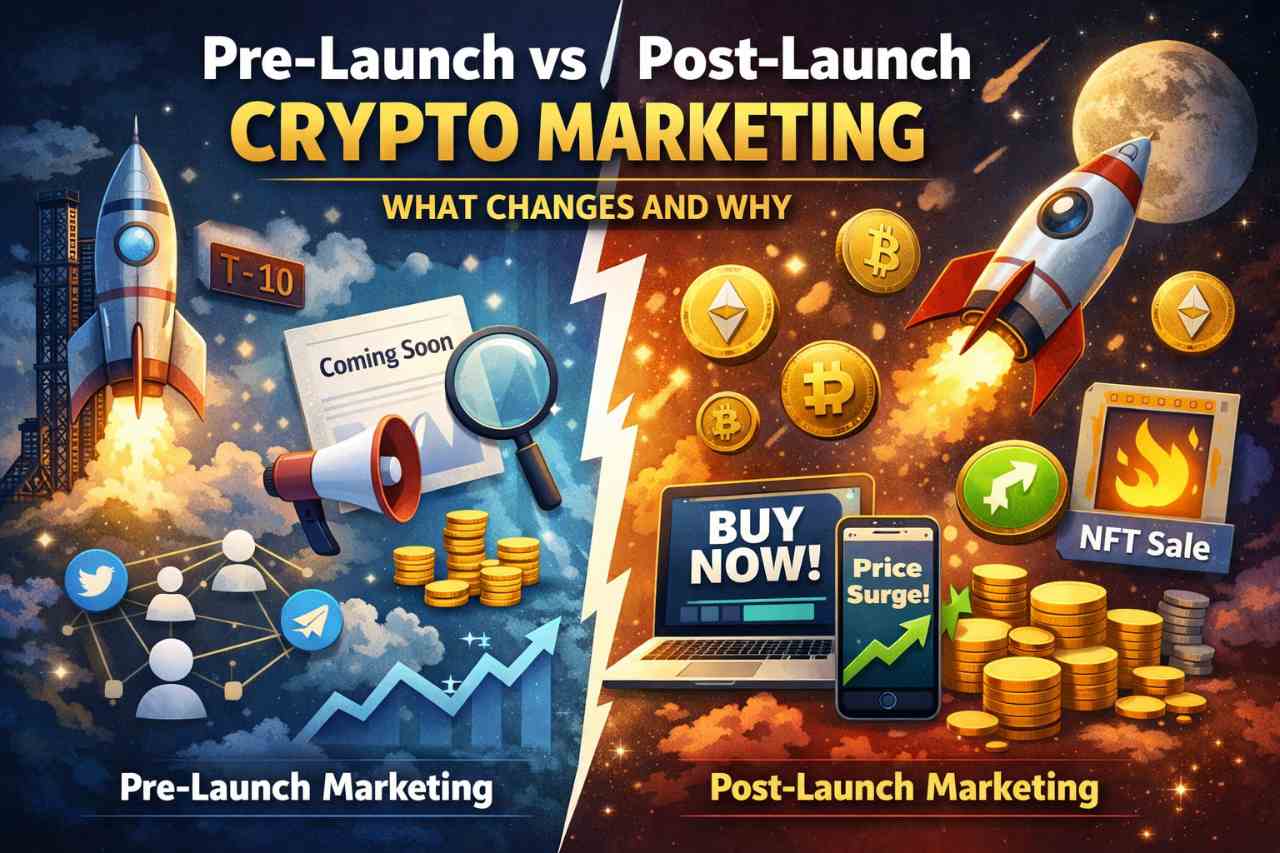
Crypto marketing does not stay the same from start to scale. A project needs one kind of message before launch and a very different one after launch. In the pre-launch stage, the job is simple: get attention, build trust, and give people a clear reason to care. After launch, the focus shifts to product use, user retention, active community participation, and steady growth. a16z crypto notes that Web3 go-to-market work changes across awareness, conversion, and retention, and that token-based products often need a different motion than standard software products.
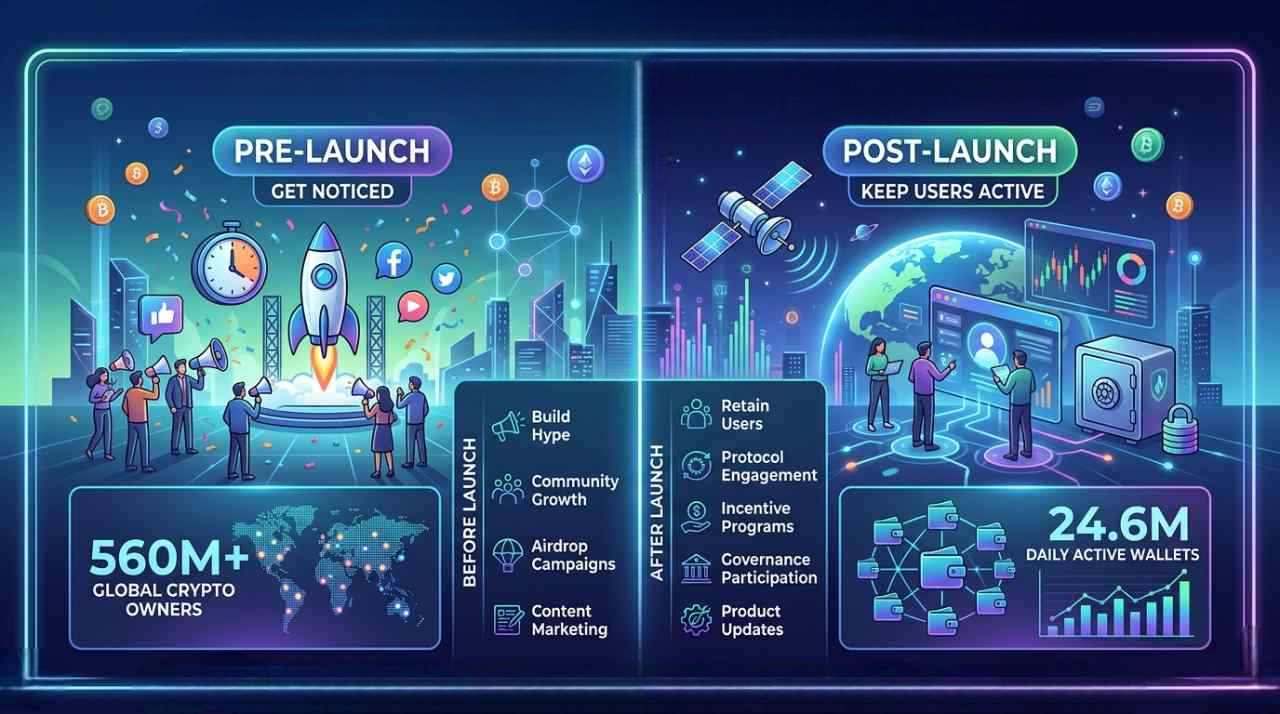
That shift matters even more in a market that keeps getting bigger and more active. Triple-A estimates that over 560 million people worldwide owned digital currencies in 2024, equal to about 6.8% of the global population. DappRadar also reported that the dapp industry reached 24.6 million daily unique active wallets by the end of 2024, showing that Web3 growth is no longer just about attention. It is about sustained product activity at scale.
For founders, marketers, and Web3 teams, that changes how budgets and messages should work. Pre-launch campaigns warm up the market and create belief. Post-launch campaigns prove that the project can keep users active, involved, and committed. If a team uses the wrong tactic at the wrong stage, it often gets noise instead of traction. A project can gain reach before launch, yet still fail after launch if users do not stay, act, or see lasting value.
What Is Pre-Launch Crypto Marketing?
Pre-launch crypto marketing is the stage that comes before the token, app, protocol, or platform goes live. This is where a project introduces its story, explains its value, and prepares the market for launch day. The main goal is not instant conversion. The main goal is readiness. Teams want people to know what the project does, who it serves, and why it deserves attention.
This stage usually includes brand positioning, audience education, social growth, whitelist or waitlist building, and early trust signals. Whitepapers play a key role here. Binance Academy explains that crypto whitepapers help projects present their goals, product details, tokenomics, features, and team information to the public. That makes them a core pre-launch asset for education and credibility.
Main Pre-Launch Crypto Marketing Strategies
Community Building
Early community building gives a crypto project its first base of supporters. Teams usually start on Telegram, Discord, and X, where early followers ask questions, react to updates, and spread the word. This stage is less about raw follower count and more about active interest. A smaller engaged group often creates more value than a large silent audience. In Web3, community is not just an audience. It often becomes part of governance, advocacy, and network growth. Coinbase explains that governance tokens give holders a say in project decisions, which makes early community trust even more important.
Content Marketing
Content gives people a reason to stay and learn. Blogs, explainer pages, founder articles, whitepaper summaries, tokenomics breakdowns, and FAQ pages help reduce confusion before launch. Good content answers direct questions. What problem does this project solve? Who is it built for? Why now? That kind of clarity matters in crypto, where many users still review fundamentals before they commit time or capital. Binance Academy notes that whitepapers often serve as a starting point for project research, which shows why clear educational content matters in early-stage campaigns.
Public Relations
PR helps a project look real before it goes live. Funding news, team announcements, roadmap milestones, security updates, ecosystem tie-ups, and launch date reveals all help shape public perception. Strong PR can place the project in front of media readers, investors, early users, and partners at the same time. It can turn an unknown brand into a visible one if the story is strong and timed well.
Influencer and KOL Marketing
Crypto audiences often follow trusted creators, niche analysts, traders, researchers, and community voices. A smart KOL campaign helps a project reach the right pockets of the market early. The best results come from relevance, not volume. A respected creator with a focused audience often drives better attention than a broad account with weak trust. Pre-launch, this channel works best for awareness, early validation, and message spread.
Social Media Marketing
Social media keeps the project visible from week to week. It gives teams a place to publish product progress, founder views, teaser updates, educational threads, and launch reminders. a16z crypto points out that startups need clear systems for how, when, and what to post, which fits the pre-launch need for steady narrative building. Good social media work keeps the brand active in public and prevents the project from looking unfinished or inactive.
Email and Waitlist Campaigns
A waitlist turns passive attention into a usable audience. Landing pages, early access forms, whitelist entries, and email capture flows help teams collect interested users before launch day. That matters for one reason. The project now owns a direct channel. Social followers can scroll past a post. Email subscribers and waitlist members have already raised their hand. This group often becomes the first source of traffic, testers, token buyers, or early community members.
Partnership Marketing
Partnerships help reduce trust friction. If a new project is backed by known launchpads, wallet providers, infrastructure partners, research groups, or ecosystem communities, it enters the market with more credibility. Pre-launch partnerships do more than add logos to a website. They show that other players in the space are willing to stand near the project in public. That can shape buyer confidence before the first live release.
Why Pre-Launch Marketing Matters
What Is Post-Launch Crypto Marketing?
Post-launch crypto marketing starts once the token, app, protocol, or platform is live in the market. At this stage, attention alone is not enough. The project must turn interest into action. People need to sign up, use the product, join the community, and stay active over time.
This stage is more practical than pre-launch marketing. The market already knows the project exists. Now the team must prove that the product works, the community has energy, and the ecosystem has room to grow. That is why post-launch marketing focuses on product usage, user trust, retention, and market traction.
Main Post-Launch Crypto Marketing Strategies
Community Engagement and Retention
After launch, community work shifts from growth to participation. A project needs active discussions, quick replies, regular updates, and clear moderation. AMAs, user polls, governance discussions, reward programs, and feedback sessions help keep members involved.
An inactive community sends the wrong signal. It makes the project look weak, even if the product is strong. A lively community does the opposite. It shows that users care, respond, and return.
Content Marketing for Adoption
Post-launch content must help users get real value from the platform. That means tutorials, onboarding guides, feature explainers, product walkthroughs, ecosystem news, and case studies. The goal is simple. Help people understand what to do next.
A user may like a project but still drop off fast if the first steps feel confusing. Good content removes that friction. It shows how to use the product, where to start, and what results users can expect.
Public Relations After Launch
PR still matters after launch, but the story changes. Pre-launch PR talks about vision and plans. Post-launch PR talks about proof. This can include exchange listings, product updates, usage milestones, trading volume, new partnerships, chain expansions, and user growth.
These updates keep the project visible in the market. They show that the team is still building, shipping, and gaining traction. That matters in crypto, where many projects go quiet after launch.
Performance Marketing
Paid campaigns play a larger role after launch. At this point, a project has something real to promote. Teams can run paid ads, retarget site visitors, promote app installs, drive wallet connections, and push campaign participation.
This works best once the funnel is ready. If the landing page is weak, the onboarding flow is unclear, or the product lacks a clear action path, paid traffic burns budget fast. Post-launch marketing needs a tighter link between ad spend and user action.
Social Media Marketing
Social media after launch must show traction, not just promise. The content should focus on new features, platform benefits, campaign results, community wins, partnerships, and product updates. The tone becomes more grounded. The project now has real data, real users, and real progress to talk about.
That shift matters. Before launch, social media builds excitement. After launch, it builds confidence.
Influencer and KOL Campaigns
Influencer campaigns do not stop after launch. They just serve a new role. At this stage, creators can explain product use, review features, join campaign pushes, and bring new users into the platform. The strongest post-launch creator work feels educational and action-based.
This helps the project in two ways. It keeps brand visibility strong, and it gives new users a clearer reason to try the product.
SEO and Organic Growth
SEO becomes far more valuable after launch. Once a project is live, people start searching for its name, features, reviews, comparisons, token details, pricing, and use cases. That creates a strong opportunity for branded and non-branded traffic.
Post-launch SEO should cover product pages, blog content, help center content, glossary pages, feature comparisons, and search terms tied to user intent. This is long-term traffic. It can keep bringing users in long after a paid campaign ends.
Partnership and Ecosystem Marketing
Partnership marketing grows in value after launch. The project can now pursue wallet tie-ups, exchange support, protocol integrations, cross-community promotions, and ecosystem co-marketing. These efforts can expand reach and improve product usage at the same time.
A live product gives partners more reason to engage. There is now something real to plug into, promote, or build around.
Why Post-Launch Marketing Matters
Post-launch marketing keeps a project alive in public view. Launch day creates a spike in attention, but that spike fades fast. A strong post-launch plan keeps users engaged, supports trust, and gives the market fresh proof that the project is active.It does more than hold momentum. It helps the team grow users, increase activity, improve retention, and strengthen brand credibility. Without post-launch marketing, even a strong launch can lose energy within weeks.
Need a crypto marketing plan that works before and after launch?
Build early awareness, attract the right audience, and keep users engaged after launch with a strategy built for each growth stage.

Pre-Launch vs Post-Launch Crypto Marketing: The Key Differences
Pre-launch and post-launch marketing serve different jobs. One prepares the market. The other grows the business. Teams that treat them the same often waste time, budget, and effort.
Difference in Goals
Pre-launch marketing focuses on awareness, trust, and anticipation. The team wants people to notice the project, understand the story, and prepare for launch.
Post-launch marketing focuses on adoption, retention, and growth. The team wants users to join, stay active, and find value in the product.
Difference in Messaging
Pre-launch messaging is more educational and vision-led. It explains the problem, the product idea, the roadmap, and the reason the project exists. It tries to spark belief.
Post-launch messaging is more practical and proof-led. It shows what the product does now, what users can gain, what features are live, and what progress the team has made. It tries to build trust through action.
Difference in Strategies
Pre-launch marketing leans more on community building, PR announcements, influencer awareness, social storytelling, waitlist campaigns, and early partnerships. The project is getting ready for market entry.
Post-launch marketing leans more on onboarding content, user retention campaigns, SEO, paid acquisition, product-led social content, ecosystem expansion, and platform adoption. The project is now working on usage and growth.
Difference in KPIs
Pre-launch KPIs track attention and early interest. Common metrics include website traffic, social reach, community growth, media mentions, email signups, whitelist entries, and landing page conversions.
Post-launch KPIs track business activity and user behavior. Common metrics include active users, wallet connections, app installs, conversions, retention rate, transactions, trading activity, campaign participation, and community engagement.
That is the core shift. Pre-launch asks, “Are people interested?” Post-launch asks, “Are people staying and using it?” Those are very different questions, and they need very different marketing work.
| Marketing Area | Pre-Launch Crypto Marketing | Post-Launch Crypto Marketing |
|---|---|---|
| Goal | Build awareness, trust, and early interest | Drive adoption, retention, and growth |
| Audience focus | Explain the project and build interest | Prove product value and keep users active |
| Messaging | Educational and vision-led | Product-focused and proof-led |
| Content | Whitepapers, explainer blogs, landing pages | Tutorials, updates, case studies, help content |
| Community | Grow early supporters | Engage and retain active users |
| Social media | Teasers, storytelling, launch updates | Product news, feature launches, user engagement |
| PR | Funding, roadmap, partnerships, launch news | Listings, milestones, adoption, growth updates |
| Influencers | Awareness and early reach | Education and user acquisition |
| SEO | Early awareness and branded visibility | Branded search, feature terms, comparison keywords |
| Partnerships | Build trust and exposure | Expand reach through integrations and co-marketing |
| KPIs | Traffic, signups, community growth, media mentions | Active users, conversions, retention, transactions |
Why Businesses Need Different Strategies for Each Stage
Crypto projects do not face the same market conditions before and after launch. The audience changes. The business goal changes. The message changes too. That is why businesses need separate marketing plans for each stage. A pre-launch plan prepares the market. A post-launch plan drives product use and long-term traction.
Using one fixed strategy across both stages creates gaps. A campaign built for early awareness will not do enough once the product is live. In the same way, a conversion-focused campaign will struggle before launch if the market still lacks trust or clarity. Good marketing follows the stage of the project, not just the size of the budget.
Audience Expectations Change
Before launch, people want the basics. They want to know what the project does, who it serves, and why it matters. They look for simple explanations, team credibility, early community signals, and a clear reason to pay attention. At this point, the audience is still deciding whether the project is worth watching.
After launch, the questions become more direct. Does the product work? Is the token useful? Are users active? Is the team still shipping updates? The audience no longer wants only a strong story. They want proof, product value, and signs of steady progress.
Business Priorities Change
Before launch, the project needs visibility and trust. The team must get seen, build recognition, and prepare users for launch day. Every action at this stage should help the market feel more familiar with the project.
After launch, the priority shifts to growth, retention, and credibility. The team must bring users in, keep them active, and show that the product has real value in the market. This stage is more demanding. A project must now support its claims with user activity, updates, partnerships, and working features.
Marketing Execution Must Change
Marketing execution cannot stay the same after launch. The audience journey changes once the product is live. Before launch, users read, watch, join, and wait. After launch, they compare, test, sign up, transact, and decide whether to return.
That change affects every channel. Content must move from explanation to onboarding. Social media must move from hype to proof. Community work must move from growth to engagement. Paid campaigns must focus on user action, not just impressions. A smart team adjusts fast, or the marketing starts to feel out of step with the product.
Best Practices for Pre-Launch Crypto Marketing
Pre-launch marketing works best when it feels clear, steady, and well-timed. This stage is not about pushing too hard. It is about preparing the market with the right message and the right channels. Strong execution here gives the project a better launch and a stronger first impression.
Build Community Early
Early community building gives the project a place to grow trust before launch. Telegram, Discord, and X often serve as the first public touchpoints. These spaces help teams answer questions, share updates, and spot early interest patterns.
The goal is not just numbers. A smaller active group gives better value than a large silent audience. If people ask questions, share posts, and stay engaged, the project enters launch with stronger support.
Focus on Clear Educational Messaging
Crypto projects often fail at this stage for one reason. They sound confusing. Pre-launch messaging must stay simple, direct, and easy to follow. People should understand the problem, the product, and the value without reading five pages of technical language.
Educational content helps fix that. Blogs, explainer pages, short threads, whitepaper summaries, and FAQ sections can make a new project easier to trust. Clear messaging reduces doubt and helps the market understand why the project deserves attention.
Use PR and Influencer Campaigns Carefully
PR and influencer work can create strong early visibility, but poor execution can damage trust. A project should not chase every media mention or every creator with a large following. Relevance matters more than raw reach.
Good PR should focus on real updates. Good influencer work should focus on aligned audiences. If the message feels forced, people notice fast. If the story feels real and timely, these channels can build early awareness in the right circles.
Create Strong Launch Pages and Waitlist Funnels
A launch page should do one job well. It should explain the project and guide the visitor to a clear next step. That step may be a waitlist signup, whitelist form, early access request, or email subscription.
Weak pages lose interest fast. Strong pages keep the message focused, reduce friction, and give the team a direct line to future users. A waitlist is not just a list of names. It is a pool of people who have already shown intent.
Align Content, Social Media, and Partnerships Before Launch
Pre-launch marketing works best when the channels support each other. Content should match the social message. Social posts should support the launch story. Partnerships should add trust to the same narrative.
This alignment creates consistency. It helps the market see one clear story instead of mixed signals. If the blog says one thing, the social content says another, and the partner message feels unrelated, the project loses clarity. Strong alignment keeps the market focused and makes the launch feel more prepared.
Need expert support for crypto community and user growth?
Best Practices for Post-Launch Crypto Marketing
Post-launch marketing needs more discipline than pre-launch promotion. The product is live, and the market expects proof. People want a smooth first experience, clear value, and regular signs of progress. That means every campaign should support user action, product usage, and long-term trust.
A good post-launch plan does not chase noise. It helps new users start fast, keeps the community active, and tracks growth with real business metrics. That is what separates a short spike from steady market traction.
Make Onboarding Easy for New Users
New users drop off fast if the first steps feel confusing. That is why onboarding must stay simple, direct, and easy to follow. The project should give users clear guides, product walkthroughs, FAQ pages, wallet connection help, and short tutorials that explain what to do first.
The best onboarding flows reduce friction at every step. A user should know how to sign up, where to click, what action matters first, and what value they can expect. If the process feels smooth, more users stay. If the process feels hard, interest fades fast.
Keep the Community Engaged With Regular Updates
A live crypto project needs an active community. Silence creates doubt. Regular updates keep people informed and involved. These updates can include feature releases, campaign news, roadmap progress, governance discussions, AMA sessions, and community feedback posts.
Engagement needs consistency. Teams should not post only when there is a major announcement. Smaller updates matter too. They show that the project is active, the team is present, and the community still has a reason to pay attention.
Use Content to Support Real Product Adoption
Post-launch content should help users act, not just read. This is the stage for tutorials, case studies, product explainers, ecosystem news, and user education pieces that connect features to real use. Good content answers simple questions. How do I start? What does this feature do? Why should I use it?
That kind of content supports adoption in a direct way. It helps users move from interest to action. It can reduce support load, improve retention, and make the product easier to trust.
Invest in SEO, Partnerships, and Retention Campaigns
After launch, growth should come from more than social media alone. SEO helps the project capture branded searches, feature queries, comparison terms, and problem-based searches. This creates a steady flow of organic traffic from users who already have intent.
Partnerships can expand reach and strengthen trust. Exchange tie-ups, wallet integrations, ecosystem campaigns, and co-marketing efforts can bring in new users and keep the brand visible. Retention campaigns matter too. Reward programs, re-engagement emails, user missions, and loyalty pushes can bring people back after the first interaction.
Measure Growth Through Business-Focused KPIs
Post-launch marketing should be judged by business results, not vanity numbers. Follower count still has some value, but it is not the main signal anymore. The stronger metrics are active users, signups, wallet connections, retention rate, transactions, campaign participation, and platform usage.
These numbers show whether the marketing is driving real action. They help teams see what is working, what is weak, and where budget should go next. A project grows faster when it tracks user behavior with care and adjusts based on real performance.
Conclusion
Pre-launch and post-launch crypto marketing serve different goals, and each stage needs its own message, channels, and success metrics. Before launch, the focus stays on awareness, trust, and audience building. After launch, the focus shifts to user adoption, retention, and steady growth. Projects that understand this shift can plan better campaigns, use budget with more care, and build stronger market traction over time. For businesses that want expert support across both stages, Blockchain App Factory provides Crypto marketing services that help brands build visibility, attract users, and grow with a clear and structured strategy.

Vimal J is the Head of Sales at Blockchain App Factory, with 10+ years of experience in sales, client strategy, and Web3 business growth. He helps startups, enterprises, and project founders choose the right blockchain solutions for their goals, bringing a practical market perspective to topics like token development, crypto launches, and Web3 adoption.