Key Insights
- Tokenized T-bills bring government-backed returns into easy-to-use digital platforms.Investors can enter with small amounts and track assets in real time.
- Companies are shifting unused cash into short-term government-backed options. This helps earn steady returns instead of leaving funds inactive.
- Transactions happen within minutes instead of days. Investors can act anytime without waiting for market hours.
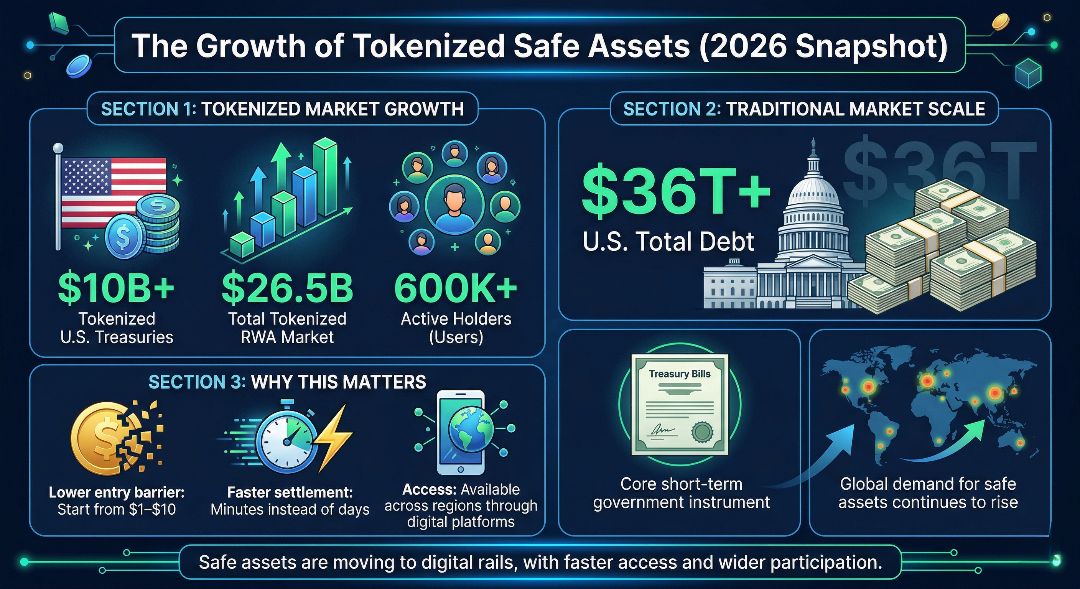
Safe investing is entering a new phase. The tokenized U.S. Treasury market has crossed $10 billion in value by early 2026. The wider tokenized real-world asset market now stands near $26.5 billion, with hundreds of thousands of holders across platforms. At the same time, U.S. government debt has moved past $36 trillion. These numbers show one clear shift. Investors want safe assets in a format that is easier to access and manage.
Why Traditional Fixed-Income Products Are Being Reimagined
Fixed-income products such as treasury bills, bonds, and deposits have long offered steady returns. They appeal to investors who want safety and predictability. Yet access has stayed limited. Many products need high minimum amounts, fixed holding periods, and manual processes. A retail investor in 2024 often needed thousands of dollars to enter government debt markets.
Today, investor expectations have changed. People want quicker access, smaller entry sizes, and easier tracking. Markets now run with real-time data, but fixed-income products still rely on older systems. This gap has pushed financial firms to rethink how these instruments reach users. They now focus on access, speed, and clarity in ownership records.
The Rise of Digital Assets Meets Government Debt
Digital assets have grown from niche experiments into a large market. Investors now hold cryptocurrencies, stablecoins, and tokenized assets in digital wallets. At the same time, government debt remains one of the safest asset classes.
These two areas have started to connect. Platforms now offer tokenized versions of treasury bills that sit on blockchain networks. This allows investors to hold government-backed instruments in a digital format. The shift brings familiar safety into a system where assets move faster and settle with fewer steps.
What Makes Tokenized T-Bills the Talk of 2026
Tokenized T-bills have gained attention as interest rates stayed above 4 percent through 2025. Investors looked for safe returns that beat savings accounts. At the same time, crypto markets showed high volatility. This pushed many users toward stable yield options.
Tokenized T-bills meet that demand. They offer exposure to government debt with lower entry barriers. Some platforms allow investments starting from $1 or $10. Investors can buy, hold, and track these assets through apps instead of traditional brokers. This mix of safety and accessibility has made them widely discussed in 2026.
What Are Tokenized Treasury Bills? (Simple Explanation)
Breaking Down Treasury Bills in Plain English
Treasury bills are short-term loans that investors give to a government. The government promises to repay the full amount after a fixed period, which ranges from a few weeks to one year. Instead of paying regular interest, these bills sell at a discount. For example, an investor may pay $980 and receive $1,000 at maturity.
This difference represents the return. Governments such as the United States have strong credit ratings, so these instruments carry low risk. Many banks and institutions use them to store funds safely.
What “Tokenization” Actually Means in Finance
Tokenization refers to converting ownership of a real asset into digital units on a blockchain. Each unit, or token, represents a share of the asset. These tokens sit in digital wallets and can move between users through network transactions.
In simple terms, tokenization turns a traditional asset into a digital version that is easier to divide and transfer. Ownership records update on a shared ledger, which reduces the need for paper-based systems and manual reconciliation.
How Real-World Assets Become Blockchain Tokens
The process begins with an institution that purchases real treasury bills from the government. These assets remain in custody with regulated entities such as banks or trust companies. The institution then issues digital tokens that represent claims on those underlying bills.
Each token links to a portion of the asset pool. Smart contracts handle issuance and transfers. Investors who buy these tokens gain exposure to the returns generated by the underlying treasury bills. Regular audits and reports confirm that the tokens match the real holdings.
Tokenized T-Bills vs Traditional T-Bills: Key Differences
Traditional treasury bills require investors to go through banks or brokerage accounts. They often involve minimum investment sizes and fixed settlement timelines, which can take one or two days. Records sit within centralized systems controlled by institutions.
Tokenized T-bills change this experience. Investors access them through digital platforms with lower entry amounts. Transactions settle faster, often within minutes. Ownership records update on a blockchain, which allows easier tracking. The underlying asset remains the same, but the method of access and transfer differs.
How Tokenized T-Bills Work Behind the Scenes
Step-by-Step: From Government Issuance to Blockchain Token
The process starts when a government issues treasury bills through auctions. Financial institutions purchase these bills and hold them in secure custody accounts. A tokenization platform then creates digital tokens that represent these holdings.
Each token corresponds to a fraction of the total asset pool. Investors buy these tokens through supported platforms. The platform records ownership on a blockchain, which updates with each transaction. This structure links the digital token to a real financial instrument.
The Role of Smart Contracts in Automating Ownership
Smart contracts act as digital programs that run on blockchain networks. They manage the creation, transfer, and tracking of tokens. When an investor buys a token, the contract updates ownership records instantly.
These contracts also calculate returns based on the performance of the underlying treasury bills. They distribute earnings to token holders without manual intervention. This reduces delays and lowers operational errors.
Custodians, Issuers, and Platforms Explained
Custodians hold the actual treasury bills in regulated accounts. They play a key role in maintaining asset safety. Issuers create the tokens and link them to the underlying assets. They also publish reports to confirm asset backing.
Platforms act as the interface for investors. They allow users to buy, sell, and track tokenized T-bills through apps or web portals. Each participant has a defined role that supports trust in the system.
Settlement, Redemption, and Yield Distribution
Settlement refers to the transfer of ownership after a transaction. In tokenized systems, this occurs quickly as blockchain records update in near real time. Investors do not wait for multi-day clearing cycles.
Redemption takes place when tokens convert back into cash or when the underlying treasury bills reach maturity. The platform processes these events and credits investor accounts. Yield distribution follows a set schedule, often daily or weekly, based on the earnings of the treasury bills. This structure provides a steady flow of returns without manual claims.
Why Investors Are Rapidly Shifting to Tokenized T-Bills
Earn Stable Returns with On-Chain Transparency
Investors want predictable returns without guessing where their money sits. Tokenized T-bills link directly to government debt, which has a long record of repayment. Platforms publish data on holdings, audits, and yields. An investor can check balances and returns in real time through a dashboard.
This visibility reduces uncertainty. You know the asset, the yield range, and the source of returns. That level of access was not common in older fixed-income systems.
24/7 Liquidity: No More Waiting for Market Hours
Traditional markets run on fixed hours. If you place an order after closing time, it waits until the next session. Tokenized assets operate on blockchain networks that run all day, every day.
This means an investor can buy or sell at any hour. A user in India can act at midnight, and a user in the U.S. can act during the day. The system does not pause. This constant access adds flexibility, especially during fast-moving market conditions.
Fractional Ownership: Invest with Smaller Capital
In the past, treasury investments often required large sums. Tokenization breaks assets into smaller units. A single treasury bill can split into thousands of tokens.
This allows someone to invest with a small amount, such as $10 or $50. It opens the market to a wider group of users. Students, freelancers, and small business owners can now access government-backed returns without large capital.
Faster Settlement Compared to Traditional Systems
Settlement in traditional finance can take one to two business days. During that time, funds remain in transit. This delay affects how quickly investors can reuse capital.
Tokenized systems update ownership within minutes. Once a transaction completes, the buyer gains control of the asset almost instantly. This speed improves cash flow and reduces idle time for funds.
Reduced Intermediaries = Lower Costs
Traditional investments involve multiple parties such as brokers, clearing houses, and custodians. Each layer adds fees. These costs reduce net returns for investors.
Tokenized systems reduce the number of steps between buyer and asset. Smart contracts handle transfers and record updates. Platforms still charge fees, but the overall structure tends to be leaner. Lower costs help investors keep more of their returns.
Ready to bring tokenized Treasury Bills into your business strategy?
Start building a system that gives you faster access, steady returns, and better control over your reserves.

Key Benefits That Make Tokenized T-Bills a Game-Changer
Enhanced Accessibility for Global Investors
Geography used to limit access to government debt markets. Investors often needed local bank accounts or licensed brokers. Tokenized T-bills remove many of these barriers.
A user with a verified account and a digital wallet can access these products from many regions. This expands participation across countries. It brings more users into markets that were once limited to institutions.
Real-Time Tracking and Transparency
Ownership records update on a blockchain ledger. Each transaction reflects almost immediately. Investors can track holdings, transfers, and returns without waiting for periodic statements.
This creates a clear view of asset movement. It helps users verify balances and check performance at any time. The system reduces reliance on delayed reports.
Improved Capital Efficiency for Institutions
Institutions manage large pools of funds and aim to reduce idle capital. Faster settlement and easier transfer improve how they deploy funds.
For example, an institution can move funds from one asset to another within the same day. This flexibility allows better use of capital across trading, lending, and treasury operations.
Seamless Integration with DeFi Ecosystems
Tokenized T-bills can interact with decentralized finance platforms. Investors can use these tokens as collateral or part of lending strategies.
This adds new use cases. Instead of holding an asset passively, users can put it to work in different financial activities. It expands how a single asset contributes to a broader portfolio.
Programmability: Automating Financial Logic
Smart contracts allow rules to run automatically. These rules can handle interest distribution, compliance checks, and redemption processes.
For example, a contract can distribute earnings to holders every week without manual action. This reduces administrative effort and keeps processes consistent. Automation also lowers the chance of human error.
Tokenized T-Bills vs Other Yield Options
Compared to Traditional Bonds and Fixed Deposits
Traditional bonds and fixed deposits offer steady returns but come with restrictions. Fixed deposits lock funds for a set period. Early withdrawal often leads to penalties. Bonds may require larger investments and involve longer holding periods.
Tokenized T-bills offer more flexibility. Investors can enter with smaller amounts and exit without long delays. The underlying asset remains similar in risk level, but access and movement differ.
Compared to Stablecoin Yield Products
Stablecoin products often provide higher yields. These returns may come from lending, trading strategies, or liquidity pools. Higher returns often carry higher risk. Some platforms have faced failures in recent years.
Tokenized T-bills focus on government-backed returns. The yield may be lower, often between 3 percent and 5 percent, but the source is more predictable. Investors choose between higher returns with risk or lower returns with stability.
Compared to Money Market Funds
Money market funds invest in short-term instruments such as treasury bills and commercial paper. They offer liquidity and low risk. Investors access them through banks or asset managers.
Tokenized T-bills provide similar exposure but through digital platforms. They offer quicker access and real-time tracking. Fees and structures vary, but the underlying assets often overlap.
Risk vs Reward: Where Tokenized T-Bills Stand
Tokenized T-bills sit in a moderate position on the risk scale. The underlying asset has low default risk, but the digital layer introduces new factors such as platform reliability and smart contract performance.
Returns stay modest but stable. For many investors, this balance fits a conservative strategy. They gain steady income with easier access and faster movement compared to traditional systems.
Who Should Consider Tokenized T-Bills in Business Strategy
Startups Managing Runway Capital
Startups often keep cash in operating accounts that pay little or no return. That cash supports payroll, software bills, rent, and vendor payments. Every month of runway matters. A company with $500,000 in reserve cannot ignore yield if rates remain above 4 percent.
Tokenized T-bills can suit startups that want safety and access to funds within a short time frame. They are not a replacement for working capital needed next week. They can fit the share of cash that sits unused for one to six months. This gives founders a way to earn on reserves without moving too far out on the risk curve.
SMEs Looking for Better Returns on Reserves
Small and mid-sized firms often hold cash for tax payments, seasonal inventory, or planned expansion. Much of that money stays in low-yield accounts. In many cases, finance teams stick with banks out of habit, not out of review.
Tokenized T-bills give these firms another option. The product is easier to access than older treasury channels, and entry sizes are lower than many institutional products. A business with modest reserves can place part of that cash in short-term government-backed assets and improve returns on idle funds.
High-Growth Companies with Idle Liquidity
High-growth firms raise capital in large rounds and then deploy it over time. A company that closes a Series A or Series B round does not spend every dollar on day one. Some cash sits for months until hiring plans, expansion, or product work catches up.
That creates a treasury question. Should the firm leave all funds in a basic bank account, or should it place part of the reserve in short-duration instruments? Tokenized T-bills can suit that second bucket. They offer a place for temporary liquidity that still needs to stay relatively safe and accessible.
Crypto-Curious Entrepreneurs Seeking Safe Entry
Some founders want exposure to digital assets but do not want the price swings of Bitcoin, Ether, or smaller tokens. They may be open to blockchain-based finance but want a lower-risk starting point.
Tokenized T-bills can serve that role. They let business owners use digital rails without taking on direct crypto market volatility. This makes them a practical first step for firms that want to understand wallets, custody, and on-chain settlement through an asset linked to government debt.
Real Business Use Cases Already Emerging
Startup Treasury Diversification Strategies
Startups are beginning to divide treasury funds into simple buckets. One bucket covers near-term operating needs such as payroll and rent. Another bucket holds reserve capital that is not needed right away. Tokenized T-bills fit the reserve side of that plan.
For example, a startup with 12 months of runway may keep three months of expenses in cash and place part of the remaining balance into tokenized T-bills. This does not remove risk from the business, but it improves how idle capital works. Over a year, even a 4 percent return on unused reserves can offset part of software or compliance costs.
DAO and Web3 Company Treasury Management
DAOs and Web3 firms often hold treasury assets in stablecoins. That creates concentration risk. A stablecoin may hold value near one dollar, but it does not always generate yield on its own. Treasury managers in these groups now look for ways to move a share of reserves into low-risk yield instruments.
Tokenized T-bills fit well here. They stay on-chain, which matters for organizations that already operate through wallets and smart contracts. This allows treasuries to move from idle stablecoin balances into government-backed short-term exposure without leaving the digital asset environment.
Cross-Border Businesses Avoiding Banking Friction
Cross-border firms often face delays in moving money between banks, entities, and countries. Transfers can take days. Fees can stack up. Cutoff times and holiday calendars create more delay.
Tokenized T-bills do not remove every friction point, but they can reduce some of them. A business that already works with digital dollar infrastructure can hold a share of reserves in tokenized government debt and move value faster across supported platforms. This helps firms that manage suppliers, contractors, or treasury teams in different regions.
Parking Funds Between Funding Rounds
Many firms go through quiet periods between fundraising events, acquisitions, or large purchases. During those windows, capital may sit unused for several weeks or months. That is common after bridge rounds, strategic investments, or asset sales.
Instead of leaving all proceeds in a non-yielding account, some firms now park a portion in tokenized T-bills. The aim is simple: keep funds in a low-risk place, earn modest return, and stay ready for the next corporate move. This use case matters most for firms that need short duration, not long lockups.
How to Get Started: A Step-by-Step Playbook for Entrepreneurs
Define Your Investment Objective (Liquidity vs Yield)
A business should start with one question: is this cash needed soon, or can it sit for a while? That answer shapes the whole plan. Funds needed for payroll, taxes, or urgent vendor payments should stay highly liquid. Funds that are unlikely to move for 30 to 180 days may fit short-term treasury exposure.
This step prevents poor allocation. The goal is not to chase a slightly higher return with money the business needs tomorrow. The goal is to separate operating cash from reserve cash and assign each pool a proper role.
Choose a Reliable Tokenization Platform
Platform choice matters as much as the asset itself. A business should review who issues the product, who holds the underlying T-bills, and how redemptions work. It should also check audit records, legal structure, fees, and investor eligibility.
A useful review includes basic questions. Is the asset fully backed? How often are reports published? Which custodian holds the bills? What happens during redemption? A platform that answers these questions plainly is easier to trust than one that relies on vague marketing.
Complete Compliance and Business Verification
Most business-grade platforms require verification before access. This step often includes company registration records, ownership details, tax documents, and identity checks for directors or authorized signers.
The process can feel administrative, but it matters. Tokenized T-bills sit at the meeting point of regulated finance and blockchain systems. A business that completes compliance early avoids delays later, especially when treasury decisions need quick execution.
Allocate Capital Strategically (Not All-In)
A measured allocation works better than a full shift. A business can begin with a small share of reserves, review the experience, and then decide whether to add more. For example, a company may start with 10 percent to 20 percent of non-operating cash rather than move the full reserve on day one.
This gradual method reduces operational risk. It gives the finance team time to test custody, reporting, transfers, and redemption. It also helps the company build an internal policy before the allocation grows.
Monitor Performance and Rebalance Regularly
Treasury work does not end after purchase. A business should track yield, liquidity needs, counterparty exposure, and concentration across platforms. It should also review whether cash needs have changed after new hires, slower sales, or a new product launch.
Regular review keeps the allocation aligned with business reality. A company that raised funds six months ago may have a very different cash profile today. Rebalancing protects liquidity and keeps reserve capital in line with the original treasury plan.
Conclusion
Tokenized treasury bills show how finance is changing in practical ways. They combine the safety of government debt with faster access, smaller entry sizes, and real-time tracking. Businesses and investors now have a way to earn steady returns without locking funds into rigid systems. Startups, SMEs, and global firms can manage reserves with more flexibility and better visibility. The shift is already visible across treasury strategies, and adoption continues to grow as platforms mature. Blockchain App Factory provides Treasury Bills Tokenization Development Services that help businesses design, launch, and manage these solutions with clarity and control.

Vimal J is the Head of Sales at Blockchain App Factory, with 10+ years of experience in sales, client strategy, and Web3 business growth. He helps startups, enterprises, and project founders choose the right blockchain solutions for their goals, bringing a practical market perspective to topics like token development, crypto launches, and Web3 adoption.